
软件评测Software Review

国际发货,ShipStation 值不值得用?Is ShipStation Worth It for International Shippers?

问一个美国电商卖家在用什么发货软件,最常见的答案还是 ShipStation。过去十多年,它一直是默认的多承运商打单工具;在美国境内件上,它确实配得上这个名声:批量打印快、订单同步干净、通过 USPS 和大承运商能拿到实打实的折扣。但话题一转到国际件,气氛就变了。国际发货正是 ShipStation 覆盖开始显得像拼拼凑凑的地方,也是「值不值得用」从修辞问题变成真问题的地方。Ask a US ecommerce operator which shipping software they use and the most common answer is still ShipStation. It has been the default multi-carrier label tool for over a decade, and for domestic parcels it earns that reputation: fast batch printing, clean order sync, and genuinely good rates through USPS and the majors. Then the conversation turns international, and the tone changes. International shipping is where ShipStation's coverage starts to feel like a patchwork, and where "is it worth it" becomes a real question rather than a rhetorical one.

这篇文章给你的是一套决策框架,而不是一个高高在上的结论。我们会看 ShipStation 对国际件到底做了什么,走一遍两个完全不同的发货场景(美国发货和中国发货),把成本算上真实数字,最后用五个问题收尾,十分钟就能答完。看完你应该知道自己属于哪一档:留下、混合,还是换掉。This article gives you a decision framework instead of a verdict handed down from on high. We will look at what ShipStation actually does for international parcels, walk through two very different origin scenarios (US outbound and China outbound), put real numbers on the cost, and finish with five questions you can answer in about ten minutes. By the end you should know which bucket you fall into: keep it, mix it, or move on.

A shipping manager at a warehouse desk reviews customs documents and printed labels beside stacked international parcels, a tablet showing a shipping dashboard nearby

ShipStation 到底覆盖了什么(国际支持从哪里开始)What ShipStation Actually Covers (and Where International Support Starts)

ShipStation 是一套围绕美国电商技术栈打造的发货自动化平台。它连接你的销售渠道(Shopify、Amazon、eBay、Walmart、BigCommerce 等几十个),拉取订单,用规则自动化批量打印面单。价格方面,Starter 套餐每月 14.99 美元起,Standard 29.99 美元,Premium 349.99 美元,每个档位随月度发货量递增,所有套餐都有 30 天免费试用。ShipStation is a shipping automation platform built around the US ecommerce stack. It connects to your sales channels (Shopify, Amazon, eBay, Walmart, BigCommerce and dozens more), pulls in orders, and lets you print labels in batch with rules-based automation. Pricing starts at $14.99 per month on the Starter plan, with Standard at $29.99 and Premium at $349.99, each tier scaling by monthly shipment volume, and a 30-day free trial on every plan.

对国际件来说,它已有的支持确实有用,但只针对美国发货的包裹。承运商一侧,你能拿到 USPS First-Class Package International 和 Priority Mail International、FedEx 国际件服务、UPS Worldwide 和 DHL Express。FedEx、UPS 和 DHL 支持电子报关,USPS 件可以打印标准的 CN22、CN23 报关单。更高套餐会解锁 Asendia、GlobalPost 这类国际整合商,如果你想用便宜价格拿到国际追踪、又不想付快递的价格,这些就很重要。For international parcels, the support that exists is genuinely useful, but only for US-origin shipments. On the carrier side you get USPS First-Class Package International and Priority Mail International, FedEx International services, UPS Worldwide, and DHL Express. FedEx, UPS and DHL support electronic customs filing, and you can print the standard CN22 and CN23 customs forms for USPS shipments. On higher plans you unlock access to international consolidators like Asendia and GlobalPost, which matter if you want cheap international tracking without paying express prices.

边界线在这里,而且很重要:ShipStation 负责打印国际面单和基础报关单,原生能力到此为止。关税和税费可以在打面单时计算、在结账时显示,但只能通过付费的 Zonos 插件实现,按单计费、定制报价。它没有原生的 IOSS 或 VAT 逻辑,没有多币种结算,也没有跨境退货流程。HS 编码要在商品档案里一个 SKU 一个 SKU 地手动维护。面单打印之后发生的一切,关税代收、税费代缴、清关合规、海外退货,要么靠第三方插件拼凑,要么靠人工硬扛。国际件做得越深,你手工拼装的工作流就越长。Here is the boundary line, and it is important: ShipStation prints international labels and basic customs forms, and its native coverage stops there. Duties and taxes can be calculated at label creation and shown at checkout, but only through the paid Zonos add-on, with per-shipment fees and custom-quoted pricing. There is no native IOSS or VAT logic, no multi-currency settlement, and no cross-border returns workflow. HS codes are maintained manually, SKU by SKU, in product profiles. Anything that happens after the label prints, duty collection, tax remittance, customs compliance, returns from abroad, is bolted on with a third-party plugin or done by hand. The deeper you go into international shipping, the more of the workflow you are assembling yourself.
场景一:从美国发货(强项与短板)Scenario 1: Shipping From the US (Strengths and Gaps)

对一家以美国为基地、国际件只占少数的品牌或 3PL 来说,ShipStation 能用,而且用得不错。USPS 和 DHL Express 的集成是行业里最成熟的。批量自动化意味着你的团队根本不用操心面单。订单渠道整合是同类里最好的。如果你的包裹 95% 走境内、剩下 5% 偶尔过个境,ShipStation 是完全合理的选择。For a US-based brand or 3PL whose international volume is a minority of orders, ShipStation works, and works well. The USPS and DHL Express integrations are the most mature in the business. Batch automation means your team does not think about labels at all. Order channel integration is best-in-class. If 95% of your parcels go domestic and the other 5% occasionally cross a border, ShipStation is a perfectly reasonable choice.

短板会随着国际版图扩大而浮现。第一,HS 编码:每个 SKU 都要在 ShipStation 里手动维护一个,还很容易弄错。第二,商业发票:ShipStation 生成的格式不会随目的国要求或承运商偏好自适应,遇到规矩严格的市场(欧盟、巴西、澳大利亚都有自己的讲究),你得手工改发票。第三,de minimis 免税额阈值:货物价值越过目的国起征点、开始产生关税时,它没有任何预警,而这恰恰是客户收到意外账单、你收到愤怒邮件的时候。第四,DDP 与税费垫付:「完税后交货」已经成为国际 DTC 的入场券,而 ShipStation 通往它的唯一路径是付费的 Zonos 插件;它没有原生的税费垫付流程,所以你要么多一个供应商、多一笔按单费用、多一套规则,要么丢掉这单生意。The gaps show up as your international footprint grows. First, HS codes: every SKU needs one maintained by hand in ShipStation, and they are easy to get wrong. Second, commercial invoices: the format ShipStation generates does not adapt itself to the destination country's requirements or the carrier's preferences, so you will fix invoices by hand for markets with strict rules (the EU, Brazil, Australia all have opinions). Third, de minimis thresholds: there is no warning when a shipment crosses the value threshold where the destination country starts charging duty, which is exactly when customers get surprised invoices and you get angry emails. Fourth, DDP and duty prepayment: "delivered duty paid" has become table stakes for international DTC, and ShipStation's only path to it is the paid Zonos add-on; there is no native duty-payment flow, so you add a vendor, per-shipment fees and a second set of rules, or you lose the sale.

规律是一致的:目的国越多、市场对合规越敏感,ShipStation 制造的人工工作就越多。它是挂着国际功能的境内发货工具,不是跨境平台。如果国际件占比一直低于大约三分之一、目的国只有个位数,这个嫁接还能撑住;一旦超出这个范围,接缝就开始露出来了。The pattern is consistent: the more countries you ship to and the more compliance-sensitive those markets are, the more manual work ShipStation creates. It is a domestic shipping tool with international features grafted on, not a cross-border platform. If your international mix stays under roughly a third of orders and your destinations number in the single digits, the graft holds. Push beyond that and the seams start showing.

场景二:从中国 / 亚洲发货(几乎一片空白)Scenario 2: Shipping From China / Asia (A Near Blank Slate)

现在把发货地换过来。一个中国卖家或跨境团队,从中国、香港或东南亚发货,会发现 ShipStation 几乎完全没法用。不是因为它有 bug,而是因为这个产品根本不是为他们造的。Now flip the origin. A Chinese seller or a cross-border ecommerce team shipping from China, Hong Kong or Southeast Asia will find ShipStation almost entirely unusable, not because of a bug, but because the product was not built for them.

真正运送中国电商包裹的承运商,它一个都没接入:云途、4PX、燕文、中国邮政,以及所有主导中国发货的头程网络。没有人民币结算,没有多币种清算。中国卖家赖以生存的欧洲线路,没有 IOSS 或 VAT 处理。界面只有英文,客服按美国时区上班,整个定价模型都假设你是美国境内货量。There is no integration with the carriers that actually move Chinese ecommerce parcels: YunExpress, 4PX, Yanwen, China Post, and the other first-mile networks that dominate China-origin shipping. There is no RMB billing or multi-currency settlement. There is no IOSS or VAT handling for the European routes that Chinese sellers depend on. The interface is English-only, support is US-hours, and the entire pricing model assumes US domestic volumes.

中国卖家真实的技术栈完全是另一套:店小秘、马帮、易仓这类本土工具管 ERP、采购和仓库运营;国际件则伸手去拿跨境原生平台,它们天生就懂 ePacket 式头程、IOSS 和 VAT 代收这套语言。ShipStation 不在这个名单上。如果你从中国发货,诚实的答案是:ShipStation 不是「不太合适」,而是「完全不适合」。别围绕它搭建你的跨境工作流。The real technology stack for China-origin sellers looks completely different: domestic tools like Dianxiaomi, Mabang and ECCANG handle ERP, sourcing and warehouse operations, and for international parcels sellers reach for cross-border-native platforms that already speak the language of ePacket-style first-mile, IOSS and VAT collection. ShipStation does not appear on that list. If you ship from China, the honest answer is that ShipStation is not "not the best fit"; it is not a fit at all. Do not build your cross-border workflow around it.

用 ShipStation 做国际件的真实成本The Real Cost of Going International With ShipStation

订阅费是看得见的成本,而对国际发货来说,它是最小的那一笔。真实成本藏在三个地方。The subscription price is the visible cost, and for international shippers it is the smallest one. The real costs hide in three places.

第一,插件订阅。landed cost 和关税代收只能通过 Zonos 插件实现,它定制报价、按单收费,叠在你的 ShipStation 套餐之上。第二,集成费用:如果你因为 ShipStation 自己的国际覆盖太薄,把国际面单路由到 Easyship 这类服务,你得付它的订阅费和每张面单的加价,还要同时维护两套系统、两套费率表。第三,人工:手动维护 HS 编码、手工改商业发票、回复「为什么海关扣了我的包裹」的邮件,这些工时永远不会出现在账单上。海关扣件和国际退货也都贵,而每一次手动错误都会成倍提高两者的概率。First, add-on subscriptions. Landed cost and duty collection are handled only through the Zonos add-on, which is custom-quoted and priced per shipment, on top of your ShipStation plan. Second, integration fees: if you route international labels through a service like Easyship because ShipStation's own international coverage is thin, you pay their subscription and their per-label markup, and now you are maintaining two systems with two rate tables. Third, labor: manual HS code upkeep, hand-fixed commercial invoices, and answering "why did customs hold my package" emails are hours that never show up on an invoice. Customs holds and international returns are also expensive, and every manual error multiplies the odds of both.

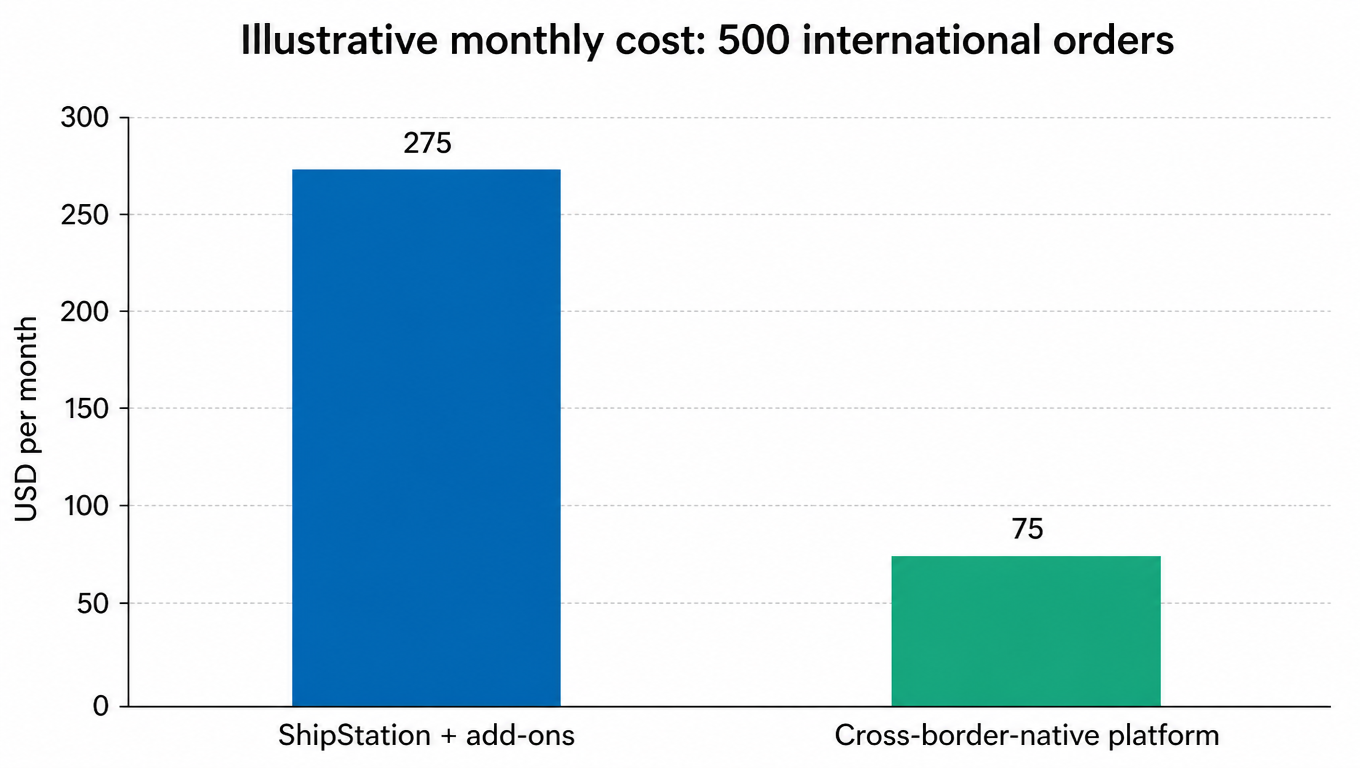
说得具体一点,这里给一个示意场景:一家美国 DTC 品牌,每月发 500 单国际件,数字为便于理解都取整。ShipStation 路线:这个货量下 Standard 套餐大约 90 美元,Zonos 关税税费插件按单计费、定制报价(500 单时是一笔实打实的开销),再加上每月约 3 到 5 小时的手工清关工作,小团队按市场行情算 100 到 150 美元。加起来,在算任何一张面单费用之前,大约每月 275 美元。同样货量下,一套把 landed cost 和报关单证内置的跨境原生平台,通常只要 0 到 50 美元,每张面单的费率也和 ShipStation 报出来的差不多。你的数字会有出入,但这个对比的形状是稳定的。To make this concrete, here is an illustrative scenario: a US DTC brand shipping 500 international orders per month, with the numbers rounded for clarity. The ShipStation route: a Standard plan near $90 at this volume, a paid Zonos add-on for duties and taxes (custom-quoted, a real line item at 500 orders), and roughly 3 to 5 hours a month of manual customs work, which a small team realistically values at $100 to $150. That illustratively lands around $275 per month before a single label fee. A cross-border-native platform with landed cost and customs paperwork built in typically runs $0 to $50 for the same volume, with per-label rates that are comparable to what ShipStation would quote. Your mileage will differ, but the shape of the comparison is stable.

月度成本示意:500 单国际订单时,ShipStation 路线约 275 美元/月,跨境原生平台约 75 美元/月Illustrative monthly cost at 500 international orders: the ShipStation route near 275 USD per month versus a cross-border-native platform near 75 USD per month

这些都不是在说 ShipStation 贵。它说的是:对国际货量而言,ShipStation 路线的总成本不是那个标价,而且你越依赖它薄弱的功能,这个差距就越明显。None of this is an argument that ShipStation is expensive. It is an argument that for international volume, the total cost of the ShipStation route is not the sticker price, and the gap narrows the more you lean on its weaker features.

决策框架:5 个问题The Decision Framework: 5 Questions

这就是整篇文章一直在铺垫的框架。诚实地回答这五个问题,正确答案会自己浮现。Here is the framework this whole article has been building toward. Answer these five questions honestly and the right answer emerges by itself.

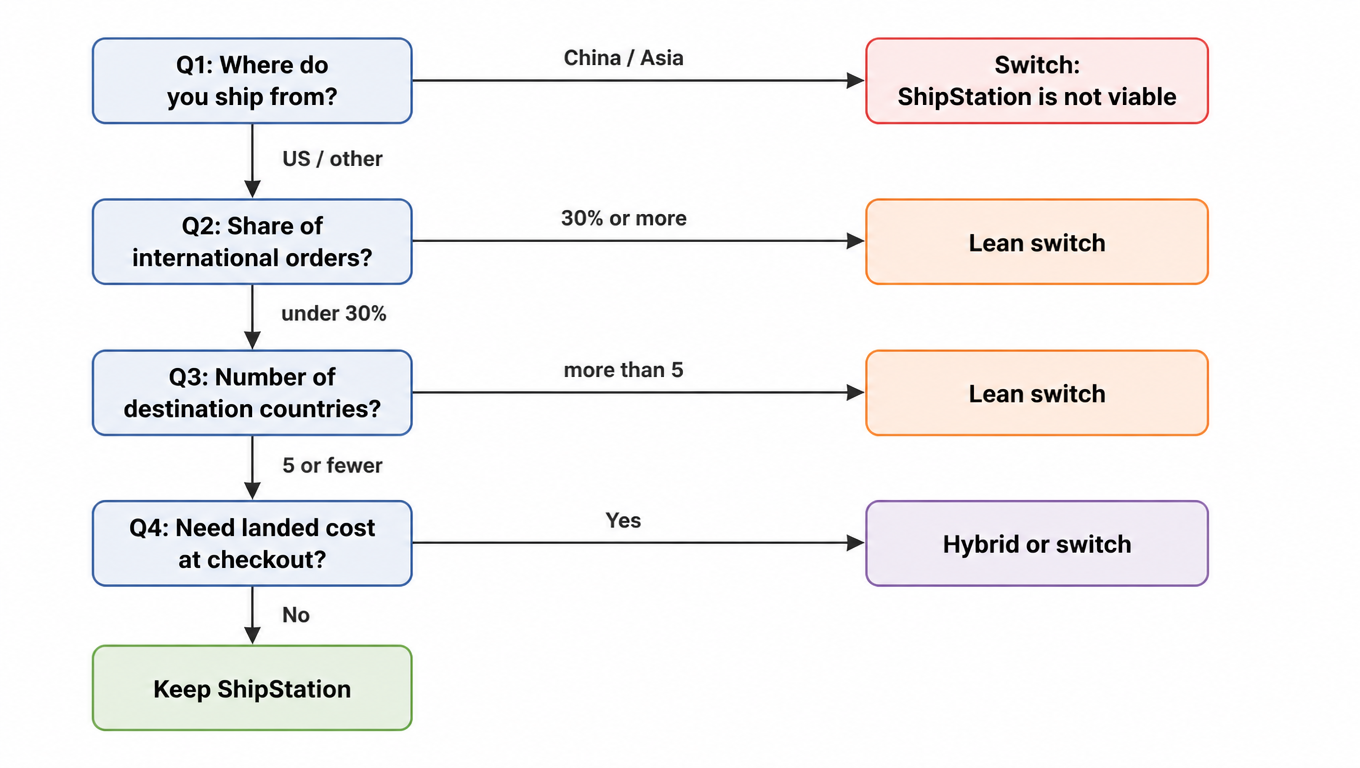
问题 1:你从哪发货? 美国或其他西方发货地,ShipStation 还有戏。中国或东南亚发货地,对话到此结束:直接看「换」档。Q1. Where do you ship from? US or other Western origins keep ShipStation in play. China or Southeast Asia origin ends the conversation: skip to "switch".

问题 2:国际订单占比多少? 低于 30%,国际件只是个功能,不是生意,ShipStation 的短板几乎不花钱。达到 30% 及以上,国际件就是你的生意,每一个短板都变成反复发生的成本。Q2. What share of your orders are international? Under 30% and international is a feature, not a business; ShipStation's gaps cost you little. At 30% or more, international is your business, and every gap becomes a recurring cost.

问题 3:你发往多少个目的国? 5 个及以内、都在同一区域,是舒适区。20 个以上国家,意味着 20 多套发票规则、免税额阈值和合规讲究,而这恰恰是 ShipStation 不会自动适配的东西。Q3. How many destination countries do you ship to? Five or fewer, all in the same region, is the comfort zone. Twenty-plus countries means twenty-plus sets of invoice rules, thresholds and compliance quirks, which is exactly what ShipStation does not adapt to.

问题 4:结账时需要显示 landed cost 吗? 如果客户希望在付款前就看到总价(关税、税费、手续费),ShipStation 只能通过付费的 Zonos 插件做到,还要在你的套餐之上叠加按单费用。如果你想要 landed cost,但不想算插件账、不想多养一个供应商,这就指向离开 ShipStation。Q4. Do you need landed cost shown at checkout? If your customers expect the total cost upfront (duty, taxes, fees) before they pay, ShipStation can deliver it only through the paid Zonos add-on, with per-shipment fees on top of your plan. If you want landed cost without add-on math and extra vendors, that points away from ShipStation.

问题 5:你是单一品牌还是多客户 3PL? 单一品牌为了熟悉的工具可以吸收摩擦。3PL 替许多规则各异的客户发货,需要承运商无关的灵活性、按客户计费、跨账户的清关处理;那是另一个产品品类。Q5. Are you a single brand or a multi-client 3PL? A single brand absorbs friction in exchange for familiar tooling. A 3PL ships for many clients with different rules and needs carrier-agnostic flexibility, client-level billing and customs handling across accounts; that is a different product category.

五问决策流程图:从哪发货、国际占比、目的国数量、结账 landed cost、业务模式,逐题走向留下、混合或换平台Five-question decision flowchart: origin, international share, destination countries, checkout landed cost, and business model, leading to keep, hybrid, or switch

统计你的答案。两个及以上「倾向换」的答案,或问题 1 答了中国,指向换平台。一个「倾向换」的答案,或问题 4 答了需要,指向先做混合方案、同时继续评估。零个「倾向换」答案,说明 ShipStation 服务得还不错,你应该把精力花在运费费率上,而不是软件上。Tally your answers. Two or more lean-switch answers, or a Q1 that says China, points to switching. One lean-switch answer, or a Q4 that says yes, points to a hybrid setup while you evaluate. Zero lean-switch answers means ShipStation is serving you fine, and you should spend your energy on shipping rates rather than software.

结论:什么时候留下,什么时候换Conclusion: When to Keep It, When to Switch

如果你是美国优先的运营者,国际件只是少数条目:几个目的国、一小部分订单、没有 landed cost 需求,那就留下 ShipStation。它是好用的境内工具,国际件也凑合能用,为了换而换是浪费。Keep ShipStation if you are a US-first operator where international is a minority line item: a handful of countries, a small share of orders, no landed cost demands. It is a good domestic tool and a serviceable international one, and switching for switching's sake is a waste.

如果跨境是你的核心业务,那就换,或者至少认真评估:中国发货、国际占比 30% 及以上、目的国众多、结账要 landed cost、或做多客户 3PL。这些情况下,ShipStation 制造的摩擦不是不方便,而是一条成本线和一台转化杀手,跨境原生平台恰恰就是为这个而生的。对美国的跨境 3PL 和多承运商运营来说,easyshippingx 围绕美国包裹生态设计,内置 landed cost 和承运商无关的工作流;对 DTC 品牌,Easyship 这类平台原生承担清关和税费。想看完整的横向对比,我们的发货软件深度评测把各家讲得很细。Switch, or at least seriously evaluate, if cross-border is core to your business: China-origin shipping, international share at or above 30%, many destinations, checkout landed cost, or multi-client 3PL work. In those cases the friction ShipStation creates is not an inconvenience, it is a cost line and a conversion killer, and cross-border-native platforms are built for exactly this. For US cross-border 3PLs and multi-carrier operations, easyshippingx is designed around the US parcel ecosystem with landed cost and carrier-agnostic workflows; for DTC brands, platforms like Easyship carry the customs and tax burden natively. If you want the full head-to-head, our deep comparison of shipping apps covers the options in detail.

问题Question倾向留下Keep leaning倾向换Switch leaning
问题 1:从哪发货Q1: Origin美国 / 其他西方US / other Western中国 / 东南亚China / Southeast Asia
问题 2:国际占比Q2: International share低于 30%Under 30%30% 及以上30% or more
问题 3:目的国数量Q3: Destination countries5 个及以内5 or fewer20+20+
问题 4:结账显示 landed costQ4: Landed cost at checkout不需要Not needed需要Required
问题 5:业务模式Q5: Business model单一品牌Single brand多客户 3PLMulti-client 3PL

诚实的小结:ShipStation 对国际发货者值不值得,取决于国际发货是不是你的主业。只要还不是,它就值得;一旦是了,你就在付订阅费的同时,自己动手补造产品缺失的那一半。跑一遍这五个问题,让你的答案来做决定。The honest summary: ShipStation is worth it for international shippers exactly as long as international shipping is not your main business. The moment it is, you are paying the subscription and building the missing half of the product yourself. Run the five questions, and let your own answers make the call.

常见问题Frequently Asked Questions

ShipStation 支持国际发货吗?Does ShipStation support international shipping?

支持,但只针对美国发货:USPS First-Class Package International 和 Priority Mail International、FedEx 国际件、UPS Worldwide 和 DHL Express,可打印 CN22/CN23 报关单,部分承运商支持电子报关。从中国或东南亚发货的场景下,ShipStation 基本不可用。Yes, for US-origin shipments: USPS First-Class Package International and Priority Mail International, FedEx International, UPS Worldwide, and DHL Express, with CN22/CN23 customs forms and electronic filing where available. For shipments originating in China or Southeast Asia, ShipStation is effectively not usable.

ShipStation 能处理关税税费(landed cost)吗?Does ShipStation handle duties and taxes (landed cost)?

只能通过付费的 Zonos 插件。关税税费可以在打面单时计算、在结账时显示,但 Zonos 定制报价、按单收费,叠在 ShipStation 套餐之上。没有原生的 IOSS 或 VAT 逻辑。Only through the paid Zonos add-on. Duties and taxes can be calculated at label creation and shown at checkout, but Zonos is custom-quoted, priced per shipment, and sits on top of your ShipStation plan. There is no native IOSS or VAT logic.

2026 年 ShipStation 多少钱?How much does ShipStation cost in 2026?

Starter 每月 14.99 美元起,Standard 29.99 美元,Premium 349.99 美元,每个档位随月度发货量递增,所有套餐都有 30 天免费试用。月发约 500 单时,Standard 通常落在 90 美元上下。Starter starts at $14.99 per month, Standard at $29.99, and Premium at $349.99, with each tier scaling by monthly shipment volume. A 30-day free trial is available on every plan. At roughly 500 shipments per month, a Standard plan typically lands near $90.

中国卖家适合用 ShipStation 吗?Is ShipStation a good fit for Chinese sellers?

不适合。它没有接入云途、4PX、燕文、中国邮政这类中国头程承运商,没有人民币或多币种结算,欧洲线路没有 IOSS/VAT 处理,界面只有英文。中国卖家的典型配置是店小秘、马帮、易仓做 ERP,跨境原生平台发国际件。No. It has no integration with China first-mile carriers like YunExpress, 4PX, Yanwen or China Post, no RMB or multi-currency billing, no IOSS or VAT handling for European routes, and an English-only interface. Chinese sellers typically run Dianxiaomi, Mabang or ECCANG for ERP and cross-border-native platforms for international parcels.

跨境发货不用 ShipStation 用什么?What should I use instead of ShipStation for cross-border shipping?

对美国的跨境 3PL 和多承运商运营,easyshippingx 围绕美国包裹生态构建,内置 landed cost 和承运商无关的工作流。对 DTC 品牌,Easyship 原生承担清关和税费处理。我们的发货软件深度评测对两者都有详细拆解。For US cross-border 3PLs and multi-carrier operations, easyshippingx is built around the US parcel ecosystem with landed cost and carrier-agnostic workflows. For DTC brands, Easyship carries customs and tax handling natively. Our deep comparison of shipping apps covers both in detail.

准备好在国际件上少一点拼凑了吗?Ready to stop patching together international shipping?

easyshippingx 为美国跨境 3PL 和多承运商运营设计:landed cost、报关单证和承运商无关的工作流,内置在一个平台里。easyshippingx is built for US cross-border 3PLs and multi-carrier operations: landed cost, customs paperwork, and carrier-agnostic workflows in one platform.

Get Rate Comparison
Get Rate Comparison