
3PL Operations Guide

What Is Blind Shipping? A Practical Guide for Ecommerce Sellers and 3PLs

Editorial illustration of two hands folding a linen duvet cover into a kraft box, with a brand packing slip and a supplier postcard sitting on the packing table.
Illustration of a hypothetical case, not a customer example or any provider's actual operating procedure.

Harbor & Loom sells linen bedding from a small studio in Austin. Its best-selling duvet cover is sewn by a mill in South Carolina, and rather than trucking inventory to Texas and back, the brand has the mill ship oversize orders straight to customers. The arrangement works for six months. Then a customer opens her box and finds, next to the duvet, a printed card from the mill: buy direct, save 20 percent. The packing slip in the same box carries the mill's phone number. Her next email goes to the brand's support inbox, and it is one sentence long: who did I actually buy from?

Nothing about that failure was random. The brand had never written down what \"ship it for us\" meant. Which name goes on the label, what may sit inside the box, where an unhappy customer sends the duvet back: every one of those was left to a supplier that had its own commercial interests. Blind shipping, as a discipline, is nothing more than those decisions, made in advance, written down, and tested on a real parcel.

This guide uses that home goods brand throughout: what blind shipping actually is, how it differs from dropshipping and discreet shipping, the five details to confirm line by line, how sellers and 3PLs put the rules into practice, and what to ask before signing.

What blind shipping actually means: three parties, three different jobs

Three parties stand behind every parcel, and they do not share the same job.

  • The seller of record. Owns the customer relationship, takes the payment, and answers the support email. In a blind arrangement this is the only party the recipient is supposed to see.
  • The actual shipper. Holds the inventory and hands the parcel to the service that moves it: a supplier's warehouse, the brand's own DC, or a 3PL running fulfillment for several brands at once.
  • The recipient. She sees exactly what the outside and the inside of the box show, and nothing else.

Blind shipping means the actual shipper's identity is removed from the outbound parcel and paperwork while the seller of record's identity stays (ShipBob on blind shipping). The label, the packing slip, and any insert carry the brand. The mill's name, logo, phone number, and promotional material do not appear.

The term covers two arrangements that are worth separating, because brands often buy one and expect the other.

Full blind shipping hides the shipper completely: the label shows the brand or a neutral facility, paperwork is brand-templated, and nothing in the box points to the supplier. Branded shipping is what most growing brands actually run. The brand's own warehouse or its 3PL packs in brand packaging, so there is no supplier identity to conceal in the first place. When a 3PL ships for twenty clients, branded shipping for each of them is still blind shipping relative to the 3PL, and it is the more common commercial case.

One myth is worth killing early: blind does not mean anonymous, and it does not mean a label with no return address. A return address still prints, because undeliverable parcels and customer returns need somewhere to land. What changes is whose address it is: the brand's, or a neutral receiving location the 3PL operates on the brand's behalf.

It should not belong to the supplier's production dock, which cannot process a consumer return and should not be receiving one.

One thing has to be said plainly: blind shipping is not a way to hide from anyone who matters. The service sees the shipping account, the pickup location, and the tracking record. For cross-border parcels, customs sees the exporter and the importer of record on the commercial invoice, and the importer of record remains responsible for the accuracy of that entry documentation and the duties owed (U.S. Customs and Border Protection: tips for new importers and exporters). Blind shipping changes what the recipient sees. It does not change what a carrier, a broker, or customs sees, and it cannot be used to sidestep duties, licensing, or a marketplace's seller-identification rules.

Blind shipping, dropshipping, and discreet shipping answer three different questions

The three terms get used interchangeably in supplier conversations, and that is where most specifications go wrong. Each one answers a separate question, and a business can be any combination of them.

  • Dropshipping answers who holds the inventory and fulfills the order. It is a business model question.
  • Blind shipping answers whose identity appears on the label and the paperwork. It is an attribution question.
  • Discreet shipping answers what the outside of the parcel reveals about the contents and the sender. It is a privacy question (Shippo on discreet shipping).
TermThe question it answersWhat the recipient seesWhat it solvesOverlap with blind shipping
DropshippingWho stocks and ships the orderA parcel from the brand if blind, from the supplier if notWorking capital, catalog breadthCommon, but not required
Blind shippingWhose identity is on the label and paperworkBrand name, brand packing slip, no supplier identityBrand control, channel conflictIt is the definition
Branded shippingDoes the parcel visibly come from the brandBranded box, tape, insertRecognition and unboxing experienceOften called blind when a 3PL is the shipper
Discreet shippingWhat the outside reveals about contents and senderPlain mailer, neutral label, contents not evidentPrivacy, theft deterrence, giftingSometimes, as a separate decision
White labelWhose brand is on the product itselfProduct branded by the sellerProduct ownershipNo, this is a product question

Getting the terms tangled has practical costs. A beauty brand that asks its 3PL for \"discreet packaging\" may receive a plain grey mailer that also drops the brand's own welcome card, because the request never mentioned inserts. A brand that asks for \"blind shipping\" may assume the return address can be omitted, then discover that undeliverable parcels have nowhere to go. A dropshipper may assume that because the supplier ships blind, the supplier also follows the marketplace's identification rules, which is a separate obligation entirely.

Five details to confirm before the first order ships

A shipping specification is short, specific, and physical. Each line below should be written into the supplier agreement or the 3PL onboarding form, and each one should be checked on a real parcel rather than in an email thread.

DetailWhat to specifyHow it fails in practice
Name on the labelExact ship-from and return strings, including the suite line, and who owns the shipping accountThe supplier uses its own account, so the mill's name appears in tracking and on the label
Packing slipWhich template, which fields, whether prices print, which languageThe mill's invoice with wholesale pricing lands in a retail customer's box
Package markingsAllowed and banned logos on boxes, mailers, tape, tissueBranded tape runs out, and a supplier-branded roll gets substituted
InsertsBrand inserts allowed, third-party and supplier promotional material bannedThe postcard in the Harbor & Loom box
Return instructionsWhere undeliverable parcels and customer returns go, plus the RMA processThe return address points at a production floor with no returns desk

Name on the label. Approve the exact string in writing, down to the abbreviation and the secondary address line. Decide who owns the shipping account as well, since that determines who pays, whose name shows in tracking, and who can pull the parcel back if something goes wrong.

Packing slip. Specify the template and the fields. Most brands want the brand name, order number, item names, and a support contact, with no pricing on gift orders. Marketplace sellers face a stricter version of the same rule: Amazon requires that a seller using a third party be the only entity identified as the seller on packing slips, invoices, and external packaging (Amazon drop shipping rules).

Package markings. Say what may print on the outside. Plain kraft and brand-printed materials are the usual allowance, and a supplier logo on a poly mailer is not. Suppliers substitute materials when stock runs low, so name the acceptable fallback rather than only the banned item.

Inserts. This is where Harbor & Loom lost the customer. Ban supplier promotional material outright, including referral cards, QR codes, and price sheets, and say so in the same sentence as the packing slip requirement. Walmart's packaging rules are blunt about it: no promotional material from your company or any other entity, and an unbranded packing slip is acceptable if a branded one is not available (Walmart packaging rules). A brand's own insert is a separate decision, and a reasonable one. The rule to write down is that the only insert in the box is the brand's.

Return instructions. Two addresses matter, and they are not always the same one. The label return address handles undeliverable parcels. The customer return address handles deliberate returns and needs an RMA process behind it. Both should point at a location that receives and processes parcels, typically a 3PL dock or the brand's own returns desk, never a supplier production floor.

Editorial overhead illustration of an opened kraft box: a brand packing slip sits neatly on the folded linen, with a supplier postcard beside it standing out.
Everything in the box was somebody's decision. Whatever the brand left unspecified, someone else decided.

How sellers and 3PLs put it into practice

Write the spec as an annex, not an email. One page, five sections matching the table above, plus the change process. Attach it to the supplier agreement or the 3PL onboarding form so it survives staff turnover, and name the person on each side who can approve a change.

Configure a profile per brand. In shipping software, the brand profile should carry the ship-from identity, the return address, the packing slip template, the insert rule, the SKU to brand mapping, and the shipping account. Ask a direct question before you buy: can label identity be set per brand, or is there one ship-from identity per facility? If the answer is the second one, blind shipping is approximate at best, because every client's parcels will carry the same sender. A multi-carrier layer is useful here for a different reason: it compares the available US options per parcel and applies the label identity and return address held in each brand profile, executed through the portal, a spreadsheet, or the API, so one facility can ship correctly for several brands without editing labels by hand. Which fields a parcel record needs is covered in the order, shipment, and label data model.

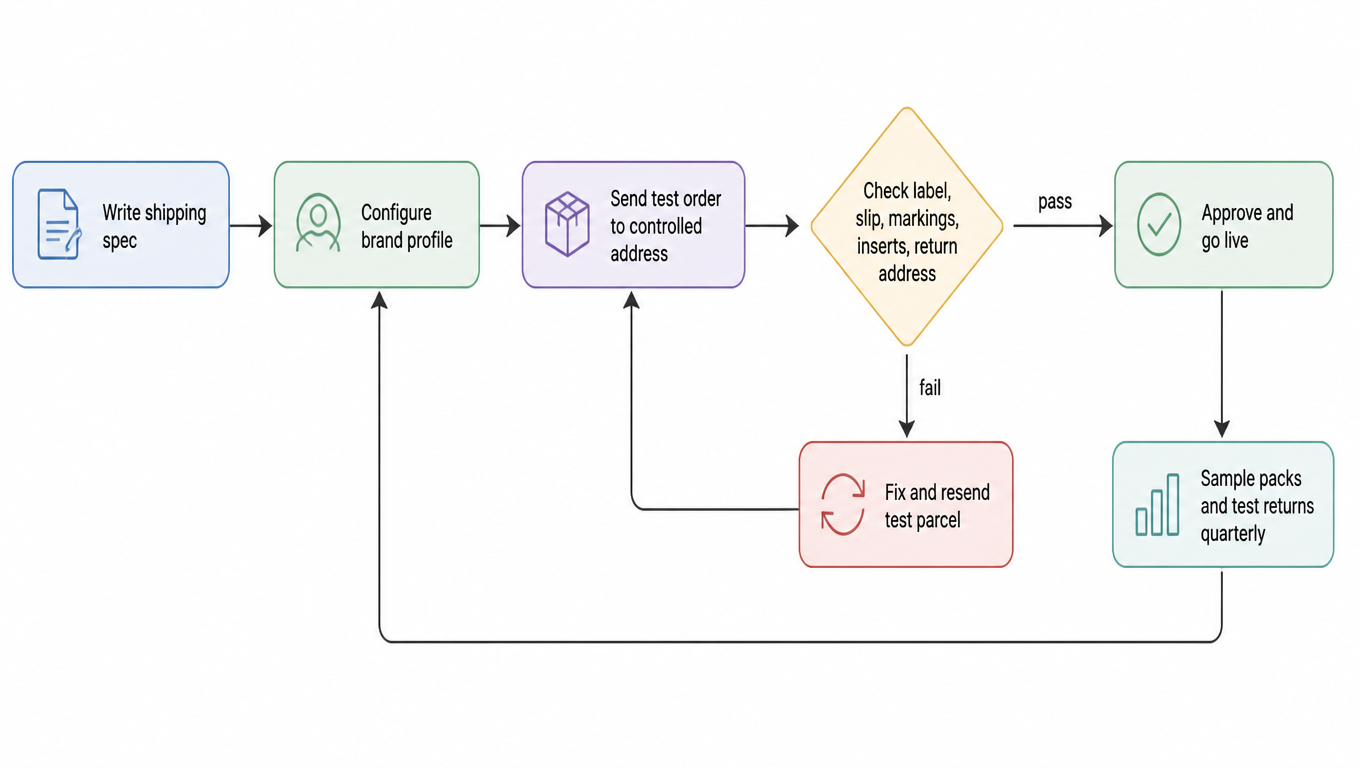
Run a test order to an address you control. Send one parcel, then inspect five things: the label, the packing slip, the outside markings, the inserts, and the printed return address. Photograph all five and file them as the approved reference. Repeat the test whenever the supplier changes packaging, moves to a new software system, or starts shipping from a new site.

Prove the return path as well. A printable return address is not the same as a working returns process. Send a real return to the address that prints on the label, then measure how long it takes to be logged and matched to an order. Many brands discover at this step that the address belongs to a facility that will accept the parcel but has no way to tell the brand it arrived. Which kind of warehouse should receive a return is covered in which warehouse receives a return.

Audit with samples, not with promises. Ask for a pack-station photo per brand, place a mystery order each quarter, and keep the photos next to the spec. Three samples a year catch the substitution problems that a signed agreement does not.

Flow chart: write the shipping spec, configure the brand profile, send a test order, check the label, packing slip, markings, inserts, and return address, approve and go live or fix and resend, then sample packs and test returns quarterly
Spec, configuration, test parcel, and quarterly sampling form one loop, and any change sends it back to the test.

When a brand uses a drop ship supplier instead of a 3PL, the same loop applies: replace the brand profile with a supplier onboarding sheet and configuration with written confirmation. The technology side of white labeling is covered in white label shipping technology for 3PLs.

flowchart TD
  A[Write shipping spec] --> B[Configure brand profile]
  B --> C[Send test order to controlled address]
  C --> D{Check label, slip, markings, inserts, return address}
  D -->|pass| E[Approve and go live]
  D -->|fail| F[Fix and resend test parcel]
  F --> C
  E --> G[Sample packs and test returns quarterly]
  G --> B

What to ask before you choose a supplier or a 3PL

Most of these questions take one meeting to answer, and one of them will usually expose whether blind shipping is a standard capability or a favor.

  1. Can you set label identity per brand, or is there one ship-from identity per facility? This tells you whether the system supports the arrangement or whether someone is editing labels manually.
  2. What is standard, and what is billed as an extra? Custom packing slips, inserts, branded tape, kitting, and per-parcel handling charges are all legitimate. The point is to know them before the invoice, not after.
  3. Who receives returns, and does that address print on the label? Ask for the receiving hours and the RMA process, not just the street address.
  4. How do you keep client packaging materials from mixing? Look for dedicated bins, labeled shelving, and a scan or confirmation step at the pack station. A promise of care is not a control.
  5. What happens when packaging or software changes? A provider with a change process will retest. A provider without one will discover the problem in a customer's box.
  6. Who owns the shipping account and the tracking data, and how does tracking reach the brand? The account owner decides who pays, who can intercept, and whose name shows up in tracking, so it belongs in the spec rather than in a side conversation.
  7. For cross-border parcels, whose name is the exporter on the commercial invoice, and who is the importer of record? The declared exporter should match reality, and the importer of record carries the obligation for accuracy (CBP on importer responsibility). A brand name printed for appearance, when the supplier is the actual exporter, creates a documentation mismatch that is far more expensive than it looks.

A one-page checklist before the first blind shipment

  • Exact ship-from and return strings approved in writing, including the secondary address line
  • Return address is a receiving location with an RMA process behind it
  • Packing slip template approved, with a price rule for gift orders
  • No third-party logos on boxes, mailers, tape, or tissue, and the fallback material named
  • Insert policy written down: brand inserts allowed, supplier promotional material banned
  • Supplier promo cards, referral codes, and price sheets removed from the pack station
  • Account owner agreed, and the tracking feed confirmed
  • One test parcel inspected and photographed against all five details
  • One test return sent to the printed address and logged
  • A named owner and a quarterly review date for re-auditing

Harbor & Loom's postcard was not a packaging mistake. It was an unspecified decision, made by default by someone with a different interest in the outcome. An annex and one test parcel would have caught it, and the customer would have kept believing she bought bedding from Austin. Brands working on the adjacent problem can continue with a discreet shipping audit for DTC brands.

FAQ

Blind shipping is not illegal in itself. It is a commercial arrangement about whose identity is presented. What creates a problem is using it to sidestep duties, licensing, or a marketplace rule that requires a seller to be identified.
No. The label still needs a return address. It just needs to belong to the brand, or to a neutral receiving point the 3PL runs for the brand, rather than to a supplier's production floor.
No. Dropshipping describes who holds inventory and fulfills the order. Blind shipping describes whose identity appears on the label and paperwork. A drop ship arrangement can be blind or not.
Look for three things: dedicated bins and labeled shelving per brand, a scan or confirmation step at the pack station, and a quarterly sample check. A verbal promise alone is not a control.
Not unless the agreement explicitly allows it. The default is to write down that the only insert in the box belongs to the brand, and to ban supplier referral cards, QR codes, and price sheets.
Five: the label, the packing slip, the outside markings, the inserts, and the printed return address. Photograph all five and keep them as the reference for every later change.

Ship correctly for several brands from one facility

Blind shipping rarely fails because of how a warehouse packs. It fails because the spec was never written down or never proven. Write the five details, configure a label identity and return address per brand, then confirm both with one test parcel sent to an address you control.

EasyShippingX compares carrier options inside the US in one place as a channel-neutral shipping layer and executes them through the Portal, Excel, or the API, so label identity, return address, and brand profile travel with every shipment and one facility can serve several clients correctly.