Discreet Shipping Guide

Discreet Shipping Audit for DTC Brands: Labels, Tracking, and Returns

Discreet shipping is not a switch, it is a chain. From checkout to unboxing to return, a customer meets five surfaces in order: the box and the label, the tracking page, the delivery notice, the return label, and the packing and support layer behind all four. If any one of them shows a product name, a category word, or order detail nobody needed, the work done on the other four stops counting.

This audit takes each surface apart into checks you can tick off. Every check has a red line first, meaning something that has to be fixed once it is hit, then the fix, meaning which field, template, or standard operating procedure changes, and finally the verification, meaning how you prove the change landed. Each surface scores out of five for a total of 25, and a blank scorecard at the end can go straight into a spreadsheet.

It is written for DTC brands that ship their own orders, especially in privacy-sensitive categories such as care, wellness, jewelry, and adult health. The parts that touch a 3PL sit in their own section, because a shared warehouse adds a failure mode the customer never sees and that will show up eventually.

Editorial illustration of a packing bench seen from above in early light, two hands pressing a plain white label onto an unprinted corrugated carton, rolls of tape and a marker beside it, a stack of torn old labels at the corner of the bench, generous empty space on the left, hand-inked linework, restrained palette with a single orange accent.
One exposed word undoes four surfaces: audit the chain, not the parcel

Know who you are hiding from: the three motives behind discreet shipping

Brands usually carry all three of these motives at once, and the fixes conflict. Settle the proportions before you change anything, or the answer to one motive will damage another.

Theft. The goal is to lower the value signal of the parcel. A brand mark on the outside, the visual signature of a premium category, and a readable product description on the label all tell a passerby that this one is worth taking. One survey of homeowners found three in five worried about package theft in the delivery season (package theft survey). The matching action is to reduce identifiability, so the parcel looks like any other carton.

Household and workplace. The goal is to lower the category signal. The recipient does not mind the carton being seen, only being read by the people around them. Here a brand mark is not the problem; the product name and the category word are. Research on unmarked packaging finds that the box itself is part of the purchase decision and gets read as a privacy promise (study on discreet packaging). Care goods, prescription-adjacent supplements, and adult health products sit in this group.

Order data. The goal is to tighten fields and links. Extra fields on the label, enumerable IDs in the tracking page, and a publicly searchable returns address leak order and customer information regardless of whether the goods are sensitive, so every category should handle it. An enumerable tracking link is the classic insecure direct object reference, where changing one digit in the address returns somebody else's order, and the prevention pattern is documented publicly (OWASP guidance on insecure direct object references).

The sharpest conflict is network choice: moving to a narrow regional network to strip identifying marks also narrows coverage, and the support cost of a customer who cannot see where the parcel went is usually higher than the privacy gain was worth. So the ordering this audit uses is: keep tracking first, lower the signal second, tighten the data third. Network selection deserves its own pass, and the method is in multi-carrier shipping strategy. The five surfaces a customer can see connect like this:
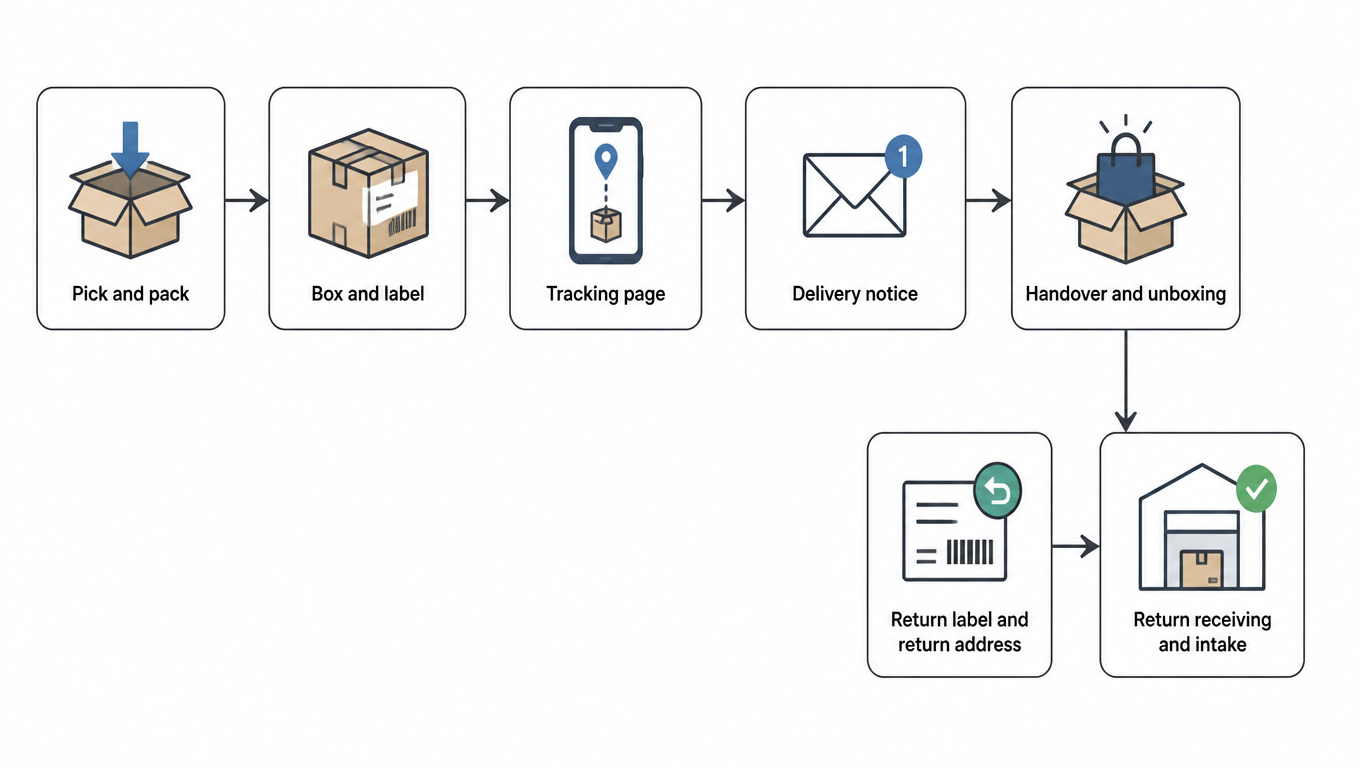

Flowchart: pick and pack leads to box and label, then the tracking page, the delivery notice, and handover and unboxing, and finally the return label and return address followed by return receiving and intake
The five surfaces in the order the customer meets them: one exposed word travels back up the chain

Scoring rules: five surfaces, equal weight, one veto

The scorecard has five rows, one per surface: label and parcel appearance, tracking and delivery notices, return labels and the returns address, warehouse and 3PL execution, and customer expectations. Each scores out of five for a total of 25. Scoring rather than only listing checks matters because whether something is a problem rarely has an absolute answer, while whether you can make an external promise needs a threshold.

The bands work like this. A five means fully in place with a repeatable verification record, so a different person checking reaches the same conclusion. A four means it holds, but verification depends on manual sampling, so what nobody samples stays unknown. A three means the main path holds and edge cases leak, for example a rush order in peak season that skips the standard template. A two means a specific red line is still open. A one means exposure in several places and no steady way to find it.

Three bands. A total of 20 or above passes and can be promised to customers. A total of 15 to 19 passes conditionally, with remediation expected inside one month. Below 15 does not pass, and the external promise pauses. Above the total sits one veto: if either the label surface or the return label surface scores a two or below, the total does not matter. Those two are the surfaces that customers and outsiders, front desk staff, neighbors, pickup points, and couriers, can all see, and an exposure there cannot be recalled.

The five rows carry equal weight by default, because exposure multiplies rather than adds: miss one surface and four perfect scores do not buy back the disappointment. The one exception is the veto above, which is really a statement that the label and the return label have less room for error than the other three.

Surface one: the label and the parcel

This is the first gate of all. Before the customer opens anything, the courier, the pickup point staff, and anyone walking past the door have already read it.

Red lines. A product name, a category word, or a readable SKU description in the label's contents field; a brand mark printed on the box next to a category slogan; an unsealed paper catalog or flyer riding along inside; a sender name that exposes a sensitive supplier or a category-identifying legal entity; a carton size and packing pattern distinctive enough that a repeat customer recognizes it as yours.

The fix. Hard-code the contents field in the label template to a neutral value such as Merchandise or Consumer Goods instead of leaving it to a packer to type, because manual entry fails eventually. Move the box to plain or single-color stock and keep brand recognition inside on a card. Separate the sender name from the returns address, and use a neutral trade name or the legal entity rather than a category-linked brand name. Neutralize inside what the network allows, since sender elements on a label are constrained by address standards (USPS Domestic Mail Manual 602 on addressing). For how fields map to templates in a system, see the order, shipment, and label data model, and put the neutral value in the template rather than in an operator's memory.

The verification. Each month pull a fixed sample of ten parcels and print the labels, then walk every field against the neutral template: sender name, contents field, and any marketing field left behind. Scan the tracking page from one of those labels and confirm the page title carries no product information. File the sample and the label sheets together, because that file is the next review's evidence and it is exactly what separates a five from a four. Sampling with a record is what makes the result reproducible.

Editorial illustration of a torn shipping label seen close up, edges curling with one crease, carrying only the delivery address block and a barcode, the contents line left as an empty light gray box, a pen resting beside it with a single ink dot, warm off-white paper texture, hand-inked lines of uneven weight.
The empty line is the product: fill the contents field with a neutral word or leave it blank

Surface two: the tracking page and delivery notices

While the parcel is moving, a customer may open the tracking page several times a day. This is the surface most often ignored, because the page belongs to the network and the brand assumes it is out of reach.

Red lines. A tracking page title or description carrying a product name, a category word, or a brand category label; a delivery text or email whose body carries a product description or a product thumbnail; a tracking URL built from a sequential order number or a customer's email address, where changing a few characters returns somebody else's order.

The fix. Put a neutral code in the label's reference field, decoupled from product data, holding only the internal number the warehouse needs to match the order (reference field documentation). If you run your own tracking page, title it at the order level and never render product information. Keep notification templates to the last four digits of the order number and a delivery window, with no product name and no product image, because the notification preview is visible on a locked screen. Move tracking links to tokenized short URLs and close the order-number lookup. This part touches support: when a token expires, agents need an alternative path that works from the last four digits plus a verification step, otherwise customers ask an agent to read the order back to them in chat and you have opened one more surface. For a consistent set of notice templates and status callbacks across networks, see the multi-carrier order tracking workflow.

The verification. Place one test order and screenshot every message from dispatch to signature, then read each body and each preview. Then change the order number in the tracking URL by hand and confirm you cannot reach another customer's order. Only after both steps can this row earn a five. The second step reproduces an access-control failure, so keep it in house and keep it on the test order.

Surface three: the return label and the returns address

Returns is the leg most often skipped, because return flows get designed for efficiency rather than privacy. And it is the leg that undoes everything done upstream.

Red lines. A return label's ship-to block or an RMA page showing the brand's category or a product name; returns arriving at the main warehouse and mixing into the same receiving line as inbound stock; a returns address that is the same public address printed on the marketing site, so anyone who looks it up knows which brand is coming back.

The fix. Route returns through a separate receiving point or a separate RMA lane, and keep the ship-to name on the label neutral and decoupled from the public brand name. Keep the RMA page to the RMA number and instructions, with no product name. Physically separate the returns unpack area from inbound receiving so parcels cannot cross-expose one another. Decouple the moment the return label is generated from the outbound label: many systems reuse the same template variables, so changing one silently changes the other, in either direction. For how the RMA, the physical parcel, and the refund are reconciled, see the RMA, return shipment, and refund data model. And if this leg should not bring goods back at all, run the numbers first in box-free vs. QR-code vs. mail-in returns, because not shipping it back is often cheaper than a neutral address and quieter too.

The verification. Buy from yourself and return it once, then read all three artifacts end to end: the label PDF, the pickup paperwork, and the receiving record. Then search the returns address and confirm no brand name or category word comes back. This is the step people skip, and it is the only one that verifies the label and the address at the same time.

Surface four: the warehouse and 3PL execution layer

This row is not exposed to the end customer but to the warehouse floor and to the other brands sharing it. A dedicated warehouse rarely has the problem; a multi-brand 3PL does, and the risk is material crossing over.

Red lines. A brand A privacy parcel going out with brand B's mark or insert, which in a shared building will happen in some month, since order accuracy is a measured operational metric with published benchmarks (order accuracy metrics for 3PLs); a pick sheet or packing slip riding along with the parcel, which hands the customer the itemized contents; material from the previous order left in the box, especially a card or a dust bag carrying a mark.

The fix. Put three instructions in the work order you hand the 3PL: no insert, no invoice, plain label. Send the packing slip electronically with the dispatch email instead of in the box. Configure per-brand packing specifications and material isolation fields in the WMS so one brand's material cannot be pulled for another's order. Add a clear-the-bench confirmation at the pack station, with a photo of what went into the box, so a dispute has something to go back to. Packaging material is a cost line as well as a privacy one, and which items to trade away is covered in the parcel-first packaging cost audit.

The verification. Each month send a sample of five orders to your own address and open them, checking that the contents of the box belong to that order and nothing else. Reconcile the count and handling time of material-crossing tickets with the 3PL. Two consecutive months at zero is the only path to a five; one occurrence caps the row at four.

Surface five: customer expectations

The first four rows govern objects; this one governs words. If the customer's expectation about privacy is never set at checkout, the gap at the door turns straight into tickets and reviews.

Red lines. A product page or checkout that never says whether the packaging is unmarked, so the customer finds out at the door; support scripts that disclose what is in the parcel, above all when a family member or a colleague signed for it; a replenishment or subscription reminder whose body names the product, since those messages land on a device the recipient often shares.

The fix. State the unmarked packaging commitment at checkout in one sentence, saying the outer parcel carries no brand and no product information. Write the signed-for-by-someone-else case into the support script: confirm the last four digits of the order and nothing about the contents, and send the customer to the account page to look for themselves. Keep replenishment and subscription mail at the order level, and leave item detail behind a login.

The verification. Run one anonymous support inquiry from an address unrelated to the brand, playing the person who signed for someone else's parcel, and check whether the reply reveals the contents. Then hold the checkout copy next to the parcel that actually arrived, because a promise you cannot keep does more damage than no promise at all.

A worked example and a blank scorecard

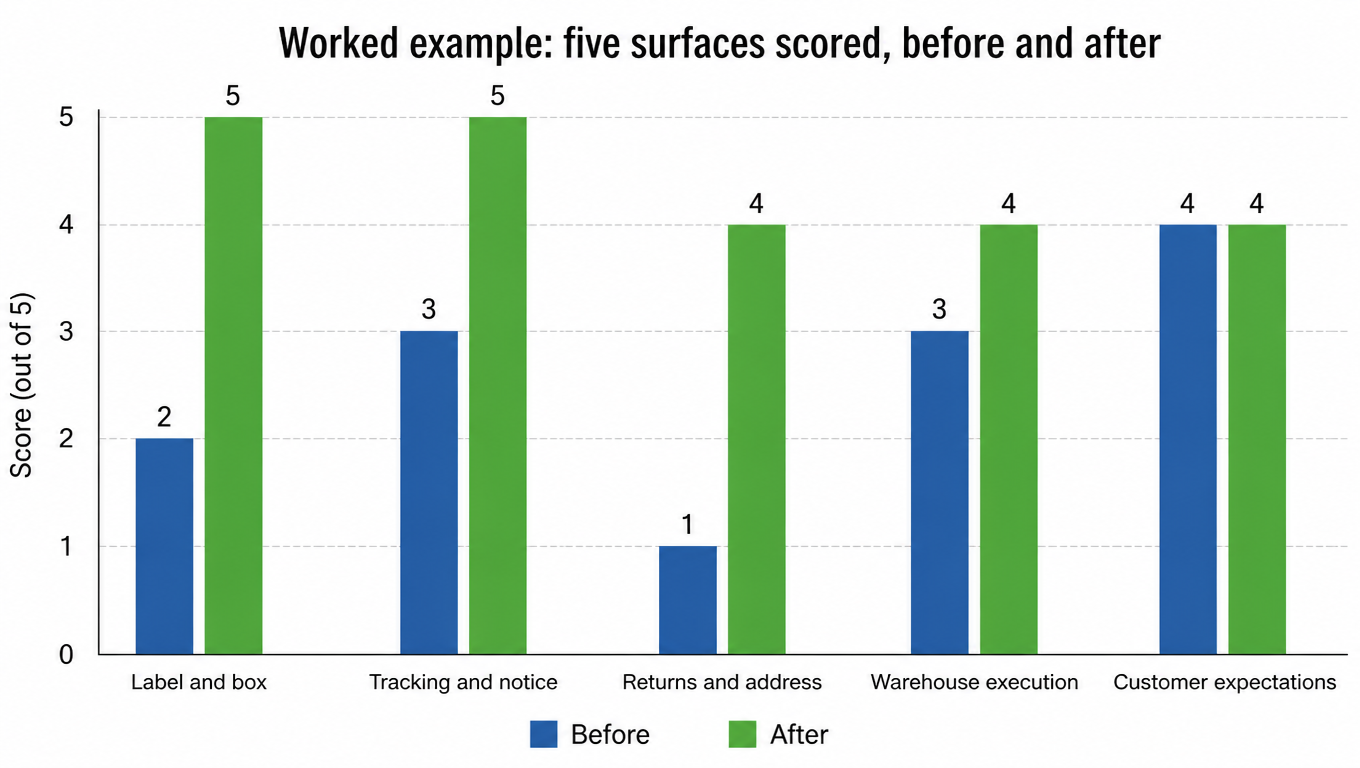
The example brand sells care and wellness products, ships about 40 orders a day and roughly 1,200 a month across some 60 SKUs, runs a small warehouse of its own, and sends part of its volume through one 3PL site. These are hypothetical parameters rather than benchmarks. Scored before any changes: label 2, tracking and notices 3, returns and address 1, warehouse execution 3, customer expectations 4, for a total of 13, with the returns row below two, which trips the veto.

The work orders itself by effort. The label and tracking rows are template changes: hard-code the contents field, swap the reference value for a neutral code, delete the two pieces of product information in the notice templates. That is an afternoon plus one conversation with the network side. Returns is the largest single piece, because it needs a separate receiving point, rewritten RMA copy, and the unpack area moved off the main inbound line, which costs two days of warehouse labor and one external notice about an address change. Warehouse execution is a work-order wording change and a WMS field. Customer expectations is one line at checkout and one support script.

Surface Before After Nature of the change
Label and parcel25Template field locked
Tracking and notices35Templates trimmed, tokenized links
Returns and address14Separate receiving point and address change
Warehouse execution34Work order and WMS fields
Customer expectations44Checkout copy and support script

The total after the work is 22, which passes. Returns stops at four because the new receiving point has only two months of records behind it, not yet enough for a different person to reproduce the conclusion. Warehouse execution also stays at four, for the same reason: verification still rests on manual unboxing of a sample.

Bar chart: worked example scored across five surfaces, before at 2, 3, 1, 3 and 4, after at 5, 5, 4, 4 and 4, vertical axis is the score out of five
Worked example across five surfaces: 13 before, which tripped the veto, and 22 after, on hypothetical parameters

The blank table below goes straight into a spreadsheet. Each row takes three entries: the score now, whether a red line was hit, and where the verification record lives.

Check Red line hit Score (1 to 5) Fix owner Where the record lives
Label and parcel    
Tracking and notices    
Returns and address    
Warehouse execution    
Customer expectations    
Total (out of 25, 20 or above passes; label or returns at 2 or below is a veto)    

Score everything once to start, then review quarterly. Three events also require an immediate re-score: changing the network or the label provider, changing the 3PL or the warehouse, and any change to packaging material or label templates. Each of those quietly pushes a row back down, returns most of all, because a coupling between the address and the template is usually discovered only when the first returns reach the dock. For how this fits a wider fulfillment program, see ecommerce shipping solutions.

Put privacy in the template, not in everyone's memory

EasyShippingX is a channel-neutral shipping layer: it compares US carrier options in one place and executes them through the Portal, Excel, or the API. Label templates, the reference field, and return labels run on one configuration, so a neutral contents value and a neutral ship-to name are set once and take effect on both the outbound and the return leg, which recovers two of the five surfaces without anyone having to remember anything.