US Chocolate Brand & 3PL Shipping Guide

How to Ship Chocolate Without Melting: Packaging, Timing, and Costs for US Sellers

To ship chocolate without melting, confirm the product’s storage and transport requirements, choose a validated pack and coolant arrangement, then match service and handoff to the full exposure time through indoor receipt. Start with those conditions, not the number of cold packs or the cheapest label. Release only within the validated product, loading, initial-condition, and route envelope; otherwise assess an upgrade, reschedule, or pause.

Not completely melted is an inadequate acceptance standard. Chocolate can lose gloss, bloom, deform, or break; the retail box can become wet or its seal damaged even when the pieces remain recognizable. For gifts, presentation is part of the delivered product. Write down appearance, seal, and applicable safety criteria so the warehouse and customer-service team use the same definition of success.

This guide concerns US domestic solid chocolate, bars, and gift boxes suitable for their planned conditions. Refrigerated fillings, fresh-fruit chocolates, ice cream, and frozen desserts require separate assessment. All weights, hours, probabilities, costs, and four orders below are teaching assumptions, not shipping experiments or customer data. Use the cookie-shipping guide for general bakery protection; this guide focuses on chocolate’s thermal, condensation, and validation decisions.

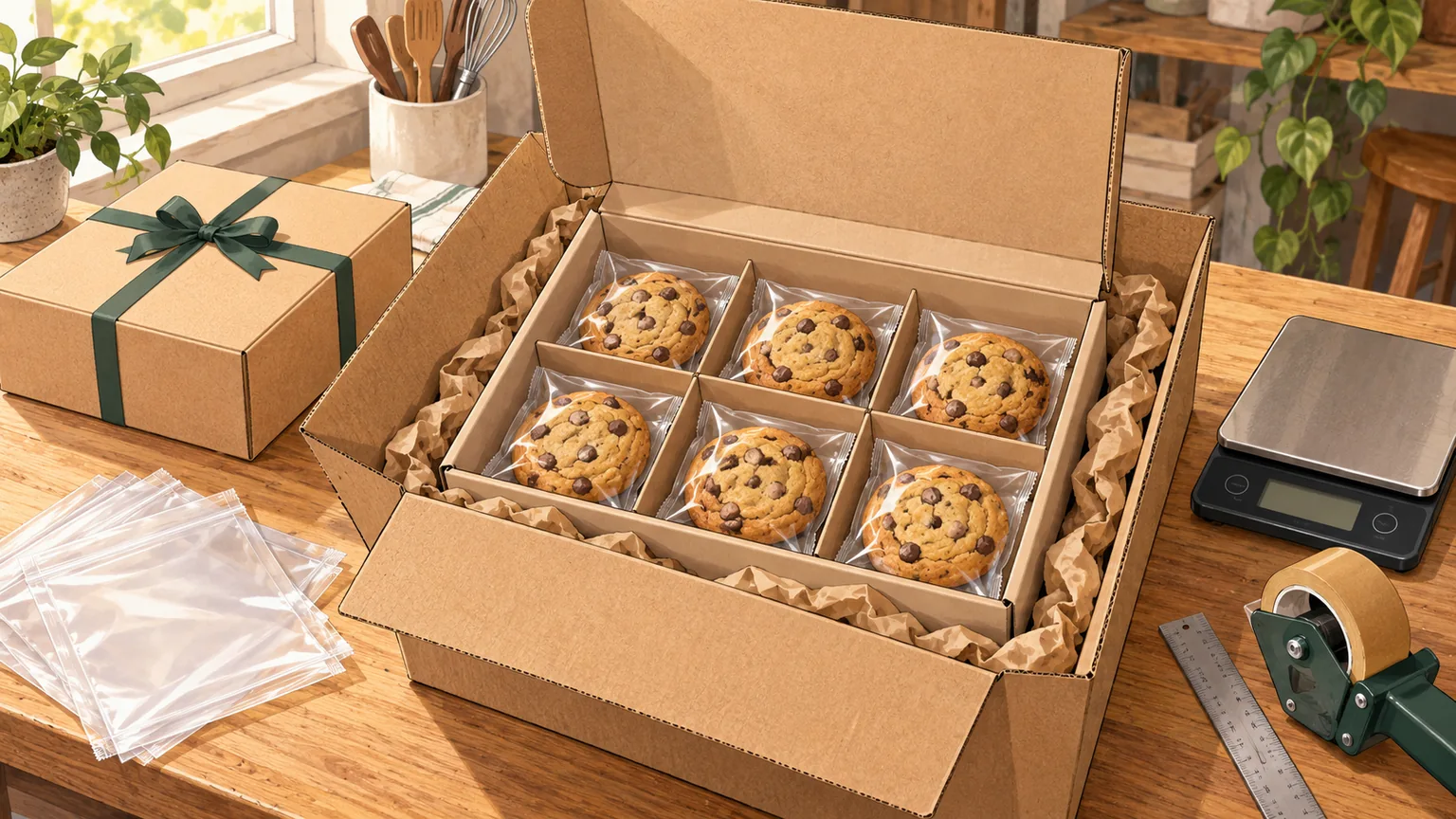
Original concept illustration of a sealed chocolate gift box in an insulated carton, with sealed coolant packs in separated side compartments, plus a wrapped bar, scale, tape measure, and blank temperature-recording tool.
Illustration of insulation and coolant placement. Validate the materials and amount of coolant for the product and shipping conditions.

1. Which chocolate are you shipping, and what can go wrong?

Classify the finished product from its specification, not just “dark,” “milk,” or a filling name. Obtain SKU-specific storage and transport instructions, pack requirements, supported shelf-life information, and temperature limits for the final sale format. Similar ingredients can appear in products with different moisture and processing. A warehouse cannot declare ambient suitability from one ingredient word; incomplete records remain pending rather than become approved through label creation.

Risk screening, not mailability or safety certification by name
ProductRisk / required evidenceParcel condition
Specified ambient solid barSoftening, bloom; finished-product requirementsActual conditions and pack validated
Delicate gift assortmentCrush, distortion, wet box; presentation/support criteriaThermal and mechanical checks pass
Filled confectionSpecific formulation, process, manufacturer requirementsNo ingredient-name shortcut
Refrigerated / frozenFull safety and storage/transport requirementsSeparate suitable system or pause

Storage recommendations are neither melting points nor allowable transport excursions. Callebaut’s storage guidance gives 12–18°C for pure chocolate; Valrhona’s guidance specifies dry, dark storage at 16–20°C on arrival for its listed solids and gift boxes. Different scope is not an invitation to average these into a standard or convert them into packaging hours. There is no universal melting-point table here.

Melting or softening changes shape. Fat bloom concerns fat behavior or migration; Callebaut explains how heat and temperature swings accelerate it. Sugar bloom concerns moisture-related sugar crystals, with condensation also addressed in its storage guidance. Breakage is mechanical. Spoilage is a different question. A photograph of white marks cannot establish ordinary bloom, much less food safety.

When safety evidence or arrival conditions are uncertain, follow the brand’s food-safety response rather than ask the recipient to taste-test. FoodSafety.gov’s delivery guidance notes that unsafe food can appear normal. Its refrigerated-perishable advice does not classify every solid chocolate as needing refrigeration. Shipping trials assess the pack’s performance; they do not replace formulation, process, or shelf-life validation.

Check condition before packing as well. A compliant production specification does not establish that this batch remained within requirements while waiting. Adding coolant cannot rewrite an already softened or wet product as sound at dispatch. The brand defines isolation, review, and approval for that exception; the warehouse records the observed condition and lot. This is a release check, not an instruction for packers to retemper chocolate, repair its appearance, or extend shelf life. Keep those product decisions with the responsible qualified team.

For an assortment, review all finished components rather than only the chocolate shell. Different pieces can have different storage, presentation, and opening instructions. Establish a common supported range before assembly or handle them separately. Preserve the relevant identity and lot links, and prevent a free sample, substitution, or new filling from silently entering an approved combination. Passing the shipping pack does not replace the brand’s assessment of the finished product. An unchanged decorative box is not evidence that its new contents are equivalent.

2. How should the pack, insulation, and coolant work together?

Define a pack version with materials and placement before assembly. The structure below needs product-specific validation; it is not a universal standard. Insulation slows heat transfer rather than actively cooling, and a reflective finish does not establish performance. FedEx’s perishables guidance treats coolant, insulation, liquid control, and the outer carton as separate parts, not interchangeable complete systems.

Protect the food, then the shape and retail box

First use food-contact packaging appropriate to the intended food and conditions, checking its supplier specification and seal integrity. FDA’s food-contact information explains intended-use assessment; an arbitrary bag or shipping bubble wrap is not a food wrapper. Next use a tray, partitions, or retail box to maintain shape and prevent collisions. Structural supports should carry loads without immobilizing chocolate by squeezing it.

Third address moisture and leakage: protect the product wrap and gift box, with containment and absorption appropriate to the selected design. A sheet on the carton floor alone is not proof against wet damage. Condensation can affect presentation, carton integrity, and label adhesion. Specify closures, absorbent placement, and coolant-package integrity, checking the whole system rather than only whether chocolate touches liquid.

Choose insulation and coolant with separation and support

Fourth fit the insulation selected for the carton, load, and testing, with repeatable seams and closure. Fifth prepare the specified coolant under its supplier instructions, recording model, total quantity, initial state, and conditioning. “Two chocolate boxes” is not a coolant calculation: thermal mass, voids, geometry, exposure, and placement matter. Additional packs can also force a larger carton and change the previously validated arrangement.

Sixth separate and support coolant so unsuitable materials cannot contact chocolate and cold-pack weight cannot crush delicate shapes. Restrain it in the specified position through handling, rather than write “place on top” without a support method. Colder is not automatically better, and product preparation must not default to freezing every chocolate. Follow the product’s requirements and the selected system’s conditioning instructions.

Numbered cutaway shows food-contact wrap, tray/retail box, moisture barrier, insulation, side-contained sealed coolants, rigid separators/supports, cushioning/restraint, and outer carton; no coolant touches bare chocolate or loads the product.
Illustrative structure, not a universal pack standard. Validate materials, closure, load, and initial conditions for the SKU; do not directly substitute dry ice.

Seventh cushion, restrain, and close the outer carton without free movement or product compression. A larger box is not automatically safer; extra space can add thermal load, materials, and dimensional charges. Downsizing cannot remove required insulation or support. Eighth weigh the sealed gross parcel and measure external dimensions with units. Photos help reproduce the pack but cannot replace the material list, dimensions, or scale reading.

Weight teaching example: 12 oz chocolate, 4 oz retail box and restraint, and 6 oz carton and other basic materials total 22 oz, or 1.375 lb. Adding 3 oz insulation and two 8 oz coolants gives 22 + 3 + 16 = 41 oz, or 2.5625 lb. These quantities are not a coolant recommendation or validated thermal pack. Never quote from the 12 oz net product weight; check rounding and dimensional rules for the selected service.

Dry ice is a separate assessment, not the default coolant here. Its hazardous-material, packaging, marking, and carrier conditions differ from sealed gel packs, so do not reuse this enclosure or a generic quantity. USPS’s refrigeration FAQ and FedEx’s guidance link their own dry-ice requirements. Evaluate the product, channel, and current rules separately instead of substituting it at an ordinary chocolate station.

Check the moisture barrier and coolant seal separately. A sound product bag is not an automatic containment system for every failed coolant, and an intact coolant can still develop exterior condensation. During trials inspect contact with divider edges, then examine both sides of the protective bag and the absorption layer after removal. Name the failing layer so the correction addresses closure, location, or structure. Simply adding another unspecified plastic layer can conceal the failure instead of making the pack reproducible.

Coolant preparation needs a work record. After the supplier-required conditioning, record its state, quantity, and arrival at the station. Do not stage a whole shift’s coolant in advance and assume the last carton starts like the first. A replenishment or supplier change that alters model or specification stops automatic use of the previous version. Identical-looking packs in identical photo positions do not establish equivalent thermal performance; procurement identity and approval scope must remain linked. This also gives the next shift a usable material check.

3. Does the time budget cover packout through indoor receipt?

Budget exposure from packout through actual handoff, transport, delivery, and indoor receipt. Define the validation clock and initial conditions before calculating remaining protection. Label creation is not carrier acceptance, and delivered does not mean brought indoors. Use elapsed hours or calendar time rather than equate two business days with forty-eight hours. Warehouse hours, carrier calendars, and recipient availability all matter.

Assume one defined pack has 72 hours of protection under specified conditions, not a generic pack lifetime
Independent time assumptionHours
Waiting for handoff4
Transport, including delivery36
After-delivery wait4
Delay buffer12
Total budget56
With 48 extra hours104

Assume a defined load, initial temperature, and exposure profile supported seventy-two hours from sealing. The budget is 4 + 36 + 4 + 12 = 56 hours, below seventy-two only while those conditions remain applicable. Another forty-eight hours makes 104, requiring a new plan. Harsher exposure can invalidate even the fifty-six-hour comparison. Seventy-two is a teaching assumption, not a cold-pack lifetime or independent carrier approval.

Check actual pickup and cutoff before weekends, holidays, disruption, and delay. Dean’s Sweets describes a preference for early-week warm-season shipping while noting different peak-period practice. That is its operation, not a ban on every Friday. EasyPost’s chocolate article also raises early-week dispatch and doorstep delay; neither establishes that Monday dispatch is safe by itself.

Consider origin, destination, and likely route exposure. A forecast is a screening input, not a vehicle or in-package temperature measurement. Recipient absence, office closures, or an event’s receiving window can change the budget. Use the corporate-gift guide for roster and handover ownership, while every chocolate parcel still passes its own product and time gates.

A delayed pickup needs more than a changed date in the sheet. A sealed parcel consumes its applicable protection window and may have left the approved holding environment. Recalculate from actual elapsed time and conditions. Putting it somewhere cooler does not automatically reset the validation clock. Record the basis for holding, restarting, or changing the plan, with brand review where product and materials need preparation again. A revised mailing date cannot erase the exposure already incurred by the physical shipment.

Translate an event deadline into a workable receiving arrangement: event start, latest staffed receipt, operating hours, and who contacts the buyer if the plan fails. A recipient’s willingness to collect later does not add protection hours. Agreement to pay more does not reopen a disrupted lane. Commercial consent helps select a new date or arrangement, but the product and carrier gates still need to pass independently. Give the owner enough information to choose rather than ask only whether the buyer will accept an extra fee.

4. How should you screen USPS, expedited, and other services?

Screen mailability, address coverage, condition/time fit, handoff, then full cost. USPS Publication 52 §53 excludes easily decomposing foods or perishables unable to arrive without spoiling, with applicable packaging requirements. USPS’s FAQ states that it does not provide refrigeration. Buying insulated packaging does not make the postal network temperature-controlled. A generated label or tracking scans prove neither product acceptance nor temperature history.

Separate expected transit from a guarantee. The current Ground Advantage page gives an expected two-to-five-day range with slower-service qualifications. Priority Mail Express commitments depend on ZIP pair, tender time, and exceptions, not a blanket overnight promise. Verify the current lane commitment against the full exposure budget. A postage money-back provision is not a chocolate-quality guarantee. Use the shipping-tier guide to distinguish promises and charges.

Insurance cannot replace thermal controls. DMM 609 §4.3(g) excludes perishable contents that freeze, melt, spoil, or deteriorate. Included insurance therefore does not promise melting compensation. Check separate insurers’ own terms, exclusions, and evidence; the insurance decision guide covers that decision. Customer remediation and recovery from an insurer remain separate questions.

FedEx’s material helps explain its packing and testing recommendations, but acceptance, additional conditions, and availability need channel-specific confirmation. Its guide says the packaging information is not a comprehensive acceptance list. FedEx is not being presented as an EasyShippingX channel. Neither a different carrier nor a higher price establishes food acceptance, a lower internal temperature, or fewer complaints.

Check product requirements, dedicated cold-chain need, pack/lane validation, and current exposure/receipt conditions; outcomes include release, upgrade review/retest, rescheduling, and pauses for missing evidence or unavailable required systems.
Operational triage, not product, food-safety, or carrier approval. More coolant, an expedited name, or willingness to pay cannot bypass a failed gate.

5. How do direct cost and expected replacement spending compare?

Compare cost only among options that meet mailability and food-safety prerequisites. Direct dispatch cost is shipping packaging and coolant + packing labor + postage + applicable extras. Expected fulfillment spending adds the probability of one quality-related replacement multiplied by its incremental cost. This is not order profit, and a lower average cannot justify an unsuitable shipment. Resolve the product and service gates before choosing the cheaper row.

Amounts and probabilities are assumptions, not quotes or measured effects; not derived from the weight example
Independent teaching model, USDOption AOption B
Postage$6.40$8.80
Shipping pack/coolant$2.20$2.20
Packing labor$1.20$1.20
Direct cost$9.80$12.20
Assumed replacement probability12%2%
Incremental cost per replacement$30$30
Expected fulfillment spending$13.40$12.80

A’s direct cost is $6.40 + $2.20 + $1.20 = $9.80; B’s is $8.80 + $2.20 + $1.20 = $12.20. Other extras are omitted here and must be added when applicable. The assumed probabilities concern appearance or quality complaints causing one replacement, never an acceptable average food-safety risk. Expected spending is $13.40 for A and $12.80 for B, a $0.60 difference under these assumptions.

The $2.40 direct-cost difference divided by $30 is 0.08, or eight percentage points. An eight-point reduction breaks even; B needs more than eight points to be strictly cheaper. Twelve percent versus two percent is a ten-point reduction. More expensive service does not establish those probabilities. Estimate real comparisons from comparable products and conditions with a consistent complaint definition, not from the price difference.

Two independent assumptions: 12 + 4 + 6 oz = 22 oz or 1.375 lb; adding 3 oz insulation and two 8 oz coolants gives 41 oz or 2.5625 lb. A costs $9.80 + 12% × $30 = $13.40; B costs $12.20 + 2% × $30 = $12.80, with an eight-percentage-point break-even reduction.
Independent teaching examples, not quotes or measured effects. Coolant quantities are not recommendations; costs do not follow from the weight example, and expected spending is not order profit.

This hypothetical model includes one replacement, not a full refund as well. Build the incremental $30 from additional goods, materials, labor, shipping, and actual support, without embedding another identical reserve. Do not repeat the original goods cost in direct dispatch cost or count a retail box again if already included in merchandise cost. An expected allowance is not cash spent; reconcile direct spending, actual remediation, and model estimates separately.

For real quotes retain date, ZIP pair, service, sealed weight, external dimensions, retail/commercial basis, and included charges, separating quote from final debit. USPS’s current service page lists applicable perishable handling and other fees; determine applicability for the product and channel. A merchant’s warm-weather packing charge is not automatically that carrier fee. The weight and cost examples are independent; neither teaching postage amount follows from twenty-two or forty-one ounces.

A real issue rate needs its denominator, season, lane, and final resolution. Complaint-only counts can miss unreported outcomes; counting a refund and replacement as independent failures can duplicate one event. Define whether the comparison concerns appearance, moisture damage, or another specified outcome, then record the actual resolution. Without comparable evidence, retain an unknown probability or use labeled sensitivity analysis. B’s higher price does not authorize inserting two percent. The model supports a decision only when its inputs describe the problem being compared.

6. When should these four orders ship, upgrade, reschedule, or pause?

These four orders are teaching situations, not customers or trial outcomes. Separate inputs, judgment, action, evidence, and conclusion so another operator can reproduce the decision. Release applies to this product, pack, and exposure, not every later season, destination, or assortment. Do not combine the independent examples’ weights, probabilities, and costs into an actual invoice.

Case A: A solid bar ships in the validated cool-condition pack

The solid bar has clear requirements; its lane, load, and base pack were validated for these cool conditions, and prompt indoor receipt is available. The brand confirms the batch specification. The warehouse follows the approved restraint, sealing, measurement, and tender plan. Record SKU, lot, pack version, condition review, and handoff before release. Do not add cold packs reflexively: unvalidated additions change temperature, moisture, space, and gross weight rather than automatically improve reliability.

A longer handoff wait or a load outside the tested range reopens the decision. Cool weather is not substitute evidence. Completion includes tender within plan and later review of appearance, seals, and box condition against the original criteria. Basic packaging still supplies food-contact and mechanical protection; only the additional coolant is unnecessary within this example’s validated range.

Case A can use a routine release record linked to the validation basis without calling every normal order a new experiment. Escalate changes outside that basis rather than relabel exceptions as normal to meet volume. This preserves a valid base pack and avoids adding the same cooling expense to every order mechanically. Link arrival feedback to the version actually used so a later problem can be investigated by batch, execution, or exposure instead of attributed vaguely to the season.

Case B: A warm-destination gift uses the validated warm-weather system

The presentation-sensitive gift is headed to warmer conditions outside the base pack’s range. Another warm-weather version has validation for the applicable load and lane. Use its specified coolant, conditioning, insulation closure, moisture barrier, and supports, then remeasure gross weight and dimensions. Select an eligible service fitting the shorter window, confirm tender and recipient availability, and send a reminder. Record why the version changed rather than note only “add two packs.”

The outcome is an upgrade of the validated system, not approval from an expensive label. A coolant crushing the box or a newly absent recipient invalidates the arrangement. Review shape, seals, moisture, and any specified temperature record on arrival. A pack still feeling cool does not establish that the product met its conditions throughout the journey.

Case C: An event deadline and disruption defeat the original plan

The event gift depended on the earlier hypothetical seventy-two-hour protection range. Extra dwell makes the budget 104 rather than fifty-six hours, while extreme weather may exceed the exposure profile. Hold the original batch and discuss rescheduling, a suitable verified alternative service, local delivery, or cancellation. Here the buyer accepts rescheduling. Update the commitment and packing plan, then release only after the new conditions are confirmed, without promising the original event date.

Do not add more coolant and dispatch anyway: the changed quantity, initial condition, carton, and restraints lack the corresponding validation, and colder contents do not reopen a disrupted route. Retain the disruption source, recalculation, offered choices, buyer decision, and new owner. If rescheduling is rejected and no suitable route exists, resolve cancellation or other agreed remediation. Invalidating the plan calls for a new decision, not dispatch followed by an expected insurance recovery.

Local delivery in Case C also needs assessment; a short distance is not automatic approval. Confirm preparation, waiting, handling, receiving owner, and product-condition fit before presenting it as a workable choice. Moving the destination to another unattended place leaves the issue unresolved. Preserve why alternatives were rejected so customer service can explain the decision as the event approaches instead of repeatedly promise that someone will find a solution. A genuinely viable alternative changes the conditions, not merely the service name.

Case D: A refrigerated filling stops the ordinary-parcel plan

The filled product explicitly requires refrigeration, but the warehouse has only an ordinary solid-bar procedure. The brand must supply requirements and a suitable system covering storage, preparation, handoff, transport, and receipt, with separate carrier review. Those conditions are unresolved here, so isolate and pause the task. Do not change the label to expedited and release it. Record missing evidence, decision owner, and next review before accepting such work.

Unlike Case B, the missing prerequisite is the product’s required system, not simply a warm-weather pack version. A shipping test cannot establish food safety or shelf life. Fresh-fruit chocolates, ice cream, and frozen desserts likewise require their own finished-product assessment. An urgent customer date can change the commercial arrangement, not supply the missing evidence.

7. How can a small seller test and a 3PL reproduce the result?

Define acceptance before trials: appearance, shape, seal, moisture, and applicable temperature criteria, plus load and exposure scope. Use representative lanes and delay scenarios. One successful arrival describes that recorded combination, not summer, remote addresses, or every quantity. Mark unmeasured facts unknown; a customer saying “looks good” cannot reconstruct the missing temperature profile.

Shipping-trial management fields, not a platform import or food-safety validation form
Record groupFields to retain
Product / versionSKU, lot, specification; pack version
Materials / loadCoolant model, total, initial state, placement; sealed weight and outer dimensions
Lane / timeOrigin/destination; pack, tender, transport, delivery, indoor-receipt times
Outcome / retestApplicable temperature record; appearance, wet damage, breakage, seals; cost; criteria, failure, change, retest

Record what and where a logger measures: exterior air, internal air, and a product-related location are not interchangeable. Retain model, accuracy or uncertainty, sampling interval, placement, and time synchronization. One compliant location does not establish uniform product conditions. Have the appropriate reviewer interpret excursions against product requirements, without hiding peaks or gaps in an average. File transport performance separately from food-safety and shelf-life validation.

The brand supplies finished-product requirements and approvals; the 3PL reproduces the approved version. A missing coolant model, substitute liner, changed load, or out-of-range delay triggers the named escalation owner, not an operator’s “similar enough” substitution. Preserve approval, actual materials issued, and exceptions for the next shift. Comparable complaints and costs require repeatable execution and outcome records.

Trial and release check

  • Product requirements, acceptance criteria, measurement locations, and version approved.
  • Materials, initial states, separation, restraint, seals, and measurements recorded.
  • Actual handoff, lane, exposure screening, and receipt remain within scope.
  • Outcomes, failures, changes, and retests recorded; exceptions have a decision owner.

Design measurements around the likely failure locations, not only the easiest place to fit a device. A point beside coolant and a far-side product location may differ; measure the difference rather than assume it. Instrumentation or test specimens can also alter the load and should be documented. Preserve comparable conditions during retesting and identify the changed variable. If carton, coolant, and service all change together, a better outcome cannot by itself identify which change mattered. It still does not validate untested configurations.

8. What should customers confirm before you quote and release?

The USPS service page lists carrier handling fees to verify for the actual product and channel. Explain weather adjustments and receipt responsibilities before dispatch. A merchant’s warm-weather packaging fee can cover insulation, coolant, or extra work; disclose its scope and arrangements rather than call it a carrier surcharge. Check actual carrier fees separately. An unexplained summer charge should not conceal two different amounts that are then counted again at reconciliation.

Message: weather or route adjustment

For order [ID], current weather/route conditions fall outside the original shipping plan. We propose [rescheduling/eligible alternative], with processing planned for [date/time/time zone]. Please confirm by [deadline] or discuss another workable option. The parcel remains on hold pending confirmation; an unverified arrival date is not promised.

Message: receipt and storage reminder

Order [ID] was tendered under the confirmed arrangement; tracking is [number]. Please arrange prompt indoor receipt and follow this product’s supplied storage/opening instructions. For wet damage, broken seals, or an unexpected condition, retain packaging and records and contact [support]. Do not taste-test when safety conditions are uncertain.

For an exception, collect delivery and indoor-receipt times, outer and inner pack photos, seal and product condition, and applicable records. Route quality complaints and safety uncertainty to their designated owners without promising that a photograph proves safety or guarantees an insurance payment. Then confirm replacement, refund, or other remediation under the disclosed arrangement. Finance records the resolution actually used, matching the model’s scope rather than inventing two full losses for the same event. Keep any uncertain fact visible until the relevant owner resolves it.

After confirming product, pack, and channel suitability, prepare sealed measurements, ZIP pair, and handoff/receipt requirements for EasyShippingX’s available-channel quotes. Confirmed Portal, Excel, or API workflows support the shipping step. Those capabilities do not establish cold-chain transport, temperature monitoring, or melting compensation, and a purchasable label does not validate a chocolate pack. Use the upload guide for mapping while retaining the pack-version link.

Chocolate shipping FAQ

Not by itself. Review the product, time/temperature evidence, and acceptance criteria rather than coolant feel. A cold pack still being cold also cannot establish full-journey compliance. Use the brand’s response when safety evidence is missing.

Follow product instructions first. Manufacturer storage guidance addresses avoiding condensation during opening after warming. That is not permission to leave refrigerated products at room temperature. Document the outer and intact inner pack and contact the brand about an exception.

Only if the load change is inside the validated range. It can change thermal mass, voids, coolant position, support, and gross weight. Reassess or retest outside that range; the same carton model does not establish equivalence.

Match the required evidence to the device specification. Check whether it indicates a threshold, an exposure event, or a time series, including location and uncertainty. Do not turn one indication into a complete temperature history; follow the validation plan and retain unknowns.