Bakery Shipping Guide

How to Ship Cookies: Packaging, Delivery Times, and Costs for US Bakeries

How to ship cookies: confirm the product’s shipping conditions, design its food-contact wrap and protective pack, weigh and measure the sealed carton, choose an eligible service, then run shipping trials. For US bakeries, a workable system controls breakage, moisture, heat exposure and time, alongside postage.

This guide covers US bakeries, online cookie brands, gift businesses and fulfillment teams shipping to US buyers. It focuses on products already confirmed suitable for the planned ambient conditions. Refrigerated, frozen or temperature-sensitive fillings require a separate assessment.

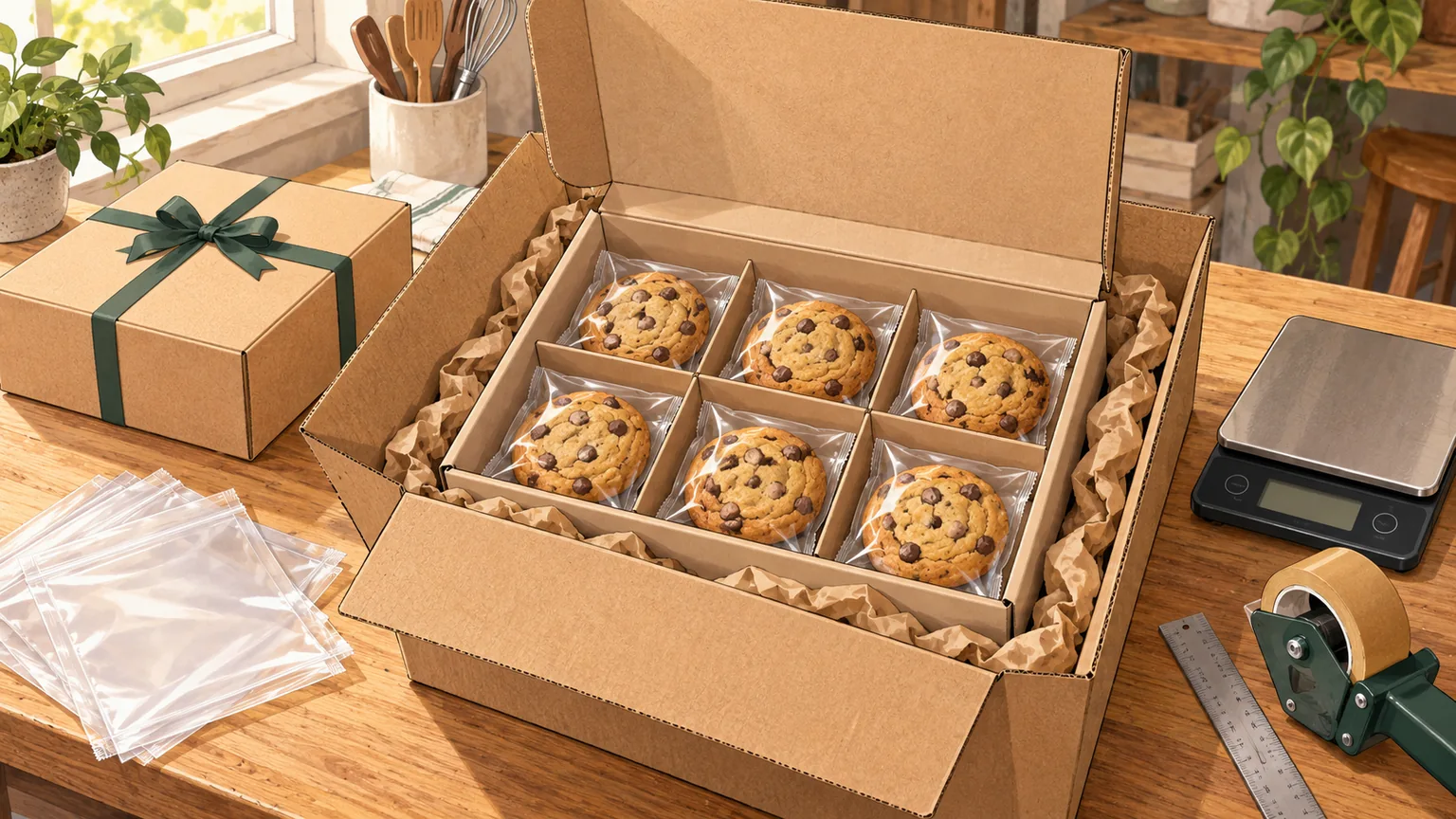
Illustration of a bakery shipping bench: individually sealed cookies in a divided inner box, a cushioned shipping carton, parcel scale and packing tools.
The cookies go in a divided inner box, with cushioning between the inner box and the shipping carton.

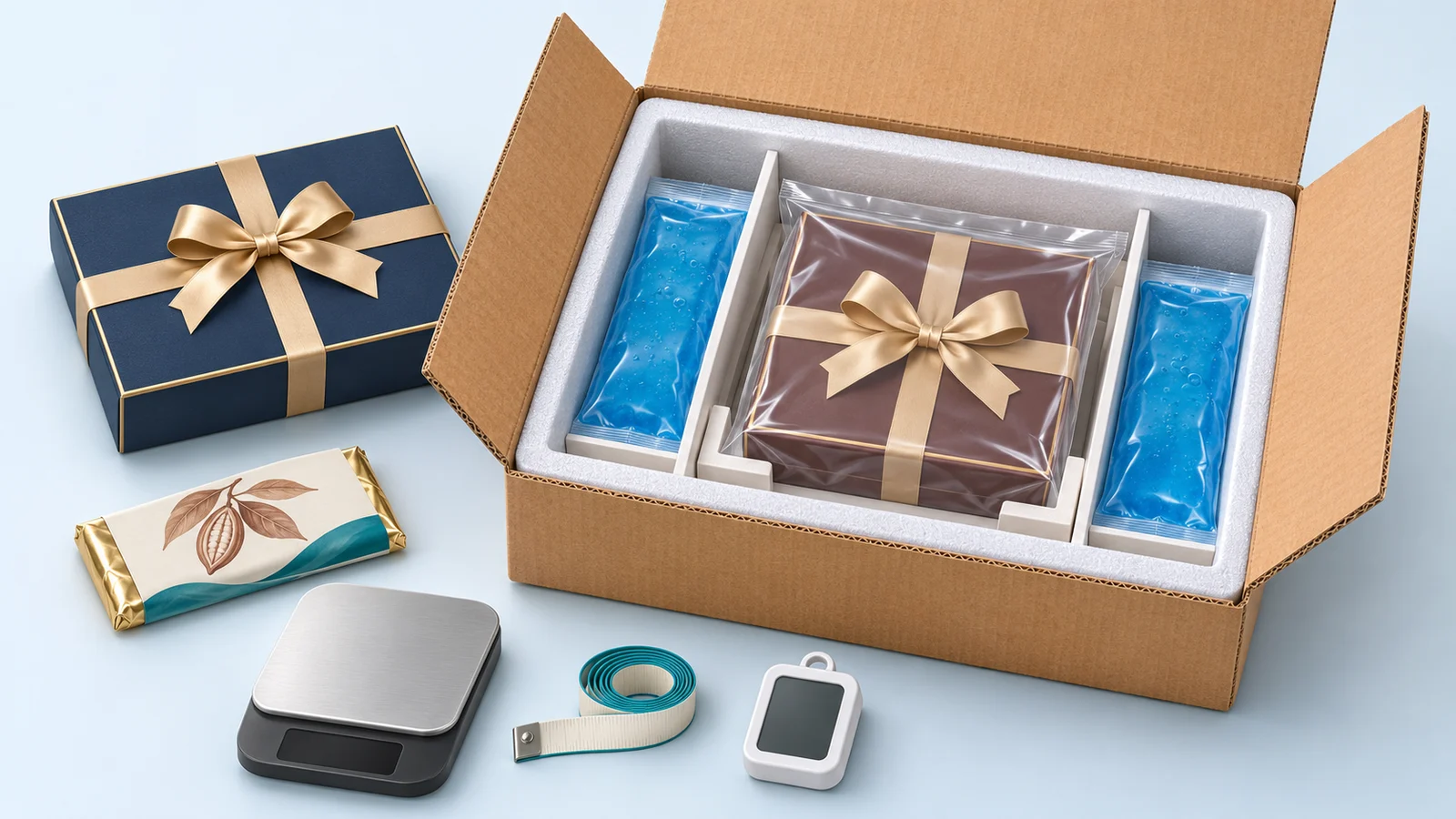
For chocolate bars and gifts, use the chocolate-shipping guide to review bloom, condensation, coolant configuration, exposure windows, and complete cost against the product requirements.

Decide which cookies belong in an ambient shipping process

Start with a SKU shipping record: recipe and process version, storage conditions, packaging specification, safety requirements and a supported quality window under those conditions. A quality window is the period when appearance, texture and flavor meet your specification; it is not a food-safety limit. University of Minnesota Extension distinguishes the two.

Risk screening, not a safety classification by product name
Product typeMain riskValidate before choosing the pack and route
Thin or brittleCracked edges; moisture softeningTest support, seals and intact count; consider smaller separated units
Soft or compressibleSticking; compressionTest support and headroom; do not immobilize by squeezing
Iced, decorated or melt-sensitiveSmearing or melting; formulation may require temperature controlAssess safety separately from heat tolerance; isolate surfaces and restrict routes or seasons
Requires refrigeration or other temperature controlTemperature abuse may affect safetyUse a separate validated temperature-control process

Assess fillings and decorations as part of the finished product; a dry base does not establish that an assembled cookie is shelf-stable. UMN Extension’s frosting and filling guidance addresses components and moisture migration. Ask a food-science extension service or qualified laboratory what formulation, process and testing evidence your product needs.

FDA warns that normal appearance, smell or taste does not establish safety. Shipping feedback evaluates presentation and quality, not pathogens. Home-based sellers should check permitted products, channels, labeling and sales geography with their state and local authorities, as FDA’s business guidance directs. Nationwide carrier coverage does not establish permission to sell nationwide.
How to ship cookies without breaking: build three layers

Give each layer a separate job. FedEx’s cookie guide recommends cooling, separating flavors and textures, and using an inner container with a shipping carton. The following is an ambient packing workflow to validate for your product.

  1. Cool before wrapping. Follow your established cooling process, then pack promptly in a clean area. Trapped warmth can cause condensation and damage texture; prolonged uncovered storage is not the solution.
  2. Food-contact layer: use bags, film or containers suitable for the food, fat content and intended conditions. Obtain supplier specifications and check seal integrity. Keep exposed cookies away from ordinary tissues, bubble wrap and shipping fill.
  3. Restraint layer: fit a tray, insert or divided inner box to the cookies. Support brittle pieces; do not wedge soft ones tightly. Keep decoration clear of lids and stacked loads, with the container structure carrying that load.
  4. Transit layer: cushion and restrain the inner container in a fitted corrugated carton, including underneath and above it. The carton should close without bulging. A gentle tilt should not let the inner box slide freely; restraint must not crush the food.

Use FDA’s food-contact packaging resources when checking material suitability; a seal alone does not establish suitability. UPS’s cookie guidance also emphasizes cooling and an outer shipping box. Treat a decorative gift box as an inner box unless its transit protection has been established.

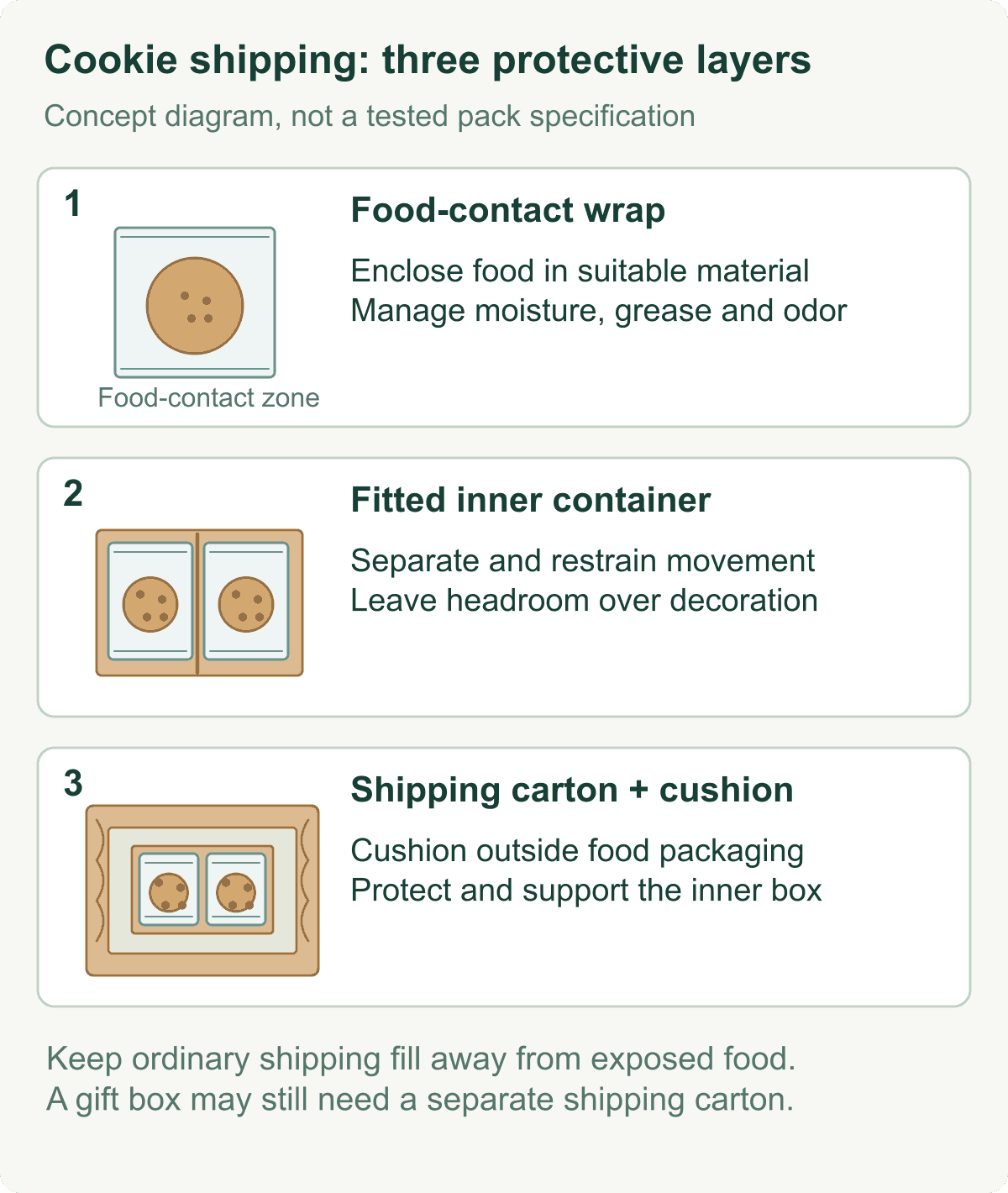
Three cookie-packing layers: sealed food-contact pouches, a divided inner container, and exterior cushioning inside a shipping carton.
Food-contact areas stay separate from ordinary shipping fill; the diagram is not a tested pack specification.

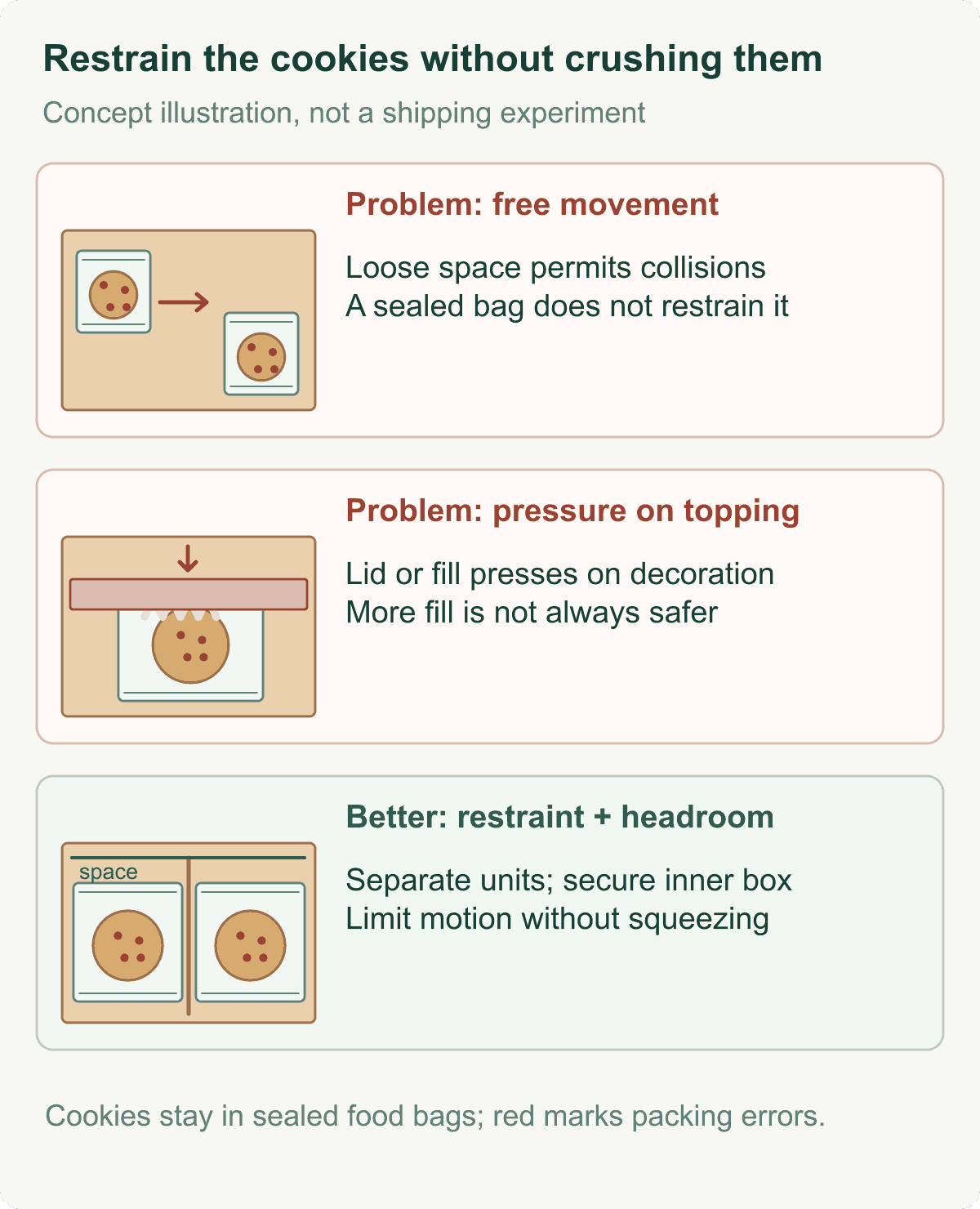
Seal strong flavors, delicate flavors, soft cookies and crisp cookies separately before testing a mixed box. A shared gift box does not supply each product’s moisture barrier, and flavor separation is not an allergen-control plan. Specify material quantities and placement. Remove unneeded space, oversized cartons and decorative weight before removing support. See the box-versus-mailer comparison for the wider packaging trade-off.

Packing-principle comparison: loose sealed cookies, pressure on a decorated surface, and fitted compartments with headroom.
Concept illustration, not a transport experiment: limiting movement is different from compressing the cookies.

Turn the quality window into a dispatch schedule

Verified quality time remaining at packout ≥ wait for handoff + transit + delay buffer + desired buyer enjoyment time. Compare remaining time at packout, not days since order placement. Use the starting point established by your product validation, deducting cooling and holding time already elapsed as applicable.

The wait ends at actual carrier handoff, not label creation. Transit comes from the selected route estimate; the buffer allows for disruption; buyer time protects the remaining customer experience. Convert every term to elapsed calendar days or hours. Carrier business days and the bakery’s operating days may differ.

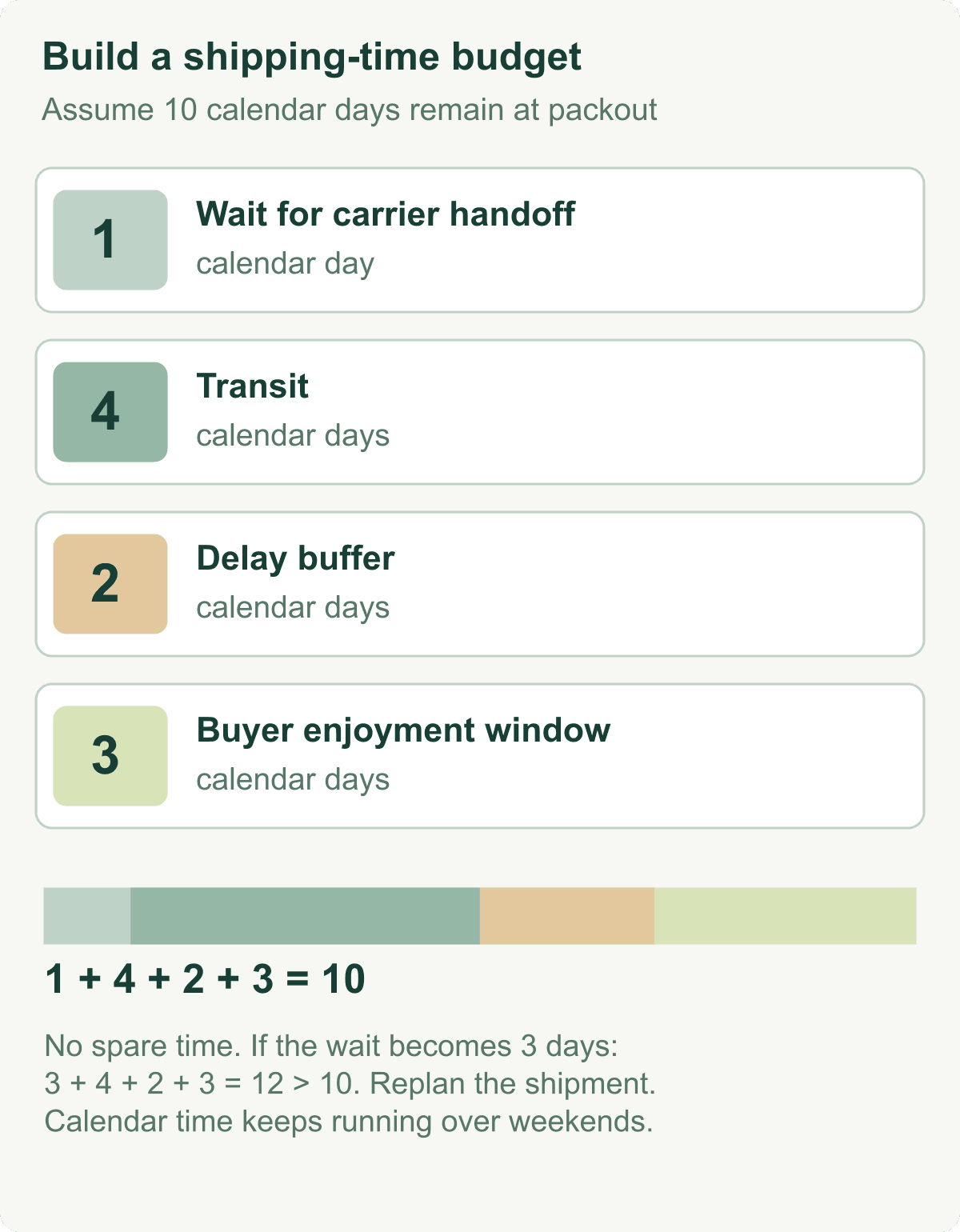
Assumption: a batch suitable for the planned ambient conditions has 10 calendar days of supported quality remaining at packout. Budget 1 day waiting, 4 days transit, 2 days buffer and 3 days for the buyer: 1 + 4 + 2 + 3 = 10, with no spare time. This is operational modeling, not a cookie shelf-life claim or safety validation.

Assumed ten-calendar-day quality budget: one day waiting, four in transit, two for delay and three for the buyer; a three-day wait requires twelve days.
All values are assumptions in calendar days; they do not establish food safety or shelf life.

The normal handoff budget is one day. Now assume Friday packout misses that day’s handoff and the next opportunity is the same time Monday: the actual wait is three calendar days. The requirement becomes 3 + 4 + 2 + 3 = 12, exceeding ten. Replan production, select a tested route that fits, or withhold that destination.

Schedule cutoff time and time zone, dispatch days, weekends and holidays explicitly. Reassess longer routes, remote destinations and heat exposure. Outside validated conditions, pause or use a separately assessed plan; expedited transport is not refrigeration. The shipping-tier and checkout-promise guide separates handling from transit and checkout language.

How much does it cost to ship cookies?

Shipping cost per order = food-contact packaging + inner container + carton + cushion + packing labor + postage and extras + expected after-sale loss. Labor is minutes ÷ 60 × hourly cost. Original product production cost belongs in merchandise cost; this is not the entire order profit calculation.

All weights, dimensions, costs, selling prices and event probabilities below are assumptions, not measurements, carrier rates or EasyShippingX quotes. Assume ZIP 91761 to 10001 and $24/hour labor. Postage represents a hypothetical eligible tracked ambient parcel option, not a named carrier product. Verify eligibility, route, timing and all fees before purchase.

Three recalculable hypothetical orders, not universal postage
Input, USD unless specified6-cookie everyday order12-cookie gift box24-cookie corporate gift
Net cookie weight9 oz18 oz36 oz
Sealed parcel weight20 oz38 oz70 oz
Exterior L × W × H8 × 6 × 4 in10 × 8 × 5 in12 × 10 × 6 in
Food-contact wrap$0.48$0.96$1.92
Inner box and insert$0.55$0.90$1.50
Shipping carton$0.70$0.95$1.30
Cushioning$0.22$0.35$0.55
Material subtotal$1.95$3.16$5.27
Labor$1.20, 3 min$2.00, 5 min$3.20, 8 min
Postage and extras budget$8.00$10.50$14.00
Expected after-sale loss, rounded$0.25$0.43$0.76
Shipping cost per order$11.40$16.09$23.23

Calculate after-sale loss without double counting

Assume mutually exclusive final outcomes: 98.5% no such loss, 0.5% refund only, and 1% full replacement without refund. Assume merchandise sales of $18/$36/$72 and replacement production costs of $4.50/$9/$18. Exclude tax, refunded shipping charges, support labor, recoveries and repeat failures here; add those if applicable. These are not industry loss rates.

For six cookies, reserve = 0.005 × 18 + 0.01 × (4.50 + 1.95 + 1.20 + 8.00) = $0.2465, rounded to $0.25. The other reserves are $0.4266 → $0.43 and $0.7647 → $0.76. Replacement cost excludes another reserve and does not also include a full refund.

A lower label price can lose: assume savings of $0.50 materials and $0.75 postage but four extra packing minutes. Labor adds 4 ÷ 60 × 24 = $1.60, raising net cost $0.35 before after-sale changes. For real quotes, save date, ZIPs, service, sealed weight, exterior dimensions, retail/commercial basis and included/excluded fees. The coffee shipping guide explains why net product weight is insufficient.

Choose the service by eligibility and time before price

Check item acceptance and address coverage, then timing, then total cost. USPS Publication 52 §53 excludes easily decomposing perishables and foods that cannot arrive without spoiling. The ability to generate a label is not acceptance approval for your product.

Service expectations, not shipment promises; remote/offshore exceptions apply
Service referencePublished expectationDecision check
USPS Ground AdvantageTypically 2–5 business days, not guaranteedTranslate the route into elapsed days and test the quality budget
USPS Priority MailTypically 2–3 business days, not guaranteedCheck whether the shorter route estimate fits and earns its premium

The table follows USPS delivery standards; see Ground Advantage and Priority Mail product pages. Check actual tender date, destination and expected arrival rather than assuming a premium tier is faster on every route. For dated gifts, confirm recipient availability and any applicable committed service.

USPS does not provide refrigeration. Faster transport is not temperature control. DMM 609 §4.3 excludes specified deterioration of perishable contents, including freezing, melting and spoilage. Mailability, delivery estimates, insurance and quality are separate checks. UPS and FedEx are packaging references here, not a claim of EasyShippingX label availability. Check regional carriers’ food acceptance, coverage and terms individually.

Test before expanding the sales footprint

Trial the actual product and materials, not a sturdier substitute. Cover short, medium and longer routes, representative dispatch days and seasonal conditions. Define acceptance criteria before shipping: intact count, seal integrity, decoration clearance and your documented quality specification.

Use these fields as a shipping-trial log
Trial-record fieldRecord this
Batch and specificationSKU, lot, bake/pack times, recipe and packaging versions
Finished parcel and routeGross weight, exterior dimensions, ZIPs, service and handoff method
Timing and conditionsActual tender, first scan and arrival; weekends, holidays, weather and known exposure
Physical protectionCarton damage, inner-box movement, broken count and decoration damage, with photos
Seals and qualitySeal integrity, visible condensation/leaks; sensory feedback only when safe to assess
Cost and resolutionActual materials, labor, final postage, refund or replacement, cause and owner
DecisionPass/fail, allowed routes/conditions, next revision and retest

Shipping trials validate packing and fulfillment, not food safety or shelf life. Do not ask recipients to taste products with uncertain safety conditions. For intact but poor-quality cookies, investigate barriers, seals and elapsed time; for breakage, examine support, movement and top load. Re-test after recipe, material or condition changes.

Tell buyers what to expect before checkout

Use matching statements on product pages, checkout, the policy page and order emails. Adapt the shipping policy template to your actual production and dispatch schedule.

  • Separate handling from estimated transit; state cutoff time zone, dispatch days, covered areas and holiday adjustments.
  • Explain weather-related holds, rescheduling and buyer contact without unvalidated freshness or arrival guarantees.
  • Direct damage reports to the bakery with order number, delivery date, batch label and photos of carton, inner pack and cookies. Retain packaging where safe; never require tasting suspect food.
  • Recommended seller workflow: publish your response interval, next-update process and refund/replacement steps. Assign a teammate to investigate shipment exceptions while keeping the buyer updated.

Cookie shipping FAQ

Yes, when the food is mailable, suitably packed and compatible with the route. USPS excludes perishables that cannot arrive without spoiling. Check the product and route before purchasing postage.

Use food-contact wrap, fitted support and separation, then a cushioned shipping carton. Limit free movement without squeezing soft cookies or decorations, and check trial results.

Only after separately packing and testing compatible products. Soft, crisp and strongly flavored cookies may need different barriers and restraint; a shared gift box does not prevent moisture or odor transfer.

No. Choose a service that fits the validated conditions and quality budget; replan production or routing when it does not. Expedited is not temperature-controlled, and an estimate is not a guarantee.

It depends on packed weight, dimensions, ZIPs, service, materials, labor and after-sale costs. The hypothetical 12-cookie order totals $16.09 in shipping-related cost; it is a worked example, not a postage quote.

Confirm sales permissions and product conditions, then test seals, breakage, quality and full cost across representative routes, seasons and dispatch days. Shipping trials do not establish safety, shelf life or nationwide suitability.

Compare options using actual packed specifications

Add approved products, pack specifications and routes to your ecommerce fulfillment workflow. For ongoing parcel volume, use sealed weight, exterior dimensions and origin/destination ZIPs in the EasyShippingX rate calculator to compare applicable enabled channels, then evaluate product conditions, timing and total cost.

Sources and example notes

Packing steps are operational recommendations; time and cost examples are labeled assumptions. Product conditions depend on recipe, process, packaging, environment and validation evidence. Apply carrier terms and purchase eligibility to the actual order.