Online Store Shipping Guide

Shipping Policy Template for US Online Stores: Rates, Delivery Times, and Tracking

A useful shipping policy tells buyers where you deliver, what shipping costs, when the warehouse ships, how long transit is expected to take, and how to get help. A US store using USPS alongside regional carriers can explain that arrangement clearly without listing every internal routing rule. The checkout option must match what fulfillment can actually provide.

The main deliverable is an editable English shipping policy template with filling instructions. Collect warehouse and operations information, select the clauses that fit your destinations, rates and carriers, then check the policy against product pages, checkout and order emails. Within your broader ecommerce shipping setup, this is the step that turns verified fulfillment capabilities into customer-facing wording.

Jump to the English template · Download the editable template and filling notes (TXT)

An online store owner reviews a shipping policy beside a parcel scale, measuring tape and label printer, with delivery vehicles outside the warehouse.
Confirm how parcels actually ship before publishing destinations, prices and timelines

1. Gather the facts before filling the template

Do not copy another store's “free US shipping” statement and ask the warehouse to make it work afterward. Start with an information sheet confirmed by the people who own each decision. A carrier offering a service, your account being able to buy it, and a particular item and address qualifying for it are separate checks.

What to fill in and where to get the information
FieldSource of informationConfirm before publishing
Ship-from locationWarehouse or 3PL fulfillment assignmentsState or region, and whether multiple locations fulfill orders; use the fulfillment location rather than the registered office
Processing timeWarehouse order-release, picking, packing and handoff recordsSeparate in-stock, preorder and made-to-order timelines; review peak-period capacity
Cutoff and time zoneWarehouse calendar and actual carrier collection scheduleSpecify the time and zone; ordering before cutoff does not automatically mean same-day shipment
Destinations and address typesCurrent channel coverage, account eligibility and checkout testsCheck ZIP and parcel eligibility; test the contiguous states, AK/HI, PO Boxes and military mail separately
Rate methodStore rate settings, approved pricing rules and actual parcel quotesFlat, order-based, weight-based or calculated rates; identify oversized-item exceptions
Free-shipping conditionsPromotion rules, discount settings and destination restrictionsCurrency, subtotal before or after discounts, tax exclusions, eligible regions and products
Transit estimateService-specific estimates and comparable handoff-to-delivery recordsStart at carrier handoff; confirm the range for each region and service
Support and follow-upSupport owner, ticket workflow and carrier reporting requirementsContact channel, hours, response target, update cadence and escalation owner

Keep this as an internal worksheet with an owner and review date for each field. The public policy can normally identify the shipping state or region without exposing warehouse street addresses, account rate sheets or internal channel codes. Use the carrier serviceability checklist to verify the services behind those statements.

2. Separate processing time from transit time

Processing time is the store's time to prepare and hand off the order; transit time begins when the carrier collects the parcel. Shopify explicitly separates transit time from order processing time in its shipping settings. A carrier's transit estimate should not become an order-to-delivery promise without adding the handling period. See Shopify's transit-time guidance.

Hypothetical example, not a USPS or regional-carrier service commitment: processing takes 1–2 business days and estimated transit takes 3–5 business days after carrier handoff. Use two separate statements rather than a single “delivery in 3–5 days” claim.

Orders are processed within 1–2 business days. After your order is handed to the carrier, estimated transit time is 3–5 business days.

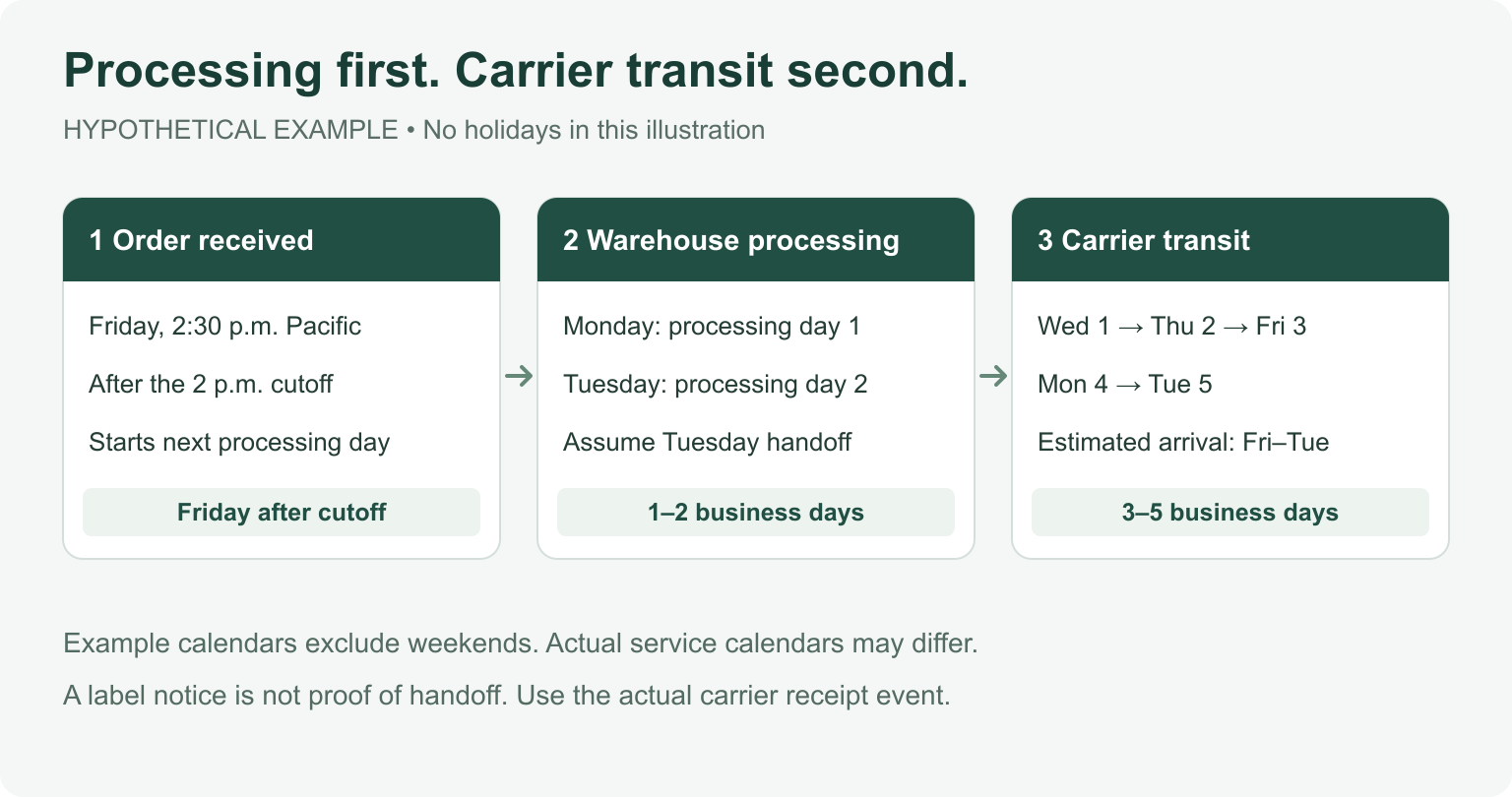
For this example, assume a 2 p.m. Pacific Time cutoff, Monday–Friday processing, and no processing on weekends or published holidays. Eligible orders before cutoff count that day as processing day one; later orders begin on the next processing day. A Friday 2:30 p.m. order starts processing Monday, with Tuesday as day two. If handed off Tuesday, and if this illustrative transit calendar also excludes weekends and starts counting the next business day, transit day three is Friday and day five is the following Tuesday.

Hypothetical timeline: order after Friday cutoff, processing Monday to Tuesday, Tuesday handoff, and estimated delivery Friday through the following Tuesday under the example calendar.
Hypothetical example: apply the processing calendar first, then the selected service's transit calendar

Define which calendar “business days” refers to. Your warehouse may not pack on Saturday even when a selected carrier delivers that day. Do not turn the Monday–Friday convention in this example into a universal carrier rule. Specify a zone such as Pacific Time or America/Los_Angeles and confirm how the store handles daylight saving changes, rather than labeling every cutoff PST throughout the year.

If checkout already displays a delivery date that includes processing, do not add processing again in the confirmation email. Disclose preorder, made-to-order, backorder and holiday schedules before purchase. Use the preorder shipping guide to connect that promise to warehouse release, mixed carts and delay decisions. An expedited shipping option changes the transit portion unless the warehouse also provides faster handling; the wording should say which portion changes.

3. State destinations and special addresses separately

“US shipping” is not a sufficient destination rule. The contiguous 48 states, Alaska and Hawaii, US territories, PO Boxes and APO/FPO/DPO addresses may need different service availability, checkout settings and timeline wording. Explicitly include or exclude Washington, DC rather than leaving buyers to infer it from “48 states.”

  • Contiguous states and DC: identify the standard option and verify any fallback for destinations outside a regional network. A ZIP being reachable through USPS does not make it reachable through every carrier.
  • Alaska and Hawaii: choose supported or unavailable. If supported, enter the relevant rates, services and transit estimates separately. Do not silently extend a contiguous-state free-shipping offer or timeline. Make a separate decision for US territories.
  • PO Boxes: USPS states that only USPS may deliver mail into a PO Box. Separate Street Addressing arrangements at participating Post Offices should not be treated as blanket access to every ordinary PO Box. Confirm the actual shipping path before retaining the clause. See USPS PO Box guidance and our PO Box shipping guide.
  • APO/FPO/DPO: USPS directs shippers to check destination military ZIP restrictions and provide customs declarations when required. Domestic postage does not make ordinary contiguous-state service, item and transit assumptions valid. See USPS military and diplomatic mail guidance and our military-address shipping guide.

The template provides supported and unsupported wording for optional destinations. Retain a clear exclusion when you do not serve an address type, rather than deleting every reference to it. Run representative addresses through checkout to confirm that unavailable services cannot be purchased.

4. Multiple carriers: is the buyer selecting a tier or a service?

Start with the checkout label. For “Standard Shipping,” explain that USPS or a regional carrier may fulfill the tier, with selection based on destination, parcel details and service availability. If checkout names a specific USPS service, fulfillment should honor that selection. A general substitution clause should not override the specific service the buyer purchased.

Our Standard Shipping option may be fulfilled by USPS or a regional parcel carrier. We select the carrier based on the delivery address, package details and service availability. Your shipment confirmation will identify the carrier and include a tracking link for each package.

Use that wording only if your notifications actually identify the carrier and provide package-level links. State the trigger: label creation or carrier handoff. If confirmation is sent at label creation, explain that the notice provides shipment details and that subsequent tracking indicates carrier receipt. Printing a label is not the same event as handing over a parcel.

USPS explains that “Shipping Label Created, USPS Awaiting Item” means a label exists but the parcel has not yet been given to USPS, and directs questions to the shipper. See USPS tracking-status guidance. Our tracking-unavailable guide explains the status in more detail, while the policy should retain an immediate support route.

For named-service checkout, use the alternative clause in the template: ship with the selected service, and contact the buyer if it becomes unavailable to explain the alternative and any timing or price change before proceeding under the agreed arrangement. Keep that decision with the order and update the shipping notice accordingly.

Editable English shipping policy template, with filling instructions

Square brackets are fields to complete, not suggested values. Fill the English clauses below, retain the applicable options, and copy the finished version to your store. Remove filling instructions, conflicting alternatives and unfilled fields before publication. The download contains the same English template and English filling notes for review with your warehouse and support team.

Download English template and filling notes (TXT)

A. Store details and processing

Filling notes: enter the shipping state or region, processing trigger and handling calendar. Choose whether eligible orders before cutoff begin counting that day or the next. Use a support response target your team can meet, rather than a carrier-resolution deadline.

Shipping Policy
Last updated: [DATE]
Store: [STORE_NAME]

We ship orders from [SHIP_FROM_STATE_OR_REGION]. For shipping questions, contact [SUPPORT_EMAIL_OR_CONTACT_URL]. Our support hours are [SUPPORT_HOURS_AND_TIME_ZONE], and our initial response target is [RESPONSE_TIME].

Order processing: In-stock orders are processed within [PROCESSING_RANGE] business days after [PROCESSING_TRIGGER]. Our processing business days are [HANDLING_DAYS], excluding [HOLIDAY_OR_CLOSURE_CALENDAR]. Our order cutoff is [CUTOFF_TIME_AND_TIME_ZONE]. Eligible orders received before cutoff begin processing [SAME_DAY_OR_NEXT_PROCESSING_DAY]. Orders received after cutoff or on a non-processing day begin on the next processing day.

Processing includes preparing, packing and handing your order to the carrier. It does not include carrier transit time. Any different processing schedule for preorder, backorder or made-to-order items is shown [WHERE_DISCLOSED_BEFORE_PURCHASE].

B. Rates, free shipping and transit estimates

Filling notes: choose one rate method, or specify each method's region if you use several. Choose the no-free-shipping version if appropriate. Otherwise complete the threshold, discount treatment, tax treatment and exclusions. Add a transit line for each service rather than reusing a standard range for expedited or special-address shipments.

Shipping charges: [KEEP ONE RATE CLAUSE BELOW, OR LABEL EACH APPLICABLE REGION.]

[FLAT RATE] Standard Shipping costs [AMOUNT_AND_CURRENCY] per [ORDER_OR_SHIPMENT] to [ELIGIBLE_REGION]. [OTHER_RATE_EXCEPTIONS].

[TIERED RATE] Shipping charges are based on [ORDER_VALUE_OR_PACKED_WEIGHT] under [RATE_TABLE_OR_LINK]. The applicable charge is shown at checkout before payment.

[CALCULATED RATE] Shipping charges are calculated at checkout using [ACTUAL_CHECKOUT_INPUTS]. Available options and the shipping charge are shown before payment.

Free shipping: [KEEP ONE.] We offer free [SERVICE_TIER] shipping to [ELIGIBLE_REGION] on orders with a qualifying merchandise subtotal of [THRESHOLD_AND_CURRENCY], measured [BEFORE_OR_AFTER_DISCOUNTS] and excluding [TAX_SHIPPING_AND_OTHER_EXCLUSIONS]. [PRODUCT_AND_ADDRESS_EXCLUSIONS]. / We do not currently offer free shipping.

Estimated transit after carrier handoff: [SERVICE_TIER] to [REGION_OR_ADDRESS_TYPE]: [TRANSIT_RANGE] [BUSINESS_OR_CALENDAR] days. Transit days follow [SERVICE_CALENDAR_OR_CLEAR_DESCRIPTION]. [ADD_A_LINE_FOR_EACH_ADDITIONAL_SERVICE_OR_REGION]. Processing time is additional unless a displayed delivery date expressly includes it.

Delivery dates are estimates unless an option explicitly states a guarantee and its terms. Weather, service interruptions or other transit exceptions may affect delivery. If your order is delayed, contact us through the steps below so we can check its status and explain the available next steps.

C. Optional destination and special-address clauses

Filling notes: choose supported or unsupported for each line. If supported, complete the actual service, rate and timing details, and disclose any eligibility conditions. Verify item and ZIP eligibility before offering military mail. State the position on DC, US territories and international destinations explicitly.

Contiguous United States: We ship eligible orders to [SUPPORTED_CONTIGUOUS_STATES_OR_THE_CONTIGUOUS_48_STATES]. Washington, DC is [INCLUDED_OR_EXCLUDED]. [ANY_ITEM_OR_ADDRESS_RESTRICTIONS].

Alaska and Hawaii: [SUPPORTED] We ship eligible orders to Alaska and Hawaii using [AVAILABLE_SERVICE]. Applicable charges and estimated transit are [RATE_AND_TIMING_DETAILS_OR_WHERE_SHOWN_BEFORE_PAYMENT]. [FREE_SHIPPING_ELIGIBILITY]. / [NOT SUPPORTED] We do not currently ship to Alaska or Hawaii.

PO Boxes: [SUPPORTED] We accept eligible PO Box orders using [VERIFIED_USPS_SERVICE_OR_SHIPPING_PATH]. [CHECKOUT_SELECTION_INSTRUCTIONS_AND_ANY_LIMITS]. / [NOT SUPPORTED] We do not currently ship to PO Boxes. Please use an eligible street address.

APO/FPO/DPO: [SUPPORTED] We accept eligible APO/FPO/DPO orders through [VERIFIED_POSTAL_SERVICE], subject to destination ZIP and item restrictions. Complete military or diplomatic address details are required. [RATE_AND_TIMING_DETAILS_OR_WHERE_SHOWN_BEFORE_PAYMENT]. The contiguous-state transit estimate does not apply. / [NOT SUPPORTED] We do not currently ship to APO/FPO/DPO addresses.

US territories and international destinations: [SUPPORTED_DESTINATIONS_AND_SEPARATE_TERMS_OR_CLEAR_EXCLUSION].

D. Carrier selection, tracking and split shipments

Filling notes: select the carrier clause that matches checkout. If you offer generic tiers and named services, label which clause applies to each. Match the notification trigger to the system and complete the split-shipment charge rule, with any charge disclosed before payment.

[GENERIC SHIPPING TIER] Our [SERVICE_TIER] option may be fulfilled by USPS or a regional parcel carrier. We select the carrier based on the delivery address, package details and service availability. This option does not let you choose a specific carrier.

[NAMED SERVICE AT CHECKOUT] If you select a specific carrier service at checkout, we ship using that service. If it becomes unavailable, we contact you before shipment to explain the alternative, any timing or price change, and the available cancellation or refund options.

Shipment confirmation: We send a shipping email when [ACTUAL_NOTIFICATION_TRIGGER]. It identifies the carrier and tracking link for each package. If sent at label creation, this notice does not confirm carrier receipt; tracking will show subsequent carrier updates.

Split shipments: [SPLIT_SHIPMENT_RULE]. If your order ships in multiple packages, we identify the items and tracking link for each package in [EMAIL_OR_ORDER_STATUS_PAGE]. Packages may arrive on different days. [EXTRA_SHIPPING_CHARGE_RULE_AS_DISCLOSED_BEFORE_PAYMENT].

E. Exceptions: contact, information and the next update

Filling notes: name the store's support channel, the threshold for reporting stale tracking, the initial response target and the follow-up cadence. These are store settings rather than universal carrier deadlines. Encourage prompt damage reports without using a store reporting window to limit applicable consumer rights or replace carrier claim requirements.

Address changes: Contact [SUPPORT_CHANNEL] as soon as possible with your order number and complete corrected address. We confirm whether the order can still be changed before carrier handoff. After handoff, we check the available carrier options, any fee and your approval before requesting a change. A request does not guarantee that an address can be changed.

Tracking has not updated: Check the carrier link and contact [SUPPORT_CHANNEL] if [STORE_TRACKING_CONTACT_THRESHOLD]. Include your order number, tracking number and the last visible status and date. We check warehouse handoff records and contact the carrier when appropriate. We reply within [INITIAL_RESPONSE_TARGET] and provide the next update within [FOLLOW_UP_INTERVAL], even if the investigation remains open.

Damaged parcel or missing contents: Contact [SUPPORT_CHANNEL] promptly with your order number, tracking number, a description of the issue, and photos of the outer package, label, internal packaging and affected items. Keep the packaging and items for possible inspection. We review the evidence, explain any further information needed and the available replacement or refund steps, and provide an update within [FOLLOW_UP_INTERVAL].

Package not received: Check the delivery address, all package links and any carrier delivery notice. If tracking shows delivered, check safe places and with household members or building staff, if applicable. If you still cannot locate it, or an undelivered parcel is past its estimated window, contact [SUPPORT_CHANNEL] with your order number, tracking number and relevant details. We open a support case, review the delivery information and coordinate the carrier inquiry where appropriate. We tell you the case reference, next update date and available resolution options. You may reply to the same case for progress.

Orders delayed before shipment: If we cannot ship within the stated processing period, we notify you, explain the revised shipment timing or that it is unknown, and provide the applicable options to agree to the delay or cancel for a prompt refund. We obtain any consent required for the delay. If we cannot fulfill the order, we notify you and issue the applicable refund.

Returns and refunds: [RETURNS_AND_REFUNDS_POLICY_URL]. Nothing in this policy limits your applicable consumer rights.

5. Make exception handling an executable workflow

“We are not responsible after shipping” gives neither the buyer an action nor support a follow-up obligation. Use a consistent path: buyer contacts the store → supplies the relevant information → store checks the order and handoff records → carrier inquiry if needed → next update and available resolution. An open carrier investigation does not prevent support from explaining what has been checked and when it will report back.

  • Address changes: establish whether handoff has occurred, confirm available changes and obtain approval for any fee before requesting one. Receipt of an email does not guarantee interception.
  • Split shipments: identify each package's items, tracking link and outstanding items. One delivered box does not establish that the entire order arrived. See the split-shipment guide.
  • Stale tracking: distinguish no handoff, handoff awaiting a scan, and no new scan during transit. Do not explain every case as a system delay; use actual handoff records to decide the next action.
  • Damage or missing contents: ask the buyer to retain items and inner and outer packaging and collect photos. USPS claims have service-specific eligibility, evidence and filing periods. Keep the store's customer resolution process distinct from carrier reimbursement. See USPS domestic claims guidance.
  • Package not received: check split-package status and the address, then review delivery evidence or the carrier's missing-parcel process. A search request and an insurance claim are different processes. Keep a store support case open instead of permanently redirecting the buyer to the carrier. See USPS missing-mail guidance.

Separate a delay before shipment from a delay in transit. FTC guidance requires a reasonable basis for shipment promises and explains delay notices, customer choices and refund obligations when an order cannot ship as promised. A general “estimates only” statement does not replace an order-specific delay notice or the applicable consent process. The template preserves that workflow; see the FTC business guide for the full requirements.

Set an initial response target and update cadence the support team can meet, with a named escalation owner internally. Do not turn “we will respond” into “the carrier will resolve it by then,” or promise automatic replacement or carrier reimbursement in every case.

Attachment: the pre-publication consistency checklist

Walk through an ordinary order, baskets on either side of the free-shipping threshold, special destinations and a split order. Check the buyer's full journey rather than proofreading only the policy page.

Compare the policy, product page, checkout and order emails
CheckWhat must agree before publication
□ Shipping chargesThe policy's rate method, product-page promotion, checkout charge and email amount agree; ordinary shipping charges are disclosed before payment
□ Free shippingThreshold, currency, discount treatment, region and item exclusions match banners, cart, checkout and emails
□ Timeline meaning“Ships by” does not become “arrives by” in emails; processing and transit remain separate; delivery dates do not double-count handling
□ Cutoff and calendarTime zone, daylight saving, weekends, holidays and preorder timing match warehouse operations and checkout dates
□ Destinations and addressesPolicy and checkout agree for contiguous states, DC, AK/HI, territories, PO Boxes and military mail; unsupported services cannot be purchased
□ Service namesGeneric tiers and named services are distinguished; the order, warehouse instruction and shipping email reflect the same choice
□ Tracking and splitsThe email trigger matches the policy; each package has a carrier, tracking link and item list; split fees are disclosed
□ Support and versionThe contact channel works and support knows its response and update targets; remove every unfilled field and conflicting option; record the effective policy version

After publication, review the policy when a warehouse moves, collection schedules change, regional coverage changes, or shipping prices and promotions change. Update disclosures before new purchases and handle existing orders under their original promises and the applicable change process. Silently editing the policy does not communicate a delay on an existing order.

Shipping policy template FAQ

Include the ship-from region, processing time, cutoff and time zone, destinations, rates and free-shipping conditions, estimated transit after handoff, carrier and tracking notices, and support steps for address changes, splits, stale tracking, damage and packages not received. Align it with product pages, checkout and emails.

No. Processing covers preparation and handoff; transit starts when the carrier receives the parcel. An overall delivery estimate must account for both calendars. Do not add handling again if checkout already displays an inclusive delivery date.

For a generic Standard Shipping tier, explain that USPS or a regional carrier may fulfill it, how selection works and when the buyer receives the carrier and tracking number. Honor a named checkout service; if unavailable, explain the alternative and any timing or price change before proceeding.

Do not assume so. Confirm the actual service, address type, destination ZIP and item eligibility, then retain an explicit supported or unsupported clause. State the position on AK/HI, DC and US territories as well.

First define whether the range includes processing, whether it uses business or calendar days, and which destinations and services it covers. This guide's 1–2 processing business days plus 3–5 transit business days is a hypothetical example, not a carrier estimate to copy.

Label creation alone does not establish handoff. USPS distinguishes that status from receiving the parcel. State when your notice is sent and have support check actual handoff records. See USPS tracking-status guidance.

Verify actual parcels before choosing shipping options and policy wording

Before writing the policy, pack representative orders and record actual packed weight, outer dimensions, origin ZIP and destination ZIP. Then check available services and quotes. Verify contiguous-state, AK/HI and special-address scenarios separately; a quote for an ordinary street address does not establish eligibility for a PO Box or military address.

Use the EasyShippingX USPS and regional shipping rate calculator to review returned services and quotes, then confirm account access, item eligibility, warehouse handling and actual lane performance before deciding what the store offers. Check service availability and pricing with common parcels' actual packed weight, dimensions and destination ZIPs, then use those results to define your checkout options and policy. Transit estimates do not supply your warehouse's processing time, and one quote is not a delivery guarantee for every order.

Sources and example methodology

The 1–2 processing business days, 3–5 transit business days, 2 p.m. cutoff and Friday-order timeline are hypothetical examples, not carrier standards or store commitments. The template, field table and checklist are editorial recommendations to complete using the merchant's verified settings and operating capabilities.