Shipping and Addressing Guide

Shipping to APO, FPO, and DPO Addresses: A US Seller's Guide

An order lands with an address that reads APO AE 09021. Your checkout counts it as a United States address, the rate engine quotes domestic postage, and nothing looks wrong. Then the label screen asks for a customs declaration, and the order sits in the queue while someone works out which step broke.

Nothing broke. That is how military and diplomatic mail is built: addressed and priced as domestic, but carried into another country's customs territory. USPS states that mail to an APO, FPO or DPO address pays domestic prices (Military and Diplomatic Mail), while the same pieces fall under the customs and destination rules in DMM 703. Both statements hold at once, and the job is not to pick one but to put each rule in its right place.

Short answer. Enter United States as the country, APO, FPO or DPO as the city, AA, AE or AP as the state, and the military ZIP code. If the parcel contains goods, a computer-generated customs declaration is required no matter how light it is. Before you buy the label, run that military ZIP through the restrictions lookup, because eligibility belongs to the specific post office, not to the fact that the address says United States. The whole chain sits inside ecommerce shipping solutions, and it belongs to the same family as carrier rules for shipping to a PO box: the address format decides which network carries the parcel.

Packing bench illustration: a taped kraft box with a printed label, a folded olive t-shirt, a pale green customs form and a pen on one workbench.
Domestic postage, foreign customs: both at once

Address fields, one line at a time

USPS asks for the recipient's name and rank, the unit and box line, the APO, FPO or DPO designator, the two-letter state code and the military ZIP. It also asks you to do the opposite of what most address forms train you to do: leave the host city and country out entirely, so the piece does not enter a foreign mail network (USPS; DMM 703).

The three designators are not interchangeable. Army and Air Force personnel are served through an Army Post Office, Navy and Marine Corps personnel through a Fleet Post Office, and diplomatic posts through a Diplomatic Post Office; all three are branches of the U.S. postal system operating overseas rather than foreign post offices (DMM 703). What they share is the addressing convention, and that is where orders go wrong.

Field Enter this Do not enter this
NameRank plus full name, or a job title such as "Commander""Any Service Member", nicknames, a first name alone
Address line 1The unit line: PSC, UNIT, CMR, OPC or UPR number, then the box numberThe base's street address in the host country
CityAPO, FPO or DPOThe host city (Kuwait City, Seoul, Ramstein) or a base name
StateAA, AE or APThe host province, or a substituted U.S. state such as NY or CA
ZIPThe military ZIP code, or ZIP+4 where the buyer supplies itA local postal code from the host country
CountryUnited StatesThe host country (Germany, Japan, Kuwait)

The three state codes are not decoration. They carry geographic meaning and map to specific ZIP prefixes: AA for Armed Forces Americas with prefix 340, AE for Armed Forces Europe, the Middle East, Africa and Canada with prefixes 090 through 098, and AP for Armed Forces Pacific with prefixes 962 through 966 (DMM 703). Publication 28 states the same rule from the addressing side: AA covers the Americas excluding Canada, AE covers Europe, the Middle East, Africa and Canada, and AP covers the Pacific.

Three correctly built addresses, as USPS publishes them (USPS):

TypeCorrect format
APOPFC JOHN DOE
PSC 3 BOX 4120
APO AE 09021
FPOSEAMAN JOSEPH SMITH
UNIT 100100 BOX 4120
FPO AP 96691
DPOJOHN ADAMS
UNIT 8400 BOX 0000
DPO AE 09498-0048

Two details in that format are easy to miss. The recipient must be a specific person or a job title, so "Any Service Member" and similar wording is prohibited (DMM 703). And USPS asks for the nine-digit ZIP code on military shipments, plus a return address on every piece (USPS).

Two expensive mistakes, and the DPO dimension line

Add the host city and the domestic rate disappears

If the foreign city and country appear in the address alongside the APO, FPO or DPO designator, the piece is treated as international mail and charged international postage under international conditions (DMM 703). That is not a technicality, it is the postal service refusing to guess which network should carry your parcel. For a seller, one extra city name is an unplanned international rate on an order that was priced as domestic.

The seller-side bug is quieter. Many checkout validators reject AA, AE or AP because they are not real states, so a developer maps AE to New York or AP to California to get the order through. The result is a label that no longer matches the format USPS specifies (Publication 28), for a ZIP code that belongs to a military post office overseas. If your platform cannot store the three codes as first-class values, fix the platform rather than laundering them into state names. The wider trade-off is covered in evaluating an address validation API.

The DPO size cap and prohibited list

The size rule belongs in this section because it changes packaging, not just data entry: Department of State mail to a DPO destination is capped at 27 inches long, 14 inches wide and 14 inches high (DMM 703). The DPO rulebook also carries a prohibited list that catches ordinary gift inventory: liquids, aerosols, glass containers, fragile materials, seeds, plants, animals, and weapons or anything that resembles one, toy guns included (DMM 703; 14 FAM 760). A box that passes your normal size rules can still be ineligible, and a children's toy set can be refused for its shape rather than for what is inside it.

Does an 8 oz t-shirt need a customs declaration?

Take a single cotton t-shirt. Packed, it weighs 8 ounces. Destination: APO AE. Postage: domestic. Declaration: still required. The rule is written in two parts, and the second part is the one sellers miss. For mail to or from APO, FPO and DPO locations, USPS requires a computer-generated PS Form 2976 (the CN 22 customs declaration) or, if the mailer prefers, PS Form 2976-A (the CP 72 dispatch note), when either condition applies: the piece weighs 16 ounces or more regardless of contents, value, shape or mail class, or the piece contains goods regardless of weight, shape or mail class. Only items under 16 ounces that contain no goods escape the form (DMM 703). USPS's own customs guidance says the same from the other side: all items addressed to or from overseas military and diplomatic post offices require a customs declaration, with limited exceptions (USPS customs forms basics).

So the 16-ounce number is not a small-merchandise exemption. It is a second trigger aimed at documents and other non-goods. A t-shirt satisfies the goods condition at a packed weight of 8 ounces, and it would at 2 ounces as well.

Situation Weight Customs declaration?
One t-shirt, no documents8 ozYes, contains goods
Birthday card with nothing insideunder 16 ozNo
Card with a gift card tucked insideunder 16 ozYes, the gift card is goods with a value
Printed manual, no merchandise2 lbYes, the 16 oz trigger
Any Priority Mail Express Military Service parcelany weightYes, PS Form 2976-B regardless of weight, value or contents

The form has to come out of a computer

A handwritten declaration is not a finished transaction. Items bearing a handwritten customs form, a form that was not computer generated, or a form paid for with postage stamps alone must be presented to a postal employee at a retail counter, and pieces presented improperly are returned to the sender (DMM 703). For an ecommerce operation the meaning is blunt: the customs data has to come from your label software, whether that is Click-N-Ship, a PC Postage vendor or an API. A stack of green forms and a pen is not a shipping process, and a stamp-paid parcel with a form dropped into a collection box is a parcel that comes back.

Priority Mail Express Military Service is the other exception worth knowing before it appears in a cart. Every PMEMS piece needs a computer-generated PS Form 2976-B no matter how light it is, the service only reaches designated APO and FPO ZIP codes, it is not available between APO and FPO destinations, and its scheduled delivery date is fixed at the time of mailing rather than at checkout (DMM 703). That last point explains why a checkout page should never quote a PMEMS arrival date.

Foreign customs authorities use the form to clear mail for entry and, where applicable, to assess duty and taxes (USPS customs forms), and current USPS forms ask for detailed package descriptions (USPS). Write what the item is in words a stranger could match against the contents, then quantity, declared value and weight. If you are shipping merchandise, do not write "gift" as the description; describe the shirt. A reshipment of a replacement item is still goods. Who pays duty, and how DDP differs from DAP, is covered in DDP versus DAP.

Check the destination before you choose a service

Two questions decide whether a military order is shippable, and they are separate. First, what will this particular military post office accept? Second, which USPS service can carry it there? The first question has an official entry point: USPS publishes an APO/FPO/DPO restrictions lookup that takes the ZIP code and the date you plan to mail (APO/FPO/DPO Restrictions). The lookup is backed by the "Overseas Military/Diplomatic Mail" section of the Postal Bulletin, which carries the full restriction list as well as conditions set by the Department of Defense (USPS; DMM 703). Restrictions cover content, preparation and handling, and they draw on several rulebooks at once: the International Mail Manual's hazardous materials rules, DMM 601, Publication 52, and the Defense Department's own conditions (DMM 703).

This is why "it ships fine to Texas" proves nothing. USPS states plainly that hand sanitizer and flammable sanitizing wipes may not be shipped overseas (USPS). A gift set built around a scented candle and a sanitizer bottle can be a clean domestic shipment and a refused overseas military one in the same week. Weight and size add their own ceilings: Priority Mail and its Flat Rate packaging cap at 70 pounds (DMM 123), and the DPO limit of 27 by 14 by 14 inches applies on top of that (DMM 703).

Flat Rate deserves a note because sellers either use it blindly or avoid it without reason. Small and Medium Flat Rate Boxes are eligible for APO, FPO and DPO destinations. The Large Flat Rate Box is a domestic product, with one exception: the military version marked "AmericaSupportsYou.mil" is priced lower than the conventional domestic Large Flat Rate Box, and if you use that box for a non-military address, the normal domestic or international Large Flat Rate price applies (DMM 123). The discount is tied to the destination, not to the cardboard.

There is also an operational rule that surprises anyone running a 3PL handoff. Military post offices do not verify and accept bulk or commercial mail; those mailings have to be deposited at a regular U.S. Post Office with postage affixed to each individually addressed piece (DMM 703). Parcels that carry a computer-generated customs form and postage paid by something other than stamps can go into a collection box, a lobby drop, a Contract Postal Unit or a scheduled pickup (DMM 703), which is where a seller's normal carrier handoff fits. The checks around that step sit in the carrier handoff checklist.

Run this list before you buy the label

CheckPass condition
ZIP resolves as a military ZIPThe restrictions lookup returns the post office and its conditions
Address formatAPO, FPO or DPO as city; AA, AE or AP as state; military ZIP; no host city or country
ContentsAllowed for that ZIP on that mailing date, including hazmat and perishables
Weight and sizeWithin 70 lb, and within the DPO limit of 27 x 14 x 14 inches where it applies
Customs dataDescription, quantity, declared value and weight, computer generated
Service choiceThe service you picked is eligible for that ZIP, not just for "US addresses"
Return addressPresent on the label, with a spare copy of both addresses inside the box
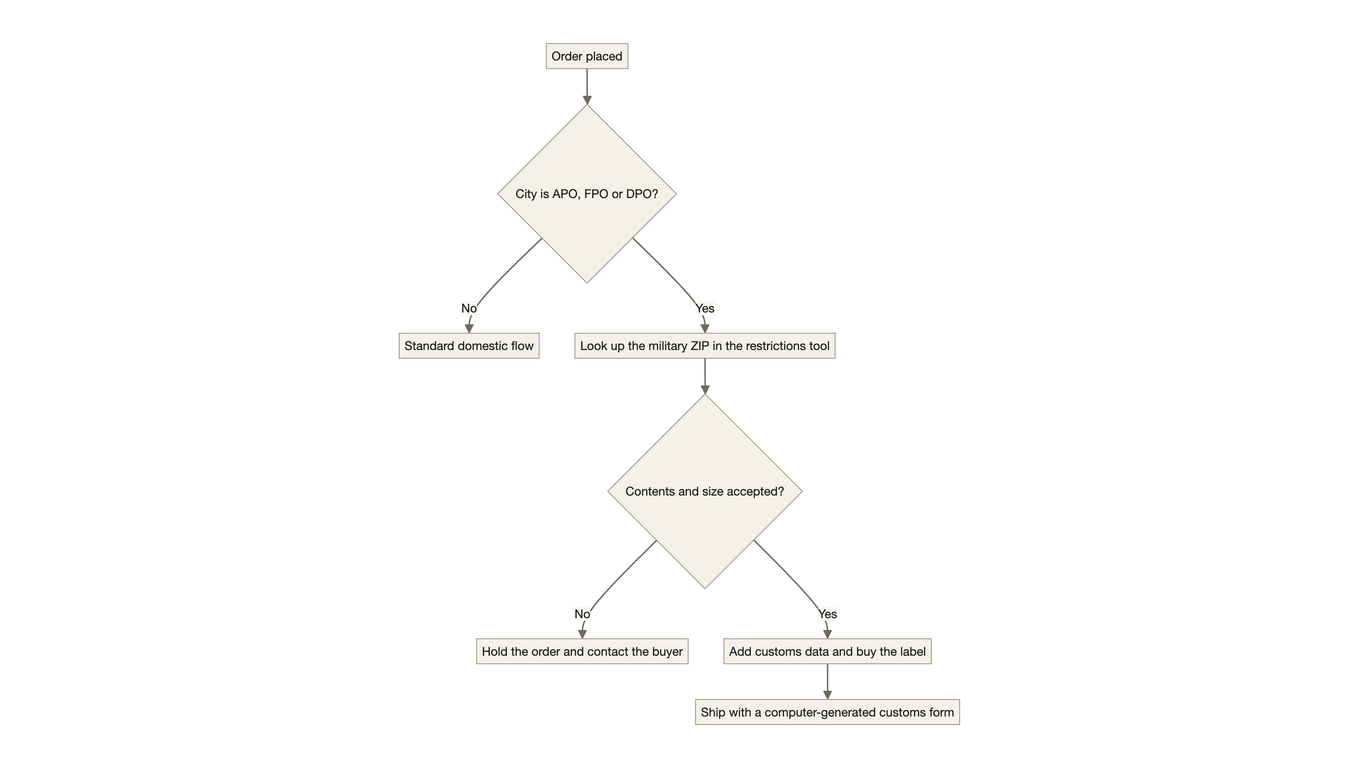
Decision flowchart: an order arrives, the city field is checked for APO, FPO or DPO, then the military ZIP is looked up in the restrictions tool, and only an accepted content and size set proceeds to customs data and a label while a refusal holds the order
A military order is two extra checks inside the flow you already run

What to say at checkout and in support

Delivery promises break more trust on military orders than anywhere else, and the break is almost always a copy problem, not a carrier problem. Separate the two clocks first. Processing time is yours: pick, pack, declare, hand off. Transit time belongs to the postal system, and USPS describes it in expectations rather than commitments. Ground Advantage is quoted as expected delivery in 2 to 5 days, and Priority Mail at 2 to 3 days (USPS Ground Advantage; DMM 123). USPS's refund policy attaches a money-back delivery guarantee to Priority Mail Express and not to Priority Mail or Ground Advantage, so those two numbers are service standards rather than promises (USPS refunds).

Two more layers sit on top. USPS's own footnote on the Ground Advantage page says packages going to certain places, including offshore destinations, or containing hazardous materials may receive slower service (USPS Ground Advantage). Military mail adds one more leg: the piece is delivered to the military post office, which hands it to the unit's mail clerk for final delivery (DMM 703). Put those two together and a date promise copied from your domestic template has nothing to stand on.

Three pieces of copy cover most of it, and they can be pasted as written.

At checkout:

APO, FPO and DPO orders ship at domestic rates but require a customs declaration. Enter APO, FPO or DPO as the city, AA, AE or AP as the state, and the military ZIP code. Please do not enter the base's host country or city.

On the product page or delivery estimate:

Military addresses: transit time depends on the destination post office and customs review. We show our processing time and the U.S. leg of the journey, not a guaranteed delivery date.

Support macro for a "where is my order" ticket:

Your parcel is moving through the U.S. postal network to the military post office that serves your unit. Tracking can pause for several days at that handoff. If the address included a unit and box number, please confirm both so we can check the label.

Two habits keep that copy honest. Exclude military orders from guaranteed-delivery badges and date-specific promotions rather than quietly hoping the deadline holds. And treat a military order as a destination question first and a speed question second, because the buyer usually cares more about the parcel arriving at all than about two days.

Where this fits in a normal shipping workflow

Military orders do not need a separate channel. They need three extra checks inside the one you already run: confirm the destination ZIP and what that post office accepts, collect the customs data the label requires, and only then compare the USPS services that are actually eligible. Keep the addressing question separate from the difference between residential and commercial addresses, because a military address is neither: it is a third type.

In EasyShippingX that takes this shape. A military order arrives from the same source as any other, the destination ZIP and its restrictions are verified before a rate is chosen, customs fields are filled from the order data, eligible USPS options are compared, and the label prints with a computer-generated customs form. The difference between an APO parcel and a residential one is a handful of validation rules and a declaration, not a second shipping system.

Frequently asked questions

United States. An APO, FPO or DPO address is an extension of the U.S. postal system overseas: it is addressed as a domestic address and priced at domestic postage. Put APO, FPO or DPO in the city field, AA, AE or AP in the state field, and the military ZIP in the postal code field. Add the host city or country and the piece is treated as international mail and charged international postage. The country field is a separate decision from whether the contents need a customs declaration.
Yes, as long as it contains goods. Mail to APO, FPO and DPO addresses has two independent triggers: the piece weighs 16 ounces or more regardless of contents, or it contains goods regardless of weight. A t-shirt that packs to 8 ounces satisfies the second, so a computer-generated PS Form 2976 or 2976-A is required. Only items under 16 ounces with no goods, such as an empty greeting card, escape the form. Handwritten forms and stamp-paid pieces have to be presented at a retail counter, and improper presentment means the parcel comes back.
The answer belongs to the specific military ZIP code, not to the name of the service. Run that ZIP and your intended mailing date through the USPS APO/FPO/DPO restrictions lookup to confirm the post office accepts your contents and size, then confirm the service you picked is eligible for that ZIP. Just as important: military post offices do not verify or accept bulk or commercial mail, which has to be deposited at a regular U.S. Post Office with postage affixed to each piece. Parcels with a computer-generated customs form and postage paid by other than stamps can go into a collection box, a lobby drop or a scheduled pickup.
The piece is treated as international mail and charged international postage under international conditions, so an order priced at domestic rates picks up a difference nobody budgeted for. That rule is written in DMM 703, and it explains why an address validator should never map AE to New York or AP to California just to pass validation: the resulting label no longer matches the format USPS specifies. If the platform cannot store AA, AE and AP, fix the platform.

Three checks before you label a military order

Nothing in this method needs another system; what it needs is three gates in the flow: verify the ZIP and the address format, look up the destination restrictions for that ZIP, then fill the customs data and confirm the chosen service is eligible for that ZIP. In EasyShippingX the order runs in that sequence: enter the address and parcel data, verify the destination ZIP and its restrictions, fill the customs fields, compare the available channels, then execute through the Portal, a spreadsheet import, or the API if you want it inside your own system.