USPS Domestic Mail · Non-Contiguous Destinations

USPS Shipping to Puerto Rico: Costs, Address Formats, Delivery Times, and Customs Requirements

On a Friday afternoon an order lands in the back office: the delivery address is in San Juan and the state field says PR. Three questions arrive with it. Can this ship as domestic mail? What is the URB line in the address, and can it be deleted? Are the cost and the delivery window the same as shipping to Florida? The starting point is unglamorous: look up which zone your origin ZIP and a 006, 007 or 009 destination ZIP produce (USPS domestic zone chart), because every conclusion in this guide starts from that cell.

Direct answer: Puerto Rico is domestic mail inside the United States postal system. There is no customs form and no import clearance, but postage is priced in the highest domestic zone band, the address has to follow the dedicated Puerto Rico field order in Publication 28, and since October 1, 2026 the USPS service expectation for surface service to non-contiguous destinations has been extended, so the gap between Ground Advantage and Priority Mail is no longer a day or two.

Editorial illustration seen slightly from above: an ecommerce packing desk with an order card marked PR at the edge of a screen, a small bench scale, a labeled box, a roll of tape and a pen, with only the hand holding the pen in frame, black ink linework with a single orange accent and a faint paper grain.
Three questions, one fixed order: destination and address, then eligibility, then the money

1. Is Puerto Rico domestic or international mail

USPS treats Puerto Rico as domestic mail: a parcel to PR moves on the domestic network, needs no CN22 or CP72 customs document, does not enter CBP import clearance, and does not attract import duty. The correct label fields are country United States, state PR, and a ZIP beginning 006, 007 or 009. Writing Puerto Rico in the country field pushes many systems onto an international label path, which either errors out or prices the shipment as international. UPS and FedEx work the other way: their systems commonly classify PR under an international service line and require customs fields even when the rate itself is domestic (carrier integration documentation).

Being classified as domestic mail does not mean every shipping requirement is identical to a mainland shipment. Three separate layers have to be read apart.

  • Mail classification. USPS handles it as domestic mail, and at this layer shipping to PR is the same as shipping to Ohio, with no non-contiguous surcharge added by USPS.
  • Postage. In domestic zone pricing, PR ZIPs land in the highest band, Zone 9, so domestic classification is not the same as mainland pricing (USPS domestic zone chart). The zone depends on the origin and destination ZIP pair, so check it with your own origin, and read the interaction with accessorials in zones and delivery area surcharges.
  • Declaration duties. There is no import clearance, but shipments between the states and Puerto Rico still carry export declaration duties at certain values and commodity types, covered in section five.

So the answer to \"can we ship to Puerto Rico\" depends on which carrier and which service line you use. The same order is one domestic label in USPS and possibly an international label with customs fields in UPS or FedEx. Carrier eligibility is not decided by a coverage map; it is verified per product, per origin warehouse, and per destination ZIP, which is the method in carrier serviceability validation.
2. How to write the address, and what URB means

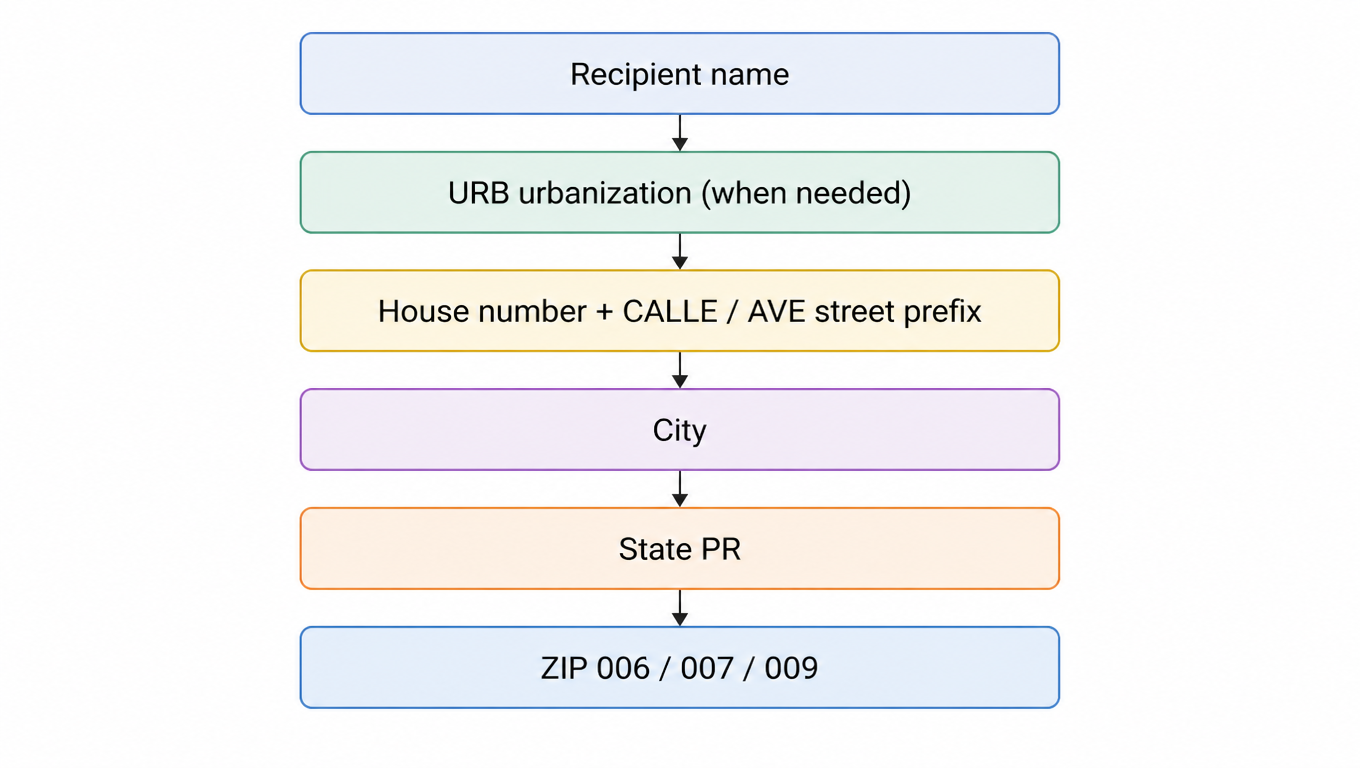
Publication 28 gives Puerto Rico its own address standard, with the fields ordered name, URB urbanization (where needed), house number plus the CALLE or AVE street, city, PR, ZIP+4 (Pub 28 §29).

URB stands for urbanización, a development, subdivision or named residential area inside a geographic area. USPS states the point plainly: the urbanization name is a required part of the address format because it describes where a given street is located, and no two urbanizations inside the same five-digit ZIP share a name, since one delivery route normally serves each (Pub 28 §292). Two streets with the same name and the same house-number range can exist in one ZIP, and the urbanization is what separates them. Delete it and the carrier loses a locating dimension.

  • When URB is not repeated. If the name already is a descriptive word such as Extensión, Mansiones, Reparto, Villa, Parque or Jardines, URB is not added in front of it (Pub 28 §295). As a template rule, read the name first and only then decide on the prefix.
  • CALLE is not translated to ST. In Puerto Rico addresses the Spanish prefix (CALLE, AVENIDA, PASEO) precedes the street name and the house number comes first. USPS states that translating CALLE into the suffix ST makes the address undeliverable.
  • Numeric streets keep the word CALLE. Without it, the street number and the house number blur together, as in A17 CALLE 1 or 13 CALLE 191. Lettered house numbers take no hyphen (write A17, not A-17), but when the address range itself contains a three-digit block number, the hyphen is a meaningful character (write 199-31 CALLE 19).
  • Boxes and rural routes have their own formats. A customer may write APARTADO, CALLER, CALL BOX or GPO BOX; normalize all of them to PO BOX before the label is printed. Rural routes standardize to RR plus BOX and highway contract routes to HC plus BOX, for example HC 1 BOX 18 (Pub 28 §25). Neither format takes a sector or barrio name appended after it, which causes match failures.
  • Use the city name USPS recognizes. Condado, Barrio Obrero and Río Piedras are popular names inside the San Juan metropolitan area, not valid city names; the last line has to read SAN JUAN.

Address field example table

Field What goes in it Correct example Common error
Recipient nameFull name on its own lineJUAN PEREZName squeezed onto the urbanization line
Urbanization lineURB plus the urbanization nameURB VILLA NEVAREZLeaving the URB line out
Street lineHouse number, CALLE or AVE prefix, street name14 CALLE PERAL14 ST PERAL
Numeric streetKeep the CALLE prefixA17 CALLE 1, 13 CALLE 191A-17 CALLE 1
CityThe city name USPS recognizesSAN JUANCONDADO
StateThe two-letter code PRPRWriting Puerto Rico in the state field
ZIP codeFive digits or ZIP+400927-1234Entering a mainland ZIP
Post office boxNormalize to PO BOXPO BOX 1234APARTADO 1234
Highway contract and rural routeHC or RR plus BOXHC 1 BOX 18HC 1 BOX 18 BARRIO ...

Two complete examples, one urban address with an urbanization and one rural address on a highway contract route:

JUAN PEREZ
URB VILLA NEVAREZ
14 CALLE PERAL
SAN JUAN PR 00927-1234
MARIA RODRIGUEZ
HC 1 BOX 18
ADJUNTAS PR 00601
Address structure diagram: name, then URB urbanization when needed, then house number with the CALLE or AVE street prefix, then city, then state PR, then a ZIP in the 006, 007 or 009 range, each step joined by an arrow
The field order is fixed: URB before the street, CALLE before the street name

Many address validation endpoints handle URB, HC and PO BOX formats badly and return a false invalid. When configuring an ERP or label platform, the cleaning logic has to preserve these fields instead of deleting them as anomalies; the trade-offs and fallback design are covered in address validation APIs.

3. Ground Advantage or Priority Mail: screen eligibility before comparing price

Run the eligibility screen before the price comparison; doing it the other way wastes a round of quoting.

  • Can the product ship at all. Lithium batteries not installed in equipment are restricted to surface transportation, while cells installed in or packed with equipment may fly (Pub 52 Packaging Instruction 9D). For Puerto Rico, surface means ocean, so delivery is measured in weeks, and those parcels should not enter a lane where you promise a date. Alcohol, aerosols and perfume carry their own restrictions, detailed in USPS hazardous materials requirements.
  • Parcel conditions. Ground Advantage caps at 70 pounds with length plus girth under 130 inches, and any parcel over one cubic foot is priced on dimensional weight, computed as length times width times height divided by 139 (USPS Ground Advantage; USPS dimensional weight rules).
  • Whether the box can go Flat Rate. A shipment that fits official Flat Rate packaging and stays under the weight limit costs the same to Puerto Rico as to any mainland address, with no distance zone applied (USPS Priority Mail Flat Rate). That makes it the first choice for dense, low-volume parcels, and the full service comparison lives in Ground Advantage versus Priority Mail.

Service selection comparison

Service How it is priced Official mainland expectation Realistic expectation to PR Parcel profile
USPS Ground AdvantageWeight and size at Zone 9, dimensional weight above one cubic foot2 to 5 business days10 days or longer, with some lanes well beyondRoutine ecommerce parcels under 70 pounds, not date sensitive
Priority MailWeight and zone, or one Flat Rate price1 to 3 business days2 to 4 business daysDate-sensitive parcels and dense goods that fit Flat Rate
Priority Mail ExpressZone based or Flat Rate1 to 3 business daysPlan against the 2-day commitmentReships and urgent parcels

The one line worth memorizing: the generic Ground Advantage estimate cannot be used as the promise for a non-contiguous destination. Effective October 1, 2026, USPS adjusted the Ground Advantage service expectation between the mainland and Puerto Rico to 10 days or longer, noting that some lanes run well past that, and regardless of weight those parcels now move primarily by surface, which for Puerto Rico means ocean (USPS service expectation notice). The stated reason is to align the published expectation with available capacity and to keep hazardous materials out of the air network, at the cost of light parcels no longer flying.

In the same adjustment, the Priority Mail expectation for Puerto Rico moved from up to 3 days to 2 to 4 business days, while Priority Mail Express was left alone and still plans against a 2-day commitment (USPS Priority Mail; USPS Priority Mail Express). The dividing line for a Puerto Rico order is therefore no longer a day or two; it is whether the parcel is measured in weeks or in days. Writing that sentence into your service-selection rule beats explaining it to a customer afterwards.

4. How to price it, and why a mainland quote cannot be reused

Fix five record fields before quoting, because missing one makes the result impossible to audit later: origin ZIP, destination ZIP, weight and dimensions including dimensional weight, service and packaging, and the quote date. A mainland quote cannot be reused, for four reasons.

  • Zone 9 is the highest band, so the same weight costs more to PR than to a neighboring state (USPS domestic zone chart).
  • Dimensional weight: light, bulky parcels over one cubic foot are billed on length times width times height divided by 139, so a light actual weight does not lower the charge (USPS dimensional weight rules).
  • Flat Rate inverts the logic: it ignores distance and weight and only asks whether the item fits (USPS Priority Mail Flat Rate).
  • Parcels under a pound price in ounce tiers, where the spread is far smaller than on heavy goods, so light and heavy shipments need separate rules.

A three-parcel quote worksheet

Parcel Dimensions (inches) Actual weight Billable weight Service and packaging Example quote
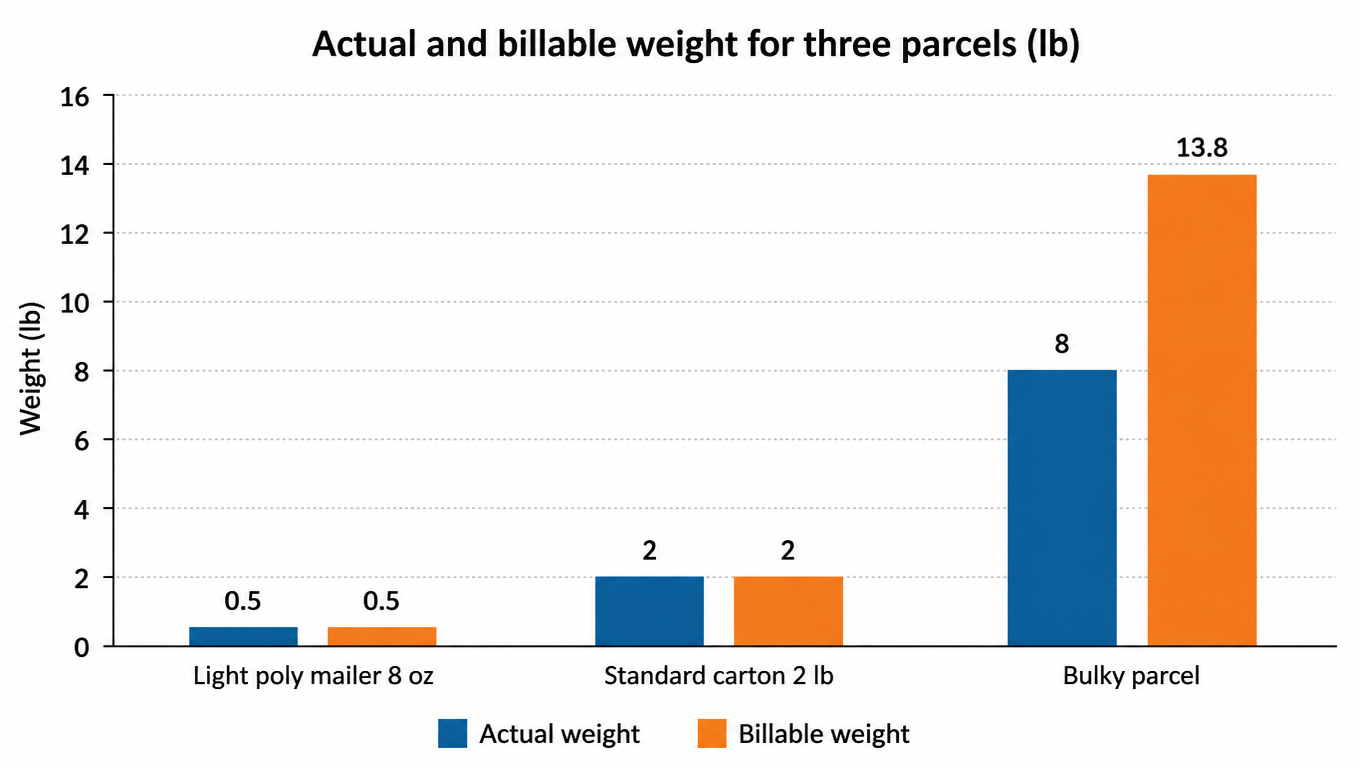
A. Light poly mailer (accessories, jewelry)9x7x18 oz8 ozGround Advantage, own packagingabout $6.50
B. Standard carton (2 lb of household goods)12x9x42 lb2 lbGround Advantage against Priority MailGA about $12, Priority about $16
C. Bulky parcel (8 lb, low density)16x12x108 lb13.8 lb (dimensional)Ground Advantage, or a Flat Rate box it fitsabout $30

Record keeping notes: origin ZIP 75001, destination ZIP 00920, commercial discounted rates, quote date 2026-10-07, priced through the shipping rate calculator. The amounts in this table are illustrative example values, not the USPS price list, and they are not a quote you can pass to a customer; recheck with your own account, real dimensions and same-day pricing.

Grouped bar chart comparing actual and billable weight for three parcels: a light poly mailer at 8 ounces against 8 ounces, a standard carton at 2 pounds against 2 pounds, and a bulky parcel at 8 pounds against a 13.8 pound dimensional weight
Only the bulky parcel bills above its actual weight, so only there does repacking pay

Three operating conclusions come out of those example rows. On light parcels the service spread is small but the delivery expectation is not: the same 8-ounce mailer costs a few dollars more on Priority Mail and moves from weeks to days, so pick the service by the days the customer can actually wait, not by the dollars saved. The 2-pound tier is the usual break point, where Priority Mail typically costs 3 to 5 dollars more and is worth it only when the promised date requires it. The biggest hidden cost sits in the bulky parcel, where dimensional weight turns 8 pounds into 13.8; shrink the box under one cubic foot first, then consider a Flat Rate box it fits. For the zone lookup itself, use the USPS zone calculator.

5. Do you need customs forms or any other declaration

Ordinary USPS mail between the mainland and Puerto Rico is domestic, does not enter CBP import clearance, and carries no customs form. That sentence has edges, though, and it cannot be stretched into \"no declaration is ever required\".

  • Electronic Export Information (EEI). A shipment between the states and Puerto Rico whose value under a single Schedule B number exceeds $2,500 requires EEI filed in AES, with the ITN available for CBP verification, while a shipment between two states requires none (US Census Bureau). This is a statistical filing, not clearance, and it creates no duty. Most DTC parcels sit below the threshold; B2B replenishment, sample batches and equipment transfers have to be checked against it.
  • Export controls. Items subject to the export administration regulations, or requiring an export license, follow the same rules whether or not the destination sits inside the US customs territory.
  • Routing. If a parcel is routed through a foreign country or a third-country transshipment, it can fall into import declaration scope, and the domestic premise no longer holds.
  • Local tax. Duty-free is not tax-free. Puerto Rico runs its own sales and use tax (IVU) under the island's Treasury Department, and the use tax applies to the person bringing property into Puerto Rico for local use or consumption (Puerto Rico Treasury Department, IVU). Whether a buyer is taxed depends on the seller's tax configuration, not on a label field.
  • Change carrier, change rules. UPS and FedEx require an international service line and customs fields for Puerto Rico even when the rate band is domestic (carrier integration documentation). The same order on a different carrier carries a different declaration requirement, which is one more reason to price the paperwork into carrier selection.

Compress the section into one sentence: what is not required is the customs form, not the concept of a declaration. The test is the commodity, the value, the routing and the service line you picked, not the two letters PR in the destination field.

6. What a seller has to configure in checkout, labels and carrier fallback

Checkout. The destination allowlist has to include PR, the country field stays United States, the state field accepts the two-letter code PR, and ZIPs in the 006 to 009 range have to be released rather than blocked or priced as international.

Address fields. The label platform has to carry URB, CALLE, HC and PO BOX as they are written, without anglicizing them and without discarding the urbanization as redundant. Give URB its own field slot instead of folding it onto the street line, and on a validation failure surface the record for review rather than deleting a field.

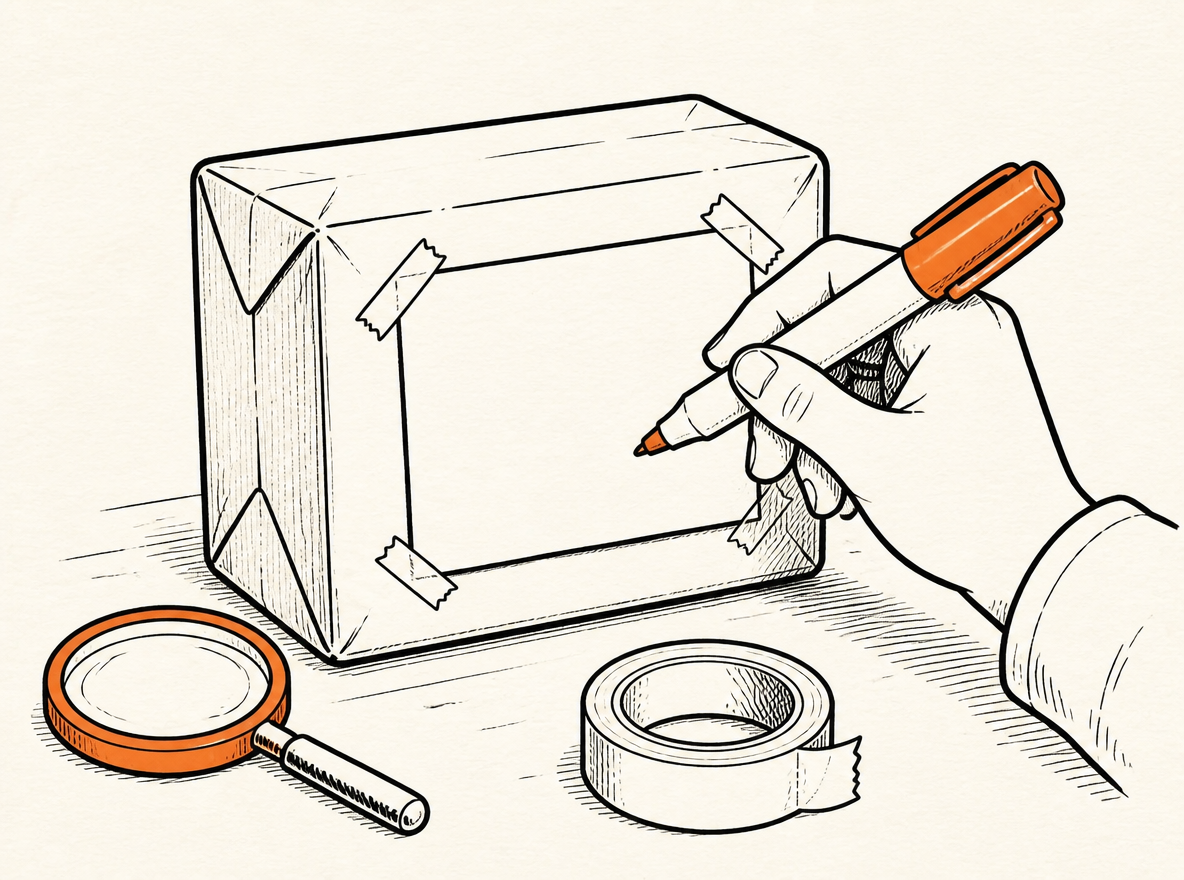
Hand-drawn editorial cartoon of a blank label taped to a small parcel, a hand holding a marker paused above the middle line of the label, with a magnifier and a roll of tape beside it, loose ink contours with intentional imperfections, orange used only on the marker cap and the magnifier rim, warm paper background and no lettering or numerals in the image.
Pausing on the urbanization line before printing beats chasing the parcel afterwards

Rate templates and delivery copy. Configure rate templates against Zone 9 and dimensional weight, and write delivery copy per service instead of copying the mainland 2 to 3 days onto a Puerto Rico lane. For Ground Advantage write 10 days or longer and note that some lanes run longer; for Priority Mail write 2 to 4 business days, then add a 1 to 2 day buffer for peak season and hurricane season (USPS service expectation notice). Neither capacity nor sailing schedules on the ocean leg are yours to control, so under-promising is safer than a promise you cannot keep.

Label creation. Quote heavy parcels both ways, Flat Rate and Ground Advantage; sort loose lithium batteries onto the surface lane; and for shipments approaching the $2,500 threshold under one Schedule B number, confirm before dispatch that the electronic export information was filed and the ITN travels with the shipment.

Carrier fallback. A coverage map is not a decision input. Verify per product, per origin warehouse and per destination ZIP: run real quotes and one test shipment against 006, 007 and 009 ZIPs on your own account, and read service eligibility, accessorials and the actual last-mile delivery agent. Regional delivery networks do not necessarily cover PR, USPS is the most complete layer, and everything else is added from pilot results. The full selection framework is in serviceability validation, and the USPS overview sits on the USPS carrier page.

Pre-dispatch checklist

Check Pass condition
Destination classificationState field is PR, country is United States, ZIP sits in the 006 to 009 range
Address completenessName, URB where applicable, house number with CALLE, city, PR and ZIP+4 are all present
No address rewritingCALLE was not converted to ST, and URB, HC, RR or PO BOX were not deleted
City nameThe USPS-recognized city name is used
Service choiceGround Advantage, Priority Mail and Flat Rate were compared against the promised date
Billable weightParcels over one cubic foot were converted to dimensional weight by dividing by 139
Delivery copyGround Advantage is quoted as 10 days or longer, Priority Mail as 2 to 4 business days
Batteries and hazardous goodsLoose lithium batteries moved to the surface lane and the box markings are applied
Declaration dutyShipments near the $2,500 threshold have the export information filed and the ITN attached
Record keepingOrigin ZIP, destination ZIP, dimensions and weight, service and quote date are logged

Run those ten lines in order and a Puerto Rico order is handled like any other mainland region: address fields preserved as written, billing computed on Zone 9 and dimensional weight, and the ocean leg given a buffer. What actually goes wrong is never carrier capability, but these three configuration points.

Put non-contiguous destinations into one carrier comparison

EasyShippingX is a channel-neutral shipping layer: it compares US carrier options in one place and executes them through the Portal, Excel, or the API. Puerto Rico orders can run through the same quoting, labeling and promise-setting flow as mainland orders, with the difference living in the buffer you hold for Zone 9 and the ocean leg.