Social Selling Fulfillment Guide

How to Ship Instagram Orders Without an Online Store

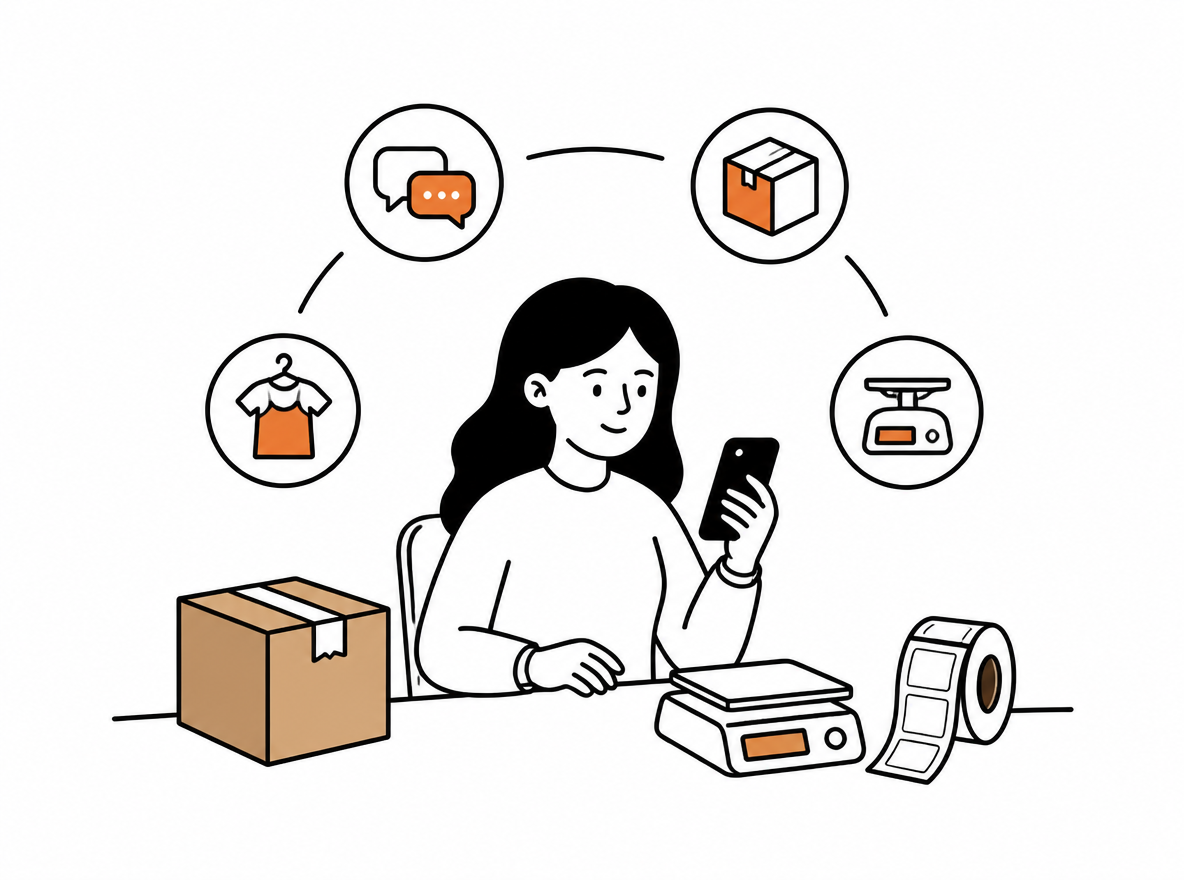
Editorial illustration of a small seller at a desk looking at chat messages on a phone, with a taped box, a compact digital scale and a roll of thermal label paper beside them and small icons for chat, parcel, weight and label arranged around the figure.
Workflow illustration, not a customer case or an actual account record.

Twenty orders can arrive in a single evening. Instagram lets a qualifying small business take the order, collect the payment, and keep the record inside one direct message, so a storefront is no longer a precondition for selling physical goods.

What the message thread does not do is turn itself into a label. The address, the packed weight, the carton size, and the destination still have to be assembled by hand, and a social-channel order has to be handled differently from a store order.

Step 1: five inputs you need before the first label

A label is printed from five inputs. Miss one of them and the workflow stalls at the worst possible moment, usually after the buyer has already paid.

  • A sender and return address the service can send a parcel back to if the destination turns out to be unusable.
  • A complete recipient record: full name, street, apartment or suite number, city, state, and ZIP. Where a secondary unit exists, USPS requires the designator to appear on the piece, so an address without its apartment number is not a complete address (Publication 28, section 213).
  • An item list: the style, specification, colour, and quantity in each order, used for picking and for the final check.
  • Packed weight and carton dimensions: the actual weight after packing, plus length, width, and height. On USPS services, a parcel whose outer volume passes 1,728 cubic inches is billed on the greater of actual or dimensional weight (USPS parcel size and weight standards).
  • A source for labels: not the retail counter. A free USPS Click-N-Ship account already prints labels online below counter prices (USPS online shipping), and a multi-carrier platform does the same without a store plugin while comparing the services available for that same parcel.
InputWhere it comes fromWhat it decides
Sender and return addressYour own business or home addressWhere a parcel goes when it cannot be placed
Complete recipient recordThe buyer's reply in the message threadWhether the parcel can be sorted and placed correctly
Item listYour own SKU listWhich item goes into which parcel
Packed weight and sizeA scale and a tape measureWhich price tier the parcel falls into
Label sourceUSPS Click-N-Ship or a multi-carrier platformWhen the parcel can actually leave

Send the address template in the first reply rather than after the payment, so the buyer's answer drops straight into the matching row of the register instead of needing a second round of questions.

How online postage pricing actually works, including when a platform beats a direct account, is covered in where discounted shipping labels actually come from.

Step 2: keep twenty threads from becoming twenty mistakes

The failure that shows up most often in social selling is treating the account name as the recipient. The handle retrieves the conversation; the parcel still has to go to a real person at a real street address.

Payment comes before packing. Confirm the money has actually landed before the tape goes on, because a sealed parcel is already a sunk cost.

Use one fixed template so the buyer can simply fill it in:

Please reply with your shipping details in this format:
- Full name:
- Street address (including apartment or unit number):
- City, state, and ZIP code:
- Phone number:
- Email address (for tracking updates):
OrderHandleRecipientFull addressItemPaymentWeightTrackingStatus
IG-01@example_handleExample buyer A123 Example St, Apt 4B, Austin, TX 78701Linen tote x2Cleared1 lb 4 oz9400…Label printed
IG-02@example_mkExample buyer B88 Example Ave, Denver, CO 80202Ceramic mug x1Pending14 oz(none yet)Not packed
Illustration of a seller at a kitchen table copying scattered chat messages from a phone into tidy rows on a laptop screen, with sticky notes, a mug and two half-packed parcels beside them.
Turning scattered messages into structured rows is what makes a batch possible

The two rows above are an example register for a hypothetical twenty-order week, not any seller's order records. The fields matter more than the sample content, and three rules are worth hard-coding: the handle and the recipient name each get their own column; nothing moves to packing until the payment column reads cleared; and the tracking column is filled from the label data, never from memory.

The mistakes that recur across channels, from a missing apartment number to a duplicate label, are collected in common shipping mistakes, and the first version of the register can be designed from that list.

Step 3: what to charge the buyer for shipping

A direct message has no checkout calculator, so the charge has to be decided by hand. Three methods cover almost every small seller, and each one trades accuracy against the number of messages it costs.

Method 1: quote the live price for that parcel

Take the buyer's ZIP, enter the origin, the destination, and the packed weight and dimensions, and quote what comes back. USPS Ground Advantage covers most small parcels of a pound or two on the surface network (USPS Ground Advantage), so the figure that comes back usually lands in that band.

Method 2: set one flat charge

For light parcels that are broadly similar, publish one flat charge and absorb the difference yourself. When the parcel profile really is uniform, a carrier's flat-rate product removes the guesswork entirely: Priority Mail Flat Rate prices by packaging type rather than by weight or zone (Priority Mail).

Method 3: bundle the freight into the item price

Free shipping closes fastest in a message thread, on one clear condition: the average freight cost is already inside the item price before you quote. Otherwise all you saved was a round of messages, and what you lost was margin.

Method 4: one buyer, several items

Items sharing one carton do not multiply the charge. Load them into the carton you intend to use, weigh and measure it with the void fill in place, price that single combined parcel, and then decide whether the small difference is worth another message.

Estimating before you quote saves a round trip: put the origin, the destination, and the weight into the shipping rate calculator and read the result back to the buyer.

Step 4: from two parcels a day to a full batch

With one or two orders, typing each one in is perfectly reasonable: enter the address, let the platform's own address check catch the obvious typos, choose the service, and download the PDF label.

At twenty orders the register becomes the input. Export it to CSV or Excel, upload the file, and the platform parses recipients, addresses, and parcel data, compares the available services, and generates every label in a single multi-page PDF.

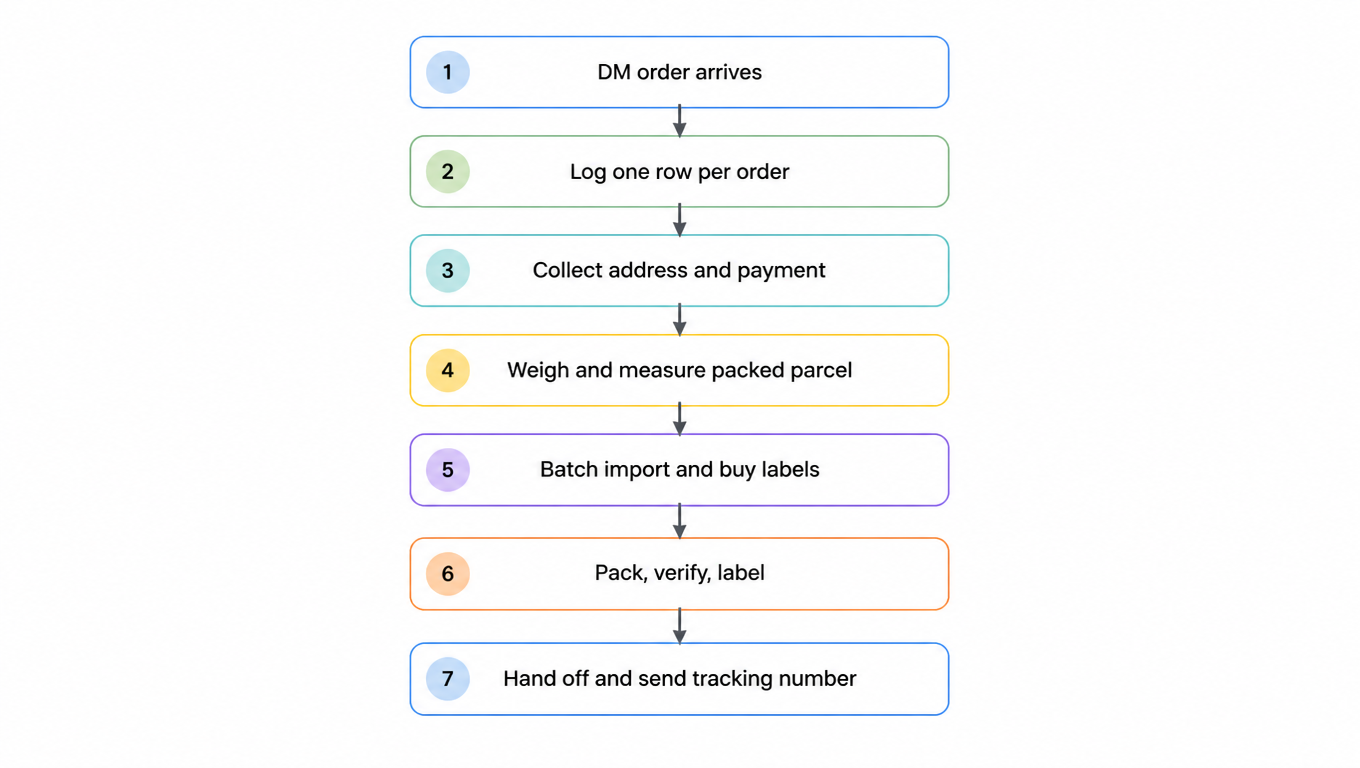
Decision flow: a direct-message order is logged as one row, the address is collected and the payment confirmed, the packed parcel is weighed and measured, labels are bought through a batch import, the parcels are packed, verified and labelled, and finally handed off with the tracking number sent to the buyer
Seven steps: a new order enters where it fits and follows the rest

Packing, labelling, and the double check

  1. Stage the items for each order number in a row, so the goods, the register row, and the freshly printed label sit physically together.
  2. Before the box is closed, compare the name printed on the label with the goods and the register row; only then apply the label to the carton.
  3. Handoff: labelled parcels can go straight into a postal drop point, or be collected at no charge through USPS Package Pickup during the regular route (USPS Package Pickup).

Packing quality decides whether any of this survives the network. Carton strength, void fill, and tape lines are covered in how to ship packages safely.

Step 5: tracking numbers, buyer questions, and exceptions

Once the labels are bought, the tracking column is filled from the label data, and every buyer gets the same short message back in the thread:

Hi! Your order has been packed and shipped.
Carrier: USPS
Tracking number: 9400 1xxxxxxxxxxxxxxxxxx
You can track your parcel on the USPS website. Please contact us if you have any questions after it arrives.

Keep proof of handoff. USPS Certificate of Mailing (PS Form 3817) is stamped at acceptance and returned to the sender as written evidence that the parcels entered the mailstream (PS Form 3817). If a pickup was scheduled instead, keep the request and the collection confirmation.

Write the awkward rules down before they are needed; it is much cheaper than explaining afterwards. Whether an address can still be changed once the label is printed, whether a made-to-order item can be cancelled, and who pays the second charge when a parcel comes back because the address was incomplete.

  • Address changes: state the cut-off, which in practice is the moment the label is printed.
  • Cancellations: separate stock items from made-to-order items, and give a clear cut-off for anything already packed.
  • Aftercare and returns: when an incomplete address sends a parcel back, the buyer covers the second charge; when the wrong item or a defective one was sent, the seller covers the replacement.

If a marketplace or a second social channel is added later, the same register feeds a very different fulfilment model, and the difference is set out in TikTok Shop fulfillment compared with Amazon MCF and a 3PL. The wider frame this workflow sits inside, from service choice to returns, is laid out in ecommerce shipping solutions.

FAQ

Yes. A label needs a sender address, a complete recipient address, and the parcel's weight and dimensions. It does not need a storefront or a domain. A free USPS Click-N-Ship account, or a multi-carrier platform, buys and prints labels without a store plugin.
Give the handle and the recipient name a column each, and send the address template in the first reply. Always capture the apartment or suite designator too, because an address missing its secondary unit is simply incomplete.
It depends on how stable the parcels are. Items whose weight varies a lot suit a quoted price: one extra message, no loss. Similar light parcels suit one flat charge, which closes faster. And when the profile really is uniform, a carrier's flat-rate packaging prices by the box rather than by weight and zone.
No. Export the register to CSV or Excel and upload it in one batch; the platform parses recipients and parcel data, compares services, and generates every label at once. Keep manual entry for the days when there are only one or two orders.

Make the manual workflow hold up under a batch

EasyShippingX acts as a channel-neutral shipping layer, comparing carrier options inside the US in one place and executing them through the Portal, Excel, or the API. Once the register is tidy, comparison, label generation, and tracking backfill stop being a manual loop.