Plant Seller Shipping Guide

How to Ship Plants: Packaging, Delivery Times, and Costs for US Sellers

How to ship plants: confirm plant and destination requirements, verify acceptance by the specific shipping channel, design the pack, weigh and measure the sealed parcel, schedule handoff, and test shipments. Restrain the pot and contain its medium before protecting roots and foliage. A valid ZIP or printable label does not complete the first two checks.

This guide covers commercial small-plant orders originating in the contiguous 48 states, mainly potted plants, for nurseries, online sellers and fulfillment teams. International shipments, Hawaii, Alaska, territories, large trees and cut flowers need separate review.

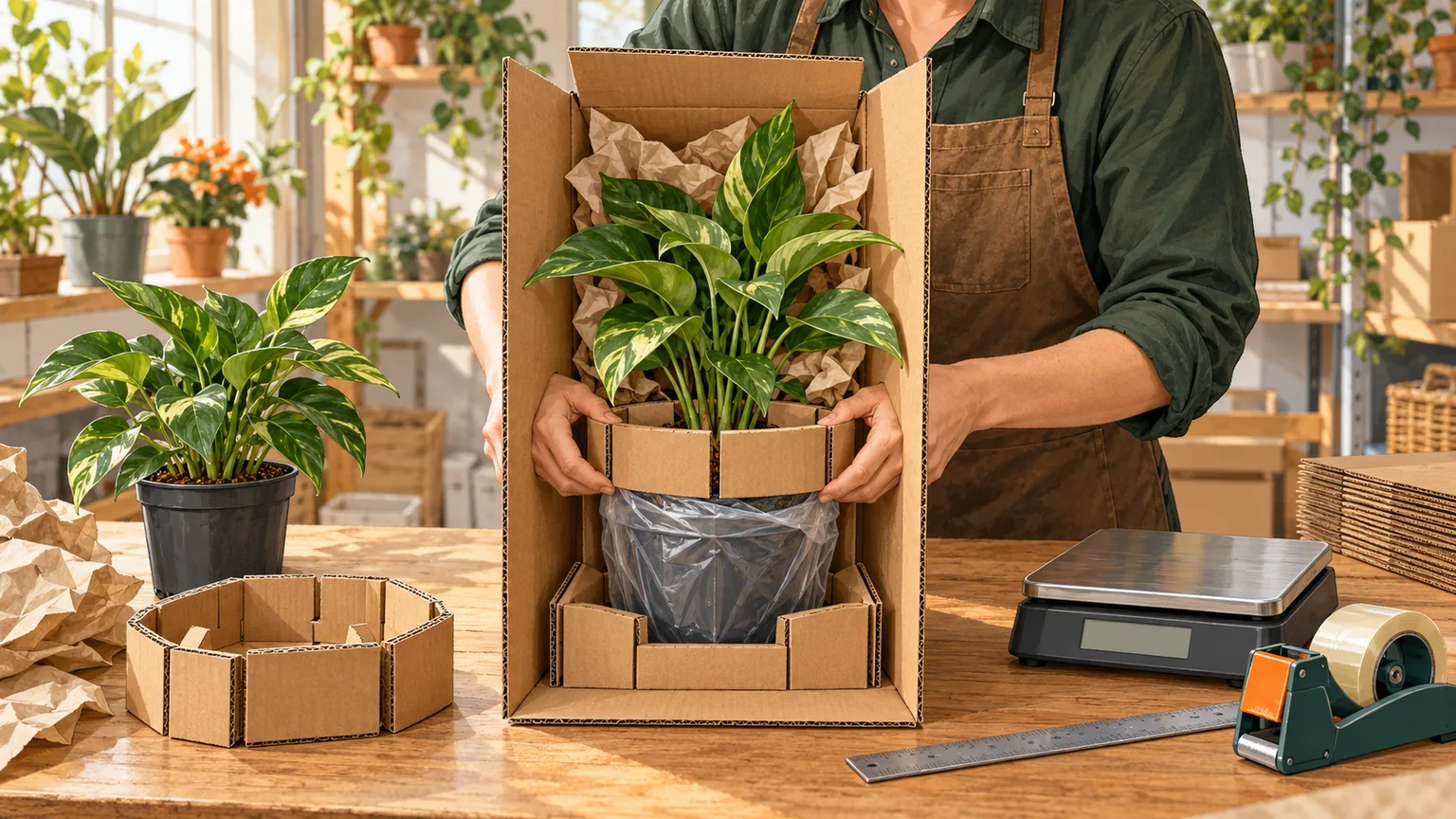
Illustration of a plant seller holding a cardboard pot restraint inside a shipping carton, with a small plastic nursery pot, spare insert, parcel scale and packing tools.
Plant packing illustration. Secure the pot and leave clearance for stems and leaves.

Before accepting orders: plant, destination and channel checks

Build an order record for plant, shipping form and origin/destination. USPS Publication 52 §561 permits plants subject to applicable restrictions and points to Publication 14; unlawful shipments are nonmailable. General mailability does not approve a particular species, medium or route.

An actionable pre-order plant shipping checklist
CheckWhere to confirmKeep with the order
Plant identitySupplier identity, scientific name where needed, prohibited/restricted and host listsName, cultivar, quantity and lot
Form and mediumPotted, bare-root or other form; soil/media type and originActual form and medium specification
Locations and quarantine areasOrigin state/county, destination state and applicable pest quarantine areasLocations, findings and scope
Commercial credentialsOrigin/destination plant authorities for licensing, inspection, certificates or permitsValid documents, issuer, commodities and validity
Marking and inspectionPostal/state content marking, document attachment, notification and inspection instructionsMarking format, document placement and inspection arrangements
Specific-channel acceptanceCarrier and label channel, disclosing live plants, medium, container and address typeService, acceptance response, restrictions and review date

Use the National Plant Board directory to locate authorities and regulatory summaries, then check current state rules, orders and federal requirements. Summary dates vary. Send officials the plant identity, form, medium, commercial purpose and locations; retain sources, responses, documents and review dates rather than asking only whether a ZIP is covered.

For example, APHIS imported-fire-ant guidance addresses regulated movements of plants, soil and other articles from quarantine areas and explains the certificate-request route for producers. Domestic postage does not remove those checks; this is not a universal permit rule for every plant.

Do not apply personal-relocation exceptions to sales. Oregon’s houseplant-moving page addresses noncommercial moves; its nursery-licensing page has separate criteria. ODA’s FAQ also describes the shipping permit accompanying plants sent out of state. These Oregon examples illustrate separate checks, not identical document names or rules nationwide.

After regulatory review, use the carrier serviceability workflow to check the complete address and service. Record plant requirements, item acceptance and delivery coverage separately before enabling a product/destination combination.
Potted or bare-root: weight is only one factor

Choose the plant-appropriate form before comparing weight
Decision factorPottedBare-root, only when suitable
SuitabilityRetains the established root ball and mediumConfirm species, season and condition tolerate handling
Root riskLess disturbance; restrain pot and mediumHandling, drying or unsuitable moisture may damage roots
Parcel and laborPot/media add weight; restraint requiredMay weigh less; preparation and root protection add labor
Buyer setupUnpack, inspect and care for that speciesExplain appropriate potting/planting and care beforehand
Plant-health rulesCheck plant, medium and location rulesRemoving soil does not automatically remove plant/host restrictions

UMN Extension’s bare-root nursery-stock guidance emphasizes protecting roots from drying and distinguishes stock types. Its tree/shrub context does not establish bare-root suitability for every tropical houseplant. Keep an appropriate form or withhold an untested option rather than remove medium or cut roots solely to save postage.

How to ship plants in pots: restrain the pot before the foliage

Specify where the pack carries weight and where it leaves clearance. FedEx’s plant guide treats medium containment and pot restraint separately. Adapt and test the following workflow for the actual plant, pot and route.

  1. Check condition and moisture. Verify identity, lot, root ball and visible pest/damage signs; segregate questionable stock. Use species-appropriate moisture management for the route, avoiding free water or excessive drying rather than a universal watering countdown.
  2. Contain the medium. Fit a root-zone liner and medium-retaining cover to the pot. Attach to the rim or pot body, leaving suitable stem clearance. Do not close the opening by tightening string or tape around stems. Check drainage-hole leakage and remaining escape paths.
  3. Lock the pot first. Support its base and use fitted rim/body restraints connected to the carton structure to limit lift, lateral movement and rotation. Foliage is not an anchor; loose paper beside a heavy pot is not a substitute.
  4. Protect the foliage. Use shape-appropriate loose protection against bending, rubbing and top load, with necessary clearance. Do not compress or airtight-wrap the whole plant in an unsuitable bag, or improvise holes in the shipping carton.
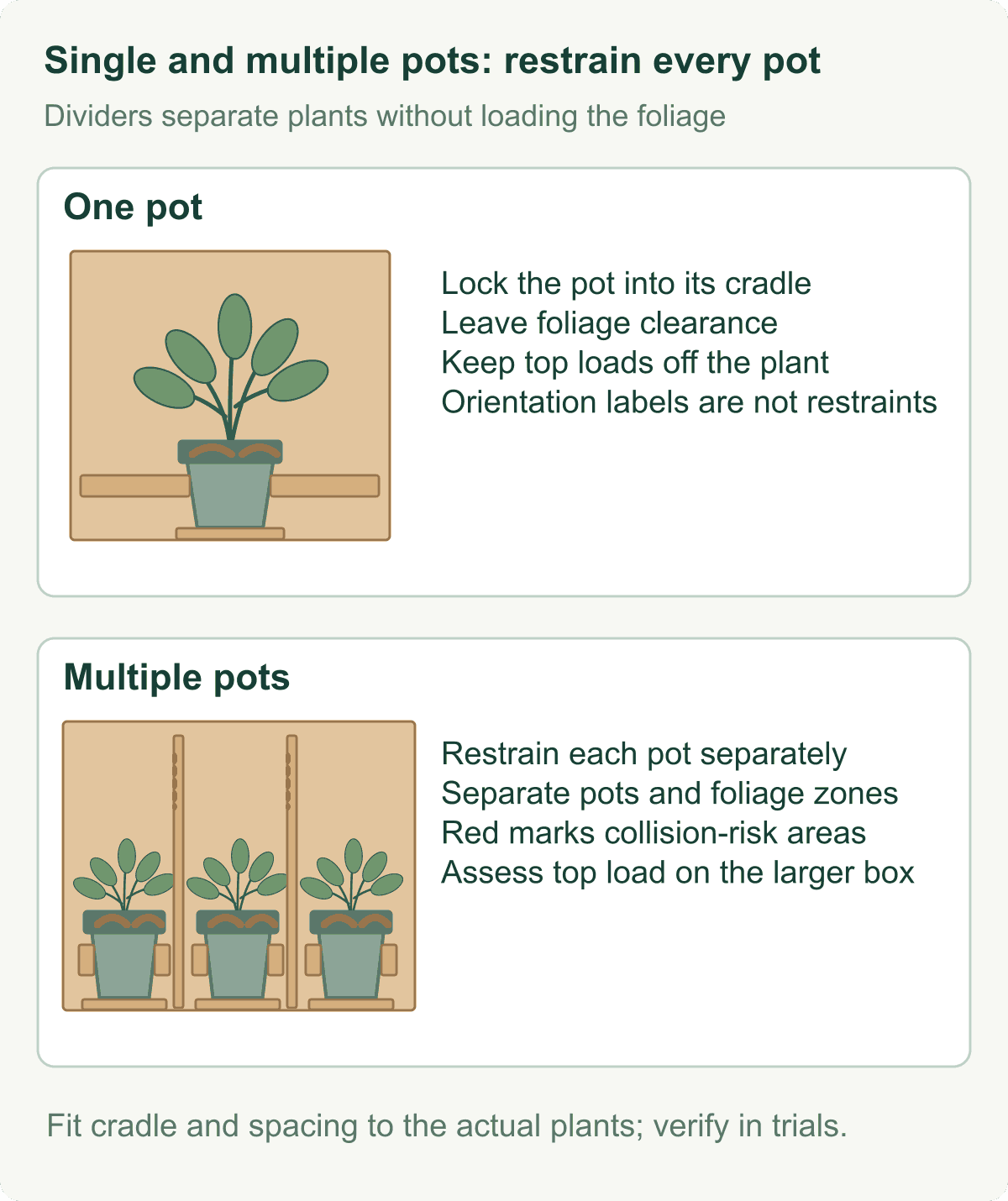
  5. Restrain each pot in a mixed order. Separate pot and foliage zones; dividers must not pinch leaves. Ceramic cachepots add another fragile component. Verify their restraint, cushioning and breakage protection independently, and confirm whether they need to ship with the plant.
  6. Measure after sealing. Use a structurally suitable carton without unneeded volume; close seams, weigh the whole parcel and measure exterior dimensions. Verify label, content identification and documents, and attach the pack version to the order.

Illinois Extension explains that watering depends on species, environment, container and medium. USPS §563 addresses waterproof containment of wettable material/roots without leakage, lost contents or weakened boxes, plus protective coverings and puncture protection where needed. Root-zone containment is distinct from airtight whole-plant wrapping.

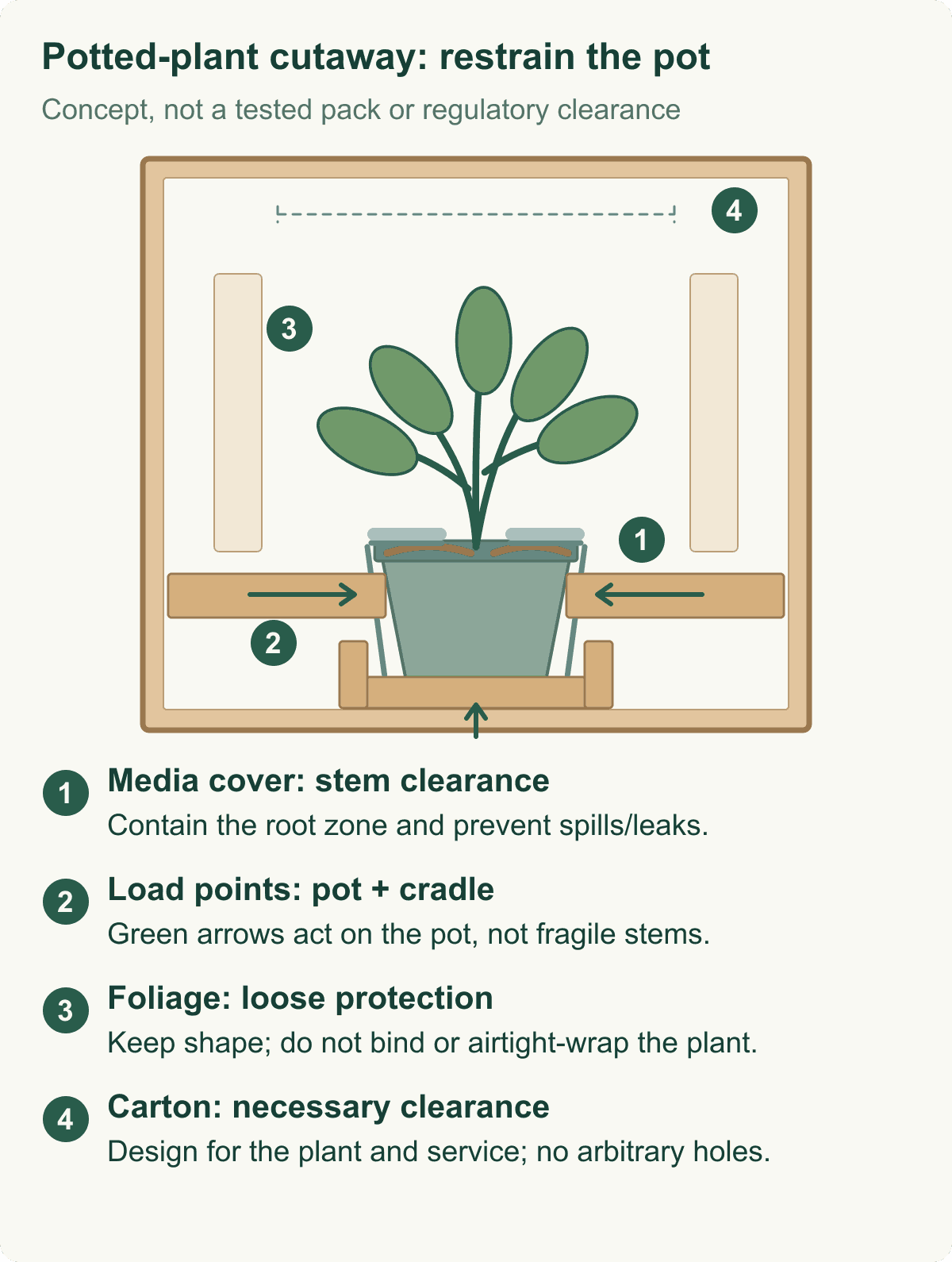
Potted-plant cutaway: root-zone containment with stem clearance, base and side restraints carrying the pot, loose foliage protection and headroom.
Restraint loads act on the pot body/rim and cradle; this is a principle diagram, not a validated pack specification.

Restraints should still control the pot when orientation changes; define suitable tests without treating a quiet shake as transit validation. FedEx cautions that orientation markings do not ensure upright travel. Check mandatory content identification and documents separately from handling hints. “This Side Up” does not replace them. See the packaging comparison for outer-container choices.

Single- and multi-pot comparison: each pot has base/side restraint, dividers separate plants, and red marks highlight collision-risk areas.
Adapt both packs to plant shape; this illustration is not evidence of a real shipping test.

Plan weather exposure, handoff and transit together

Assess species, condition and tested packing limits alongside origin, destination and plausible in-transit weather. Forecasts are not box-interior measurements; record “not measured” without a logger. Include warehouse holding, missed cutoffs, weekends, holidays and time waiting for the recipient.

For eligible USPS shipments, published standards list Ground Advantage typically at 2–5 business days and Priority Mail at 2–3, both nonguaranteed. Translate the actual route and tender date into elapsed calendar time and allow for disruption; these are not plant survival limits. Faster transport is not temperature control.

Decision examples, not temperature thresholds or service promises
Hypothetical situationActionRelease check
Tested plant/pack; weather and route fit the validated plan; recipient availableDispatch normallyRecheck forecast, cutoff and documents
Original service risks weekend holding; another tested, eligible option fitsAdjust service or scheduleRecheck total cost and expected arrival
Exposure outside tested conditions, recipient unavailable or documents missingHold and contact buyerRecheck after resolution; revise/test the pack if needed

Heat/cold packs or insulation are not automatic approval. Check manufacturer instructions, ventilation, placement, duration, plant tolerance and carrier conditions, then validate the complete system. Keep them off fragile tissue. The candle shipping guide offers a related operational perspective; its product conditions are not plant thresholds.

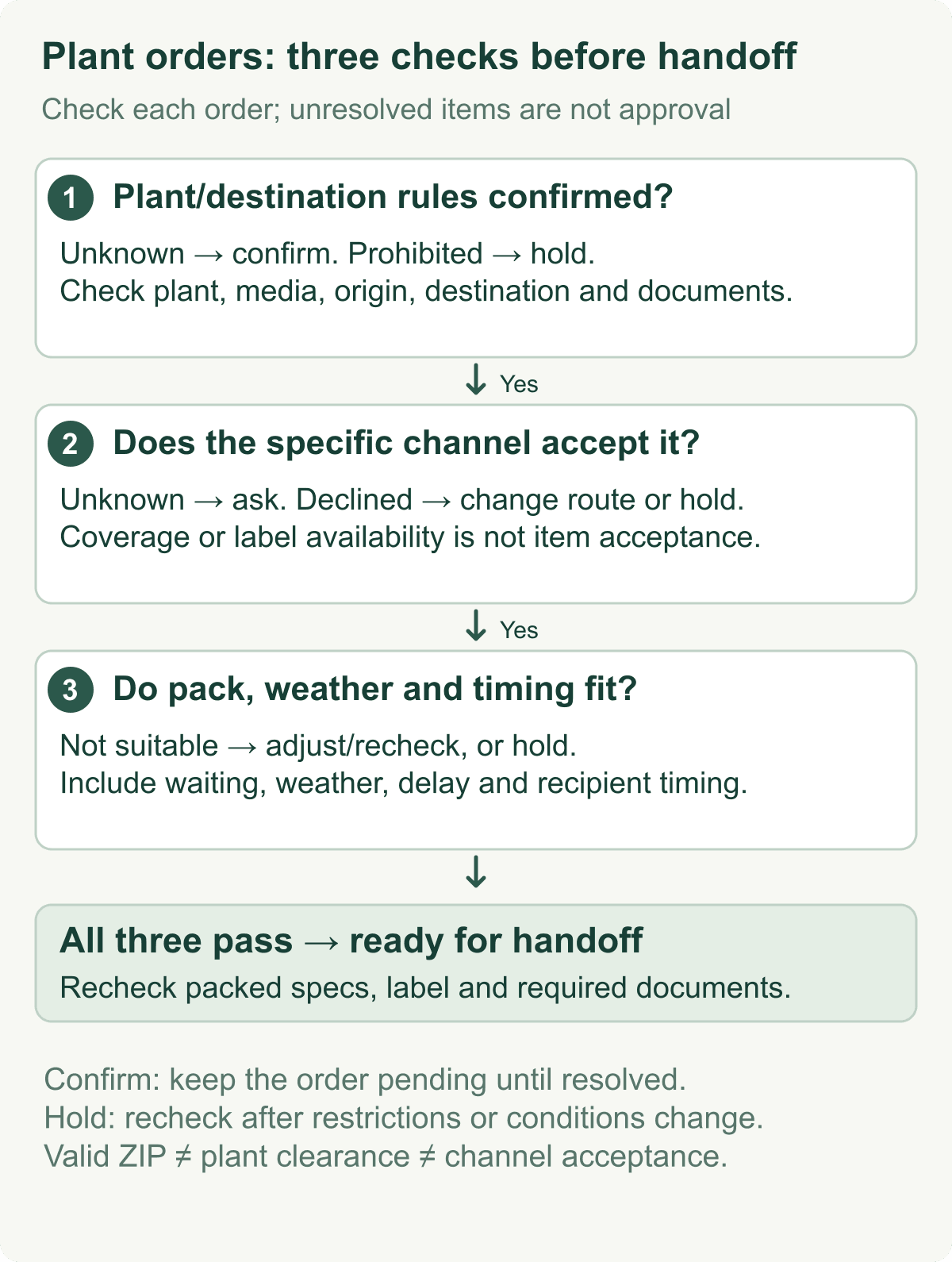
Plant shipping flow: confirm plant/destination requirements, specific-channel acceptance, and pack/weather/timing suitability; resolve unknowns, hold unsuitable orders, and tender only after all checks pass.
A valid ZIP is neither plant-health clearance nor channel acceptance; retain evidence for each check.

Calculate the full shipping cost of a plant order

Expected shipping cost per order = materials + packing labor + postage + expected after-sale cost. Labor = minutes ÷ 60 × hourly cost. Quote the sealed parcel, including medium containment, restraints and carton, rather than a catalog plant weight.

Every composition, weight, dimension, cost and event probability below is assumed, not measured or quoted by a carrier or EasyShippingX. Assume ZIP 97201 to 10001, $24/hour labor and a hypothetical eligible tracked parcel option. The cases do not establish plant/route approval. Dimensions are sealed exterior inches.

Hypothetical orders in USD, not universal postage
Model inputA: one foliage plantB: three-pot orderC: suitable dormant bare-root shrub
Product and containerPlant/media 16 oz + nursery pot 2 ozPlants/media 48 oz + pots 6 oz totalPlant 8 oz; no pot or growing medium
Sealed weight30 oz70 oz18 oz
Exterior L × W × H7 × 7 × 1214 × 8 × 126 × 6 × 14
MaterialsContainment/cover, cradle, foliage protection, carton, tapeIndividual containment/restraints, dividers, guards, carton, tapeSuitable root wrap, support, carton, tape
Materials total$2.10$4.80$1.60
Packing labor$1.60, 4 min$2.80, 7 min$3.60, 9 min
Postage budget$9.00$14.00$8.00
Expected after-sale cost$0.68$1.56$0.69
Expected shipping cost$13.38$23.16$13.89

Assume mutually exclusive final outcomes: 97% no modeled exception, 1% refund only, 2% full replacement only. For A/B/C, merchandise sales are $24/$66/$24, replacement goods cost $8/$21/$8, and support costs $1/$1.50/$1 per event. Exclude tax, refunded original shipping, insurance recovery and repeat failures; add them when applicable.

A’s reserve = 0.01 × (24 + 1) + 0.02 × (8 + 2.10 + 1.60 + 9 + 1) = $0.684 → $0.68. B is $1.557 → $1.56; C is $0.694 → $0.69. Replacement includes neither a simultaneous full refund nor another reserve. Original merchandise and fixed overhead are outside this shipping table; record required document/inspection expenses separately.

C models lower postage but higher labor; it is a different plant, not an experiment converting A to bare-root. B uses fewer labels, but a larger box and whole-order replacement exposure may change real exception rates. Replace the probabilities with your records. Retain quote date, ZIPs, service, packed weight/dimensions, retail/commercial basis and included fees.

Insurance is not a live-arrival guarantee. USPS DMM 609 §4.3 includes exclusions for frozen, spoiled or deteriorated perishable contents. Check the actual item, terms and evidence before budgeting a recovery.

Trial shipments and follow up before expanding coverage

Trial representative plants, conditions, distances, dispatch days and seasons at small scale. Define acceptance criteria for medium loss, movement, tissue damage and subsequent condition before dispatch; record failures as well as attractive unboxings.

Use as a small-scale shipping-trial log
Trial fieldRecord
PlantIdentity/scientific name where needed, lot, form, root ball and condition
PackVersion, pot, restraints, containment and protection
Parcel and routeSealed weight/dimensions, locations/ZIPs, service and documents
Time and environmentWait, tender, transit, arrival and collection; available weather/temperature records
Arrival and follow-upMedium loss, pot movement, stems/leaves, root-zone condition, photos and agreed follow-up
Resolution and decisionSupport, refund or replacement, actual cost, cause, owner and next revision

Observe again at the agreed follow-up time; opening appearance does not reveal every transport effect. Without a logger, do not invent interior temperatures. A pass supports that product/pack/condition, not every species, season or route. Retest after relevant changes.

Separate handling, dispatch days and estimated transit on product pages, checkout and emails, with weather holds and recipient arrangements. Adapt the shipping policy template: buyers contact the seller with order number, plant/pack photos and arrival/unpacking times; give a next update while handling the chosen resolution and transport inquiry.

Plant shipping FAQ

Eligible plants can be mailed after agricultural restrictions and postal preparation conditions are satisfied. Verify the plant, medium and locations, then the specific label channel’s acceptance; label availability is not approval.

Sometimes, subject to the plant, medium, origin, quarantine status and destination rules. Confirm the conditions with the relevant authority before designing medium containment.

No. Species and condition must tolerate it, with root damage, drying, labor and buyer setup considered. Removing soil does not automatically remove interstate restrictions.

Connect fitted base and rim/body restraints to the carton structure to limit movement and rotation. Do not anchor the plant by its foliage or substitute loose fill and orientation labels for restraint.

Only when the plant and complete shipping plan fit the actual conditions. Adjust/recheck or hold outside tested limits. Expedited service, insulation and thermal packs do not automatically guarantee survival.

Use packed weight/dimensions, route, service, materials, labor and after-sale cost. The single-pot example assumes $13.38 in expected shipping cost; it is a worked model, not a postage quote.

Compare actual parcels after eligibility is confirmed

Keep confirmed plant, route and channel conditions in your ecommerce fulfillment workflow. For ongoing shipping, use sealed weight, dimensions and origin/destination ZIPs in the EasyShippingX rate calculator to compare applicable enabled options with packing and expected transit. Citing FedEx packing guidance does not imply EasyShippingX FedEx labels.

Sources and example notes

Packing and operational steps are recommendations to validate; costs, weights, dimensions and decision scenarios are assumptions. Apply current requirements, documentation and channel conditions to the actual commodity and locations.