Packaging and Shipping Guide

How to Ship Candles: Packaging, Heat Protection, and Shipping Costs

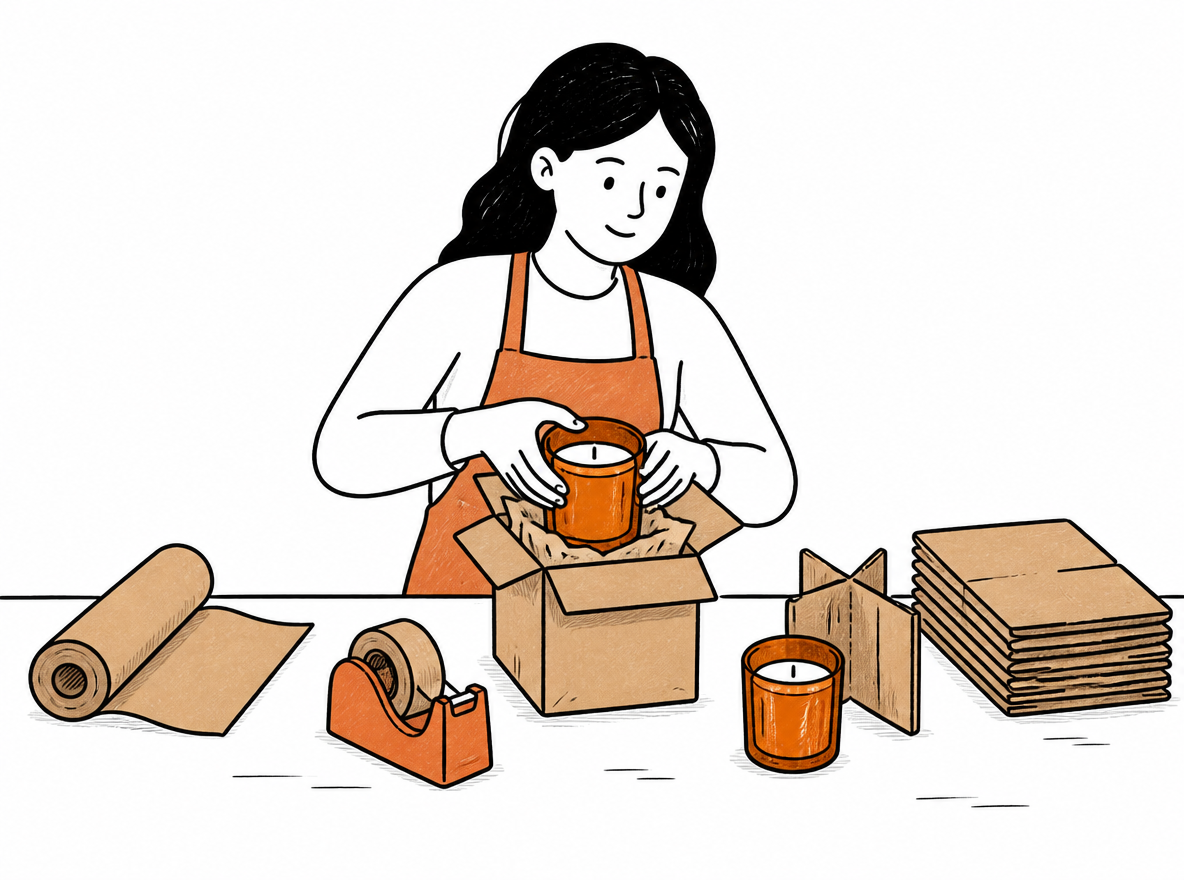
Editorial illustration of a person at a packing bench lowering a single amber glass candle jar into a small corrugated carton, kraft paper and a tape dispenser within reach, a second jar waiting beside a folded cardboard divider, and a stack of flat cartons at the edge of the frame.
Three hypothetical orders run through this guide. Every weight, dimension, and cost is a stated assumption, not an industry average.

A candle looks like the easiest parcel in your catalog: one glass jar, one small box. Then a jar arrives with a hairline crack at the base, or the wax slumps into the lid and the wick leans against the glass, and the order costs you twice. The label price was never the whole number.

Work the math in this order:

Fully loaded cost per shipped candle order = packaging + postage at billable weight + pack labor + breakage allowance + claims shortfall

Breakage allowance is the part most stores skip:

Breakage allowance = damage rate × (product cost + packaging + labor + the cost of a second shipment)

Claims shortfall is the residue. The carrier's included coverage is capped, and some candle damage is excluded outright, so one damage costs you the full replacement plus a second label, not just the product.

To keep this concrete, the guide follows three example orders. They are hypothetical, sized to be realistic rather than to represent any industry average:

  • Order A: one 8 oz glass jar candle.
  • Order B: a two-jar set, same wax, same jar family.
  • Order C: a gift set with two jars, a box of safety matches, and a wick trimmer.

1. Measure the whole parcel before you compare any price

You cannot price a candle by its wax weight. Weigh each component once, write it down, and use the same numbers every time you quote.

ComponentOrder AOrder BOrder C
Candle (wax plus wick)0.50 lb1.00 lb1.00 lb
Glass jar and lid0.55 lb1.10 lb1.10 lb
Insert, wrap, cushioning0.20 lb0.30 lb0.55 lb
Outer box and tape0.10 lb0.15 lb0.20 lb
Matches and trimmernonenone0.75 lb
Scale weight (gross)1.35 lb2.55 lb3.60 lb
Outer box (inches)6 × 4 × 48 × 6 × 510 × 8 × 6
Cubic inches96240480

Now the two rules that decide what you are actually billed.

USPS applies dimensional weight only when a parcel exceeds one cubic foot, or 1,728 cubic inches, and uses a divisor of 139, as set out on the USPS Ground Advantage rules page. All three example boxes sit well below that threshold, so USPS bills on scale weight, rounded up to the next pound. A 1.35 lb parcel pays the 2 lb price.

UPS and FedEx apply a divisor of 139 on standard US parcel services and bill the greater of actual or dimensional weight on ordinary parcels, not just oversized ones, as described in UPS on shipping dimensions and dimensional weight. The formula is length × width × height ÷ 139, rounded up. Retail and contract rate types can differ, so confirm the divisor on your own agreement.

OrderScale weightCubic inchesDim weight (÷139)USPS billableUPS/FedEx billable
A1.35 lb960.69 lb2 lb2 lb
B2.55 lb2401.73 lb3 lb3 lb
C3.60 lb4803.45 lb4 lb4 lb
C in a 12 × 10 × 8 box3.60 lb9606.91 lb4 lb7 lb

That last row is the most expensive habit in candle shipping: reaching for a bigger box because the gift set "feels tight." On USPS the oversized carton is still 4 billable pounds. On UPS or FedEx the same candle becomes a 7 lb parcel, which is three billed pounds of air, paid on every order, forever.

Two practical consequences:

  • Size the box to the pack recipe, not to whatever is on the shelf. A carton that is one inch too big in every direction can add a billed pound.
  • If you sell a smaller jar, watch the 16 oz line. In the current USPS Notice 123 price list, commercial Ground Advantage prices parcels up to 15.999 oz as a single flat tier by zone, from 7.33 to 8.95 dollars, then switches to per-pound pricing at 1 lb. A 4 oz jar in a slim box can land under that line. An 8 oz jar plus glass cannot, so do not waste time chasing it.
2. Pack the glass jar so it survives the belt, not just the drive

A candle parcel fails in five recognizable ways. Once you name them, the packing rules stop being folklore.

FailureWhat it looks likeWhat prevents it
Side impactStar crack or chip on the jar wallJar centered, at least 2 inches of cushioning on every side
Base dropCrack radiating from the bottom edgeLoad-bearing cushion directly under the jar, not just around it
Lid popLid loose, wax scuffed, fragrance on the boxLid taped or shrink-banded, headspace above the lid
Wick leanWick bent into the wax or against the glassNo pressure on the wax surface, jar upright, no heavy item on top
Wax migrationGreasy ring under the jarJar upright, cooler pack, shorter time in transit

The sequence that works for a single jar:

  1. Seal the jar. Tape the lid or use a shrink band. This is about wax and fragrance containment, not tampering.
  2. Wrap the jar body. Kraft wrap or a bubble sleeve, taped so it cannot unwrap, with the wax surface left free of pressure.
  3. Set it in a rigid insert. A corrugated collar, molded pulp cradle, or die-cut insert that holds the jar off the box floor. Loose fill alone lets a glass jar migrate to a corner.
  4. Cushion the base and the lid. Roughly half an inch under the jar and an inch above the lid, so a drop loads the cushioning, not the glass.
  5. Fill every void. Shake the closed box gently. If anything moves, add material. Peanuts settle and open gaps in transit, so use them only as a top-off over a rigid insert, never as the only separation between two jars.
  6. Close with an H pattern. Tape the center seam and both end seams. A single strip down the middle is how boxes open in the truck.

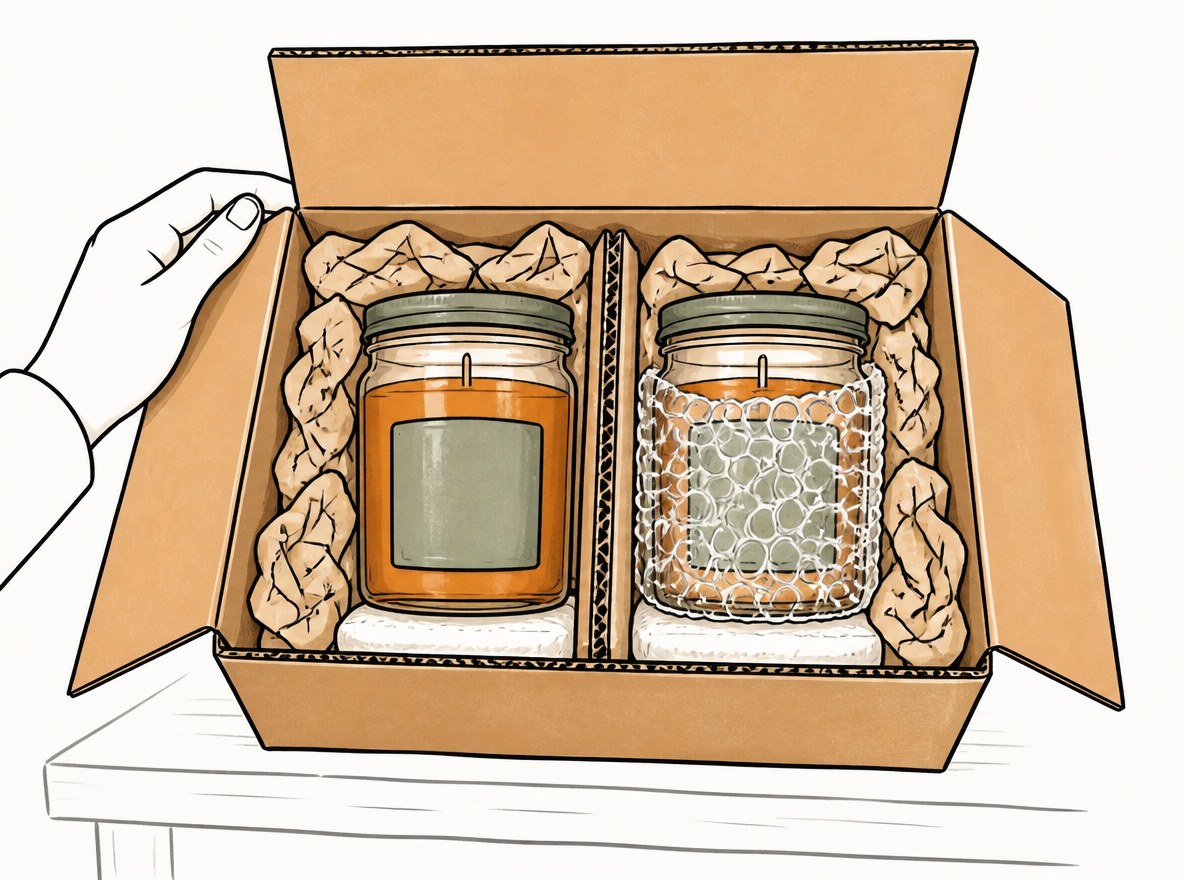
For a two-jar set, the critical change is the divider. Put a rigid corrugated or molded pulp partition between the jars, not a layer of bubble wrap. Glass against glass with soft material in between is a failure waiting for a corner drop. Once the divider is in, cushion the pair as one unit.

Hand-drawn ink cutaway of two candle jars standing upright inside an open carton, separated by a rigid corrugated divider, with half an inch of cushioning under each base, an inch of headspace above the lids, void fill packed into the corners, and a hand steadying the box flap.
The divider turns glass-on-glass contact from a cushioning problem into a structural one. Do not skip it.

A "Fragile" sticker is a courtesy, not a control. It does not change how the parcel is sorted, and it will not save a claim. The cushioning does.

Prove the pack with test shipments

Before you print a hundred labels, mail five parcels to yourself or a colleague: at least one to a nearby zone, one to a far zone, and one that travels over a weekend. Photograph every box before you open it, and record:

  • Pack recipe version and box size
  • Service and zone
  • Arrival condition of jar, lid, wax surface, wick
  • Any scuff, chip, lean, or seep

For a repeatable drop test, use a parcel-simulation sequence rather than your own guess at what a sorting belt does. ISTA 3A is the common reference procedure for parcel delivery shipments, described in the ISTA 3A overview. A jar that survives ten drops on a concrete floor in your warehouse is not evidence; a jar that survives a standardized sequence plus real handling is. The general method for fragile goods is covered in shipping packages safely.

3. Plan around heat the way you plan around weight

This is the section that separates candle sellers who refund from candle sellers who do not.

Wax softens well below the temperatures a parcel actually sees. Typical melting ranges are roughly 120 to 125°F for soy, 125 to 140°F for paraffin, and 144 to 147°F for beeswax, with coconut wax much lower, as summarized in this candle wax melting point and pour temperature chart. Your own supplier's spec sheet is the only number that matters for your blend, because container blends are formulated to hold shape and vary widely.

Delivery vehicles get hotter than that. UPS workers have shared photos of thermometer readings up to 150°F in the backs of their trucks, reported in The New York Times on heat inside delivery vehicles. Add a trailer parked in the sun, a metal loading dock, or a porch that faces west in the afternoon.

Heat does not usually melt a candle into a puddle. It does something subtler and more expensive:

  • The wax surface softens against the lid and scuffs, so the candle is unsellable but not broken.
  • The wick leans or curls, which becomes a burn-quality complaint even if the jar is intact.
  • Fragrance oil separates and seeps around the lid, leaving a grease ring on the box and a candle that looks used.
  • Label adhesive lifts at the edges.
  • Glass takes thermal stress when a hot parcel meets an air-conditioned entryway, which is exactly when a hairline crack appears.

Then the claim gets denied. Under DMM 609 on indemnity claims, USPS excludes perishable contents that are melted, spoiled, or deteriorated, damage from the fragile nature of the article regardless of packaging, and damage from shock or the transportation environment without evidence of damage to the container. Melted wax is not a covered loss, and a cracked jar inside a clean box is a hard claim to win. Plan for heat; do not insure against it.

A heat policy you can run

Set thresholds by the forecast at the destination, not at your warehouse. This example policy is hypothetical and should be tuned to your wax:

Destination high on delivery dayWhat to do
Under 80°FStandard pack, any ship day
80 to 90°FAdd a reflective bubble liner, ship Monday to Wednesday
90 to 100°FReflective liner plus a phase change pack, Monday to Wednesday, evaluate a 2 to 3 day service
Over 100°FHold, upgrade, or ship only early in the week to an address where someone receives the parcel

Three things make the policy work:

  • Ship early in the week. A parcel dropped Thursday or Friday can sit in a hub or a delivery vehicle over a weekend. For hot destinations, Monday through Wednesday departures cut exposure.
  • Use phase change packs, not wet ice. Phase change material holds a temperature band and produces far less condensation than gel packs. Even so, bag it: a sweating pack inside a paper box softens the corrugated and can wick into the label. Keep it off the wax surface and away from the label.
  • Accept the limit. Standard ground parcel service is not a temperature-controlled service. Insulation buys hours, not days. If a customer needs a candle delivered cold in July, the honest answer is a shorter transit time or a different promise, not a thicker liner.

4. Compare transport options on identical parcels

A comparison is only meaningful when the weight, dimensions, destination ZIP, and ship date are identical. Change any one and you are comparing two different products.

Order B, shipped to zone 5, prices at 12.12 dollars for Ground Advantage at 3 lb and 17.41 dollars for Priority Mail at 3 lb in the current Notice 123 price list. Whether UPS Ground or FedEx Ground beats that on your lane depends on your negotiated rates and the residential surcharge you actually pay, so pull a quote rather than borrowing someone else's blog number.

Ground Advantage carries a 2 to 5 business day expected range, tracking, and 100 dollars of included insurance, per the USPS Ground Advantage page. Build the comparison sheet with these columns, one row per service:

FieldWhy it changes the answer
Service and billable weightThe billed number, not the scale number
Zone and destination typeResidential surcharges and remote areas
Quoted price and surchargesDim weight, additional handling, oversize, fuel
Expected transit daysThe heat exposure window
Included coverage and claim termsWho pays when a jar arrives cracked
Delivery scan and proof of deliveryWhat you can show a customer

Then convert every row to cost per delivered order, which is the quoted price plus the damage allowance for that service. A cheaper service with a higher damage rate is often the more expensive choice, and the gap only shows up when you multiply by volume.

On coverage, know what you are buying:

  • USPS Ground Advantage and Priority Mail include 100 dollars of insurance; additional coverage for a value up to 50 dollars costs 2.80 dollars in the current fee table, per Notice 123.
  • Damage claims must be filed no later than 60 days from the mailing date, and fault-based exclusions apply, per DMM 609.
  • Included coverage is not a packaging strategy. It is a backstop for the losses that survive good packaging.

5. Turn the pack into a repeatable recipe

Once a pack survives testing, write it down as a recipe card. This is the difference between a process and a person who knows how to do it.

Pack recipe fields

  • SKU and recipe version
  • Box SKU and outer dimensions
  • Insert or cradle SKU
  • Wrap and cushion materials, with quantities
  • Tape pattern and label placement
  • Target gross weight and target billable weight
  • Photo of a finished, closed pack and a finished, opened pack

Example cost build, zone 5, USPS Ground Advantage commercial prices from Notice 123. Material costs, labor rate, damage rates, and product costs are hypothetical.

Line itemOrder AOrder BOrder C
Box0.55 dollars0.75 dollars1.35 dollars
Insert, wrap, cushioning0.35 dollars0.60 dollars0.45 dollars
Tape, label, small consumables0.15 dollars0.25 dollars0.20 dollars
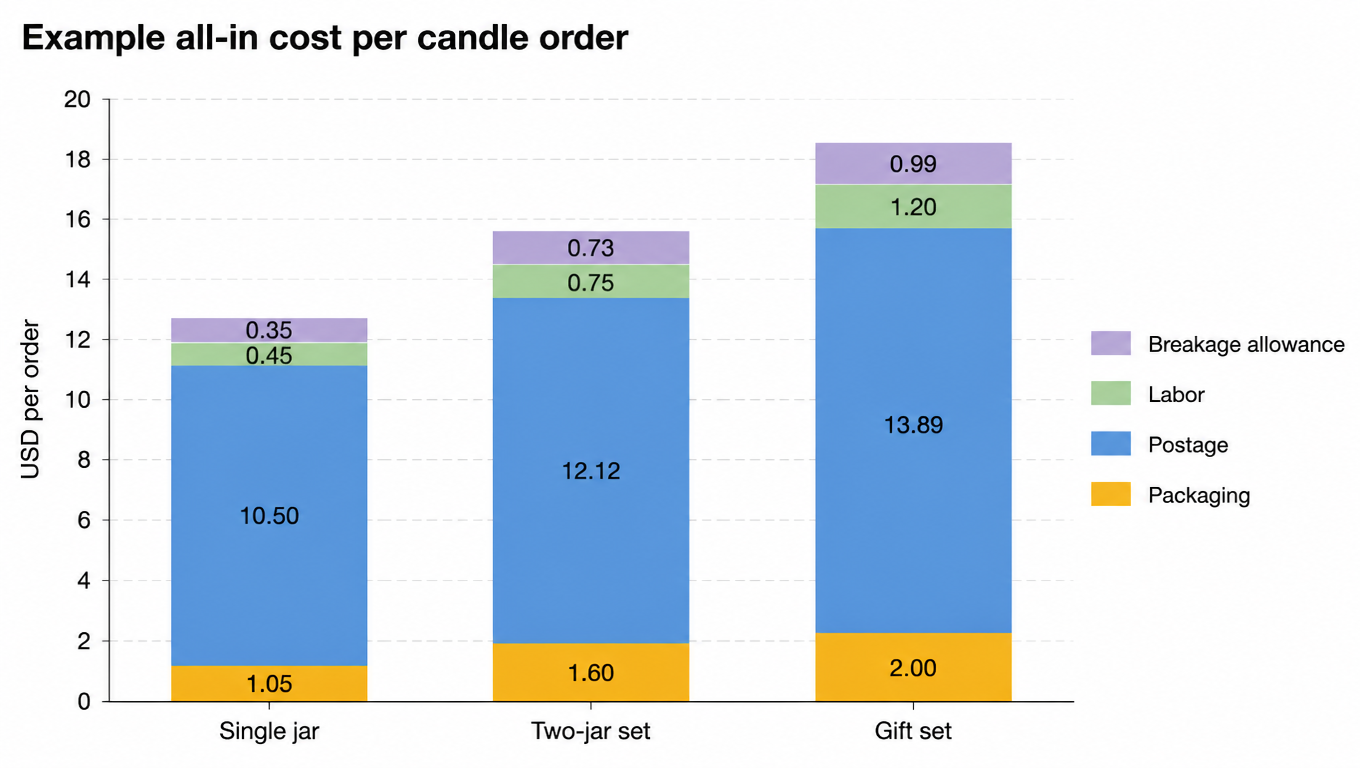
Packaging subtotal1.05 dollars1.60 dollars2.00 dollars
Pack labor (at 18 dollars per hour loaded)0.45 dollars0.75 dollars1.20 dollars
Postage, billable weight10.50 dollars12.12 dollars13.89 dollars
Breakage allowance (2 percent, 3 percent, 3 percent)0.35 dollars0.73 dollars0.99 dollars
Fully loaded cost12.35 dollars15.20 dollars18.08 dollars
Stacked bar chart of example all-in cost per candle order, 12.35 dollars for a single jar, 15.20 dollars for a two-jar set, and 18.08 dollars for a gift set, split into packaging, postage, labor, and breakage allowance
Postage is the biggest block, but most of the movable cost sits in packaging and the breakage allowance.

The interesting number is not the postage line. It is that packaging plus labor is 12 to 18 percent of the total, and the breakage allowance is small only because the pack is good. If the recipe regresses, the allowance moves the other way fast: at a 10 percent damage rate, Order C carries about 3.31 dollars of allowance on every order instead of 0.99 dollars.

Now instrument it.

  • Log every damage with SKU, recipe version, service, zone, date, damage type, and photos.
  • Log damage per 100 parcels by recipe version, not by month alone. Version tagging is what tells you whether the new insert worked.
  • Review the breakage allowance quarterly against the log, and reprice the shipping charge if it drifts.
  • Re-test whenever the box, insert, jar supplier, or wax blend changes. A new jar with a slightly different shoulder can invalidate a pack that worked for a year.

Handing off to a 3PL or a warehouse team means giving the operator the recipe card, a finished sample, and the test result, not a verbal description. State what may be substituted and what may not. "Use any box that fits" is how your billable weight and your damage rate both drift. Require a photo of any pack that deviates, and audit a sample monthly against the card. Whether the packaging itself pays for that is the subject of the parcel-first packaging cost audit, alongside box versus poly mailer versus padded mailer.

6. If the candle, or the gift set, counts as hazardous

Most candles are ordinary goods. Solid wax in a glass jar is not a hazardous material, and USPS does not restrict it as one. The problems arrive with the extras, the liquids, and the marketing names.

Fragrance oils and liquid refills. A fragrance oil is a liquid, and some have low flash points. Under USPS Publication 52 section 343, flammable liquids are prohibited in international mail and in domestic air transportation. In domestic surface mail, a liquid with a flash point at or below 20°F is not mailable at all, and liquids above that threshold are mailable only if they qualify as a Limited Quantity surface material under Packaging Instruction 3A. If you sell a refill bottle alongside a candle, that bottle sets the rules for the whole parcel. Liquid formats generally are covered in shipping liquids via USPS.

Matches. Safety matches (book, card, or strike-on-box) are Class 4.1 and are prohibited in air transportation, mailable only under Packaging Instruction 4B surface rules. Strike-anywhere matches are prohibited outright, per Publication 52 Appendix A, the hazardous materials table. That means a gift set with a matchbox is a surface parcel, which in practice points you to Ground Advantage rather than an air service. The price list also carries a hazardous materials handling fee of 7.50 dollars on Priority Mail and on retail Ground Advantage, and 0.00 dollars on commercial Ground Advantage, so service choice can change both eligibility and cost. Ask for the fee to be confirmed at acceptance on your first such mailing.

Lighters. Lighters with liquid fuel or flammable gas are Class 3 or Division 2.1. Mailing them requires a DOT-approved lighter design with an approval number, written authorization from USPS, surface-only transport, specific packaging, and the required markings, per Publication 52 section 343. This is not a box you check on a whim.

"Roman candle." Despite the name, it is a firework, and fireworks are prohibited in the mail stream. If your product copy uses the phrase for a candle shape, make sure nobody in fulfillment reads it as pyrotechnics. The wider handling rules are in USPS hazardous materials requirements.

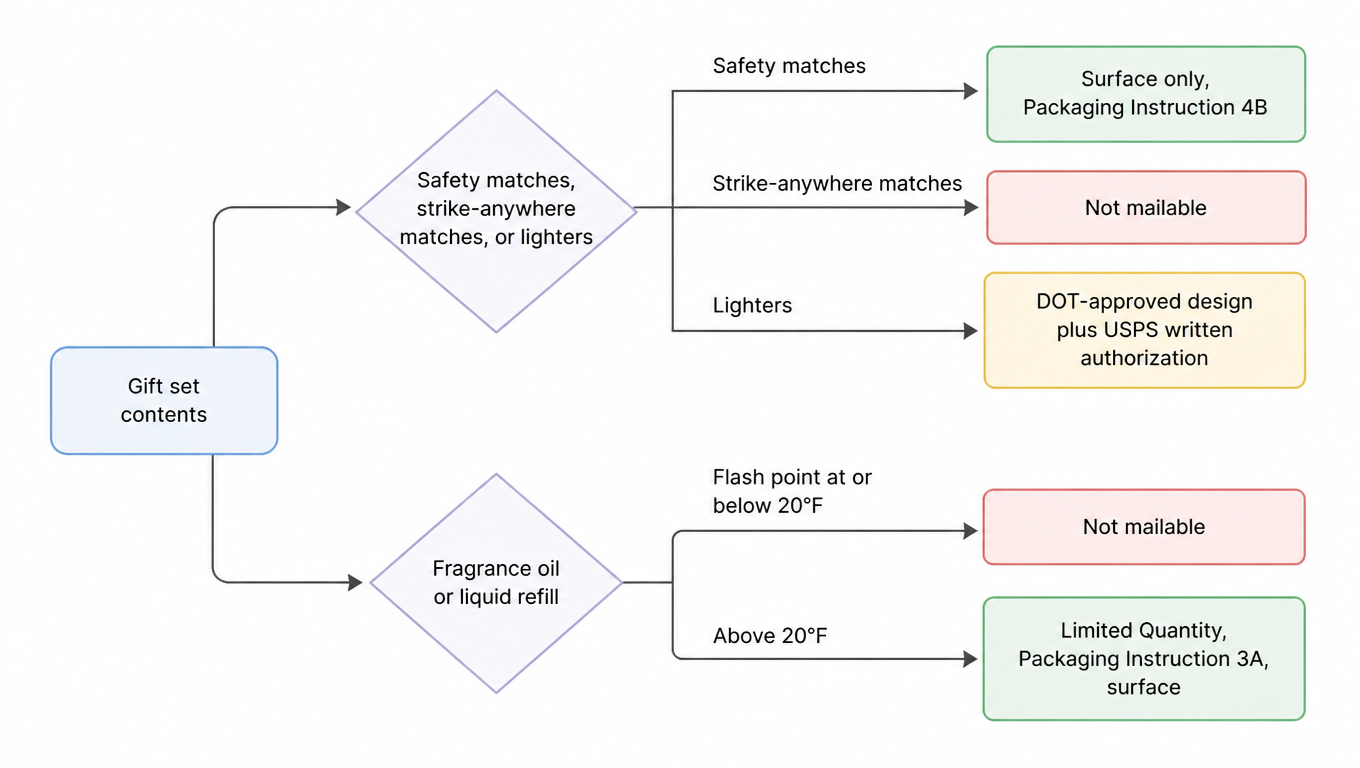
Decision tree for gift set contents: safety matches ship surface only under Packaging Instruction 4B, strike-anywhere matches are not mailable, lighters need a DOT-approved design plus USPS written authorization, and fragrance oil or liquid refills are not mailable at or below a 20 degree Fahrenheit flash point but may move as Limited Quantity surface material under Packaging Instruction 3A above it
Break the gift set into its contents before reading the rules. One branch decides whether the box ships at all, and on which service.

Before the first gift-set mailing, do three things: get the safety data sheet for every liquid in the box, confirm the flash point of each, and walk the prepared parcel into your local Post Office and ask for an acceptance check. Then write the answer into the recipe card, so the next person does not have to rediscover it.

A Monday morning sequence that fixes the number

  1. Weigh and measure Orders A, B, and C, and record the outer dimensions, not the product dimensions.
  2. Rebuild the three boxes to the smallest carton that still gives 2 inches of cushioning on every side.
  3. Mail five test parcels per recipe, including one over a weekend, and inspect before you unpack.
  4. Set the heat policy by destination forecast, and put the ship-day rule into your order routing.
  5. Quote the same parcel and ZIP across your services, then compare cost per delivered order, not label price.
  6. Write the recipe card, log damages by version, and review the breakage allowance every quarter.

A candle program gets cheaper in two places: a smaller box that cuts billable weight, and a pack that keeps the jar out of the claims queue. Both are decisions you make once and then hold, which is exactly the kind of decision a shipping layer should be enforcing rather than a packer remembering at 4:40 on a Friday. Estimate the size effect first with the dimensional weight calculator, then take the real parcel to a full quote. The measurement conventions behind that calculation are set out in how dimensional weight works.

FAQ

No. Solid wax in a glass jar is ordinary goods. The items that need their own decision are the extras in a gift set: safety matches are surface only, strike-anywhere matches and fireworks are prohibited, liquid fragrance is judged by flash point, and lighters need a DOT-approved design plus USPS written authorization.
On the example build in this guide, a single 8 oz order to zone 5 comes to 12.35 dollars all in: 10.50 dollars of postage, 1.05 dollars of packaging, 0.45 dollars of labor, and 0.35 dollars of breakage allowance. Substitute your own box cost, labor rate, and damage rate and the total moves, but the structure does not.
Usually not into a puddle, but it softens below its melting point, scuffs, leans the wick, and seeps fragrance, which is enough to make it unsellable. Most of that damage falls outside carrier indemnity, so prevent it with packaging and weekday departures rather than insuring against it.
Not for glass jars. A padded mailer provides surface cushioning, not structural support, so the jar takes belt impacts directly and cannot be kept upright. A mailer only works when the container itself resists compression and a rigid insert holds the jar in place. The full trade-off is covered in box versus poly mailer versus padded mailer.
Read the exclusions first. Damage from the fragile nature of the article, and shock damage without evidence of container damage, are outside USPS indemnity. Coverage helps with loss and total destruction, and does very little for melt and hairline cracks. The better return is in dividers, inserts, and test shipments.

Measure the parcel, then compare the full quote

Postage is where most of a candle order's cost sits, and the two levers that move it are box size and pack quality. Weigh and measure the finished parcel once, store it on the SKU, then compare that parcel against the carrier options actually eligible for the destination, with their full charges and coverage.

EasyShippingX compares carrier options inside the US in one place as a channel-neutral shipping layer and executes them through the Portal, Excel, or the API.