Parcel Shipping

Prepaid Return Labels: Should You Put One in Every Box or Send It on Request?

“If we don't pay postage on an unused return label, why not put one in every box?” the apparel brand’s operations lead asks. The warehouse supervisor pulls two orders for the same shirt. One is a size exchange that always comes back to this building. The other came through a marketplace that controls the return instructions. Include a prepaid return label when the channel permits it, the receiving address and service are predictable, and the support work avoided pays for handling every box. Compare on-demand issuance when any of those conditions changes. Check what the actual account charges before choosing either route.

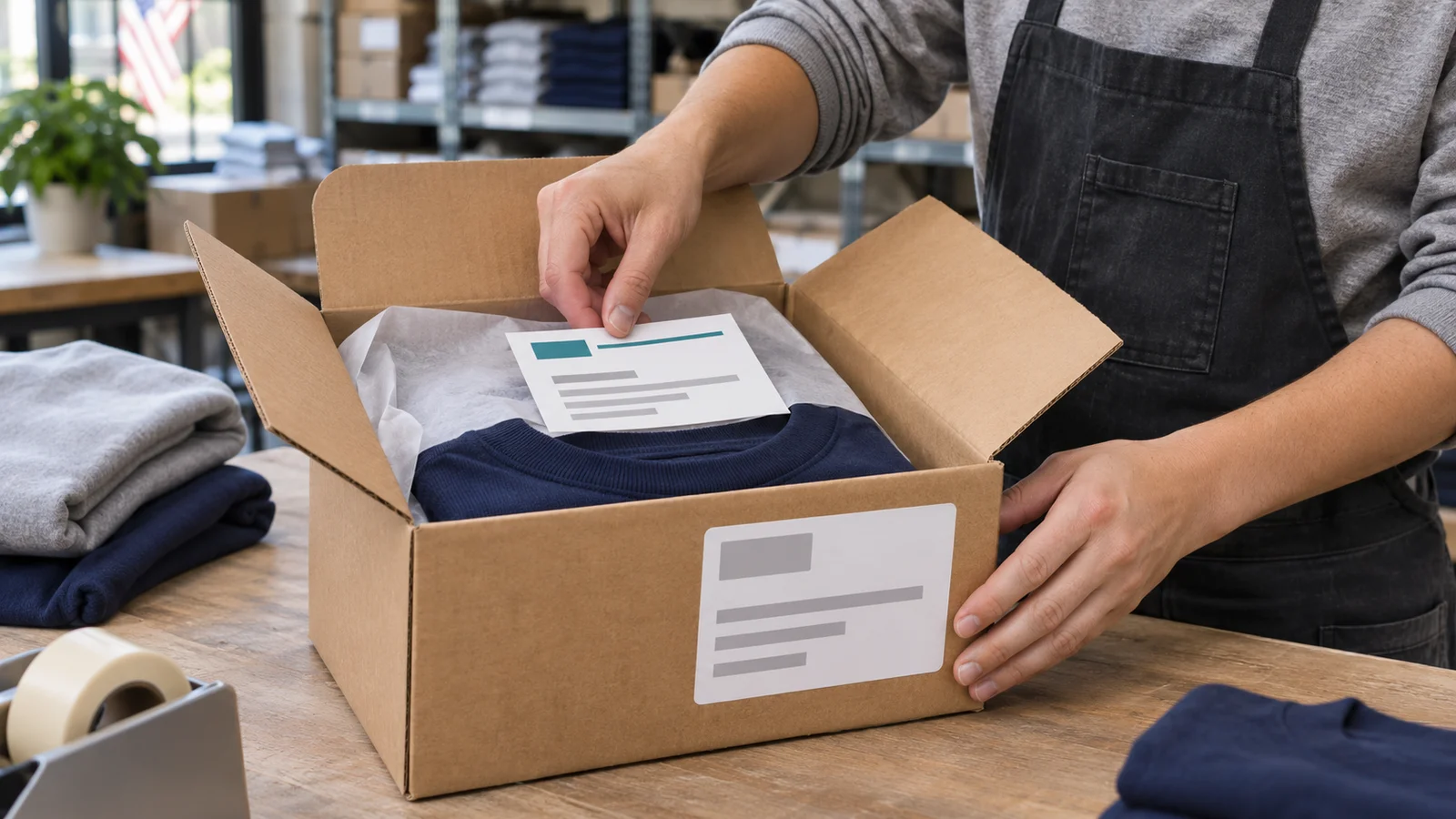
An apparel packer places a loose return sheet inside the carton. A separate outbound label is attached to the outside.
Match both labels to the carton while it is still open.

Decide what the label actually promises

At the packing bench, “prepaid” tells the buyer that a merchant-provided label can be used without buying postage at the counter. It does not tell the accountant when the carrier or label provider bills the merchant. Nor does it settle who ultimately bears the expense. A brand might cover a defective item and, where its published policy and channel rules allow, deduct a disclosed return shipping amount for a change of mind. Keep that customer charge on its own line. It need not equal the amount the carrier eventually bills.

Give each order rule three fields: when the buyer gets the label, what triggers postage on this account, and what the buyer was told about payment. A PDF can arrive after approval or be printed before the box leaves. A QR code may let a participating location print a label if the service supports it. Neither the file format nor the presence of a code tells you whether postage has been incurred, whether packaging is required, or whether that location accepts the parcel. Confirm the drop-off method before offering it to a buyer who cannot print.

CombinationBuyer receivesMerchant postage eventWho bears the cost?
Product · Shippo domestic returnPaper with eligible outbound purchaseCarrier scans the used return Shippo return labelsSeparate brand/channel policy
Product · Etsy USPS returnMessage after requestBuyer uses label and USPS scans it Etsy USPS return labelsCheck shop and channel policy
Concept example · brand-paid exchangePaper in the boxUse triggers postage by assumptionBrand absorbs it
Concept example · buyer contributionPDF after approvalAssume the account pays at creationBuyer contributes the disclosed amount if permitted

The real product examples in the table were checked November 19, 2026. This guide follows a parcel from a U.S. buyer to a U.S. receiving point. An overseas brand using a U.S. warehouse can use the same worksheet for that domestic leg. Start with the orders for which both alternatives really are available. Keep a note of the channel, policy version, eligible items, account and return site. A program that requires authorization can still use paper in a box if the program permits it and the instructions explain when the customer may use it. A paper label alone grants no authorization. Compare QR, box-free and mail-in returns

Price the same 1,000 outbound parcels twice

Suppose a brand ships 1,000 eligible parcels this month. In both alternatives the same buyers send back the same parcels, using the same pay-on-use service at the same postage. The insert costs an extra $0.18 per outbound parcel for printing, matching and insertion. On request, an agent spends $0.90 per request that needs manual label issuance, including requests that never produce a shipment. In this first comparison the insert eliminates all of that issuance work. All dollar figures in the exercise are teaching inputs. Use measured labor and the terms of your account to price a real cohort.

Eligible parcelsManual requestsInsert costOn-demand costLower operating cost
1,00080$180$72On demand by $108
1,000200$180$180Even
1,000300$180$270In box by $90

Download the bilingual Excel workbook · Copy the cost worksheet

Per 1,000 outbound parcels the insert costs $180. Manual issuance costs $72 at 80 requests, $180 at 200, and $270 at 300.
Incremental handling only. Both routes use the same postage in this hypothetical cohort.

With 80 manual requests, the pack bench spends $180 and the service desk would spend $72. Send on request and retain the $108 difference. At 300 manual requests the desk spends $270, so inserting the labels saves $90. The intercept matters here: the pack team does the same work on all 1,000 parcels even if nobody returns anything. Divide $180 by $0.90 to get 200 manual requests for equality. At exactly 200 both cost $180. Request 201 tips the comparison toward the insert if every other assumption still holds.

Write the general test as eligible outbound parcels times incremental insert cost versus manual issuance requests times incremental issue cost. The 20% crossing is requests requiring an agent divided by eligible outbound parcels. One order can produce two parcels, one request can cover several items, and a buyer can ask for a label without mailing anything. Counting orders in one column and received returns in the other gives a ratio with no connection to this calculation. Keep a distinct request ID and treat a resend under the same request as extra work only when it actually takes time.

Measure both unit costs during ordinary production. Time a run of comparable boxes with and without the extra sheet. Include the pause to verify the brand and the time to destroy a mismatched print. At the desk, time the label-specific steps separately from eligibility review, which both programs may require. If a 3PL quotes one bundled fee, ask what triggers it and which tasks are included. A per-order kitting charge and a second charge for the same insert motion would double-count labor. A monthly portal fee belongs in the comparison only to the extent that the decision changes that bill.

Automation and rerouting can reverse the choice

Now let 240 of the 300 requests receive a PDF automatically at zero additional cost in this exercise. Only 60 requests would reach an agent. In-box labels can displace at most $54 of that manual work, while still adding $180 at packout. On demand is ahead by $126. Check what “automated” means in the ticket history. An email generated automatically after an agent measures a carton, chooses the site and buys a label still includes manual issuance. Count the human steps that would disappear, and add any incremental per-request software fee to the route that incurs it.

Return to the fully manual, 300-request case. Suppose 40 insert recipients still need the same $0.90 assistance, and 12 parcels sent to the preprinted address need an incremental $6 transfer apiece. The insert now costs $180 + $36 + $72 = $288 against $270 on demand. A $90 advantage has become an $18 disadvantage. Include a transfer only if the comparison route would have avoided it. If contacts are shorter than a full issue, time them and replace $0.90. If rerouting changes postage or handling at the second site, use the complete incremental charge once.

Price an exception from the ticket and both warehouses’ work orders. A second warehouse may bill for receiving and grading even if the transfer carrier bills the brand directly. Ask which of those tasks would also have occurred at the intended site. Bring only the difference into the label-placement decision.

Close the month without losing the return cohort

Give finance a second view of the same 80-request example. Assume one request and one label per buyer on demand, no replacements, and 65 packages actually tendered. In the insert alternative 1,000 labels were issued, yet the same 65 packages traveled. Use an assumed final $6 postage per used parcel for both groups. Both owe $390 for this cohort when complete. Fully counted postage plus modeled operations is $570 with inserts and $462 on demand. The $108 gap is unchanged. This cancellation stops working as soon as weight, parcel count, service, destination or actual use differs.

Suppose at month-end the carrier has evidence of all 65 tenders, the warehouse has checked in 60, and 55 charges totaling $330 have posted. Ten more charges totaling $60 will appear next month in this example. If the merchant has actually settled only 50 of the posted charges by month-end, cash out is $300, with $30 posted but unpaid and $60 still to post. The five parcels pending warehouse receipt are a logistics exception list. They are not necessarily the same parcels as the ten unposted charges. Match tracking IDs before asking the warehouse to find anything.

Use one row per return parcel and a separate line for each fee event. Retain the issue date, first carrier evidence, receiving document, expected postage, statement ID and payment date. Roll each month's cash by settlement date and roll cohort cost by original outbound batch. Keep an open estimate until the billed amount is known, then replace it with the final charge. Do not add the estimate to the bill. Payroll timing may differ as well. The $72 for manual issuance measures resources consumed on 80 requests even if those agents are paid in the next payroll cycle.

An account billed at creation needs a different cash model. Multiply labels purchased by the price paid at creation, then separately record adjustments, eligible void requests and credits actually received. Show pending credits with a follow-up owner and deadline from the applicable terms. Do not treat every unused label as cash recovered. Before rolling out preprinting, buy a small authorized test batch, save the purchase record and follow one eligible cancellation through the statement. If a provider cannot confirm the credit terms, leave that recovery uncommitted in the estimate and price the exposure before buying labels for an entire wave.

For a statement without an order number, start with the provider account, return tracking number and billed service. Look for a replacement ID or a reweigh before treating a difference as an unused label charge. A fee on the same day as printing might belong to an earlier shipment. Leave an unmatched line open with its source document.

Read the product terms attached to your account

The following product checks are dated November 19, 2026. Shippo’s instructions cover domestic return labels for outbound shipments purchased in Shippo. When the return is created with the outbound label, Shippo reverses the addresses and carries over the parcel information, carrier and service. It describes billing when the carrier scans the return. Creating the label later allows details such as dimensions and service to change. That distinction matters to a brand whose shipping warehouse cannot receive damaged stock. Inspect a sample label before enabling automatic creation across outbound shipments. Shippo return labels

Pirate Ship describes a pay-on-use return feature that an approved account must request from support. Its article specifies USPS return labels, with exclusions including Media Mail and Priority Mail Express. It describes charging when USPS scans the used return and a 90-day life for these USPS pay-on-use labels on Pirate Ship. For a holiday exchange program, compare that clock with the time between printing and when the buyer could reasonably mail the exchange. Ask who supplies a replacement after expiration. A validity period quoted for another provider is a poor basis for buying a season’s inventory of labels. Pirate Ship return labels

EasyPost’s API support page draws a distinction within one provider. It describes scan-based return labels with a shipper’s own carrier accounts and billing at generation for Wallet Carriers. It separately identifies a USPS Pay-on-Delivery Returns service billed upon delivery, for which interested shippers should contact support. The difference affects exposure on unused paper even if two labels look identical. Get the carrier account ID, product and charge event in writing. USPS itself lists scan-based payment for USPS Ground Advantage Return and the Priority Mail return products on its commercial Customer Returns page. Check which product your intermediary actually supplies. EasyPost Returns · USPS Customer Returns

When an Etsy return hits the seller’s account

Take an illustrative Etsy sale by a U.S. shop to a buyer in one of the 50 states. On Monday the buyer messages about returning one shirt. The seller confirms the item and package details, creates an Etsy USPS return label against the completed order and sends it in an Etsy Message. The displayed price is an estimate. On Thursday the buyer hands over the parcel and USPS scans it. That use triggers the postage charge. Etsy says the final amount is based on the package USPS ships and generally appears in the seller’s Payment account a few days after delivery. Record the actual posting date. Etsy USPS return labels

Parallel timelines distinguish an Etsy seller sending a label, USPS scanning and delivering it, warehouse receipt and posting in the seller’s Payment account.
Etsy USPS return label for an eligible U.S. sale. Illustrative weekdays. Warehouse check-in and account posting each need their own evidence and can occur in either order.

The receiving clerk still has to identify the unit inside the carton. Carrier delivery supplies one timestamp, warehouse check-in supplies another, and the shop records the refund under its applicable policy. Etsy limits this label flow to eligible Etsy sales between U.S. buyers and sellers, excludes territories and military addresses, and requires a guest buyer to attach the order to an Etsy account to receive a label. If an unused label must be replaced, Etsy directs the seller to ask the buyer not to use it. Once used it cannot be canceled or refunded. Keep the obsolete label linked to the case. Etsy USPS return labels

Give the pack bench rules it can execute

Start with the channel and the authority to issue. If the channel has already issued a label, suppress the warehouse print job and direct the customer to that return. If authority is unclear, hold label issuance for a named channel owner to resolve. Keep the original outbound dispatch on schedule unless its own requirements demand a hold. Next ask whether this item, in the package it is likely to come back in, can go to a known site with a suitable service. Only then does the manual workload determine whether an insert earns its place.

Follow channel authority, destination and service certainty, then manual issuance cost to select the pack instruction.
Resolve channel authority before a cost comparison can release an insert.
Brand / channelItem groupAuthorization first?Site knownIssuerInsert?Exception actionRule owner
A · own storeStandard apparelStanding approval for eligible size exchangesAt packoutBrand-authorized 3PLYes, eligible cartons onlyOther reasons go to service before useBrand returns lead
B · own storeSealed or damaged goodsYesAfter reason reviewBrand returns deskNoDamage goes to inspectionReturns manager
C · own storeMulti-item or split ordersYesAfter items and carton countAuthorized service agentNoConfirm specs and issue one ID per boxFulfillment lead
A · marketplaceSame apparel SKUPer channelDuring platform flowChannel-designated issuerSuppress warehouse copyLook up existing case and labelChannel owner

Download the filled packing rules and blank template

For a single-site apparel brand, define the eligible slice in terms the WMS can identify: brand, own-store channel, standard unaltered apparel and the receiving operation that accepts all permitted exchanges. An enclosed sheet helps a buyer without a home printer, provided the buyer can prepare and tender the package. Keep unusual bundles and restricted dispositions out. On a multi-site DTC account, the very same shirt may need a different rule. If a sealed return can go straight to saleable stock but a damaged one needs inspection, wait for the reason before selecting the site. Choose a receiving warehouse

On a split order, an outbound carton is a reference, not a prediction of the return carton. A customer who received three items in two boxes may send one item in a smaller mailer. Obtain the expected packed weight, outside dimensions and number of return packages. Issue one valid tracking identity per physical parcel. If the buyer intends to combine items from two authorizations, have the receiving team confirm it can recognize both sets of lines in one box before approving that arrangement. Otherwise explain which item goes in which parcel and how to identify each one.

Give every rule a version, effective time and owner who can change it. Test a positive and a negative order at the same pack station, particularly when the warehouse serves two storefronts using identical apparel and cartons. A 3PL employee should be able to see why the second order produced no return sheet. If the brand changes a rule after a pick list has been released, explicitly decide which open waves use the revision. Archive the old version with the shipment history so customer service can reconstruct what a buyer received weeks later.

On a multi-brand account, send customer service a copy of the same rule row that drives packing. Give each brand its approved sender identity and its destination code. A support agent searching only by a shared SKU may find a perfectly valid address belonging to a different client. Require the order’s channel and brand before revealing a printable label.

Hand off each workflow from packing through settlement

For an insert, the packer scans the actual outbound carton, verifies the brand and selling channel, and reads the matching rule. The system or operator pairs the outbound carton ID with a distinct return identifier and the approved destination. Compare the printed return site with the current rule, including suite or receiving unit where relevant. Put the carrier’s outbound shipping label on the outside and the return label inside with a short instruction about authorization. Seal the carton, then record which insert version and return ID went into it. A batch print count alone cannot identify a mispacked box.

Stage the two documents in separate trays or use a one-carton-at-a-time print sequence. If the printer jams, count the physical pages against the open cartons and quarantine the unmatched sheets before resuming. A reprint of the same label and a replacement with a new tracking ID need different records. Give the buyer a small, unambiguous instruction identifying the sheet to use after authorization and how to cover or remove old shipping marks when reusing a carton. At wave close, investigate any eligible carton without a recorded insert and any insert ID assigned to two cartons.

On demand, the agent first verifies the buyer’s order, exact return lines, reason and intended package count. Apply the channel policy and record approval or the unresolved question. A return merchandise authorization, or RMA, identifies what may come back. Enter the approved site and parcel specifications, create the label under the correct account and send it through the allowed channel. Confirm that the buyer can actually use the method delivered. Save the issue event and monitor carrier evidence. A sent message may have bounced, and even a downloaded label says nothing about whether a parcel entered transportation.

At the receiving dock, match the inbound parcel to the authorization, open it according to the brand’s procedure and record the actual SKU, quantity and condition. Reserve a separate status for delivered but awaiting inspection. Customer service uses the applicable refund trigger and records the credit against the approved item lines. Finance matches tracking and charge events to the provider statement. Where channel rules require an earlier refund, keep a pending receipt task after the refund has been sent. Map authorization, shipment, label and refund

Work three exceptions all the way to resolution

The buyer has two labels

First look up both tracking IDs, the original carton, the authorization and any carrier activity. Ask the buyer which label was attached and whether another parcel is still in their possession. The service lead designates the intended active label and sends one clear instruction. Ask the provider whether the other can be voided under this specific account. If neither shows movement, keep both on the watch list until the applicable window closes. If the old one already moved, tell the warehouse to expect that ID. Do not promise that marking it inactive in your WMS stops the carrier.

If both IDs move, investigate two physical parcels before approving anything twice. The returns lead links each receipt to its items and checks existing refund transactions. Finance matches both charge lines or keeps them open. Two postage charges may be legitimate even when only one unit qualifies for a refund. Conversely, one carrier event does not identify the contents. Close the case with the number of units actually received, the final refund decision and a note explaining each fee. Add a pre-issue lookup for existing labels so the next agent sees the insert before buying a replacement.

If a refund is pending in the payment system when the buyer writes again, read the transaction status before trying a second credit. Give one agent ownership of that financial action and let the warehouse keep posting evidence independently. A manually reviewed refund can be reconciled to an existing transaction even when the customer used the wrong label.

The brand moves its returns address

The warehouse manager sets a cutover time and separates unshipped stock from boxes already dispatched. Stop printing the old address, clear queued print jobs and check open waves. Rework sealed cartons still under warehouse control when required, record the replacement and reconcile the unused stack. For dispatched parcels, identify affected customers by outbound carton and label version. Have the brand confirm whether the old site can receive during a transition, how long it will hold freight, and who pays for forwarding. Changing a default address does not change the destination on a physical label already delivered.

Ask buyers who have not mailed to use the replacement instructions. For parcels in transit, the carrier liaison checks what recovery is actually available, while the old and new sites agree a manifest, handoff and receipt match. Keep the known old tracking IDs visible at both sites. If the old facility cannot accept anything, escalate with the brand before telling a buyer where to send the parcel. Close the transition after the return and label-use windows and outstanding movements have been reviewed. Include transfers, reprints and contacts in the cost of the insert program that produced them.

Three items sold, one item returned

Have the agent name the style, color, size and quantity on the authorization. Tell the buyer which item to send and what to keep. The receiving clerk scans the parcel, counts the contents and matches only that item line. If the expected blue medium arrives in a different size, send the discrepancy for review before restocking. If two units arrive under a one-unit authorization, record both as physically present while holding the unapproved unit for disposition. Never increase the authorized refund quantity merely to make it match the warehouse count.

Before crediting, look up the amount originally paid for that line, any earlier exchange or refund, and the channel’s treatment of discounts and return shipping. The person releasing the refund checks authorized quantity, physical evidence and the applicable timing rule. An exchange shipment has its own outbound ID. If the channel already refunded the unit, attach its transaction reference instead of issuing a second credit. Leave the two retained items in their original sold state. This item-level close lets a 3PL explain why a three-line order has one return receipt and one financial adjustment.

Run a small pilot and close it on the bill

Pick one brand, one channel and one eligible product group. Assign comparable outbound parcels to insert or on demand before customers request returns. Keep the return policy, destination, postage product and available help consistent. Avoid assigning the whole sale weekend to one group or letting agents choose the insert for familiar shoppers. Keep split shipments from one order in the same policy group and count the eligible outbound parcels in each. Record any crossover, including an agent-issued replacement for an insert, against the group that originally shipped it.

Report incremental operating costs per 1,000 eligible outbound parcels in each group. Add printing, extra touches, label support and avoidable transfers, divide by eligible parcels shipped and multiply by 1,000. Also show final postage separately and the all-in total if actual usage differed. Report manual issuance requests, all return-related customer contacts and wrong-site parcels as both counts and rates per 1,000. A single request may generate three contacts, so keep those measures separate. For time to tender, use the interval from the first recorded request to the first carrier event documenting physical handover, and publish the number still waiting.

Watch a measurement trap. A buyer with paper may mail without contacting the shop. Unless the process captures an authorization or other request time, that parcel has no measurable request-to-tender interval. Flag it and report the share of tendered parcels with a usable start time in each group. Never enter zero for a missing timestamp. Wait for the policy return window and the billing observation period to close, reconcile outstanding items, and review the distribution of delays alongside the money. Fewer parcels received can reflect late mail, a different item mix or buyers unable to complete the return.

Bring one buyer journey from each group to the review. For a long delay, find out whether the customer was waiting for approval, a working file, a printer or a pickup. Correct the specific bottleneck and run the same comparison again. An agent who resent an unreadable PDF solved a different problem from one who had to choose a new receiving site.

Approve the insert for the tested slice if reconciled savings survive the extra contacts and transfers and the service team can account for unresolved returns. Narrow the rule if gains are confined to particular exchanges. Keep on demand when routing depends on condition or automation already handles most issues at low cost. Name the policy owner, the date for the next review and the events that reopen it, especially a receiving-site change or a change of label account. For a review of outbound U.S. parcel volume and available shipping channels, sellers and multi-brand warehouses can contact EasyShippingX.

Prepaid return label FAQ

Check the named account and product. Shippo describes scans for its pay-on-use returns. EasyPost distinguishes Wallet Carrier generation charges from scan-based returns on a shipper’s own carrier account.

Yes, where the channel permits it. Set an explicit eligible brand, channel, item group, receiving site and service. Test an excluded order at the same station.

Rework cartons still under warehouse control. Identify dispatched labels by version, contact buyers who have not shipped, and arrange documented receipt or recovery for parcels already moving.

Count manual issuance requests the insert would actually avoid, per eligible outbound parcel. Add residual contacts and transfers before deciding. The worked example breaks even at 200 requests per 1,000 parcels.

Use the channel’s refund rule and the approved item lines. A carrier scan records transport. Check warehouse receipt and any refund already issued in their respective records.