How many shipping box sizes should a warehouse stock? Keep the sizes that can protect the orders you actually ship and earn their shelf space over the next buying cycle. Start with a month of orders packed in a visibly roomy box. Count the combinations that could use the same smaller carton, then price those exact shipments again. Cartonization picks a box from the rack for an individual order. Carton assortment planning decides what will be on that rack when the next purchase order arrives.
Save the order and carton IDs with a bench photo so purchasing can count similar shipments.
Start with the order behind the photograph
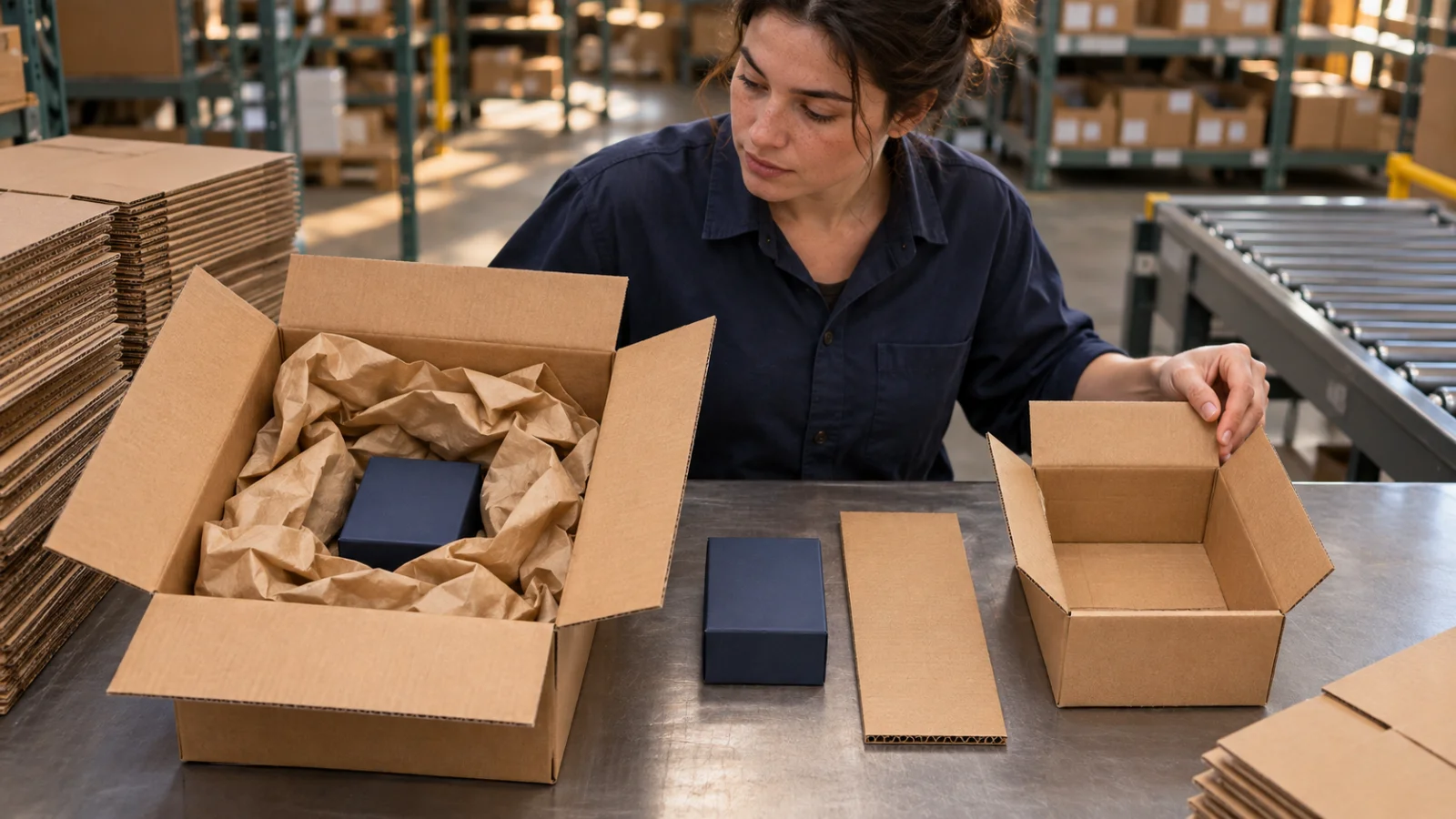
A packer pulls handfuls of kraft paper from a carton and points to the little accessory at the bottom. “We should buy the next size down.” The buyer has two questions. How often did this happen last month, and would the carrier have charged less? Save the order ID and carton code with the photo. They let someone pull the components, repeat the pack and trace the final freight charge. A photograph by itself cannot tell purchasing whether to order a pallet of blanks.
The pack lead signs off on protection for the exact combination. Transportation prices both sealed packs on the same lane, service and account. Purchasing counts repeats and prices space, replenishment and excess inventory. Identify the payer for each line. A brand buying labels may keep the freight savings while its 3PL pays for blanks and rack refills. Agree who funds the trial.
Adding a size retains every fallback. Replacing one gives up a fallback and may release its slot. Check reserve storage first. If a suitable blank already exists but the station runs out every afternoon, bring the refill forward and count overrides for another week. That tests whether the rack needs another size at all.
Rebuild the current carton list from shipped orders
Pick several ordinary shipping weeks from the same building. Keep the promotion and its aftermath in a separate column. Pull shipped orders, their lines, the cartons actually closed and every corresponding parcel charge. Start with a complete week so that Monday replenishment and Friday shortages both show up. Do not let a replacement shipment masquerade as a second original sale. Carry a link to its original order and keep the incremental cost available for the damage review. Mark returns, cancellations, pickups and incomplete bills according to what your comparison covers.
Make the grouping key specific enough to repeat at a bench. Two blue mugs and one mug plus a boxed refill are different packs. A bundle sold under one SKU may contain three components and a mandatory insert. Normalize equivalent color variants only after checking their retail packaging. Sort by the number of distinct original orders, alongside the number of parcels and units. A best seller moving four units per kit might appear in fifty orders while a less popular accessory ships alone in a hundred. Only the second group might qualify for the new box.
Use a parcel row beneath the original order, even if almost every order currently ships in one box. Store the original freight and subsequent debit or credit separately. If the invoice already shows a corrected total, take the total once. A warehouse that only records the default box from the item master should spot-check several closed cartons against the pack log. Record who measured the carton and when. If nobody can distinguish the box shipped from the box suggested, mark the group for observation before calculating its share of the month. Audit WMS package data
For a multi-line order, join parcel charges by parcel ID before joining the order lines. Otherwise the same label can appear once per item. Reconcile the number of unique parcels to the manifest and the freight total to the invoice. When a client account pays postage directly, ask for an anonymized statement extract or mark that line pending. A missing amount entered as zero makes the option with the least evidence look artificially attractive.
Order / parcel field
Example shipment record · hypothetical
Original order / parcel
O-104 / P-104-1, one parcel
Origin / client / order contents
NJ-1 / Brand A / two upright U units
Actual box / sealed outside / gross
R / 12.5 × 10.5 × 6.5 in / 2.6 lb
Service / initial / adjustment / final
Model ground lane / $6.20 / +$0.20 / $6.40
Materials / exception
Board $0.80, protection $0.16 / extra fill observed
Create a separate master for each carton revision and supplier. Measure usable inside dimensions after erecting the blank, including any permanent insert. Reserve the removable protection separately when testing the item. Record outside dimensions from a closed sample, tare, landed unit cost, purchase multiple, lead time, ownership and stock location. If blank prices change with order quantity, use the bracket the buyer can actually order. Two cartons with the same printed size may differ in board, seam or usable depth. A new supplier lot deserves a new check before inheriting the old approval.
Box / use
Usable inside, in
Sealed outside, in
Tare, oz / unit cost
Lot / lead in business days
Stock location
R · general
12 × 10 × 6
12.5 × 10.5 × 6.5
7 / $0.80
500 / 5
A1
S · general
8 × 5 × 4
8.5 × 5.5 × 4.5
4 / $0.55
500 / 5
A2
L · general long
18 × 4 × 4
18.5 × 4.5 × 4.5
6 / $0.95
100 / 7
A3
X · general oversize
20 × 12 × 8
20.5 × 12.5 × 8.5
12 / $1.50
100 / 5
A4
M · proposed general
10 × 8 × 4
10.5 × 8.5 × 4.5
5 / $0.68
600 / 7
A5 if added
If total order weight is the only measurement, rank recurring weight bands for sampling. Join actual freight or station records, where available, to prioritize expensive lanes or benches that consume excessive fill. You cannot recover the longest rigid dimension, the number of cartons in a split, the allowed orientation or which item needed isolation from a single weight. Pull a small set of original pick tickets, ask for the retail packs, and link the measured samples back to the order lines. Keep unmatched orders in the denominator as unknowns.
Build the protected pack before asking for a rate
Consider an illustrative rack with four sizes called R, S, L and X. The proposed fifth size is M. All dimensions below are length by width by height in inches. M has a usable interior of 10 × 8 × 4. A closed sample measures 10.5 × 8.5 × 4.5 on the outside. Treat those as observations you would have to repeat on your own supplier's material. A nominal size on the purchasing order cannot tell you how far the loaded lid rises or whether a projecting seam becomes the widest point.
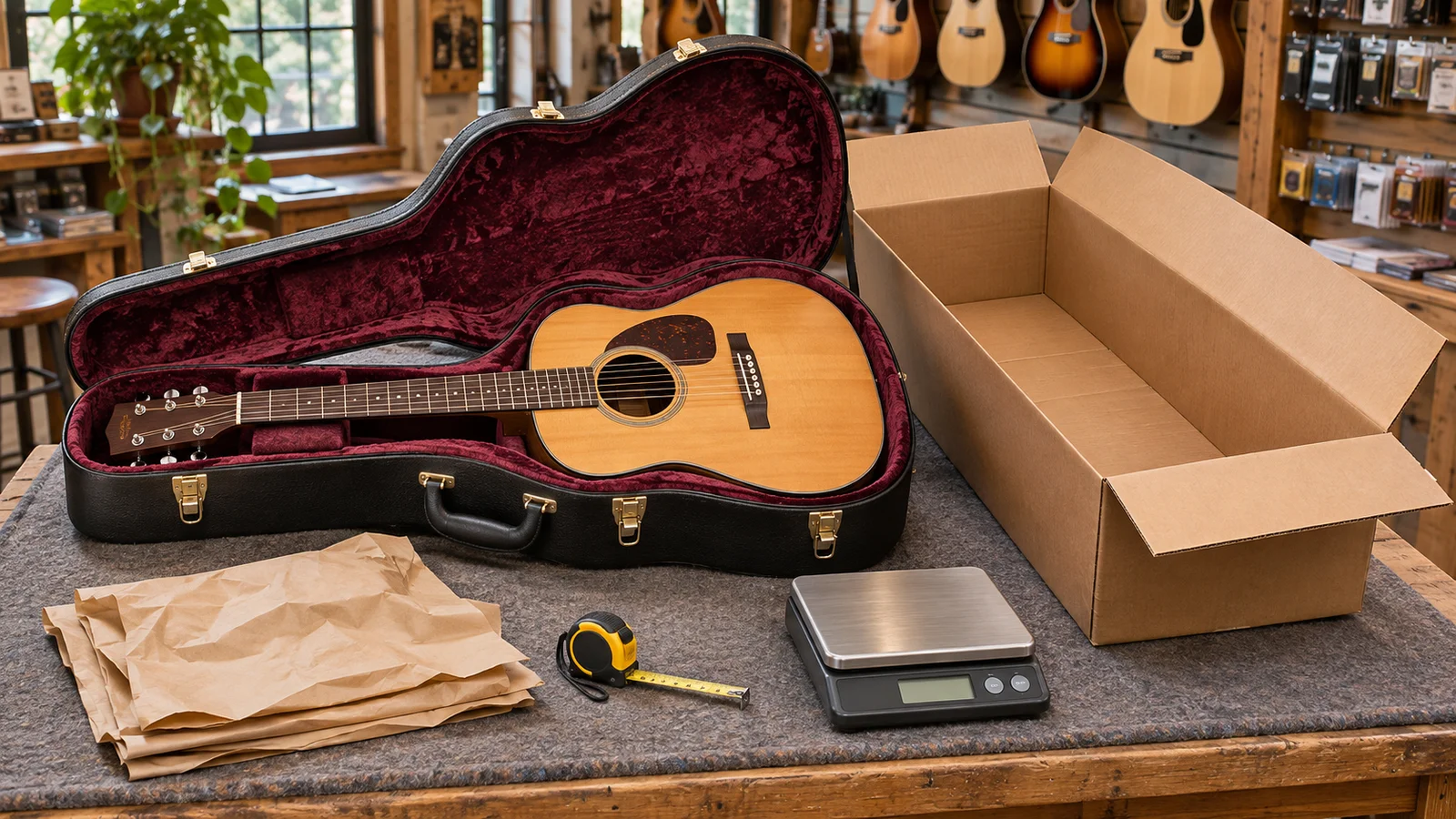
Start with a rigid rail measuring 16 × 2 × 2. Its customer requires it to lie straight, parallel to the carton length, with half an inch of protection at each end and a quarter inch on either side, above and below. The protected envelope is 17 × 2.5 × 2.5. Its volume is below M's interior volume, yet the required 17 inches exceed M's 10. The approved general-purpose L provides 18 × 4 × 4 inside. A diagonal placement or a bent end would violate this customer's pack instruction. Mark the rail ineligible for M immediately.
For a different order, put two upright retail units on the table. Each measures 6 × 3 × 3. Keep their long edges parallel and the tops up. The customer requires half an inch around the outside of the pair on all six faces and a half-inch divider between them. Side by side they occupy 7 × 7.5 × 4 with protection. A single unit needs 7 × 4 × 4. The inside of S measures 8 × 5 × 4, so either unit fits alone. The protected pair fits R or M and cannot share S under these rules.
The protected height uses all four inside inches. Check the closed lid and measure the widest outside points. Illustrative dimensions.
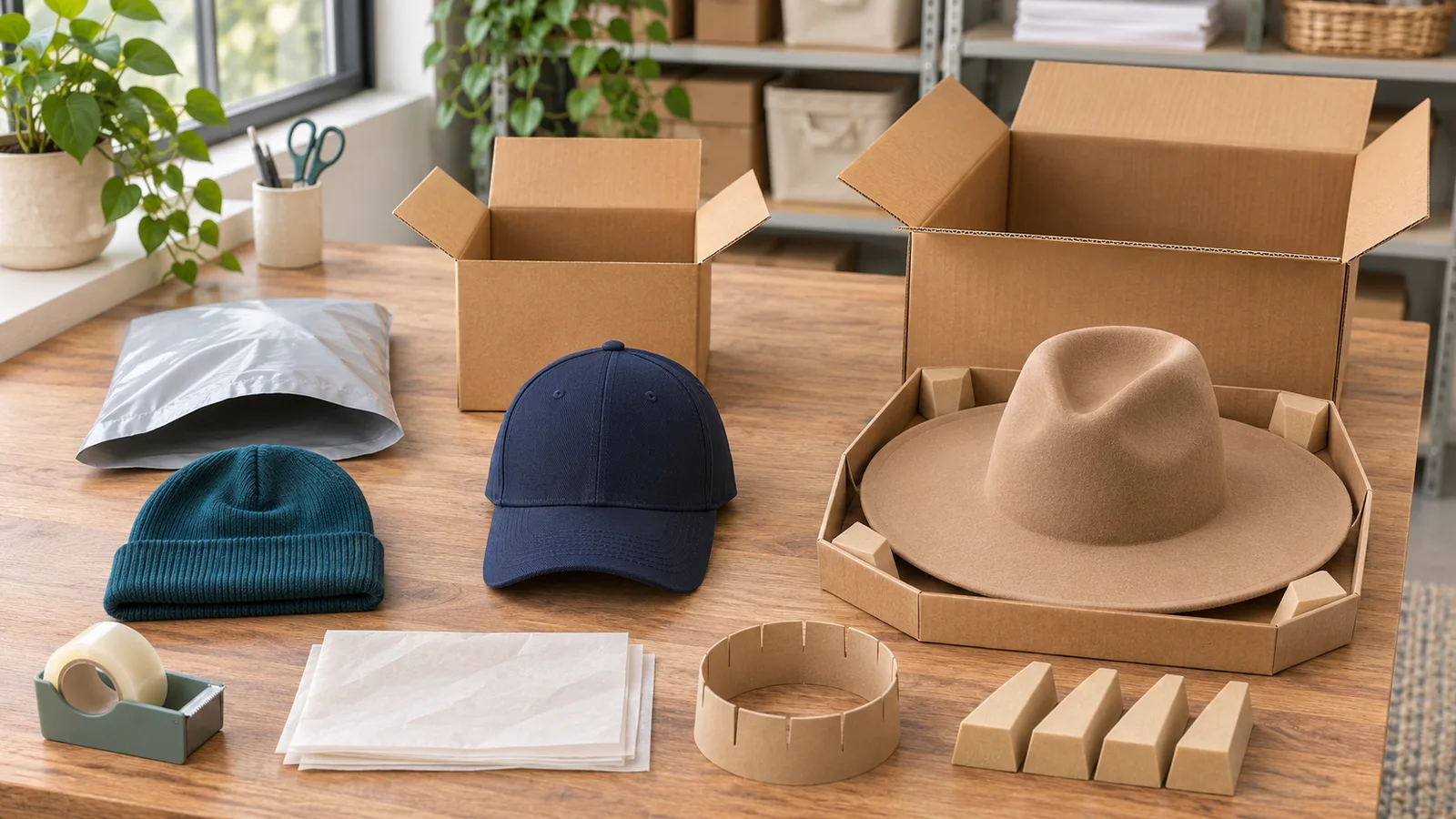
The arithmetic leaves no spare height in M. Erect blanks from the lot you would buy, fit the real divider and close the flaps without pushing the products down. Check the lid for a ridge, the sidewalls for bows and the divider for slippage when the sealed carton is handled normally. Reopen a sample and inspect what moved. A tight lid that dents the retail package fails even if the tape holds. A new foam insert or board thickness changes the fit. Soft goods also need the customer's permitted fold and compression limit.
Check at the bench
What to record before release
Match the order
SKU versions, quantities, approved orientation and packing instruction
Build the pack
Usable inside size, protection on six faces, divider and contact points
Close and inspect
Tape the seam, check bulges, reopen for movement and retail-pack marks
Weigh and measure
Final exterior at widest points, gross weight, parcel count and lot
Approve or divert
Operator, reason, actual fallback box and client authorization
Software can narrow the test queue. ShipStation's Packing Recommendations uses item dimensions, weights and configured custom packages on eligible plans. An operator can review the suggested contents of each parcel and, with the appropriate override setting, record why they changed the box. Check the item list when dimensions are missing because a partially measured order can omit items from the suggestion. Oracle's JD Edwards warehouse documentation describes item-mixing and weight restrictions and moving items between cartons after a recommendation. At the bench, match the suggested contents to the complete pick list before accepting the pack. ShipStation Packing Recommendations · Oracle JD Edwards cartonization
Top views use a common scale within each layout. The customer permits a two-parcel split only as an exception.
Price the entire original order
Keep the original service, destination, carton and final invoice. Requote the measured alternative on the same account, with the same delivery objective and fees. Date the quote. Price a slower service separately for the brand. To identify adjustments that may follow the label, see the parcel packaging cost audit.
A separate postal example shows when freight savings are zero. Under the published USPS Ground Advantage commercial weight-and-zone schedule, a regular rectangular parcel over one pound uses the next whole pound for a fraction. Suppose a sealed R weighs 2.6 lb and the same order in M weighs 2.4 lb. Both are below one cubic foot and land in the three-pound bracket. Hold zone, service, rate basis and fees constant and the postage stays the same. Check your account for cubic or negotiated pricing before using that conclusion. For rectangular pieces under DMM 283 §1.4 in zones 1–9, round each outside dimension up to a whole inch. Above 1,728 cubic inches, divide by 139 and round up to whole pounds for dimensional weight. Compare it with actual weight under that provision. USPS DMM 283, Prices and Eligibility
Treat an online dimensional-weight result as a prompt to check the contract. Confirm the service and units, how it rounds the measured sides, which factor it uses and how it rounds the resulting weight. A different carrier, a cubic price or an account minimum can change the comparison. Retain the raw measurements so the rate specialist can run a second service without first undoing the rounding from the first. For a quick calculation with your own factor, use the dimensional weight calculator.
In the purchasing example, all quantities, prices and operating times are fictional. For the eligible mix assume average freight of $6.40 in R and $6.10 in M, a $0.30 reduction established only as a model input. Board falls from $0.80 to $0.68, and protective materials including any divider from $0.16 to $0.10. The line goes from 90 to 84 seconds per order. At $24 per working hour, six seconds is $0.04. The four savings add to $0.52. A supply invoice can verify the price per blank. A timed trial estimates labor. Only reconciled freight bills can validate the postage difference.
Multiply that unit saving by the number of original orders that can actually switch this month. Deduct $180 in incremental monthly cost, made up of $120 for the additional location and $60 for replenishment and control. At 500 orders, $260 covers the $180 and leaves $80. At 300 orders, $156 leaves a $24 shortfall. Dividing $180 by $0.52 gives about 346.15. At 346 the result is negative $0.08. At 347 it is positive $0.44. For a positive unit contribution, round the quotient down and add one to find the first strictly profitable integer, including when the quotient is a whole number.
Try the purchase case with freight held flat across the eligible mix. Board, fill and labor still contribute $0.22. At 500 orders they produce $110, leaving $70 uncovered. If the time saved cannot be redeployed and there is no overtime to avoid, take out the $0.04 labor credit as well. Decide which forecast to sign based on whether the goal is added station capacity or lower cash spending. Archive the working assumptions with the approval.
347 is the first whole order count with positive savings under these assumptions. The line includes the $180 monthly cost.
Price the first purchase separately. A 600-blank lot of M at $0.68 ties up $408 before use. At 500 boxes consumed, $340 of that lot belongs to the month's production and $68 remains in 100 blanks. Charging all $408 against the month as well as 500 unit costs would count the same board twice. If the client is rebranding, ask who buys out the balance and what the unprinted blanks can be used for. Write down any expected write-off separately and include only its incremental amount in the decision. The $180 assumption includes no write-off.
For the pictured two-unit order, R and M can each ship one parcel. If both are unavailable and the customer allows a split, packing each unit in S takes two labels and two operations. With illustrative freight of $5.20 per S, the original order now carries $10.40 in postage. Its two blanks cost $1.10, cushioning totals $0.16, and two jobs at $0.52 of labor total $1.04. That makes $12.70 for the order. A single R at the example inputs totals $7.96. A cheap small label can therefore increase this customer's cost by $4.74. Check whether a split is permitted before quoting it.
Replay the month with and without the old size
Freeze one fictional month of 1,000 original orders. Of these, 400 singles and 100 protected pairs are eligible to move from R to M. They currently use R under this client's pack instruction. The small S used by other customers or in an authorized split is outside this group's normal single-parcel rule. Another 470 orders already use S. The remaining 30 need the long L or a specifically approved alternate. The rack also carries the oversize X for other work. Charge only changes in rack cost to this comparison. Never drop the hard orders just because a candidate cannot serve them.
For the 470 unchanged orders, allow $5.20 freight, $0.55 board, $0.08 fill and $0.52 labor per original order. Each of the 30 long-box orders initially costs $7.20, $0.95, $0.20 and $0.68 respectively. Adding M leaves both groups alone. Replacing L with M changes all thirty. Twelve rails may use X with an approved brace, at $10.40 freight, $1.50 board, $0.50 fill and $0.96 labor each. Eight two-piece kits have an approved long insert in L or may travel separately in two S cartons. Their customer prohibits the untested side-by-side layout for these kits.
Ten other rails require the original L specification. The replacement rack alone leaves ten orders unserved. For a like-for-like cost comparison, assume a supplier delivers exactly ten compliant blanks in time with a $6 premium each over the usual $0.95. They go straight to the bench with no permanent location. If the supplier misses the cutoff, the replacement proposal fails the service requirement. The table includes the rescue bill and shows the shortage before rescue. Removing L releases the $120 slot but leaves $60 of incremental monthly control work for the new arrangement.
Ask when replacement would win. With these same orders and confirmed rescue, its premium over addition is $21.32. If the supplier cuts the premium on each of the ten rescue blanks from $6 to $3 with every other input unchanged, replacement improves by $30 and becomes $8.68 cheaper than addition. Verify the new price, lead time and board specification before removing the long carton from the rack.
1,000 original orders / month
Keep R S L X
Add M
Replace L with M
Orders switched to M
0
500
500
Forced larger / split orders
0 / 0
0 / 0
12 / 8
Unserved by rack / after rescue
0 / 0
0 / 0
10 / 0 if rescue arrives
Parcels shipped / rack slots
1,000 / 4
1,000 / 5
1,008 / 4
Board and protective materials
$810.60
$720.60
$791.68
Freight for all parcels
$5,860.00
$5,710.00
$5,774.00
Packing labor
$564.80
$544.80
$551.04
Additional monthly fixed cost
$0
$180
$60
Comparable total
$7,235.40
$7,155.40
$7,176.72
Net savings
$0
+$80.00
+$58.68
Read the bottom line together with the exceptions. Keeping the rack costs $7,235.40 on this basis. Adding M costs $7,155.40, including the extra slot and replenishment. Replacement reaches $7,176.72 after rescue and the $60 fixed charge. It saves $58.68 against baseline yet costs $21.32 more than adding M, with eight extra parcels and a supplier dependency. Choose addition for this month if the slot exists and the trial supports the assumptions. If the rail line is discontinued, rerun the month. Removing the only general carton that protects a long item deserves its own decision.
Write the stockout instruction before opening the first pallet. If M runs out, return its approved 500-order group to R, record the reason and rerate with R's closed dimensions. A shift lead can authorize that documented fallback. A second parcel, a customer-specific blank or a missed dispatch goes to the account owner for approval. If fifty of the projected 500 orders fall back to R, only 450 earn the contribution. Monthly savings fall from $80 to $54 while the rack still costs $180. Use the observed fallback count when the buyer places the second order.
A simulation is valuable when you can explain its baseline. Paccurate describes a baseline that generally simulates the current box list and can sometimes incorporate actual box choices. Its optimized lineups may include existing and new sizes. For this exercise, reconcile the simulated current rack with the actual monthly selections first. A model that sends every possible pair in M while the brand requires an R until approval has measured an opportunity pending approval. Move that volume into the eligible column only when the client releases the revised instruction. Paccurate simulation FAQ
Three buyers can make three different decisions
An apparel brand models a normal month of 800 orders. Its single folded item fits the candidate with the approved tissue and wrap in 500 orders. The other 300 are sets that require a wider presentation tray. Keep the previously illustrated $0.52 unit contribution and $180 monthly cost. Addition earns $80. In a promotional month the brand still ships 800 orders but the mix reverses. Only 300 singles qualify and 500 sets keep the current box. Addition would cost $24 extra. The marketing calendar is part of the purchase forecast because the eligibility share changed while total volume stood still.
Buy for the customer's actual commitment period. If the rack can be released after one month, take the addition for the regular campaign and defer a new commitment for the promotion alone. If the slot runs through both months, combine $80 and negative $24 to get $56 across the two months before any write-off. Pulling out the carton for one month saves little on a slot the warehouse still has to pay for. A customer-approved narrower tray would change the promotional eligibility, so test that tray with the full set before revising the forecast.
At a multi-client 3PL, brands A, B and C appear to supply 220, 100 and 180 eligible orders per month. A and B authorize a plain shared blank. C's artwork agreement calls for a printed carton and forbids substitution, even when the fit is identical. Strike C's 180 from the pool. At 320 orders the combined benefit is $166.40 before the $180 fixed cost. Keep the current lineup. Do not average C back into the purchasing case because its products sit in the same facility. A signed waiver or 27 more eligible monthly orders would move this joint case just above zero.
Cost owner · 320 approved orders
Change vs. current month
3PL pays board and fill
+$57.60 saved
3PL pays pack labor and fixed cost
+$12.80 labor, −$180 fixed = −$109.60 including materials
Brands A and B pay freight
+$96.00 saved
Brand C retains printed pack
No eligible orders or savings
All parties
−$13.60 net
Suppose A and B pay the carrier directly and the 3PL buys board and fill, pays labor and funds the slot. At 320 orders the warehouse captures $70.40 in materials and labor and pays $180. The brands keep $96 in freight savings. Those two perspectives sum to the same negative $13.60. Even with 500 eligible orders, the warehouse would capture only $110 against $180, while the brands would keep $150. Discuss a slot fee or a per-use reimbursement after the joint case clears the hurdle. A transfer between the two ledgers can distribute a benefit, but cannot create one.
A marketplace seller ships six long collectibles in an ordinary month. In this separate hypothetical, use the dedicated carton's consumed cost and normal postage as the common reference. Stocking it adds $18 per month in carrying and space costs. Buying just in time adds $2 per order, or $12. A validated in-stock alternative costs $2.50 extra per order including protection and freight, or $15. The supplier needs three business days and the seller's order-specific handoff is due the next business day. Choose the $15 in-stock alternative. The $12 option is cheaper on paper and misses that order promise.
Revisit that choice if the supplier offers a confirmed local pickup before dispatch, or if monthly demand reaches eight. At eight orders the approved substitute costs $20 extra, above the $18 for stocking, assuming the same service and risk. A pickup that genuinely fits the existing promise could make the on-demand option viable again. For a replacement decision, ask whether the substitute's location may actually be released. If it also serves another brand, switching these six orders alone releases no location. The cost of a slot only disappears when somebody can use the space or stop paying for it.
Pilot one carton and reconcile the results
Choose one building, one approved combination and one candidate lot. Keep current blanks for controls and fallback. Assign the packing lead to the builds, transportation to final bills, and the account owner to channel-specific approval. Put the packing sketch at the bench. Open a new cohort if the brand changes an insert or the supplier changes the board.
Once the bench approves closure and protection, alternate comparable original orders between R and M within the same shift and destination mix. Record any eligible order the operator diverts to R and the reason. Keeping the diversion in the trial shows how often the proposed process can actually run. Time the work from reaching for a blank through the final closure check, using the same definition on both sides. Count walks to a remote stack or add replenishment separately. Counting the walk in both the timed job and the monthly replenishment budget overstates the saving or the expense.
Separate the prediction, the bench result and the billed result in the trial log. A predicted pair may fit, the sealed parcel may measure taller, and the carrier may later bill a different amount. Give each observation a date and retain the label ID for matching. Use pending for an absent carrier adjustment or damage response. After your normal billing and customer-reporting cycle has elapsed, compare the original orders with complete evidence and show how many are still open. One clean delivery or a small run with no reported damage does not settle a protection question.
Keep a failed trial sample as carefully as a successful one. If the packer rejects M because the top panel springs open, photograph the sealed profile and match it to the blank lot, divider revision and product batch. Quarantine that combination from the forecast. An operator on another shift can then repeat the same build and determine whether to change the board, change the insert or leave the order on R.
In the workbook, start on Buy and open Replay to change the six order groups or the emergency supplier premium. The replacement example brings back $141.32 in extra variable costs for displaced orders. On Bench, trial T-01 shows an illustrative 84-second pack with the final invoice still open. Keep that cell empty until the charge arrives. The tab-separated templates also work independently when pasted into cell A1 of a blank sheet.
Look first at the monthly net saving in the purchase sheet, then at orders left without an approved pack and any unconfirmed rescue. A positive number with an unresolved customer restriction is grounds to keep testing. A negative number after the contract exclusions suggests retaining the current assortment. If replacing an old size meets every packing promise and beats the addition after rescue costs, record its retirement date and disposition of the remaining stock. Sign the next purchase order only for the quantity covered by the forecast and the agreed fallback.
After trial packing, ask EasyShippingX to compare available services using each sealed exterior, gross weight, origin ZIP, destination mix and service requirement. For a split, submit both parcels under the original order. Put the estimates in the purchase sheet and replace them with reconciled invoices before pricing the next lot.
Carton assortment FAQ
Replay your current orders first. Add a size when recurring approved packs cover its incremental cost. Test the orders displaced by a proposed retirement before releasing the old slot.
Use weight and spend to select samples. Retrieve the items, quantities, orientation and protection for the physical fit test. Rate the sealed parcel afterward.
Set the freight saving to zero. Recalculate board, protective material, usable labor savings and fixed costs at the remaining eligible volume.
Count only orders whose owners approve the exact blank and packing method. Check who pays each cost and who receives the saving before ordering shared stock.
After every affected order has an approved, timely alternative and the fully costed replacement beats the other choices. Confirm the supply fallback before retiring the location.
Sources and methodology
Sources consulted November 20, 2026. All quantities, measurements, rates, timed jobs and supplier terms in the examples are hypothetical.