Packaging Guide

How to Ship Hats: Packaging, Box Sizes, and Shipping Costs

Ship a hat in packaging that preserves the shape the buyer expects. A soft beanie can go in a mailer when the brand approves folding and there are no vulnerable trims. A structured baseball cap or stiff wide-brim hat usually calls for a rigid carton and a fitted support that keeps pressure off the crown, brim and decorations. Close the shipment, weigh and measure the whole parcel, then compare eligible services and the total cost.

This guide is for U.S. domestic sellers and 3PLs shipping ordinary hats, including custom embroidery and secondhand or collectible pieces. The best way to ship hats depends on which parts are allowed to bend, what else is in the order and how the customer expects to receive it. Use the sequence below for one hat, several hats or apparel sharing a carton. All four worked orders are fictional.

Knit beanie, structured cap and a wide-brim hat with a mailer, cartons and removable supports on a packing bench.
Match the packaging to the structure and finish of each hat.

Start with the hat’s structure and the customer’s order

A hat can look soft until you check the front panels or the bill. Check the crown, the part that sits over the head, and the brim or bill, the part that projects outward. Then look for stiff lining, a molded shape, a sewn crease and trim that protrudes. For a trucker cap, check both the structured front and the mesh. For a soft cap with a stiff visor, follow the separate handling requirements for the crown and visor. Material names help describe the product. The actual structure, finish and brand’s instructions determine what you can do to it.

Hat typeRisk and contact pointsFolding and candidate packagingConfirm first
Soft knit, no hard trimSnags, stains, trapped tagsApproved fold and clean sleeve or mailerFold position and presentation
Unstructured or packableCreases or a stiff bill on a soft crownUse approved fold only. Consider a mailer or cartonWhich parts may bend, and for how long
Structured cap or truckerCrown dents, bill bends, mesh distortionKeep shaped sections intact in a rigid carton with supportWhether the back may tuck and how to support the front
Stiff straw, felt, dress or wide brimCrown compression, edge crush, shiftingUse a rigid outer carton with a fitted cradle or insertApproved orientation, bearing points and brim clearance
Raised embroidery, feathers, badges or cordsAbrasion, snagging, pressure marksProtect trim separately and use a box if the trim needs clearanceFinish, protrusion, loose tag and accessories
The beanie’s knit and fold, the cap’s crown, bill and raised detail, and the wide-brim hat’s crown, brim and trim have different protection points.
Check the exact style before folding or choosing a support.

Ask the brand which parts may be folded, rolled or nested, under what conditions and for which sizes or variants. If a product says it is packable, look for the actual instructions and confirm that the garment can hold the approved position for the planned shipment. A brief fold for travel might leave marks if held under pressure in a parcel for several days. Check that an otherwise foldable hat does not have a raised logo, metal badge, cord lock or stiff edge that changes the packout. When the instructions are unclear, keep the shape and seek approval for a different method. The retailer and platform guides offer examples of handling distinct styles. Hats Unlimited packing guide · Shopify hat shipping guide

Set the acceptance criteria before selecting materials. If the listing promises a flat bill, choose a sample with that profile and record it. If the buyer purchased a collectible in its original hatbox, include the hatbox in the packing specification. Note any special finish, visible stitching, hanging tags and loose parts to retain. A taller logo or pin can change required clearance with the same SKU and nominal hat size. Give the packing bench a way to detect those differences, even if the order screen looks identical.

For a new style, compare one unit from normal stock with the original approved sample. Test the size with the tallest crown, widest brim or most prominent decoration. Save the limits that made the sample pass. If adjusting a closure changes the shape, write down the position it should ship in and what the customer should receive.

Measure in the approved packing position

A head size or circumference identifies fit. Measure the actual product the way it will sit for shipping. Take its maximum length, width and height, including the widest brim, tallest crown point and any ornament that needs clearance. For a soft item, measure the approved fold. For a structured cap, set it as it will sit on the approved support and check the bill in its intended curve. A wide brim can be longer from front to back than across, so record both dimensions. If a gift box, sleeve or certificate must go with the hat, include its footprint in the fit check.

Use carton inside dimensions to check fit for the hat and the protective structure together. Try the exact insert, liner and orientation in a sample box. Close the flaps without pressing down and look for contact between the lid and crown tip, brim and walls, and ornaments and liner. With the parcel held securely, gently tilt it in different directions. If the hat can slide toward a wall, improve restraint at an approved contact point. If there are dents, rubbing or a bowed lid when you reopen it, revise the support or carton. Choose the space by the load and contact points you need to protect. Compare materials and box choices in the box and mailer decision guide and the safe packing guide.

Use clean materials that will not transfer dye, shed fibers or scrape the hat. A smooth protective layer can isolate a light-colored surface from a rough insert. Use a suitable inner bag as a barrier against incidental moisture or dirt where the product permits it. Confirm that the product is dry before packing and allow enough space around protruding details. Seal the inner bag or outer shipping package according to the specification, keeping adhesive off the hat. A bag offers limited protection against incidental exposure during shipping. Use the brand’s instructions for storage or climate-sensitive handling.

Measure and weigh again after closure. The carrier input is the outside of the entire parcel, which includes the carton, possible bulges, inserts, tape and anything billed as part of the shipment. Record the actual scale reading before applying any service-specific rounding. Do the same when substituting a carton or changing the insert. A packout photo with a ruler and a measurement record can help a second shift reproduce the setup. Keep the actual measurements and the values submitted to the carrier when the two differ by rounding.

Read carton dimensions with the supplier’s convention in mind. Order a sample if the catalog leaves the basis unclear. Measure the usable space after dividers are in place and remeasure carton bulges with the contents inside. Reserve enough space to remove the hat without pulling on the brim or a loose decoration.

Pack the hat by style

Soft beanies and approved foldable hats

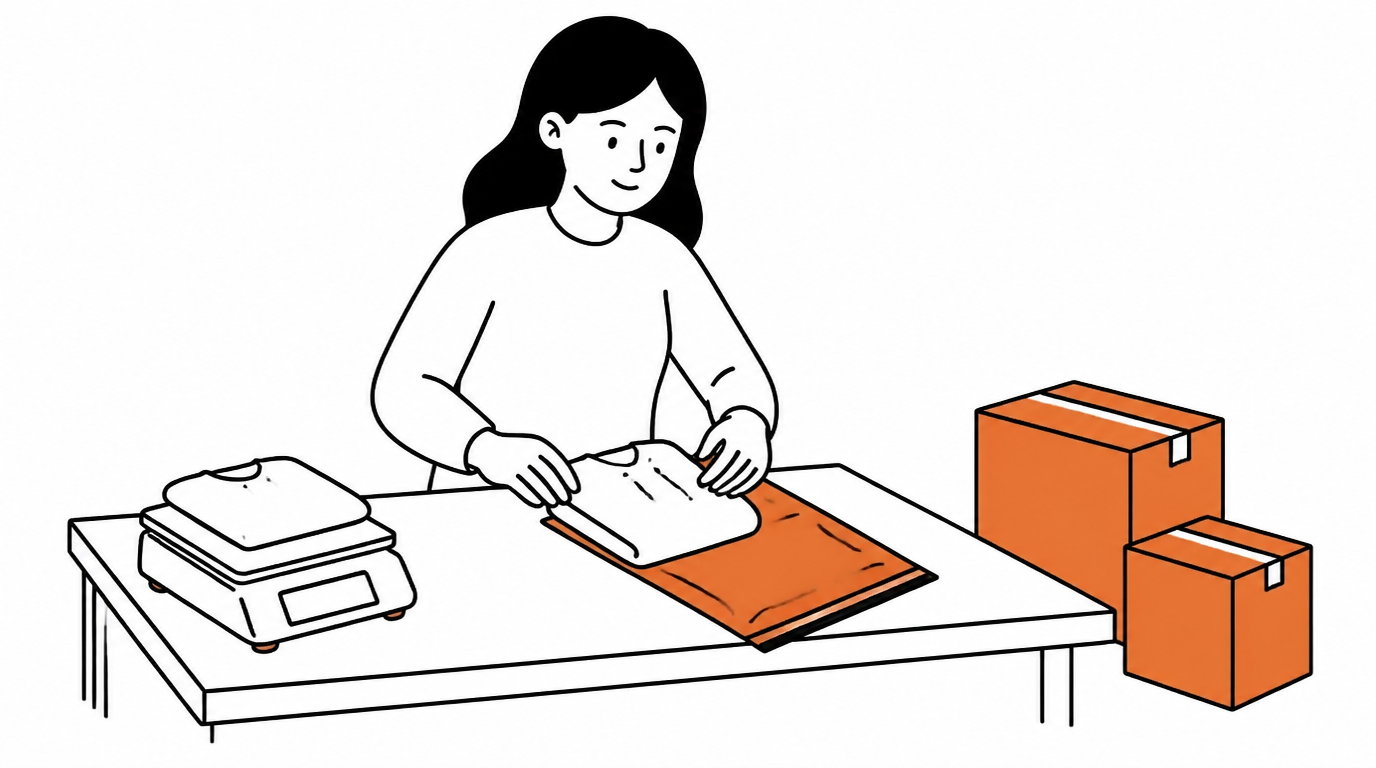
Check whether the specific hat is allowed to fold and whether a removable tag, zipper pull or trim could snag the knit. Fold it along the approved line without dragging the tag across the fabric. Put it in a clean sleeve if called for and use a mailer that closes across its full seam with no fabric caught in the adhesive. Check for a sharp corner, tight spot or large empty area that could let the contents shift. If the item includes a brittle badge, a display box or a finish that holds a crease, move the order to a packout that protects those parts. See the clothing shipping guide for more on packing soft apparel.

Case 1. Choose a bag or a box for a soft beanie

Assume the brand approves folding for a plain beanie with no hard trim. The completed bag weighs 4.2 oz and the completed box weighs 8.3 oz. In the USPS Ground Advantage Commercial weight-based example, they fall into the 8 oz and 12 oz price increments, respectively, assuming all other conditions for the weight-based option apply. Record both scale readings. For this product, compare how the fold looks when opened, how well each closure protects the knit and whether either packaging option preserves any presentation the customer chose. Use the lower-cost eligible option only after it passes those checks. USPS DMM 283 §1.1

Structured baseball caps and trucker hats

Use a rigid carton for a structured cap with a bill and crown that must hold shape. Check the front panels, eyelets, crown button, bill curve and mesh or fabric before adding support. Fit the approved insert or a light shape support inside the crown without stretching the sweatband or pushing the front panels outward. Keep the bill in its intended profile with room around its tip and sides. Restrain the cap through the support or a shaped compartment. Test for movement without using the brim as a stop against the wall. Apliiq announced a move to plain cardboard boxes for its own structured hats. Its store weight settings are specific to its fulfillment flow. Apliiq structured-hat update

Check embroidery, patches and tags separately. A smooth separator can protect a raised embroidered face from abrasion, provided it does not put pressure on it. Position any closure or loose hangtag where it will not scrape the finish. Secure the separator to the packing structure if needed, keeping tape clear of the fabric. Some styles permit tucking an unstructured back panel inside. Confirm permission and the expected fold for that product. The front panels, bill and stiff back shapes still need normal clearance. Place any notice or packing slip alongside the protected cap so it cannot press into the face.

Cross-section of a structured cap in a carton, with fitted support beneath the crown, an abrasion barrier at the front, and space above the crown and beyond the bill.
Check that the lid and walls clear the hat after closing.

Lift the cap from its support during the final check. Look for a new line at the sweatband and any mark where the separator meets a patch. Ease out the unused space by changing the shape or position of the support. Adding more filler against the crown can create pressure before the parcel reaches a truck. Pack for ordinary handling in different orientations even if you use an orientation sticker.

Case 2. Pick, protect and weigh one structured cap

Assume the cap weighs 4.5 oz on its own. Confirm the variant, crown and bill profile, tag and approved insert. Place the cap on that support in a rigid carton. Make sure the cap does not touch the lid or sidewalls and the bill retains its original curve. Close the flaps normally and check that the cap stays in its fitted position when the box is tilted. This illustrative sealed carton measures 12 × 10 × 6 inches and weighs 8.4 oz. Use the completed values for the comparison. The packing team should retain the insert as long as the approved protection depends on it.

Now suppose a later run of the same SKU has taller embroidery. If the approved cover layer or box lid starts leaving a mark on the face, stop and check the production variant. Verify clearance with the revised support, separator or carton and update the specification before the new run ships. Reweigh and remeasure that package. A nominal carton size can be a useful example, and the fit test decides whether it works for the item in hand.

Felt, straw, dress and wide-brim hats

Use a rigid outer carton and an insert that holds the hat through contact points approved for its shape. Place the crown and brim in the position the maker specifies for transport. Leave room for the full brim, including any curl, and keep the crown tip and decorations clear of lid pressure. A ring or cradle can locate the hat within the carton and keep it from walking to a sidewall. Choose one sized to the actual hat and check that it carries the load at the intended points. Avoid loading the brim edge. Consider a second carton if the approved inner hatbox needs protection as a retail item. Hat storage advice concerns a resting hat. Validate the whole assembly for normal movement during shipment. Hats Unlimited packing guide · Stetson care and storage guidance

If the brim curls upward, test the narrowest point in the carton after the lid is closed. The brim may clear at the center while its edge still touches the side. If a narrow crown support fits one size and spreads another, separate the profiles. Give the floor an approved alternate carton before the order reaches the dock.

Collectible, used and personalized hats

Photograph the exact hat before wrapping. Get an overall view, the brim profile, crown, tag, any existing crease or fading and the included packaging. Match the size, color, embroidery text, placement, count and accessories with the order. Give a condition exception its own hold reason, even when the item still looks wearable. Keep original tags and packaging the buyer was promised. Ask the seller before steaming, spraying water, applying a product or reshaping the hat. Train the packer to reproduce the approved protection from the photo, then have another person check the actual cap or hat before closing an unusual order.

Compare size, weight and charges on the completed parcel

Actual weight comes from the scale. The pricing weight depends on the service. For a regular weight-based Ground Advantage Commercial parcel, USPS lists lightweight price increments of 4, 8, 12 and 15.999 oz, and whole-pound steps at higher weights. Check the particular channel’s required input units and precision. DMM 283 also sets how commercial mailers express single-piece weight for postage calculation, including a distinction for USPS Ship users. Report the real measurements according to the workflow. The price increments do not authorize rounding the actual weight down. USPS DMM 283 §§1.1, 1.5.1

For ordinary rectangular USPS Ground Advantage Commercial parcels to zones 1 through 9, the DIM rule applies above 1 cubic foot, or 1,728 cubic inches. Round each dimension up to a whole inch, multiply them, divide qualifying volume by 139 and round DIM weight up to a whole pound. Compare it with actual weight for the applicable price. Separately check nonstandard fees. For a rectangular parcel, the nonstandard volume calculation uses ordinary rounding to the nearest whole inch and the threshold is more than 2 cubic feet, or 3,456 cubic inches. Check length and nonstandard characteristics as separate conditions. Oversized-priced parcels and USPS Ground Return pieces have exceptions under the section. Use the effective price list and account terms for fees. USPS DMM 283 §§1.4, 1.7 · USPS DMM 604 §7 · USPS Notice 123

Cubic is an alternative Ground Advantage Commercial price path for eligible customers and qualifying parcels. USPS caps qualifying volume at 1 cubic foot, actual weight at 20 lb and the longest dimension at 22 inches, and excludes rolls and tubes. Measure a rectangular carton at its maximum dimensions and round each down to the nearest quarter inch for the cubic tier calculation. Soft packs and padded envelopes have a separate measurement based on the original packaging’s length plus width, with different treatment for pleated packaging. Confirm the package and channel qualify before looking up a cubic tier. Keep measurements and pricing rules specific to each carrier you compare. USPS DMM 283 §1.3 · Dimensional weight guide

Keep the volume check separate from the price lookup. The same measured carton can receive different rounded dimensions for DIM, Cubic or a fee. A quote near a threshold deserves a second measurement, especially if the panels bow. Save the values as measured, the applicable rounding method, and the pricing path returned by the channel.

Case 3. A slightly larger carton for a wide-brim hat

Assume both rigid rectangular cartons protect the hat and each weighs 2 lb sealed. A measures 20 × 18 × 8 inches, giving 2,880 in³. Under the example’s ordinary Ground Advantage Commercial eligibility and zone assumptions, 2,880 ÷ 139 rounds up to 21 lb DIM. B measures 21 × 19 × 9 inches, giving 3,591 in³. The same calculation gives 26 lb DIM. Both DIM results exceed the actual weight. Use each corresponding price weight in the weight-based comparison.

In the example both boxes weigh 2 lb. A is 2,880 cubic inches and 21 lb DIM. B is 3,591 cubic inches and 26 lb DIM and crosses the nonstandard volume threshold.
Illustrative dimensions. Check DIM and nonstandard fees separately.

B is over 3,456 in³ under the nonstandard volume calculation and is subject to the volume fee in the ordinary outbound scenario. A is below that threshold. Neither example exceeds 22 inches in length. These whole-inch dimensions make the two rounding methods give the same volumes here. Use current eligible rates and verify fees at the time you quote. American Hat Makers describes its own experience with volume-driven charges. Its FAQ example does not determine either of these prices. Use B if A would press the brim or leave no room for the approved insert. USPS DMM 283 §§1.4, 1.7 · USPS Notice 123 · American Hat Makers FAQ

Quote the actual options with the same origin ZIP, destination ZIP, ship date and delivery needs. Record each individual parcel’s dimensions and weight, service and charge basis, and whether the quote includes relevant fees. Record the date of the quote. Compare different services only where each meets the shipping promise and accepts the shipment. A successful purchase may still be adjusted if the submitted measurements were inaccurate or carton handling differs from what was quoted. Keep the measured carton record with the quotes for later reconciliation.

Compare multi-hat and hat-plus-apparel orders

Nest matching caps only after checking that one slips over the other without distorting the bills, pushing on a printed panel or catching a snap. Keep rough or hard trims isolated and confirm where the nested set receives support. Recheck the full stack height and clearance at the top of the carton. Different sizes or crown profiles may bind or leave one brim unsupported. Pack them in independent supports or boxes when the stack test fails. Photograph the maximum count and which styles are allowed together. A warehouse should refer back to that record when the mix changes.

A hat and T-shirt can share a carton when the hat is supported independently. Fold and wrap the shirt in its own space and restrain it with a divider or separate compartment so it stays clear of the brim. A shirt placed inside the crown can change shape under pressure, so use the approved insert to hold the cap. Shoes, cups and other dense objects need their own restraint and a structure that prevents their load from transferring to the hat in any normal position. Stop and redesign the packout or use separate parcels if the divider alone can bend or shift. Keep any retail or gift box that belongs to the order.

A supported cap occupies one compartment. A wrapped folded T-shirt sits in the other, held behind a secured divider.
Secure both items independently and check that the divider stays in place.

For a mixed order, write which compartment each item uses and how the divider is anchored. Hold the closed carton securely and gently tilt it to check that the divider and shirt stay put. Reopen the carton and look for a new contact mark. Keep an approved split option for a variant that fails the same setup.

Case 4. One cap and one T-shirt

Assume both options fit and protect the goods and meet the same route and delivery requirements. The combined carton is 14 × 10 × 6 inches and 15.2 oz sealed. It uses $7.80 assumed transportation, $1.40 in materials and four minutes of work. At $24 per hour, labor is 4 ÷ 60 × $24 = $1.60, for a subtotal of $10.80.

For the split, the cap carton is 12 × 10 × 6 inches and weighs 8.4 oz. Its assumed transportation charge is $5.40. The shirt parcel is 12 × 9 × 1 inches and 7.2 oz, at $4.60. Both packages together use $1.50 in materials and six minutes of work. Labor is 6 ÷ 60 × $24 = $2.40, and the subtotal is $13.90. The three-cost difference is $3.10. The independent packaging explains why the two measured weights do not have to sum to the weight of the combined carton. All charges are illustrative and include the transportation costs assumed for the example.

Illustrative costOne cartonTwo parcels
Measured parcels14 × 10 × 6 in, 15.2 ozHat: 12 × 10 × 6 in, 8.4 oz. Tee: 12 × 9 × 1 in, 7.2 oz
Assumed transportation$7.80$5.40 + $4.60 = $10.00
Materials$1.40$1.50
Labor at $24/hour4 ÷ 60 × $24 = $1.606 ÷ 60 × $24 = $2.40
Three-cost subtotal$10.80$13.90

Get fresh quotes for real orders. Split work also means a second parcel record and tracking number. Explain in the customer’s shipment notice which contents are in each box, and use that mapping when only one reaches the buyer. Measure follow-up, potential damage and return handling if those costs differ materially by packout. Under the modeled conditions the combined option uses less of the three compared costs. If the shirt cannot stay separate from the supported cap, protect the order in a revised carton or split it. Split shipment cost framework

Set a packing profile and a release check

Give the floor an approved profile by owner and SKU or product family. Record the cap or hat type, size and finish variants, permitted folding, contact points, trim clearance, approved supports, carton, packing orientation, permitted combinations and sample photos. Keep a typical weight range to flag a missing insert or an unexpected extra item, and use the actual weight for each parcel. Put an approved photo or short instruction at the bench and set the version on the work order. If someone changes a supply, shape or decoration, review the profile before the replacement becomes a default.

Before release, match the item and any personalization with the order, then check the crown and brim, trims, tags, closure, measured parcel and label. A bent crown, wrong text, unmatched sample or no approved carton goes to a hold with the seller contact, observed issue and evidence. Use a release approval to carry a corrected packout back to the floor. For two-parcel orders, check the actual carton ID against its label and send both assignments to support. A label printed early is a staging item until the final package is checked.

Release checkWhat to verify
Correct itemSKU, size, color, personalization and count match the order
Correct shapeApproved fold or original profile, no new crease
Trim and tagsPromised pieces present and secured away from the face
Crown and brimCheck lid and wall clearance with the actual support
Normal closureBox or bag closes normally and the contents stay put
Measured packageFinal outside dimensions and scale reading recorded
Label matchActual package, destination, service and label agree

Start with a small group of shipments on approved routes and packaging versions. Record shape photos before packing, protection used, finished measurements and weight, and feedback after delivery. If the customer reports damage, ask which part was affected and whether the carton or support shifted. Record the final resolution and actual handling cost. Compare results for the same style and reasonably similar routes before replacing a proven packout. Treat the worksheets as a place to log what happened during your trial. Packing profile · Trial and damage log · Release checklist

During the trial, record damage by location and compare it with the packaging contact points. A repeat crease near the lid suggests checking top clearance. Rubbing near a snap suggests inspecting the separator. Keep the old and new packout records. Match returned parcel feedback to the correct version before treating a change as effective.

Help the customer repack the hat for return

Send style-specific notes with return authorization. Ask the customer to keep usable carton and support pieces and replace anything crushed or wet with an approved equivalent. Put the hat back in the approved position without folding a formed crown or bill to fit a smaller carton. Keep tape off the hat and retail box. Before the carton closes, check that the brim and any ornament still have clearance. If the original carton failed, ask for a photo and agree on an alternative instead of copying the damaged setup. Stetson’s Help Center asks its own customers to ship items received in its branded boxes as received. Check the actual seller’s rules for the return in front of you. Stetson returns help · Stetson refund policy

Record why the item came back, whether it was fit, disputed prior condition, transit damage, wrong style or wrong personalization. Photograph the incoming carton, support and exact damage before removing evidence. Compare with the listing and outbound photos. The seller manages the order resolution. Any claim or shipping protection request follows its own service and eligibility terms, with the original packaging retained where needed. Release the item back to stock only after the appropriate inspection and disposition. For a reusable workflow, see the 3PL returns processing guide.

For a disputed return, save the parcel identifier and the time the damage was first reported. Inventory staff can then compare the return condition with the outbound images and the buyer’s arrival photos. If the evidence is incomplete, label the uncertainty and keep the item out of sellable stock while the responsible person decides the next action.

When the package is ready, compare available services using the actual dimensions, weight, destination and delivery requirements. Depending on account and shipment eligibility, EasyShippingX supports creating labels through the Portal, Excel upload or API and tracking supported shipments. Keep the selected service and tracking attached to the actual parcel. Shipping rate calculator · EasyShippingX features

Hat shipping FAQ

Consider a mailer for approved foldable styles with no hard trim or rigid package requirement. Check closure and appearance on the actual product.

Use the smallest box that fits the approved profile, support and clearance. Try the actual packing method and measure the sealed outside dimensions for pricing.

Only if the specific style allows it. Preserve the front panels, bill and any other shaped parts.

Use a rigid carton and the maker’s approved support for that shape. Confirm clearance around the brim and make sure its edge carries no load.

A protective carton can exceed a service’s DIM threshold or qualify for a size fee. Check both on the actual closed package.

Yes if the packout protects all items. Validate nesting for the specific styles, protect the trims and check the final stack height.

They can share a carton with independent protection and restraint. Keep the folded shirt in its own space and check for movement before comparing costs.

Follow the seller’s instructions. Reuse sound supports or obtain an approved replacement, preserve the shape and tape the shipping carton.

Sources and methodology

Sources reviewed November 15, 2026. The cases use fictional orders and measured-package assumptions. Carrier rules apply to the named service and account conditions. Merchant policies apply to that merchant’s own orders.