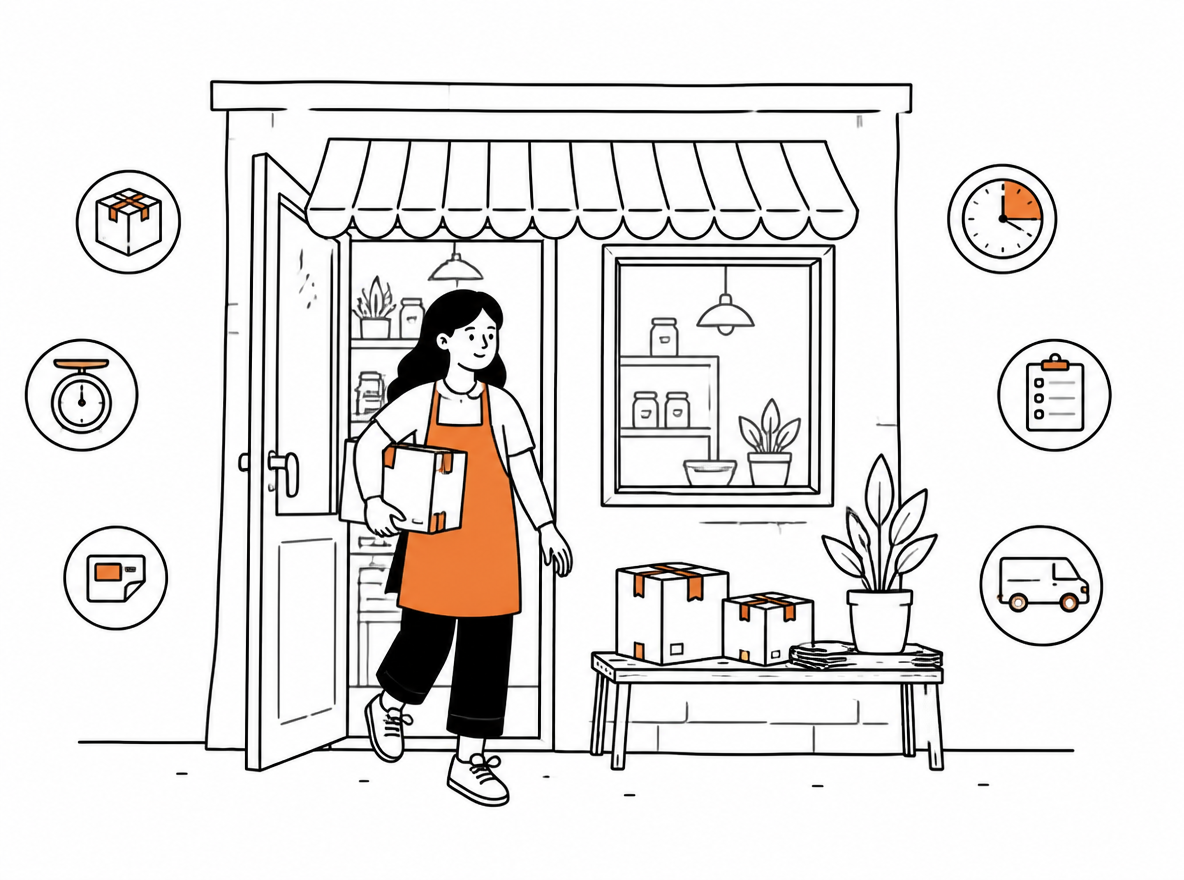
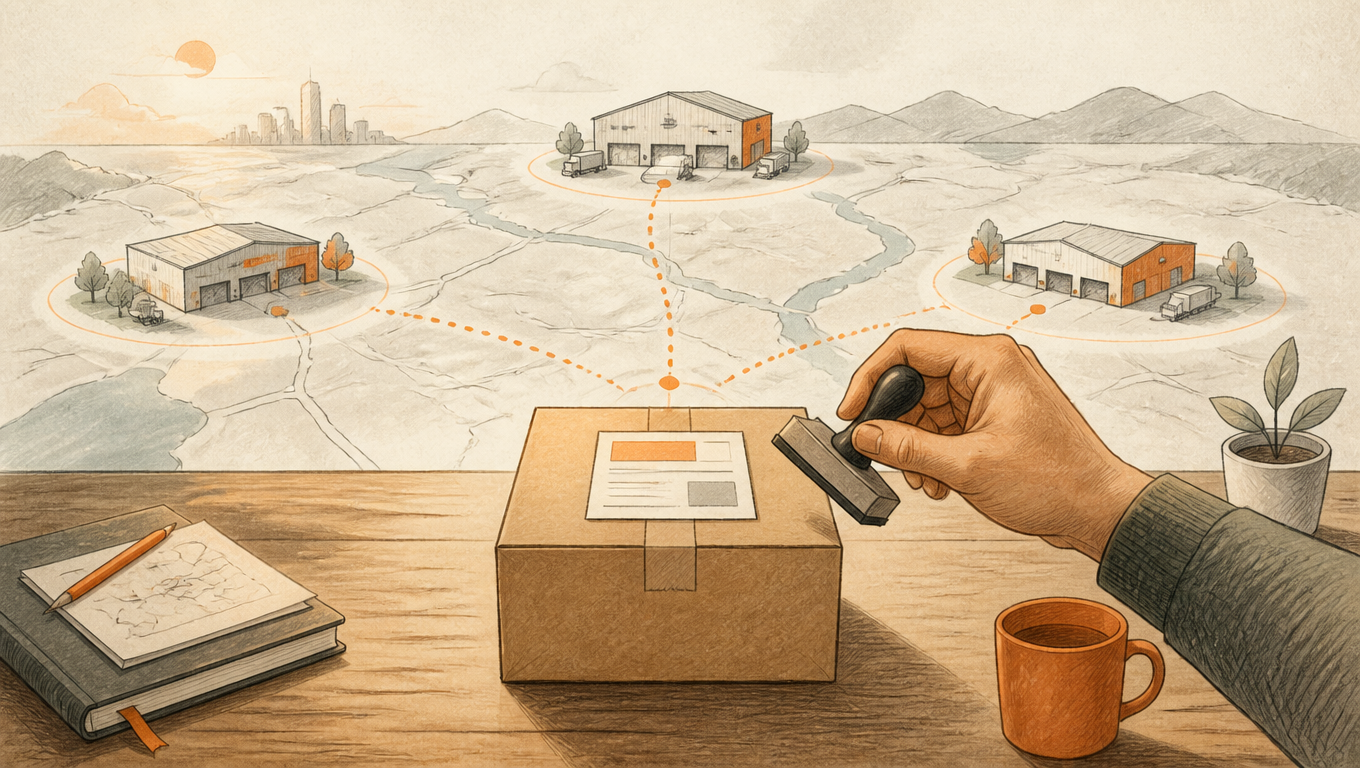
Ship from store is the practice of fulfilling an online order out of a retail location's own stock and sending it to the customer by parcel carrier, instead of routing the order to a warehouse or a distribution center. The shop becomes a small, low-volume shipping node: it picks, packs, labels and hands off, and nothing happens outside those four verbs.
The stock is on the shelf and the order is not lost, yet a large share of first attempts stall in week two. The cause is rarely strategy. It is that nobody can say who packs the parcel, where the scale lives, or which driver will actually stop at that back door before the staff locks up. What follows walks the operating sequence, and it ends with one concrete answer: can this shop, on an ordinary Tuesday, take an online order and put a scanned parcel into a carrier's hands the same day without wrecking the shop floor.
Store fulfillment ends at the first carrier scan, not at the counter
What ship from store means, and what it does not
Four nearby models get mixed up in the same conversation, and the confusion usually surfaces later as a labor or promise problem. What separates them is the last column: what the store has to staff.
Model
Where goods are picked
How the customer gets them
What the store has to staff
Ship from store
Backroom or sales floor
Carrier delivers to the address
Picking, packing, labeling, handoff
BOPIS / curbside
Backroom or sales floor
Customer collects at the store
Staging, holding, ID check, handover
DC fulfillment
Distribution center
Carrier delivers to the address
Nothing at store level
Micro-fulfillment
Small automated node
Carrier delivers to the address
Feeding the node, handling exceptions
The distinction that matters operationally is the last column. BOPIS ends when a person walks out with a bag. Ship from store ends only when a carrier scans the parcel, which means the store owns a deadline it cannot control alone.
The reason retailers bother is distance. Domestic parcel zones are set by the distance between origin and destination, so a parcel shipped from a store near the buyer crosses fewer zones, lands in a cheaper band, and is easier to promise quickly; the official zone and pricing framework sits in USPS Notice 123. That is an advantage, not a guarantee. It only converts into money if the store's handling cost stays low enough to survive the comparison.
The seven steps from online order to carrier handoff
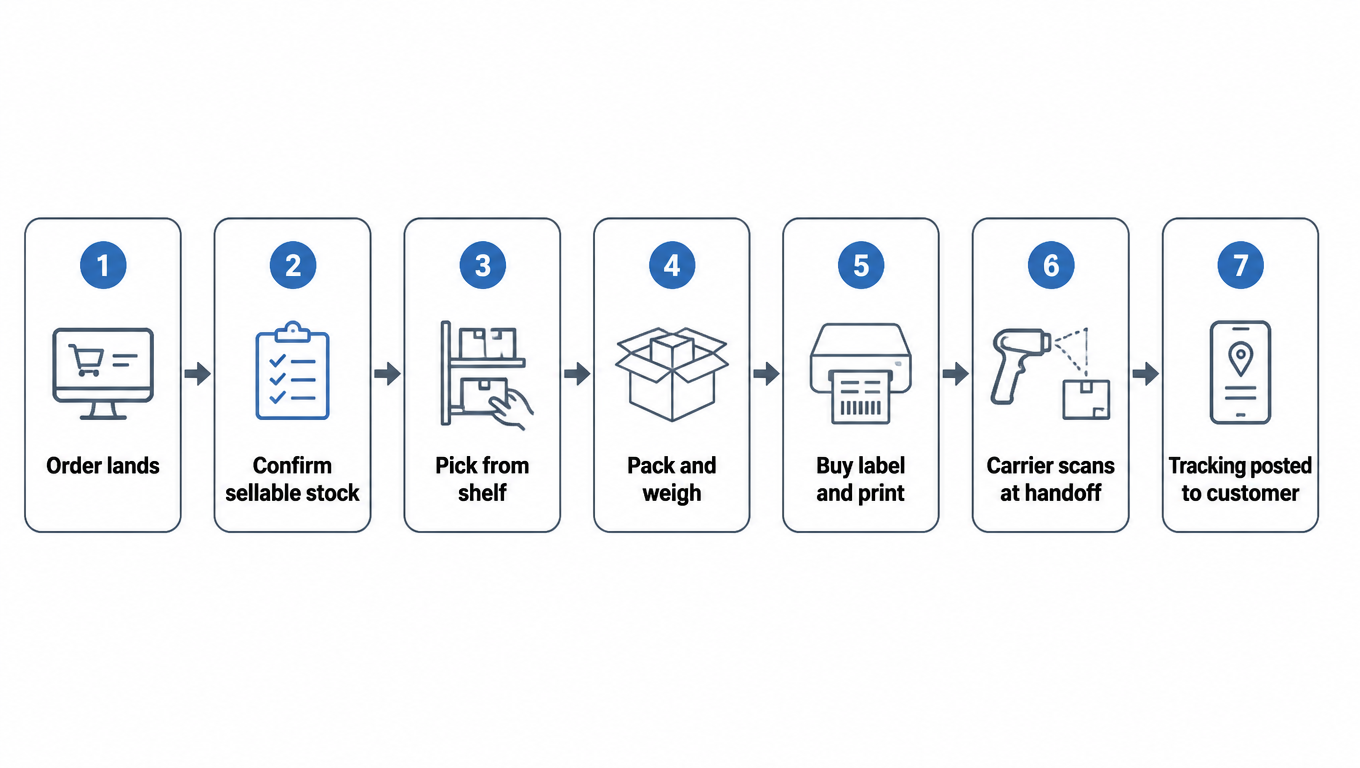
Every store-based fulfillment flow has the same backbone. Lay it out once and name an owner at each step, and most of the daily chaos disappears.
Only step six actually turns the parcel into a shipment
1. The order lands somewhere a person can see it. Decide this before anything else. If orders arrive only in a corporate dashboard nobody at store level watches, the ship-by clock runs while the parcel does not. The order needs a queue the store actually monitors, with the promised ship date visible on each record. Treat that date as the real deadline; it came from a promise made at checkout, not from anything the store chose.
2. Confirm the stock is sellable, not just countable. This is where most misses happen. System on-hand counts include items that are damaged, held for another order, on a mannequin, or sitting in a fitting room. Reserve the unit the moment the order is accepted so two channels cannot sell it, and walk to the shelf if the count is thin. A display unit is not sellable stock unless you have decided that it is and priced the shrink into the model.
3. Pick, and pick fast enough to matter. A product that takes four minutes to locate in a 12,000 square foot store will not survive contact with a busy Saturday. Keep a pick path that follows the floor plan, keep overstock in labeled bins rather than loose cartons, and put the fast-moving small assortment near the pack bench. If a single SKU costs two minutes of searching per order, that is real money once you multiply it.
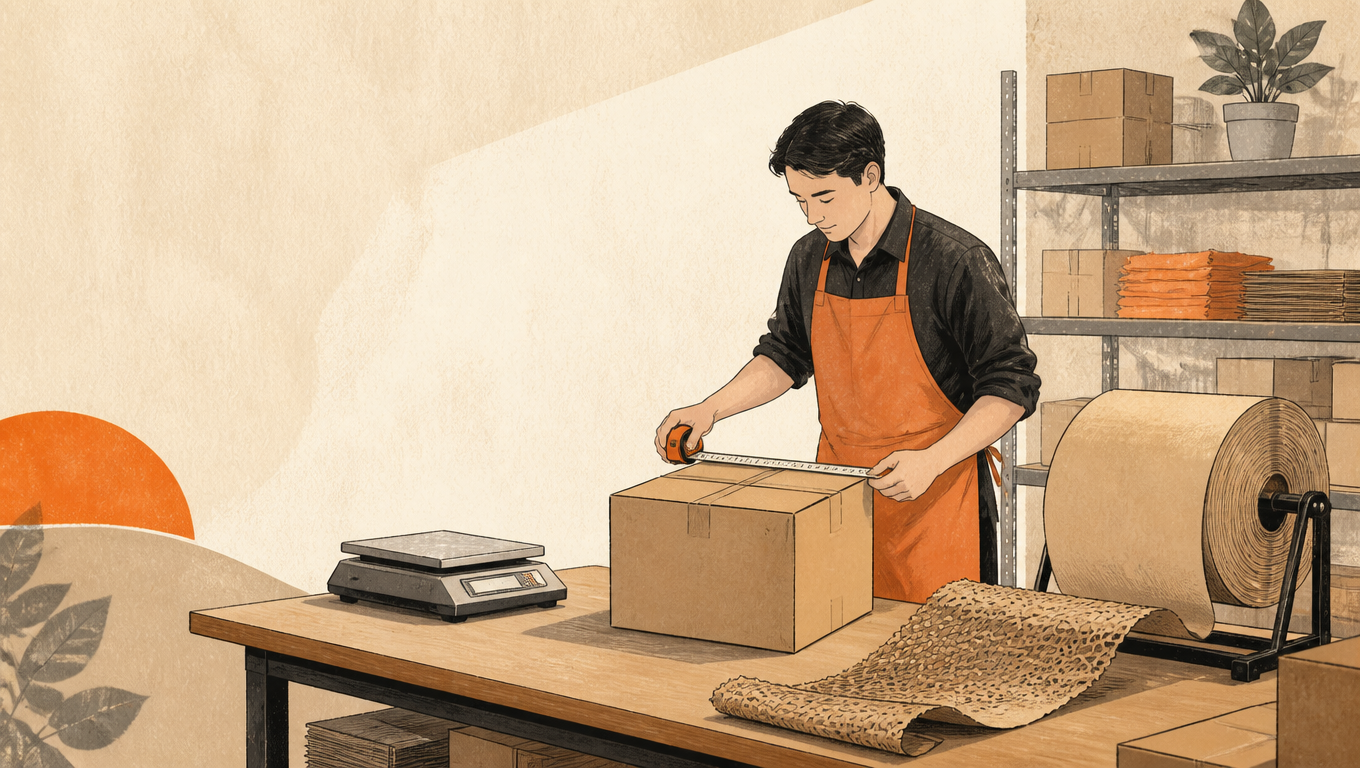
4. Pack and weigh, with the shipping container in mind. Retail packaging is designed to look good on a shelf, not to survive a parcel network. Use a shipping-rated box or mailer, then weigh the finished parcel on a scale rather than trusting the catalog weight, because fill material, inserts and gift wrapping all add up. Measure the outside dimensions too: carriers bill on billable weight, which takes the greater of scale weight and dimensional weight, so a light but bulky parcel can price out as a heavier one. USPS applies that rule to any parcel above one cubic foot, which is most of what a store ships in a reused carton; see Domestic Mail Manual 283.
5. Buy the label from the store's own origin. The rate that applies is the rate from the store's ZIP code, not from your warehouse. Quote, then buy. Print on a thermal label printer if you have one, because an inkjet on plain paper means tape, smudges and barcode scan failures at the counter.
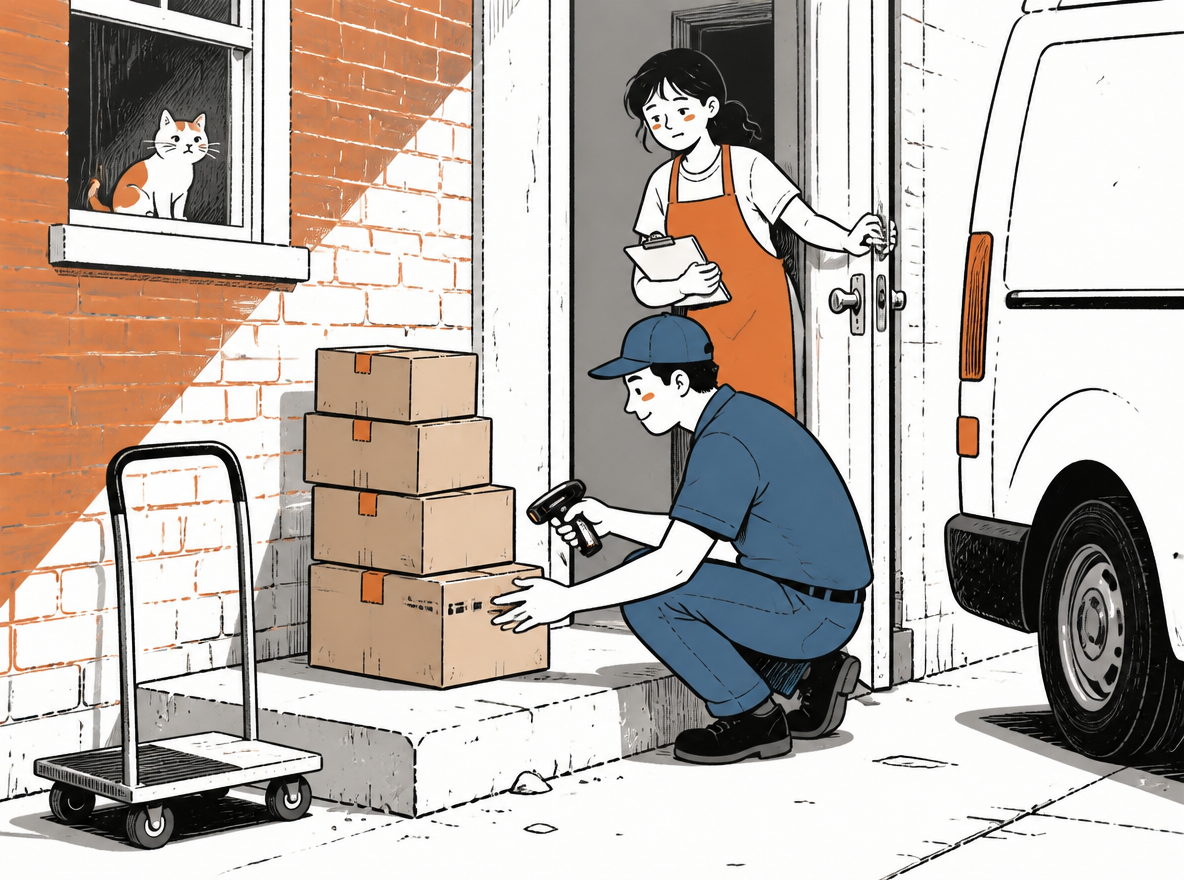
6. Handoff is the moment the parcel becomes shipped. A label is not a shipment. Tracking only becomes useful once the carrier scans the parcel into its network, so record the handoff: date, time, package count, who accepted it. A store that cannot produce that log cannot answer a customer asking where a package is, and cannot dispute a carrier that says it never received anything.
7. Post tracking back to the channel and to the customer. The order record needs the tracking number and the ship confirmation, or the customer keeps seeing "processing" while the parcel moves. Watch for the gap between "label created" and "carrier accepted"; customers read the first as shipped and the second as truth, and that mismatch generates tickets even when nothing is wrong.
Setting up: who packs, where, with what, and how many orders a day
The setup list is short, and every item on it is a decision someone has to own by name.
Who packs. Assign a primary packer and at least one trained backup. A single named person means vacation, illness and the lunch rush all become outages. Pick people whose shifts overlap the carrier's arrival, not the people who happen to be senior. Give them the authority to void a label, reorder stock, and refuse an order that cannot be fulfilled honestly, because those three decisions otherwise travel up to a manager and stall the parcel.
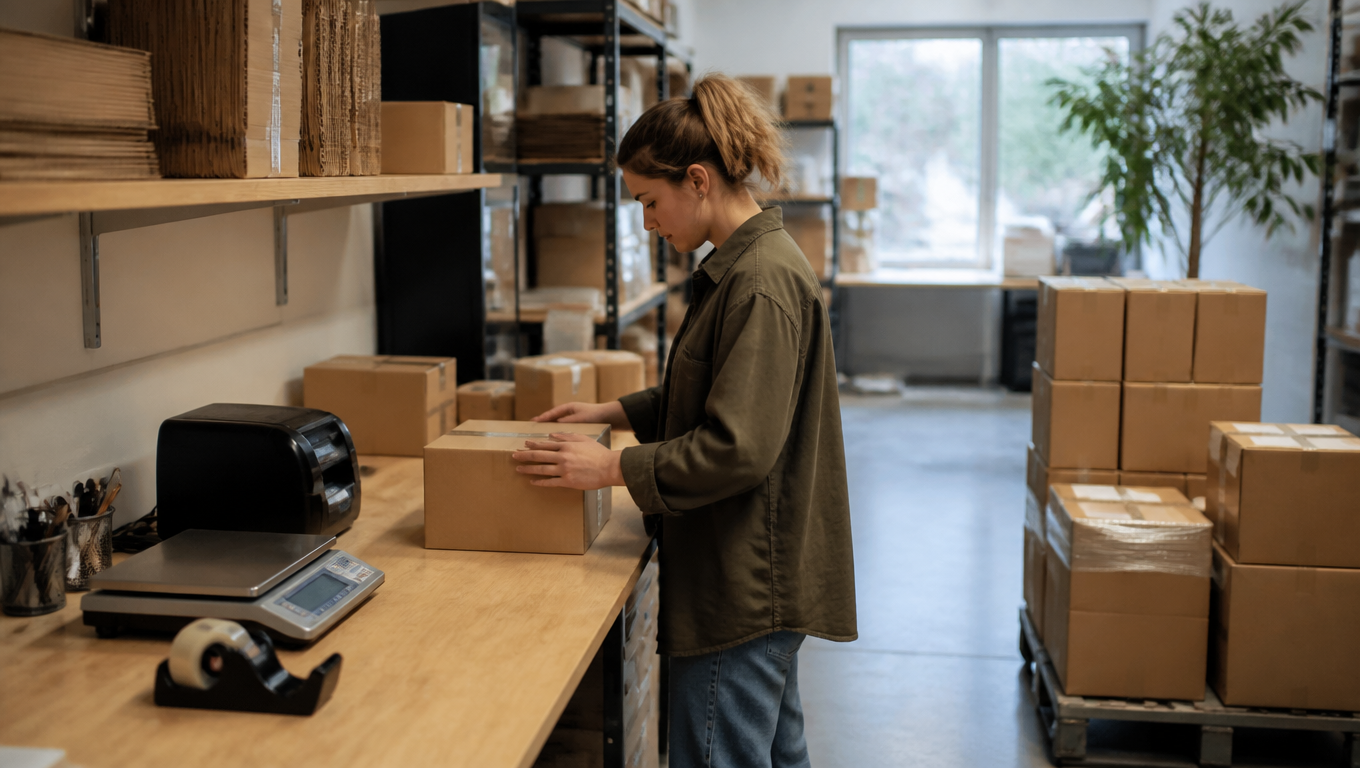
Where they pack. A bench in the back, not the counter. The pack area needs a flat surface at working height, room for a scale and printer, a bin for packaging, a place for finished parcels to wait, and a clear boundary from customer space. Keep unshipped orders out of reach. A customer picking up a parcel should never be able to walk off with someone else's box because it was stacked by the door.
What they need. A thermal label printer and a supply of 4x6 labels; a digital scale rated above your heaviest parcel; boxes and mailers in two or three sizes plus void fill and tape; a device to work the order queue, ideally at the bench rather than a shared terminal across the store; a tape gun that is not being borrowed by the visual merchandising team every week.
A pack bench can be designed; a checkout counter cannot
How many orders a day. Do not guess, compute it from hours. If the bench has three usable hours a day and a parcel takes 14 minutes from pick to label, the ceiling is roughly 12 orders before anything else goes wrong. That is an arithmetic example, not a benchmark: your minutes will be higher for fragile goods, apparel with multiple size options, or a store where stock is poorly located. The point of the calculation is to know your ceiling before someone in e-commerce raises the order cap in the system.
Costing one order: postage is the first line, not the whole bill
Store shipping projects usually get approved on a postage comparison and then lose money on labor. Cost the whole parcel, per order, and keep the accounting honest about what is genuinely new spending.
Cost line
How to calculate it
Illustrative example
Postage
Quoted price for billable weight, destination zone and service
$9.20
Packaging
Box or mailer, void fill, tape, label, per parcel
$1.15
Labor
Handling minutes × fully loaded hourly cost ÷ 60
14 min × $21.50 = $5.02
Handoff
Pickup charge divided by the parcels in that pickup
$0.00 when collected on the regular route
Rework reserve
Reship or refund cost × failure rate
$0.40
Total per order
Sum of the lines above
$15.77
Two accounting traps to avoid.
The first is treating rent and salaried store staff as free because they are already paid. They are not free, but they are not all incremental either. If packing consumes hours that would otherwise be selling, the labor is a real cost with a real opportunity cost behind it. If it consumes dead hours on a slow weekday, it is closer to free, but it is never zero: training, mistakes and peak-week overtime all land somewhere. Decide which hours you are actually spending and say so out loud.
The second is leaving rework out because it is invisible in a good month. One reshipment per fifty orders at a $20 cost is forty cents a parcel, which is small. The same rate during a holiday week, with expedited replacement shipping, is not small, and it is the line that turns a pilot into a bad story.
Compare the total against the real alternative, not against a warehouse's postage line. If your current option is a 3PL charging a pick and pack fee plus postage from a distant zone, the comparison is your $15.77 against their all-in cost. If your current option is a warehouse you already operate, much of that overhead is sunk and the comparison is messier, which is exactly why the pilot measures incremental cash rather than fully allocated cost.
Making the handoff work: pickup, drop-off, cutoffs and serviceability
The store can pack a perfect parcel and still fail, because the parcel never leaves. Solve the handoff before you accept a single order.
Verify the pickup, do not assume it. USPS will collect eligible packages free during regular mail delivery, with no charge per pickup, as described on its Schedule a Pickup page. There are conditions worth designing around: packages must be ready before the carrier arrives, the request has to be submitted by 2 a.m. CT on the day of pickup, the per-package limit is 70 pounds, and there is no cap on how many packages can be collected. For a store, the useful half is the no-cap rule, and the half that breaks first is being ready before the driver shows up.
If the regular route does not work, paid options exist. USPS Pickup on Demand buys a two-hour window and charges per trip regardless of how many items are scheduled. UPS one-time pickup charges per request rather than per package. FedEx moved on-call pickups to a per-stop structure rather than per package, and its own guidance notes that if the driver arrives during the pickup window, the charge applies whether or not a package is collected.
Read that last sentence as an operating instruction: a missed handoff still costs money, so the bench has to be ready before the window opens, not during it.
The alternative is drop-off. The manager walks the parcels to a post office counter, a carrier retail location, or an accepted drop point. It is free of pickup fees and expensive in labor, and it has to be scheduled like any other task, or it becomes the thing that happens after closing.
Work backward from the cutoff. Take the carrier's arrival time or the last collection time at your drop-off point, subtract packing time, subtract picking time, and subtract a buffer for the order that needs a stock check. What is left is your cutoff. If the driver comes at 11:30 and packing takes 14 minutes plus a 10 minute walk to the shelf, an order that lands at 11:00 is not shipping today, no matter what the dashboard promises. Publish the cutoff internally and, if you advertise promised dates, at checkout.
Pick the service class before you pick the carrier. Ground service is usually the sane default from a store, because the promise you can defend is a few days, not overnight. USPS Ground Advantage is expected in 2 to 5 business days to most U.S. destinations with tracking included, which covers the ordinary store order without a premium. Reserve faster services for the exceptions, and price them as exceptions rather than absorbing them into a flat rate.
Confirm serviceability from this ZIP. The menu of available services and the transit times differ by origin. A store in a rural ZIP may see a shorter list of available services, longer transit, or a remote-area surcharge that the warehouse quote never showed. Always quote from the store's own postal code before you promise a date to a customer, and re-check when a carrier changes its network or service names.
Reconcile every day. Count parcels against labels printed. A mismatch means either a parcel that never shipped or a label that was bought and never used, and both cost money. This daily count is also the only early warning you get before a customer writes in about a package that tracking says was never tendered.
The handoff log is the only evidence that settles a dispute later
Pilot first: four numbers from a small run
Do not roll this out to every store because it worked in a slide. Run one store for two to four weeks on a deliberately narrow slice, then decide with numbers. A reasonable slice is a single product category, or orders within a defined radius, plus one hard daily cutoff.
Capture a timestamp at each handoff of the flow: order received, pick started, packing complete, label printed, carrier scan. Timestamps beat stopwatches because nobody remembers to time themselves during a rush, and they give you the distribution rather than the average.
Handling minutes per order. Median, not mean, and note the worst decile. The tail is what causes missed cutoffs.
Errors per 100 orders. Wrong item, missing item, wrong address, damaged in transit. Include the "could not find it" cancellations, since those are a stock accuracy problem even though the parcel never existed.
On-time handoff rate. Parcels scanned by the carrier before the cutoff, divided by parcels the store committed to ship that day. This is the number that predicts customer complaints better than any postage metric.
Incremental cost per order. Postage, packaging, added labor hours, pickup charges and rework. Exclude rent and the base wage of staff who would have been there anyway, but count overtime, temp labor and any packaging you had to buy.
Then choose. All three outcomes are legitimate; the data decides which one you are in.
Scale it if handling time fits inside hours you already pay for, the error rate is close to zero, and the all-in cost beats the alternative route for those destinations. Widen the assortment and add stores with similar labor profiles.
Narrow it if errors cluster around specific SKUs, usually fragile, high-variation, or poorly located stock. Fulfill only the clean categories from stores and route the rest to the warehouse.
Hand it to a 3PL if volume is steady and predictable, if store hours cannot absorb the work without cutting into selling, or if the parcel mix is fragile and packaging-heavy. Store fulfillment earns its keep on proximity and on labor that already exists. When either disappears, a fulfillment partner usually wins on consistency.
If you are still deciding whether same-day promises are worth making at all, that is a separate question from where the parcel ships from. Our same-day delivery decision framework treats it as its own decision rather than folding it into this one.
Running it without duct tape
Manual store shipping works for a few parcels a day and collapses at thirty. The layer that keeps it working is the one between the order and the label: create the order, compare rates, buy postage, get tracking back.
EasyShippingX handles that layer through three routes, and the right one depends on how the store actually works.
Portal. For a store creating shipments by hand, the portal is the shortest path. Enter the destination, weight and dimensions, compare quotes across the carrier channels enabled on your account, buy the label, print it, and use the tracking number on the order record. It is also the place to check which services are available from that store's ZIP before you quote a customer.
Excel upload. When daily orders arrive as a list, a spreadsheet upload beats retyping them. Export the day's orders, fill in weight and dimensions, upload, review the errors before buying anything, then purchase in a batch. Errors you catch in the review screen cost nothing; errors you catch after purchase cost a voided label and a re-do.
API. If the store works from an order management or commerce system, the API lets that system create shipments, pull rates, buy labels and retrieve tracking without anyone opening a separate tab. Plan it as an integration project with an owner, not as a switch you flip on a Friday.
Two boundaries worth stating plainly. First, a rate quote is a quote; carriers adjust for actual weight, dimensions and address corrections, so only a store that weighs and measures honestly at the bench keeps its quoted prices. Our guide to rate quote vs final charge covers where the difference comes from. Second, a shipping layer is not an inventory system. Whether a particular point-of-sale or commerce integration is supported should be checked against current product documentation before you build a workflow on top of it. If the store's POS is not connected, keep the source of truth in your commerce platform and let the store work from an export, rather than maintaining two inventories that drift apart.
Two tools shorten the loop: the shipping rate calculator for quoting a typical parcel from the store's own ZIP and billable weight, and the billing reconciliation checklist for separating "bought but never used" from "shipped but never scanned" during the daily count.
Questions retailers ask first
BOPIS means buy online, pick up in store: the customer collects the order and the store's job ends at the handover. Ship from store means the store packs the order and a carrier delivers it to the customer's address, so the store takes on packing, labeling, handoff and the ship-by deadline. The labor profile differs too. BOPIS is mostly staging and holding space near the front of the store; ship from store is a bench, a scale, a printer and a daily cutoff.
Yes, and a single store is often the right place to learn. Nothing about the model requires a chain, and the pickup and drop-off options are the same ones available to any business address. What a single store cannot do is spread the fixed cost of the bench across many locations, so the economics rest entirely on that store's order density and on whether the packing hours are genuinely spare. Start with one cutoff, a narrow set of SKUs and a daily reconciliation count.
No. It is cheaper when the store sits close to the customer, so the parcel crosses fewer zones and often arrives faster, and when the labor used is time you already pay for and would not otherwise sell. It gets more expensive when handling time is high, when retail-grade packaging has to be replaced or over-built, when errors require reshipping, and when fulfilling online orders quietly strips stock that walk-in customers expected to buy. The only honest comparison is all-in cost per order for the same destinations, measured over a few weeks rather than estimated in a meeting.
The store does. The customer is dealing with your brand, not with the carrier. So put two things in the process: log the date, time, piece count and the person who accepted the handoff, and use that log plus the label number when a claim comes up. Without a handoff record, a parcel is effectively "never tendered" in any dispute.
Links verified October 24, 2026. Pickup conditions, weight limits and cutoff times change with carrier policy, so treat the conditions above as a checklist to verify rather than as permanent rules.
Want to know what one order actually costs from your store?
Send us two typical package profiles from one store, with packed dimensions, weight, the store's ZIP and a rough destination mix, and we will walk through the comparison for the channels your account can actually access, with today's alternative in the same table so the per-order difference is visible. EasyShippingX is a channel-neutral shipping layer: one consistent way to compare US domestic carrier options and execute through a portal, a spreadsheet, or an API.