You spent 18 months growing U.S. orders from a few dozen a week to a few hundred a day. Then you looked at the fulfillment line of your P&L and stopped feeling good about it. Per-order cross-border shipping costs keep creeping up, fuel surcharges jump without warning, customs handling now demands real manual work, return orders have spent money that never comes back, and the reviews section is starting to show a pattern: "took 3 weeks," "lost in transit," "no tracking updates."
Moving inventory into a U.S. warehouse sounds like the standard answer, but it has its own price: monthly storage fees, cash locked up in inventory, and the slow-burn risk of dead stock when a SKU stops selling. So the real question is not "cross-border or local?" It is "when, for which SKUs, and in which regions does local fulfillment actually pay for itself?" There is no one-size-fits-all answer, because the decision was never actually about total order volume.
The question is not cross-border or local; it is when, which SKUs, and which regions
Amounts, order profiles, and outcomes in this illustration are model assumptions, not customer results or live rates. Replace them with matched order samples, applicable invoices, and tender records before deciding.
1. Growth Is Outrunning Your Fulfillment Model
The recurring jewelry brand, $60 order value, volumes, and pilot outcomes below are hypothetical illustrations, not a verified customer case. Retain the SKU-by-region, demand stability, CPSD, return, and exit-condition dimensions; replace inputs with real orders, invoices, and concurrent comparisons before deciding.
Use the ecommerce shipping overview to place the inventory-location choice in the wider fulfillment setup. After the U.S. dispatch point is defined, the carrier handoff checklist details the local warehouse-to-carrier handoff.
Take a case we will follow through this whole article: a DTC jewelry brand selling on Shopify and Amazon, average order value of $60, individual items under 50 grams, shipped cross-border from China with a promised transit time of 8 to 14 days. It sits in the most deceptive position in ecommerce: its postage share of revenue is tiny, under 10%, which makes it look like it should never move inventory to the U.S. Yet it is losing money and goodwill every day to lost packages, item-not-received (INR) disputes [^4], unrecoverable returns, and delivery-time reviews. That tension is exactly why the framework below exists.
2. Why a Fixed Order-Volume Threshold Can't Decide This
The most widely repeated rule in cross-border ecommerce is "once you sell more than X orders a month, move to a U.S. warehouse." Depending on which forum you read, X is 500, or 1,000, or "you'll just know." Nobody can defend the number, because the rule treats order volume as the only variable, when volume is not even close to independent of category, weight, price point, and return rate.
Two sellers can both do 2,000 U.S. orders a month and get opposite answers. A lightweight jewelry item ships cross-border for roughly $4 in postage; a heavy item like a dumbbell starts around $25 and climbs fast with DIM weight; a high-return category like apparel has to spread 30% return costs across every successful order. Best-selling SKUs turn over fast and cost almost nothing to store, while long-tail SKUs quietly burn storage fees every month they sit. Same order count, opposite conclusions. That is why the threshold rule fails.
Jewelry is the most counterintuitive case, because its postage share is so low that "never pre-position" feels obviously right. But the decision variable is not per-order postage. It is the true cost of every successfully delivered order, the cost per successful delivery (CPSD). Every lost package, every INR dispute, every unrecoverable return has already consumed postage and product value, and that money has to be absorbed by the orders that did succeed. Once you count it that way, lightweight cross-border shipping is not nearly as cheap as it looks.
The conclusion from this section is the whole article in one line: the right unit of analysis is SKU × U.S. region, not account-level volume. A single hero SKU may have deserved local fulfillment on the East Coast for a year while a long-tail SKU in the same catalog should never leave cross-border shipping.
3. The Framework: Three Modes at the SKU × Region Level
Mode 1 is cross-border direct: ship each order from China as it comes in. No inventory risk, minimal cash tied up, and full flexibility to change course. The price is an 8-to-14-day transit time, customs and tariff uncertainty, and painful handling of lost or returned items. This mode fits SKUs with unstable demand, low volume, or an unproven market.
Mode 2 is U.S. local fulfillment: bulk inventory sits in an American warehouse, whether a 3PL, Amazon FBA, or Walmart WFS, and orders are picked, packed, and delivered domestically. Transit drops to 2 to 5 days [^3], returns become recoverable, and ratings and conversion usually improve. In exchange you pay inbound receiving, storage, pick-and-pack, and domestic parcel rates, and you carry inventory risk on your balance sheet.
Mode 3 is hybrid: only your proven winners move into the U.S. warehouse while long-tail SKUs keep shipping cross-border. This is the most underestimated option and usually the most rational starting point, because it minimizes the fixed cost of pre-positioning and only bets on SKUs that have already demonstrated demand.
These three modes are not a menu you pick once. They are three options that coexist inside a SKU × region matrix, and the next four steps are how you decide which SKU goes where.
4. Step 1: Diagnose the Variables That Actually Drive the Decision
Before any math, pull the full set of variables. On the demand side: U.S. order volume, whether growth is stable or spiky month over month, the ZIP distribution of your orders (are they concentrated in a few metro clusters?), SKU concentration (what share of orders do your top five SKUs produce?), and seasonality or promotion-driven volatility.
On the cost side, split it in two. Cross-border costs: postage, fuel surcharges, duties and customs handling, and failed-delivery costs (lost parcels, INR claims, bad addresses). Local costs: bulk inbound and receiving, monthly storage, pick-and-pack, U.S. parcel rates (watch zone, DIM weight, and surcharges), and return processing. Most spreadsheets model one side or the other; the decision lives in the gap between them.
On the service side: promised transit time versus actual successful delivery, loss rate, return rate by channel, and rating trend. On the readiness side: inventory capital and replenishment lead time, dead-stock risk, and how mature your integration with a 3PL, WMS, and carriers actually is, portal and API included.
The jewelry brand's diagnosis surfaced four numbers that matter: about 60% of orders come from just two hero SKUs; delivery complaints cluster in coastal metro ZIPs; the loss rate runs around 2%; and the overall rating sits at 4.3 and slipping. None of that is decisive on its own. It is just the input for Step 2.
5. Step 2: Model the Math: The Break-Even CPSD
The break-even equation gives a finite positive threshold only when cross-border CPSD minus local variable CPSD is positive. A zero or negative difference does not establish a cheaper local mode. Align denominators, undelivered orders, and refund treatment; include clearance, storage, and inventory costs for the actual arrangement rather than substituting a fixed volume threshold.
CPSD is the fully loaded cost of each order that actually reaches the customer successfully, with the denominator being successful deliveries, not shipments. In cross-border mode, every lost or returned order has already spent postage and product value, and that spend is spread across the orders that succeeded. That is why cross-border CPSD is always higher than the postage line on your invoice.
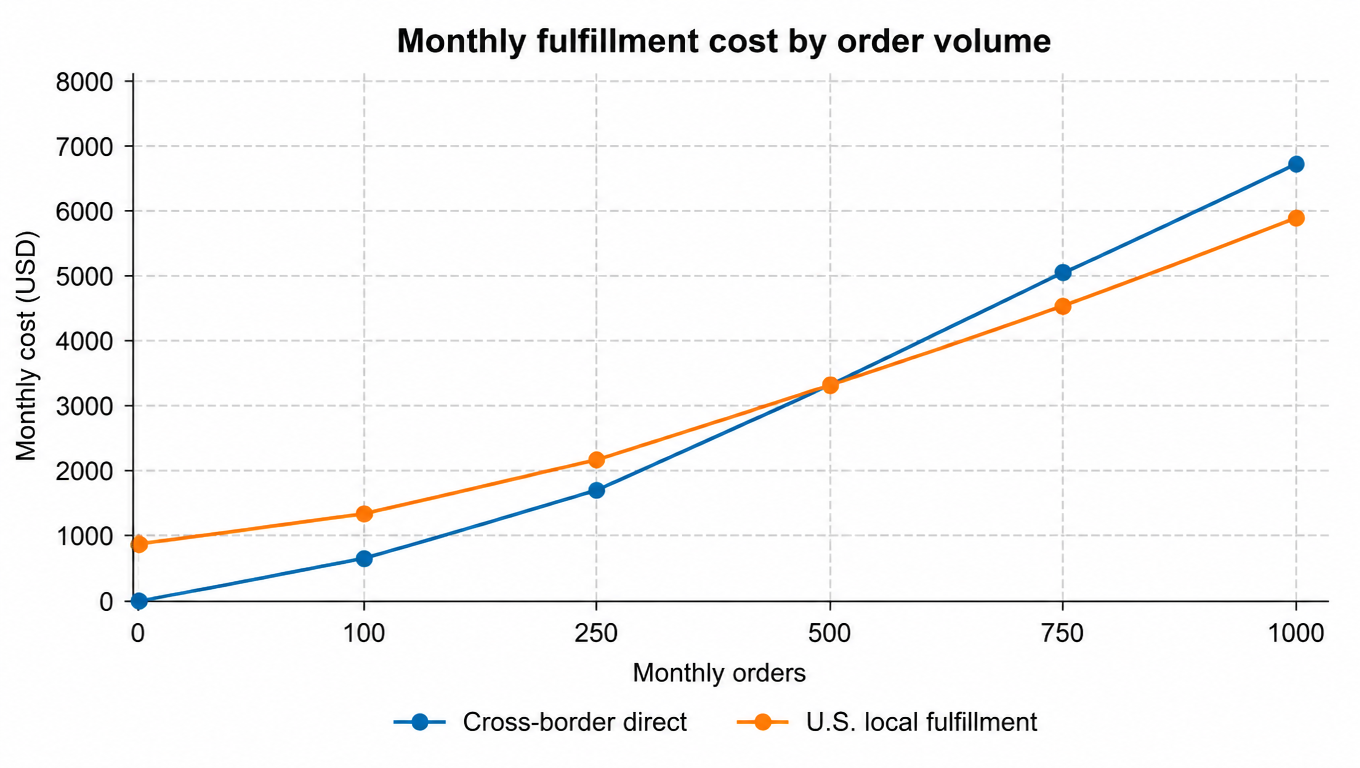
Here is the jewelry brand's cross-border CPSD, item by item: direct postage including fuel surcharges, $4.20; the 2% loss and INR rate, with product value plus postage spread across successful orders, $1.60; cross-border returns that cannot be recovered and are refunded and re-shipped, $0.70; customs and tariff handling after the end of the de minimis exemption [^1], $0.30. Total, about $6.80 per successful delivery.
The local mode is cheaper per variable unit: U.S. domestic parcel for a lightweight First-Class item [^2], $3.10; pick-and-pack, $0.85; variable storage allocation, $0.65; return processing that can actually recover product, $0.50. Total, about $5.10. On top of that, local fulfillment carries fixed and semi-fixed monthly costs: warehouse minimums and management, $500; inbound receiving allocation, $200; system and monthly fees, $150. About $850 per month before the first order ships.
That gives you the break-even formula: Break-even monthly orders = local fixed and semi-fixed monthly cost ÷ (cross-border CPSD − local variable CPSD), which here is $850 ÷ ($6.80 − $5.10), or about 500 orders per month. The precondition matters: if local variable CPSD is not actually below cross-border CPSD, the formula has no meaning and the answer is simply "don't move." The chart below shows the two cost lines crossing exactly at 500 orders: below it, cross-border is cheaper; above it, local fulfillment wins.
The two cost lines cross at about 500 orders a month
Amounts, order profiles, and outcomes in this illustration are model assumptions, not customer results or live rates. Replace them with matched order samples, applicable invoices, and tender records before deciding.
The sensitivity is where lightweight sellers should pay attention. The CPSD gap for a <50g item is $1.70, far smaller than for heavy goods, so the break-even point sits high, which is precisely why only hero SKUs usually cross the line. And note that the cross-border side of the equation is not static: as transit times slip, complaints and INR claims rise, cross-border CPSD creeps up, and the break-even point moves down on its own. The math rewards you for re-running it quarterly.
6. Step 3: Run the Three Decision Gates
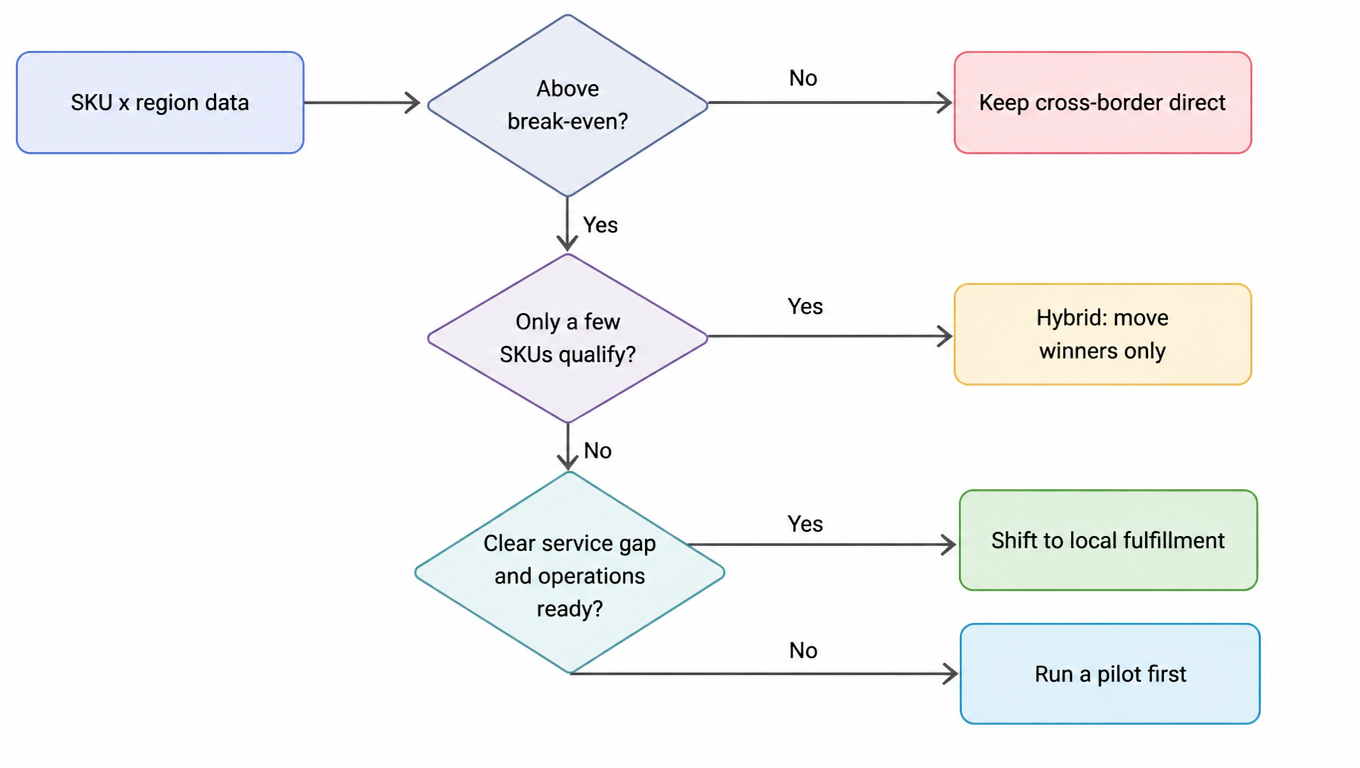
Gate 1 asks whether demand is stable and above break-even. If demand is unstable or below the break-even line, keep shipping cross-border. For the jewelry brand, the long-tail SKUs together produce about 360 orders a month, well under the 500 threshold, so they stay exactly where they are.
Gate 2 asks whether only a few SKUs cross the line. If so, go hybrid and move only those SKUs. The brand's two hero SKUs produce about 540 orders a month, above break-even, with demand stable enough to justify pre-positioning. The decision collapses into something small and safe: move two SKUs into a U.S. warehouse, leave the other 60-plus SKUs on cross-border shipping.
Gate 3 asks whether multiple core SKUs are stable, the service gap is obvious, and operations are ready. Only then do you shift toward full local fulfillment. If, after a few more quarters, a dozen SKUs sit above break-even, delivery complaints and INR disputes are measurably hurting conversion and ratings, and your 3PL integration, API, and returns flow are genuinely ready, the case for a broad move becomes real.
One rule overrides the math: the service gap can decide on its own. Even at cost parity, if local fulfillment meaningfully improves ratings, cuts INR disputes, and lifts repurchase, the decision should lean local. This is an operating decision, not a rounding error, and treating it as pure arithmetic is how brands end up with great spreadsheets and shrinking trust.
Three gates: below break-even stay cross-border, a few winners go hybrid, many stable SKUs with a clear service gap go local
Amounts, order profiles, and outcomes in this illustration are model assumptions, not customer results or live rates. Replace them with matched order samples, applicable invoices, and tender records before deciding.
7. Step 4: Pilot Before You Migrate
Whatever gate you land on, migration starts as a pilot: a small set of SKUs in a limited region, never your whole catalog. The jewelry brand's first run looks like this: the two hero SKUs, fulfilled by one 3PL into East Coast metro ZIPs, while the same SKUs continue cross-border into the Midwest and West as a control group. Same products, same price, same marketing, different fulfillment.
Plan the inventory carefully: the first inbound shipment goes by air (small volume, fast validation of sell-through), and you set safety stock, a reorder point, and a replenishment cadence before the first unit is picked. Give the pilot a 60-to-90-day window, long enough to cover a full purchase cycle and at least one marketing push.
Run the comparison on KPIs, not vibes: CPSD, actual versus promised transit time, loss rate, return rate, rating, and conversion, pilot region against control region. And agree on the exit criteria up front: if the pilot region's CPSD has not beaten the cross-border control by the end of the window, shrink the pilot, liquidate or return the stock, and go back to cross-border for those SKUs. A failed pilot costs a few thousand dollars and two months. A failed full migration costs a season.
Channel strategy deserves its own lane. Amazon and Walmart orders should lean on FBA and WFS where the traffic and badge economics justify it; Shopify DTC orders fit a 3PL where you control the brand experience and own the data; eBay buyers have the lowest delivery expectations, so that channel can ride out the hybrid transition. The same brand can run different fulfillment modes on different channels, and that is not inconsistency, it is optimization.
8. The One-Page Checklist (and a Note for Your 3PL Partner)
For an overseas brand or 4PL, add stage ownership to the checklist. With U.S. inventory, the customer or partners handle clearance, receiving, and picking. With parcel injection, they arrange import release and tender under the domestic carrier-approved account and facility. Record actual origin, transport-to-tender costs, manifests and counts, first scans, returns, and invoice ownership in both workflows. EasyShippingX evaluates U.S. domestic transportation and API onboarding here; the model does not establish international transport, customs, or warehouse services.
Before you commit a single unit to a U.S. warehouse, run the five-question checklist. Have you pulled the full dataset, order volume, ZIP distribution, SKU concentration, return and loss rates? Have you modeled the break-even on CPSD, the gap between modes times your fixed costs? Have you run every SKU through the three gates instead of the account as a whole? Have you designed the pilot and its control group? Have you written the exit criteria down before the first shipment lands? Five yeses, then you move.
If you are a 3PL reading this to arm your sales conversations, the framework gives you a better pitch than "we're cheaper." Lead with CPSD, not postage, and show the prospect what failed deliveries are actually costing them. Enter through hybrid, offer to pre-position their two hero SKUs instead of pushing a full-catalog migration. And de-risk the sale with a pilot: a 60-to-90-day control experiment is a smaller commitment for them and a faster proof for you.
That is also the honest version of your value proposition: receiving, storage, pick-and-pack, portal and API integration, carrier mix optimization, and returns processing that actually recovers value. When a brand realizes that every cross-border order is quietly paying for the ones that fail, local fulfillment stops looking like a cost line and starts looking like the growth engine. The brands that get this right are not the ones with the biggest warehouses. They are the ones who knew, SKU by SKU and region by region, exactly when to move.
FAQ
There is no universal volume threshold. Compare CPSD per SKU and region. Only when cross-border CPSD exceeds local variable CPSD should fixed monthly local cost be divided by that difference for a positive break-even volume. A zero or negative difference does not establish cheaper local fulfillment. Retain demand stability, full-cost checks, the three decision gates, and a controlled pilot.
CPSD is fully loaded cost divided by successful deliveries. Align transport, losses, INR, returns, and attributable charges to one observation period, using consistent refund and undelivered-order treatment across modes. It can differ materially from postage, but do not assert that it is always strictly higher without checking charges, denominators, and offsets.
Order volume is not independent of category, weight, price point, or return rate. Two sellers at 2,000 orders a month can get opposite answers: lightweight items have small CPSD gaps and high break-even points, heavy or high-return items cross the line far sooner, and hero vs long-tail SKUs within one catalog differ as well.
Hybrid means only proven winner SKUs sit in a U.S. warehouse while long-tail SKUs keep shipping cross-border. It minimizes the fixed cost of pre-positioning and only bets on SKUs that have demonstrated demand, which makes it the most rational starting point and the natural first step before any broader migration.
Move a small set of SKUs into a limited region (for example two hero SKUs into East Coast metros) while the same SKUs keep shipping cross-border elsewhere as a control group. Set a 60-to-90-day window, compare CPSD and service KPIs against the control, and write the exit criteria before the first shipment: if the pilot does not beat cross-border CPSD, shrink it and go back.