Most return policies are written once and then inherited. The refund is the default because it is easy to explain, easy to staff, and easy to automate, while the exchange sits in a menu somewhere as the friendlier second option. Profit rarely enters the decision, and when it does, it enters as a hunch: "refunds cost us the sale, exchanges keep it."
The hunch is half right. An exchange does keep the revenue, but it also puts a second unit of goods and a second outbound shipment on the books. Whether that trade pays depends on a small number of measurable variables, and once you write them down, the answer separates cleanly by item value and order type instead of by policy habit.
This guide costs both paths with the same seven variables, screens out the returns that should never be costed at all, and ends with a table you can fill in per SKU and decide on. Every number in the worked examples is a labeled assumption, not an industry average, so replace them with your own.
One returns desk, two exits, two sets of books
Refunds are the default answer, and that is why they cost more
A return is not one event. It is a chain: the customer asks to send something back, a label is issued, the parcel moves in reverse, the unit is received and inspected, a decision is made about its condition, and whatever survives goes back to a sellable position or gets marked down, liquidated, or scrapped. Each link has a cost, and only the first one is visible on the returns dashboard.
A refund closes the order out in a single settlement. Revenue reverses, the case is done, and the customer relationship usually survives. That simplicity is real, and for a large share of low-value returns it is also the correct financial answer: a growing group of retailers now issues returnless refunds on selected items precisely because bringing the unit back costs more than the unit is worth.
The mistake is treating simplicity as evidence of lower cost. A refund hands back the whole sale, while the unit still has to travel, be touched, and be judged before any of its value returns. An exchange keeps the sale on the books and spends money in a different place: a replacement unit leaves inventory, someone picks and packs it a second time, it ships at full outbound cost, and often the customer is offered a sweetener to accept the swap. There is also a tail risk: the exchanged unit can come back, which puts the same cycle in motion again.
So the honest framing is not "exchanges are better." It is that a refund gives up the margin on the sale, and an exchange pays for one more unit of goods plus one more fulfillment cycle to keep it. Whichever is smaller, per SKU, wins. Everything else in this article is about measuring those two quantities properly.
The scale is worth a look first, because it decides whether this work is worth doing. US retail returns reached about $849.9 billion in 2025 with an online return rate near 19.3 percent, and return volume keeps growing faster than sales, as documented in the NRF 2025 retail returns landscape. On a base that size, a few cents of mis-specified cost per unit is a six-figure difference over a year.
Seven variables: costing both paths item by item
The whole difference between the two paths fits into seven variables. Define them properly first, and the formula and the tables that follow are just arrangements of the same seven.
Variable
How it is measured
What it decides
Reverse freight
The cost of moving the unit from the customer back to a warehouse, billed by weight band, distance band, or a negotiated return rate
Whether the unit is worth bringing back at all
Replacement product cost
The landed cost of the second unit, never the selling price
How much inventory the exchange consumes
Second pick-and-pack
Pick, pack, and packaging materials for the replacement order, priced per order rather than per unit
Why the low-value tier behaves badly
Re-shipment
The outbound freight on the replacement, at whatever that lane and weight band actually bills
Whether the original order's discounted rate still applies
Incentive
Free exchange shipping, a credit bonus, an add-on discount, or a straight upgrade, each with a cost and a ceiling
The ceiling is arithmetic, not preference
Recovered value of the original unit
Four tiers: resellable as-is, refurbish-then-sell, liquidation only, scrap
The term both paths share
Second-return risk
The chance the exchanged unit comes back, times the cost of one more full cycle
How large the tail is
A few notes on each. What matters about reverse freight is less the absolute number than who absorbs it: a return label the customer pays for is free to you but reduces what the customer feels they got, while a free return label on an exchange is a real cost you chose to take on. Track it as the difference between the two paths, not as a standalone figure. The billing mechanics matter too: USPS Ground Advantage prices by weight band plus distance band, so the same item returned from different ZIP codes does not cost the same, per the official Ground Advantage description.
Replacement cost has to be landed cost, not selling price. A same-model replacement is straightforward. An equivalent-SKU substitution changes the math, because you are now comparing the margin of one item against the cost of another, and if the substitute is cheaper you may be trading down your own price point without noticing. Second pick-and-pack is priced per order, which makes it a nearly fixed cost, and that is exactly why it behaves badly at low item values: it does not shrink when the item does.
On re-shipment, watch the trap of the original order's promotional or discounted rate: the second shipment may not qualify for it, especially if the first order hit a free-shipping threshold, in which case the replacement often bills at the full standard rate. And the incentive ceiling is derived rather than chosen: it can only stay below the profit gap the exchange is protecting.
Grading recovered value into four tiers is necessary because returned units end up in very different places: resellable as-is, needing refurbishment, liquidation only, or scrap. Industry observers repeatedly note that only a share of returns can be resold at the original price and the rest are marked down, refurbished, or destroyed, which is why writing recovered value as a single fixed percentage bends the model: see this ReverseLogix summary of how retailers recoup return costs. This figure is shared by both paths, and the next section shows why that matters.
Finally, second-return risk. It is not a rounding error on high-value items, and it runs higher for anything with fit, sizing, or configuration issues. The right treatment is to amortize it as the probability-weighted cost of one more full cycle, rather than booking it as an exception on the day it happens.
Returnless refund or ship it back? Compare net recovery before issuing a label
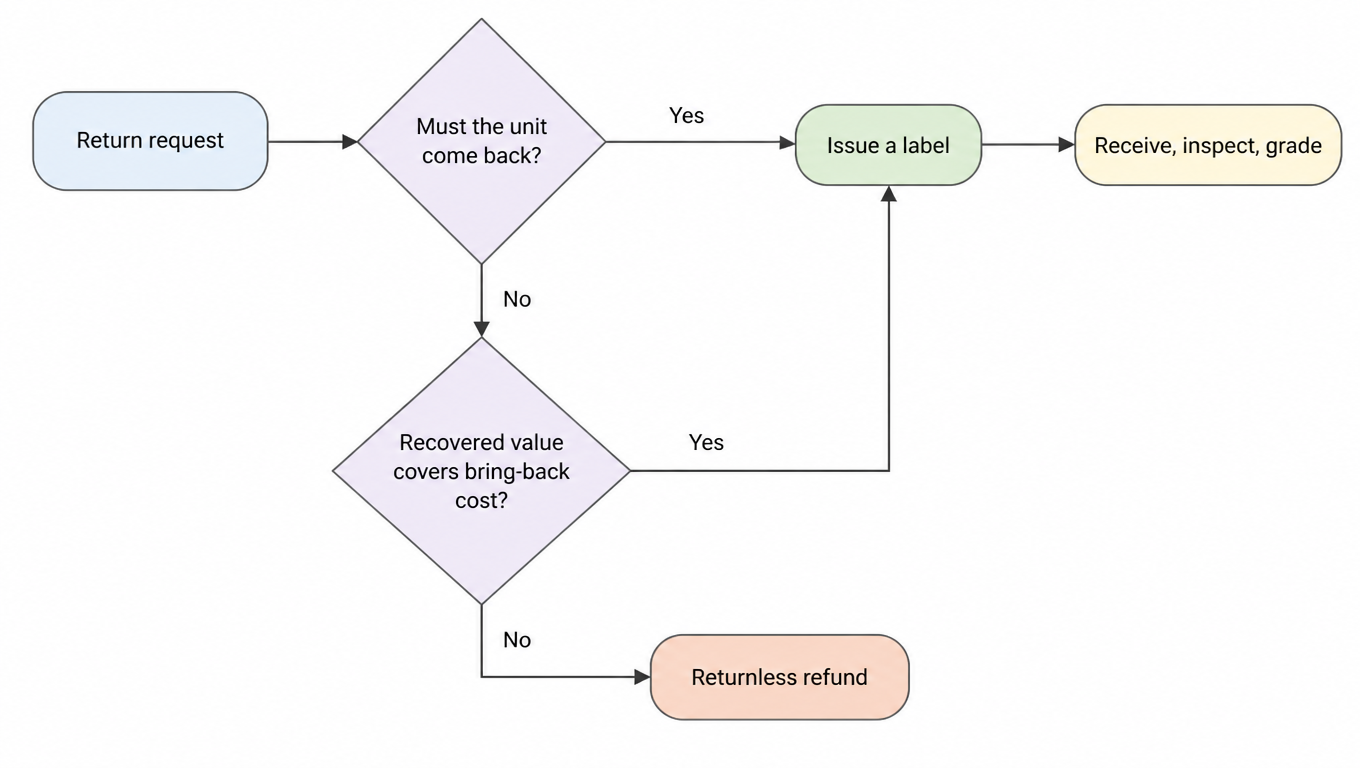
A label is a decision, and it is usually made by default: a return request arrives, the portal issues a label, and only afterwards does anyone ask whether the unit was worth bringing back. Reverse that order. Before a label goes out, compare what the unit can still return to you against everything it costs to get it into your building, and keep three exits open rather than two: refund without the unit, refund with the unit, and exchange, which the rest of this guide prices.
Each item below sits on one side of that comparison, and one of them is a constraint that overrides both sides.
Item
Which side it sits on
How to estimate it
Recovered value
Benefit side
Grade it in the same four tiers (resellable as-is, refurbish-then-sell, liquidation, scrap) and use the price you can actually get, never the selling price
Reverse freight
Cost side
The actual return rate for that weight band and distance band, plus the label itself
Receiving and inspection
Cost side
The labor to receive, identify, inspect, and grade the unit, priced per order rather than per unit
Repackaging and restock
Cost side
Materials, cleaning, relabeling, and the move back to a sellable location
Exception risk
Cost side, probability-weighted
Label issued but never used, damage in transit, a wrong grade, a second handling pass
Customer completion
Discounts the benefit side
Returns that need a printer or a trip to a drop-off point come back less often, so the units you expect to recover have to be discounted
Mandatory retention
Constraint, overrides both
Warranty claims, serialized assets, regulation, hygiene, platform rules, and supplier chargebacks that only credit on receipt, any one of which requires the unit
Start with the constraint, because it ends the discussion. Warranty terms that only honor a claim with the unit in hand, serialized or high-value assets where the unit is the record, regulatory and hygiene rules that require quarantine or destruction, marketplace rules where the platform rather than you decides what has to come back, and supplier chargebacks that only credit on physical receipt all turn a comparison into a requirement. When any of them applies, the label goes out and the arithmetic has nothing to say. The comparison only governs the cases where nobody requires the unit.
Where no requirement applies, the unit is only worth recalling when its recovered value covers the full bring-back cost: reverse freight, receiving and inspection, repackaging and restock, plus probability-weighted exception exposure. Above that line, send the label; below it, do not ask for the return. One input belongs in the model even though it never reaches your ledger, and that is the customer's effort. A return that needs a printer and a trip to a drop-off point completes less often, which lowers both the units you expect to recover and the value you expect to reclaim, and it pushes the borderline cases that look covered on paper closer to a loss.
Both directions of this decision have a failure mode, and they are opposites. Issuing a label for a unit whose recovery cannot cover the trip means paying freight and handling to receive something destined for scrap or liquidation, which is where the low-value tier in the worked examples below lands. Skipping the return on a unit worth recalling hands back the sale and the goods, and gives up the recovered value with them. A returnless refund is a lever, not a courtesy: it is the cheapest option when the bring-back cost sits above the recovery, and an expensive habit when it sits below.
Where the line falls is arithmetic rather than policy, so do not import a trigger percentage from a template or from another brand, and do not copy a figure you read in any guide, this one included. Build it from your own reverse rates, your own handling minutes, and your own grade distribution, then review it when those inputs move. One guardrail if you open returnless refunds: tie the decision to the account rather than to the single item. A policy that never asks for the unit is easy to learn and easy to farm, and the units that never come back are exactly what makes the recovered value line look optimistic.
The mandatory check first, the economics second, and the exchange question only after that
Only returns that clear both this gate and the four-gate feasibility screen below reach the exchange question, which is where the rest of the numbers in this guide start to apply.
Feasibility screen: nothing gets costed until the item passes
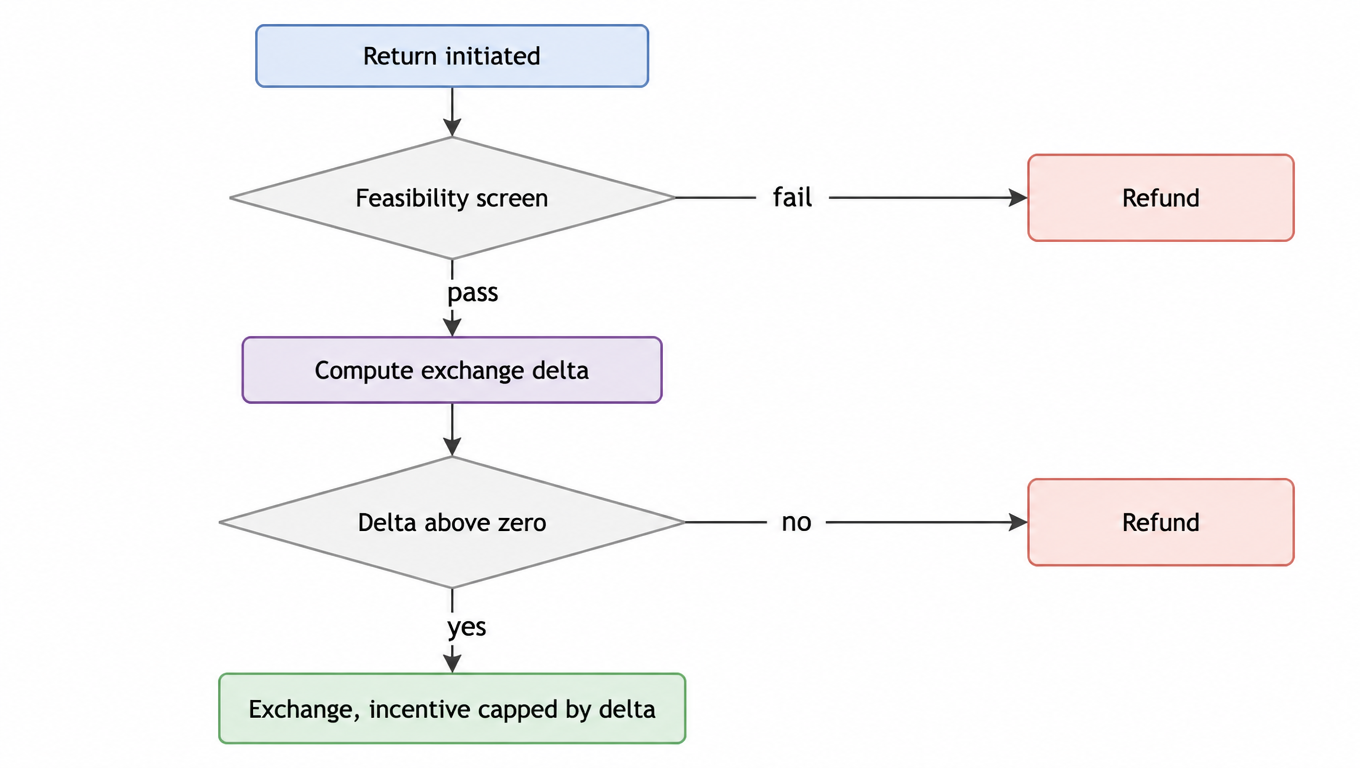
Before any arithmetic, four gates decide whether an exchange is even available for this item and this customer. First, is the item resellable in some form? If the returned unit can only be scrapped, stop paying to bring it back: the reverse freight and the inspection buy nothing, there is nothing left to grade or restock, and the refund should be issued without a return label. Second, will the customer accept an exchange at all? Someone whose appliance failed mid-project wants money to buy a replacement locally today, and no incentive will change that; survey data on return behavior keeps showing that the disposition a customer picks depends heavily on the reason and the situation. Third, can the warehouse receive, identify, and inspect the unit correctly, and is that inspection result trustworthy enough to route on? Fourth, do compliance, warranty, hygiene, or hazmat rules permit resale or reshipment of the unit?
Four gates in order, and any single failure stops the process
A single failed gate stops the analysis. Personalized or customized goods, opened hygiene items, units with missing components, and near-expiry stock route straight to a refund, and no freight quote, however attractive, should override that verdict. This is where a low reverse-freight rate becomes actively dangerous: it makes the exchange look cheap for an item that should never have been exchanged.
Run the screen first because it is cheaper than the math and because the math is only valid for items the screen passes. An exchange that fails feasibility is not a worse decision than a refund, it is not a decision at all. One aside: if the screen shows that a large share of your returns fail outright, the real fix is usually on the product page and in sizing information, not inside the returns flow.
Net recovery formula and thresholds
Define net recovery as the value captured from the return event, measured the same way on both paths. Let Rv be the recovered value of the returned unit, F the reverse freight you absorb, and C the processing and inspection cost. The refund path, with the unit returned, is Rv − F − C.
Then let P be the selling price, COGS the landed unit cost of the replacement, K the second pick-and-pack, Fout the re-shipment, I the incentive, and R the probability-weighted second-return cost. The exchange path is Rv − F − C + (P − COGS − K − Fout − I − R).
The bracket is the whole decision. Because Rv, F, and C appear on both sides, they cancel, and what remains is simply the contribution the replacement unit carries minus the cost of the second fulfillment cycle: Exchange delta = P − COGS − K − Fout − I − R.
That cancellation is where most return models go wrong without noticing. Reverse freight and inspection feel like the heart of the problem, yet to the extent both paths bear them they do not separate the two options at all. What separates them is one extra unit of goods, one extra fulfillment cycle, any sweetener you add, and the risk of doing it twice. Using reverse freight alone to argue that returns are expensive and therefore exchanges win does not hold together.
Define the net recovery ratio as exchange net recovery divided by refund net recovery. Above 1 means the exchange preserves more; near 1 means the two are close enough that operations convenience should decide; below 1 means refund. One caveat worth writing into your own sheet: when both paths come out negative, the ratio is meaningless, because dividing two negative numbers produces a positive result. Read the sign and the absolute difference instead.
Keep a self-check list of items that must not be double counted, because this is where spreadsheets quietly go wrong. Do not deduct the replacement unit's cost once as inventory and again as lost margin. Do not keep the original order's outbound freight in one column and call it sunk in another. Do not book free return shipping as reverse freight and again as an incentive: it is one payment. Do not measure replacement cost at selling price. Do not book a store credit at face value if it can only be redeemed with you; book the margin you give up on the future order. And use return initiations as the denominator when reporting any of this, never completed returns, or the returns that fail midway will vanish from your averages and make the process look more efficient than it is.
Three-tier worked examples: low, mid, and high item value
The parameters below are hypothetical assumptions chosen to make the mechanism visible, not benchmarks. Substitute your own freight rates and landed costs before drawing conclusions.
Variable
Low tier
Mid tier
High tier
Selling price (P)
$24.00
$96.00
$420.00
Landed unit cost (COGS)
$14.00
$42.00
$176.00
Recovered value if returned (Rv)
$7.00
$38.00
$190.00
Reverse freight (F)
$6.20
$9.80
$17.50
Processing and inspection (C)
$2.50
$3.60
$6.00
Second pick-and-pack (K)
$2.20
$2.80
$4.40
Re-shipment (Fout)
$5.80
$8.60
$19.00
Incentive (I)
$0.00
$8.00
$25.00
Second-return rate
3%
4%
2.5%
Risk cost (R)
$0.92
$2.67
$5.57
Refund net recovery
−$1.70
$24.60
$166.50
Exchange delta
$1.08
$31.93
$190.03
Exchange net recovery
−$0.62
$56.53
$356.53
Net recovery ratio
Not meaningful
2.30
2.14
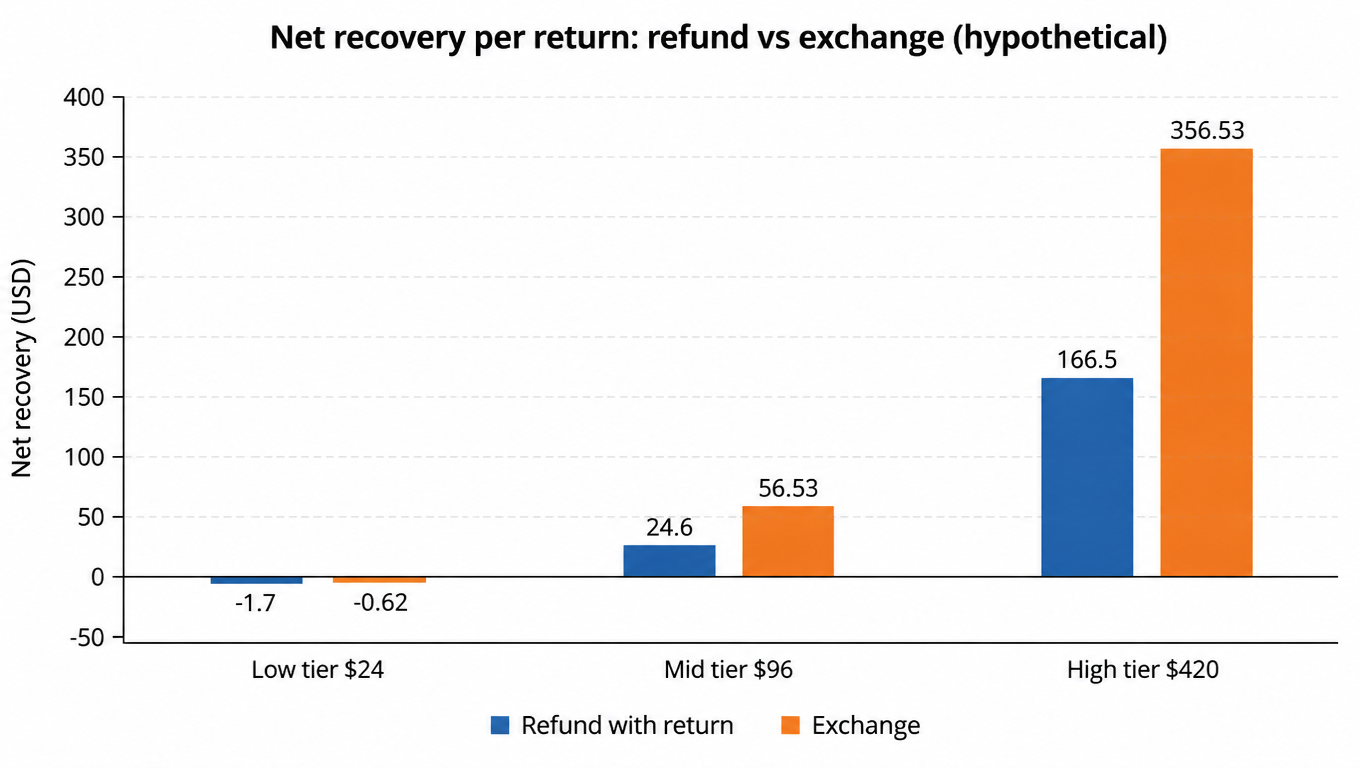
Net recovery across the three tiers, hypothetical parameters rather than benchmarks
Low tier. Reverse freight plus inspection ($8.70) already exceeds the recoverable value of the unit ($7.00), so the refund path is underwater before the exchange question is asked, and the exchange delta of $1.08 is too small to rescue it. The real lever here is not the choice between the paths, it is dropping the return requirement: refund the customer and let them keep the item, which lands at zero instead of negative and is also the better service experience. There is a settled practice around returnless refunds, described in Shopify's guide to returnless refunds.
Mid tier. Here the exchange is clearly worth having. The replacement carries $54.00 of contribution, the second cycle costs a little over $22 once the incentive and risk are included, and the exchange nearly doubles the value salvaged relative to a refund with return. This is the band where a free exchange label stops being a giveaway and starts being the cheapest way to keep a customer and a sale at the same time.
High tier. Exchange wins by the widest margin in absolute terms, $190.03 per return, even though the ratio (2.14) sits below the mid tier's 2.30. The ratio compresses because recovered value scales with item value too, so it is a poor measure of how much money is on the table. Rank options with the ratio if you like, decide with the delta.
The decision table: exchange, refund, or exchange-plus-incentive by SKU and order type
The table below is the working artifact. Fill the left columns from your own data, compute the delta, and read the decision off the trigger rules underneath.
SKU
Order type
Item value
Reverse freight as % of value
Resale tier
Exchange delta
Net recovery ratio
Second-return risk
Decision
Low-value accessory
First order
$24
26%
Refurbish-then-sell
$1.08
Not meaningful
Low
Refund, item not returned
Consumable refill
Subscription
$18
34%
Scrap
Negative
Not meaningful
High
Refund, credit toward next order
Mid-value apparel
Repeat order
$96
10%
Resellable as-is
$31.93
2.30
Low
Exchange
Mid-value device
Repeat order
$140
7%
Refurbish-then-sell
Recompute
Recompute
High
Exchange with capped incentive, or partial refund
High-value equipment
High-AOV
$420
4%
Resellable as-is
$190.03
2.14
Low
Exchange, inspection-gated
Four outputs, with their trigger conditions stated as rules you can apply directly. Exchange when the feasibility screen passes and the delta is positive with room to spare. Refund when the screen fails, or when the delta is negative, or when the refund path itself comes out negative and the item is not worth recovering. Exchange plus incentive when the delta is comfortably large and the incentive stays under the delta ceiling, which in the mid tier means something like an $8 credit is affordable against $31.93 of protected value, while in the low tier with $1.08 of delta nothing is affordable. Partial refund when the unit is functional but cosmetically imperfect, since it avoids the second cycle entirely and often costs less than either full path.
Edge cases belong in the same table rather than in a separate policy. An equivalent-SKU substitution is an exchange with a different COGS figure. A store credit is a refund with a retention condition attached, and it should be booked at the margin you give up rather than its face value. A partial refund is a refund with a discount, and it deserves its own row so it stops being an informal workaround. Keeping those three rows in the same table means support agents authorize inside a defined boundary instead of improvising each time.
Route order: screen first, then compute the delta, and only then set the incentive
Policy levers for each decision tier
The first lever is time. Most brands run one return window and one message. Splitting it is cheap: keep the full refund window as it is, and add a shorter exchange-priority window that offers free replacement shipping inside, say, the first fourteen days. Early returns are also the ones where the unit is most likely to be resellable as-is, so the shorter window and the higher recovery tier line up naturally.
The second lever is the default option in the returns portal. Ordering matters more than wording here. A portal that opens with a refund reason dropdown and buries "replace this item" at the bottom produces refunds. A portal that opens with "we can send a replacement first" and keeps the refund one click away produces exchanges without trapping anyone, which is the difference between a nudge and a dark pattern. Demand side supports the direction: industry surveys repeatedly find that a large share of shoppers will accept an exchange or store credit over a refund when the replacement can arrive fast enough.
The third lever is the incentive ceiling, and it is derived rather than chosen. The incentive must stay at or below the exchange delta, so compute the delta per SKU class before you publish any offer. A blanket "$10 credit for every exchange" is a losing policy on low-value items and an under-investment on high-value ones, where the protected value runs into the hundreds.
The fourth lever is automated routing. Once inspection produces a condition grade, the grade maps to a resale tier, the tier plus item value and order type feed the delta, and the delta selects the path. That removes the manual judgment call that currently decides most exchanges, and it makes the decision consistent between the Monday team and the weekend team. The scheduling effect of that consistency is usually larger than it looks.
For 3PLs and overseas warehouses: same math, different liability boundary
A 3PL sells the return handling that makes this math possible, so the bill should be itemized along the same lines the brand uses to decide: receiving, inspection and grading, refurbishment, restocking, and disposal or return-to-origin. When those line items are bundled into one "returns fee," the brand cannot compute the delta, and it will default to refunds simply because refunds are the only path it can price. Unbundling is not a transparency gesture, it is what gives the client the ability to choose an exchange at all.
The advisory stance matters as much as the rate card. Report only what is verifiable from the data you actually hold: units received, the grade distribution you assigned, restock rates, days in process. Do not promise savings that depend on customer behavior you cannot observe, and do not present a low per-unit freight rate as an exchange recommendation for an item that fails the feasibility screen. Those two moves destroy your advice and your numbers at the same time.
The fee can be itemized, the liability has to be written down
Finally, write down who carries the cost when the second cycle fails. If the replacement shipment is lost, if the exchanged unit comes back again, if the returned unit is graded incorrectly and shipped to a customer in the wrong condition, someone pays, and it should not be resolved case by case. The second-return rate in your model is only usable if the liability for it is settled in the agreement; otherwise it is a probability nobody owns.
Reader self-audit table and common mistakes
Build this once per SKU class, then review it quarterly as freight rates and landed costs move. The point is not precision to the cent, it is knowing which way each line pushes the decision before the next return arrives.
SKU
Item value
Reverse freight
Replacement cost
Second pick-and-pack
Re-shipment
Incentive
Recovered value
Second-return risk
Exchange delta
Net recovery ratio
Decision
Five mistakes account for most of the bad decisions in this area. Mixing providers whose networks and billing mechanics differ, and then comparing their rates as if the services were interchangeable. Treating free shipping as free, when the label, the pick, and the pack are all real costs sitting in someone's budget. Counting only completed returns, which hides every return that failed midway and flatters the process. Measuring replacement cost at selling price, which inflates the cost of the exchange and pushes brands toward refunds for the wrong reason. And setting incentives with no ceiling, which turns a profitable exchange program into a discount program with extra steps.
Get those five right and the decision usually makes itself. Low-value items go back to the customer as a refund, mid-value items get a free exchange label and a small credit, and high-value items get an inspection-gated replacement with an incentive you have already proven you can afford.
Summary
Three sentences to wrap up. Feasibility comes before arithmetic: if resale potential, customer willingness, or warehouse receiving fails, issue the refund and do not let a favorable freight quote override it. The exchange decision has only five variables, because reverse freight, processing cost, and recovered value are identical on both paths and cancel. And the incentive is derived, not chosen: it can only sit below the exchange delta.
To actually run the decision table, what is usually missing is data rather than a formula. For the RMA-to-unit match and the portal-to-WMS data loop, see the reverse-logistics data model; for what it costs to run this on your current systems and whether it earns its place, see evaluating returns software. And if your returns come mostly through a marketplace channel, the platform rules are a separate problem: see the Amazon FBM returns guide. Before you commit, size the reverse leg itself with the shipping rate calculator and check where execution cost lands against pricing.
Want the reverse leg to be a number you can compute too?
EasyShippingX is a channel-neutral shipping layer: it compares US carrier options in one place and executes them through the Portal, Excel, or the API. A replacement shipment and a return parcel run on the same quoting logic, so you can price both directions with the same inputs before deciding which tier earns a refund and which earns an exchange.