Noncontiguous Lane Guide

Shipping to Hawaii: Costs, Delivery Times, and a Seller's Guide

Editorial illustration of a kraft-wrapped parcel addressed to Honolulu on a small shop counter, with a laptop showing a label preview, tape, scissors and a coffee cup, and a loose ink drawing of palm trees and a distant container ship outside the window.
The same parcel, several thousand kilometres further. Illustration.

A Hawaii order looks identical to a California order at checkout, which is exactly the problem. Since 1 October 2026 the Postal Service publishes a service expectation of 10 days or more for USPS Ground Advantage between the contiguous states and Hawaii.

That is not the two to five days most shipping tools still assume. Why it changed, which services moved, and what a seller should edit are below.

If your storefront promises "3 to 5 business days" to Honolulu, you are now promising something the carrier no longer backs. What follows: five checks before you quote, how the three services compare, three costed examples with their conditions attached, whether Hawaii needs its own rate and delivery note, and how to arrange returns and late parcels before the first order arrives.

The three short answers

  • Ground Advantage is cheapest for most parcels. It prices by zone and weight, and mainland to Hawaii prices in Zone 8, the top domestic zone[^2].
  • How long: Ground Advantage is 10 days or more; Priority Mail has been 2 to 4 days since 1 October 2026, and that is an expectation, not a money-back guarantee[^3].
  • Small and heavy: Flat Rate wins. Flat Rate ignores zone, so a Medium Flat Rate Box to Honolulu costs the same as to the next state over, $22.02 at commercial prices[^2].

1. Five checks before you quote a Hawaii shipment

Work through these in order. Skip one and you end up absorbing a rate you never planned for.

Where it ships from. Zone runs from origin ZIP to destination ZIP, not from "the East Coast" in the abstract. A 1 lb Ground Advantage parcel is $11.22 to Zone 8 and $8.01 to Zone 1 at commercial prices[^2], and the gap widens with weight, which is why a New Jersey warehouse and a Nevada warehouse quote the same product very differently. Check the origin in the Postal Service's own lookup.

Where it lands. Hawaii ZIP Codes run from 96701 to 96898. The state is normally treated as one price group, but transit inside it is not uniform: Oahu is dense, and the neighbour-island routes to Maui, Kauai, the Big Island, Molokai and Lanai move more slowly, with rural delivery routes adding a day or more. Check the destination ZIP with the Postal Service rather than assuming a statewide number.

Weight and dimensions: measured, not estimated. Two thresholds set the price. Above 15.999 ounces, Ground Advantage jumps from a single lightweight tier to per-pound pricing: $8.95 becomes $11.22 to Zone 8[^2]. Above one cubic foot (1,728 cubic inches), the Postal Service bills whichever is greater, actual or dimensional weight, dividing by 139, so a light but large box can price as a heavy one. Section 3 works one through.

What is inside. Hawaii is a separate agricultural jurisdiction: all plants, plant parts including fruits, vegetables and cut flowers, and animals require inspection before entry, and some need a permit or are prohibited outright[^5]. If you sell food, seeds, soil, cut flowers, or leather goods with untreated plant material, confirm eligibility before you list Hawaii as a destination. Liquids, aerosols and flammables also meet ground-only rules, which matters here because Ground Advantage to Hawaii now moves primarily by surface[^3].

The date the buyer expects, written in the buyer's terms. "Delivered by 14 December" is a promise; "ships in 1 to 2 days" is not a delivery promise at all. The peak-season guidance is the tell: the recommended Ground Advantage send-by date for the contiguous 48 states is 17 December, while the Hawaii column says "see below" with no date at all and asks mailers to review the estimated delivery date for the offshore ZIP and move the induction date earlier. Priority Mail's Hawaii date of 18 December is the same as the mainland's[^1]. The slowest class has no cutoff and the two fast classes share the mainland's, which is the trap.
2. Ground Advantage, Priority Mail, or Flat Rate

Three services, three pricing logics. The choice is rarely about which is "best"; it is about which logic your parcel happens to reward. The prices and expectations below come from the price list effective 4 October 2026 and the service-expectation change effective 1 October 2026[^2][^3].

ServiceWhat sets the pricePublished expectation to HawaiiWins whenLoses when
Ground AdvantageZone and weight10 days or moreUnder a pound, or the buyer has no dateThe buyer needs it inside two weeks
Priority MailZone and weight2 to 4 daysSpeed matters and the parcel is lightWeight climbs past a few pounds
Priority Mail Flat RateThe box only2 to 4 daysDense and fits a standard boxLight, or fits no flat rate shape

Two Ground Advantage details first. Sub-pound parcels now move primarily by surface like everything above a pound, instead of a mix of air and surface, which is the mechanical reason the expectation stretched[^3]. And Ground Advantage Cubic is still available to Zone 8: a parcel of 1 cubic foot or less, 20 lb or less, with no side over 22 inches, and not a roll or tube, may price by its cubic tier. The 0.50 cubic foot tier to Zone 8 is $19.95, which undercuts per-pound pricing once the box passes about five pounds[^2][^8].

Priority Mail also prices on zone and weight, but at a meaningfully higher level, and it was widened in the same October change. It is the service you buy when the buyer has a date, not when you want the lowest label. It is not a money-back guarantee: treat any date quoted from it as a planning target and add slack in December. Flat Rate prices the box, not the weight or the zone: $11.97 for the Flat Rate Envelope, $12.84 for the Padded, $12.95 for the Small Box, $22.02 for the Medium and $32.75 for the Large, up to 70 lb where the item fits[^2].

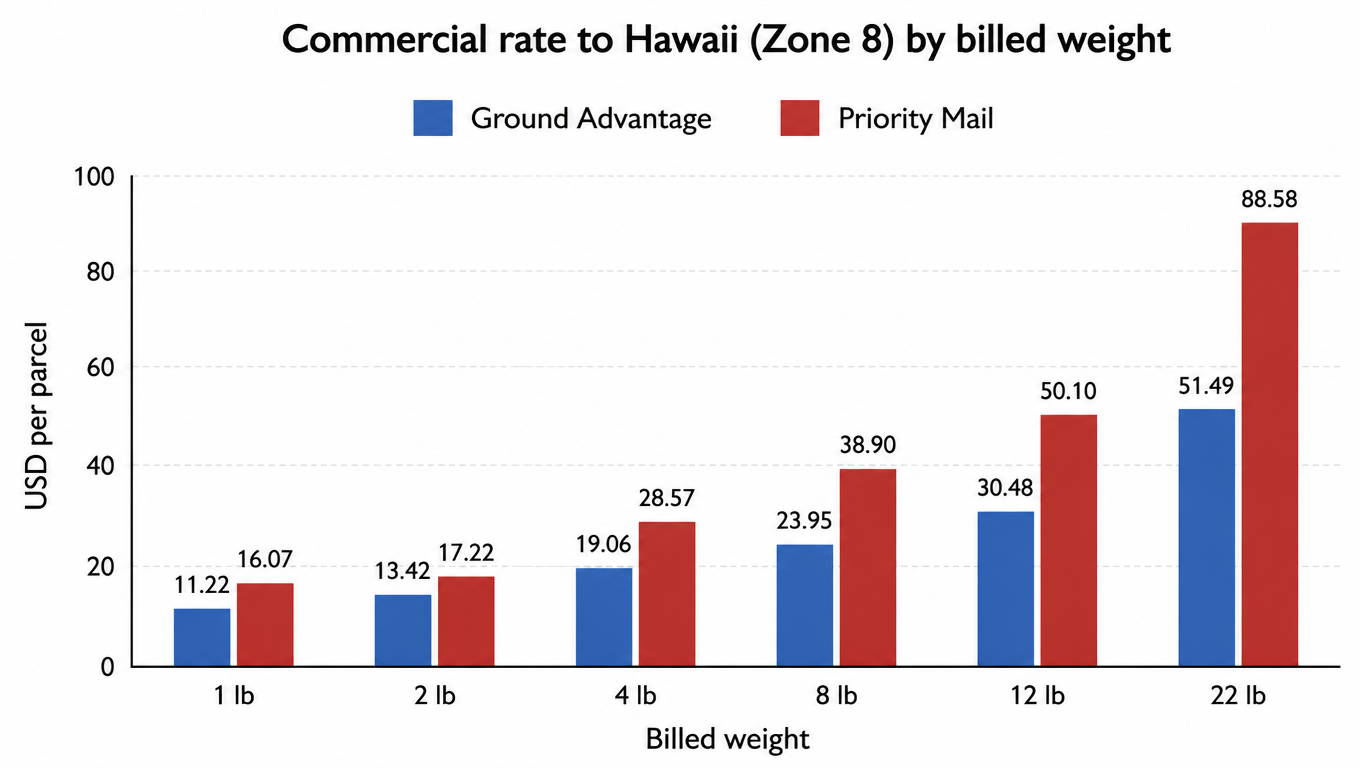
Hold the same parcel and sweep its weight: the gap between the two weight-based services is not a constant. It is narrow at low weight and widens badly as pounds accumulate. The chart below is commercial Zone 8 pricing, by billed weight.

Bar chart of commercial rates to Hawaii Zone 8 by billed weight at 1, 2, 4, 8, 12 and 22 pounds, comparing Ground Advantage at 11.22, 13.42, 19.06, 23.95, 30.48 and 51.49 dollars with Priority Mail at 16.07, 17.22, 28.57, 38.90, 50.10 and 88.58 dollars
Under two pounds, Priority costs a few dollars more and buys days. Past four pounds it costs at least $9 more per parcel, and past twelve the gap exceeds $19.

The reading is simple: at 2 lb, Priority is $17.22 against $13.42 for ground, so $3.80 buys days. At 8 lb it is $38.90 against $23.95; at 12 lb, $50.10 against $30.48; at 22 lb, $88.58 against $51.49[^2]. So the question is never whether to use Priority, it is whether this buyer's date is worth that difference.

3. Comparing costs without quoting a fantasy price

Every number below shares the same conditions, and the conditions are the point: quote date 22 October 2026; USPS commercial base prices from Notice 123, effective 4 October 2026[^2]; Zone 8, mainland to Hawaii; no insurance, no signature, no hazmat fee, no peak surcharge. Retail counter prices are higher, and negotiated rates through a shipping platform can be lower. All three are example parcels we costed under exactly those conditions, priced from the same public rate table.

Example A: light apparel. One linen shirt in a 10 x 13 x 1.5 inch poly mailer, 9 oz, from Los Angeles 90001 to Honolulu 96813. Ground Advantage bills at the 15.999 oz tier: $8.95. Priority Mail bills at 1 lb: $16.07. The mailer is wider than a 12.5 x 9.5 inch Flat Rate Envelope, so flat rate is not an option here. Ground wins by $7.12.

Example B: a small heavy box. A skincare set, 4 lb actual, in an 11 x 8 x 5 inch box, from Newark 07001 to Honolulu 96814. Ground Advantage: $19.06. Priority Mail by weight: $28.57. A Medium Flat Rate Box that fits the item: $22.02. Ground still wins, but note that flat rate beat weight-based Priority by $6.55 while running about two days faster than ground.

Example C: bulky but light. An 8 lb item in a 15 x 12 x 9 inch box, 1,620 cubic inches, so under the dimensional threshold, from Chicago 60601 to Hilo 96720. Ground Advantage: $23.95. Priority Mail: $38.90. No flat rate box fits. Ground wins by nearly $15.

ExampleParcelLaneGround AdvantagePriority MailFlat Rate
A9 oz, 10 x 13 x 1.5 in90001 → 96813$8.95$16.07Not eligible
B4 lb, 11 x 8 x 5 in07001 → 96814$19.06$28.57$22.02 (Medium box)
C8 lb, 15 x 12 x 9 in60601 → 96720$23.95$38.90Not eligible

Where the estimate usually breaks: one box size up

Repack the Example C product into an 18 x 14 x 12 inch carton. That is 3,024 cubic inches, well past 1,728, so the Postal Service compares actual weight against dimensional weight (cubic inches divided by 139) and bills the greater. The parcel still weighs 8 lb but bills as roughly 22 lb: Ground Advantage becomes $51.49 and Priority Mail $88.58 for the same product[^2]. Two inches of packing material can cost more than a service upgrade.

Outer box (in)Volume (cu in)Dimensional weightBilled weightGround (Zone 8)Priority (Zone 8)
15 x 12 x 91,620Not applied8 lb$23.95$38.90
18 x 14 x 123,02421.8 lb22 lb$51.49$88.58

If you ship Hawaii at any volume, this is the first line item to audit: measure the box you actually use, not the one you planned to use. The arithmetic and a calculator live in the dimensional weight guide and the package size checker; zone and delivery-area surcharge mechanics are in shipping zones, carrier coverage and DAS.

4. Does Hawaii need its own rate and its own delivery note?

Three workable models. None is universally right, and the choice should follow the parcel mix rather than a preference for simplicity.

One national rate, Hawaii absorbed. Defensible for light goods, because the zone spread on light parcels has compressed: a 15.999 oz Ground Advantage parcel is $7.33 to Zone 1 and $8.95 to Zone 8, a gap of $1.62[^2]. Absorbing that on a $45 order is a rounding error, and one clean rate converts better than a ZIP lookup that occasionally surprises.

Live rates by ZIP. Once weight climbs, this is the honest model. An 8 lb parcel is $10.75 to Zone 1 and $23.95 to Zone 8, a $13.20 spread[^2], which on a $60 order is 22 points of margin. If a Hawaii order arrives at the same flat rate as a Nevada order, you are not losing $2, you are losing a fifth of the order.

Hand-drawn editorial illustration over a shop owner's shoulder: a laptop showing a simple shipping settings panel with three option rows and a delivery-estimate field being edited, one hand on the trackpad and one holding a mug, a zone chart and a fabric tape on the desk, a half-open carton beside them.
What usually needs changing is not the price but the delivery estimate line at checkout. Illustration.

Free shipping threshold, with Hawaii inside or outside it. If you include it, raise the threshold for those ZIPs rather than excluding the state, and size the threshold against the heaviest SKU you actually sell into Hawaii, not the average item. Excluding Hawaii outright is the most expensive option of all: you are declining a market where the median parcel is small and the customer already expects to pay for distance.

Whichever you pick, publish a delivery note in plain language. Here is a version to paste and edit:

Hawaii delivery. We ship from [city] and most Hawaii orders travel by USPS Ground Advantage, which the Postal Service currently lists at 10 days or more between the mainland and Hawaii. Priority Mail is available at checkout and is listed at 2 to 4 days[^3]. Tracking can go quiet for several days while your parcel is in transit to the islands; that is normal and not a lost parcel. If your order has not arrived within [X] days of the ship date, reply to your confirmation email and we will open a case with USPS the same day.

One billing detail that surprises mainland sellers: Hawaii's general excise tax applies to gross income from sales delivered into the state, and shipping charges billed to the customer are generally part of that taxable amount[^6]. Whether a specific charge is included depends on how you invoice it, so confirm with your tax adviser before you set a Hawaii rate that looks thinner than it is.

5. Returns and delays, decided before the first order

Decide who pays return postage, and say it at checkout. The return leg from Hawaii carries the same 10-day-plus ground expectation in reverse. If your policy measures the return window from the day the parcel arrives back at your warehouse, a Hawaii customer can lose a week of that window to transit and blame you for it. Measure the window from the delivery date shown in tracking instead, and state the policy in one sentence.

Re-quote on a schedule, not on a hunch. Re-run your Hawaii quotes after any postal price change, when you change packaging for a SKU sold into Hawaii, and once before peak season. Rates derived from a 2025 spreadsheet are not a policy, they are a guess with a date on it. For how quotes drift from the final charge, see rate quote versus final charge.

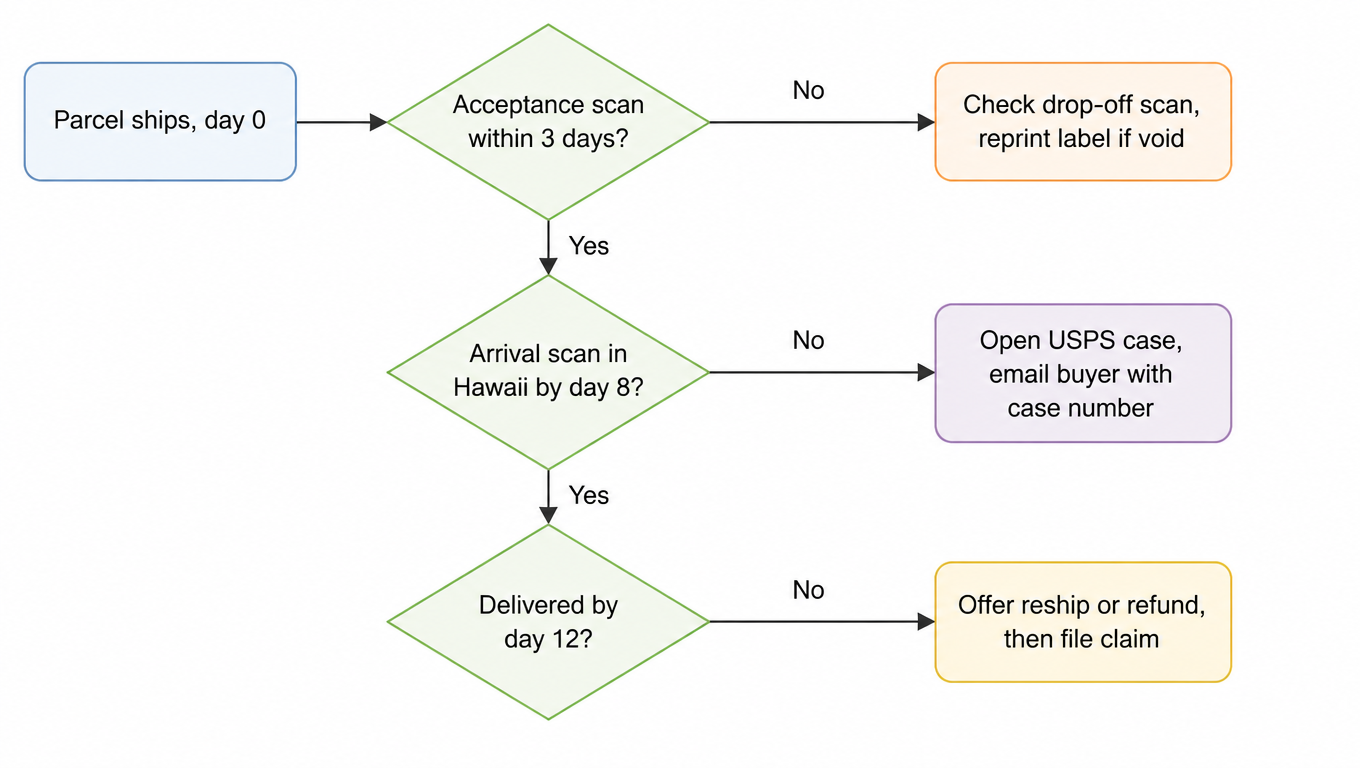
Give support a ladder instead of an instinct. Late Hawaii parcels are normal, not exceptional. The Postal Service's own wording is that some service expectations may be significantly longer than 10 days[^3], so a tracking page that has not moved by day 9 proves nothing. Script the handling so a quiet tracking page does not turn into a refund by default.

Flow chart: the parcel ships on day 0, an acceptance scan is checked by day 3 and a missing scan means checking the drop-off scan and voiding the label; with a scan, an arrival scan in Hawaii is checked by day 8 and a missing one means opening a USPS case and emailing the case number; once arrived, delivery is checked by day 12 and a missing delivery means offering a reship or refund and then filing a claim
Three checkpoints, day 3, day 8 and day 12, turn "lost parcel" from a feeling into a check.

The email at day 8 does more work than any discount. It tells the buyer you are watching the parcel, which is the actual question behind "where is my order". For the same handling pattern on another island lane, see shipping to Puerto Rico, and for the services themselves, Ground Advantage versus Priority Mail versus Flat Rate.

Checking the real number for your parcel

Published rate tables answer "what does a pound cost". They do not answer what your 3 lb 4 oz box to a Hawaii ZIP costs on the day you print the label, because zone, billed weight, service and any active surcharge all move.

That is the case for a rate lookup rather than a rate table: enter the parcel's weight, dimensions and the Hawaii destination ZIP, compare the carrier options side by side, then buy the label from the same place you compared it. EasyShippingX works as a channel-neutral shipping layer for exactly this: it compares US carrier options for a parcel, and executes through the Portal, through Excel for batch work, or through the API. Nothing in that flow assumes your storefront is on a particular platform, which matters when Hawaii orders are a small slice of volume that still has to be priced correctly.

The one thing worth doing today: open your shipping settings, find the delivery estimate your checkout displays, and check whether it is still true. The carrier changed its answer on 1 October. Your storefront has not caught up yet. For the wider cost playbook, see how to lower shipping costs.

FAQ

Since 1 October 2026, USPS Ground Advantage between the contiguous states and Hawaii carries a service expectation of 10 days or more, and some lanes run significantly longer. Priority Mail is 2 to 4 days, and Priority Mail Express was not part of that change. Check the specific lane with origin and destination ZIP in the Postal Service lookup, because the range between routes is wide.
For most parcels it is USPS Ground Advantage, which prices by zone and weight. The exception is small and heavy: Flat Rate prices the box rather than the zone, so a Medium Flat Rate Box at $22.02 commercial is often cheaper than weight-based Priority Mail and much faster. Dense boxes up to 1 cubic foot, 20 lb and 22 inches on the longest side can also use Ground Advantage cubic tiers.
On 1 October 2026 the Postal Service reset Priority Mail and Ground Advantage expectations for Alaska, Hawaii, Puerto Rico and other noncontiguous destinations to match available transportation, and moved sub-pound Ground Advantage parcels from a mix of air and surface to primarily surface. The published promise was aligned with the actual transport, rather than parcels suddenly slowing down.
For the 2026 holiday season the recommended Ground Advantage send-by date for the contiguous 48 states is 17 December. The Hawaii table gives no Ground Advantage date at all; it asks mailers to review the estimated delivery date for the offshore ZIP and move the induction date earlier. Priority Mail to Hawaii is 18 December and Priority Mail Express is 19 December, the same as the mainland.
Follow the weight mix. Light parcels can absorb it: the 15.999 oz tier runs from $7.33 in Zone 1 to $8.95 in Zone 8, a $1.62 gap. An 8 lb parcel spans $13.20 between the same zones, which is 22 points of margin on a $60 order. So light goods can carry one national rate, and heavy goods should price live by ZIP.
Plants, plant parts including fruits, vegetables and cut flowers, and animals all require inspection before entry, and some need a permit or are prohibited, under state agricultural rules rather than carrier rules. Liquids, aerosols and flammables also meet ground-only restrictions, and Ground Advantage to Hawaii now moves primarily by surface. Confirm eligibility before you list the item.

Price your parcel against a Hawaii ZIP

Enter the packed weight, the outer carton size and the Hawaii destination ZIP, see what the parcel actually costs across US carrier options, then hold that against what your shop collected. The gap tells you whether to change the price, the packaging, or the delivery estimate at checkout.

EasyShippingX compares carrier options inside the US in one place as a channel-neutral shipping layer and executes them through the Portal, Excel, or the API.