Warehouse Operations Guide

What Is a Packing Slip? Examples, Shipping Labels, and Invoices

A parcel leaving the dock carries two documents that do the talking: a shipping label on the outside, and a packing slip on the inside. The label tells the network where the box goes. The slip tells the person opening it what should be in there. The third document in this family, the invoice, usually never goes in the box at all.

The question sellers actually ask is not what these documents are called. It is why the second piece of paper is worth printing when the label already carries the address and the tracking number. The answer is that the two papers answer different questions. Without a slip, the recipient checks the box against memory, and memory is exactly what fails when an item is short, substituted, or travelling in a second parcel.

This guide follows the order of the pack bench: what each of the three documents decides, what belongs on a packing slip line by line, how to write the slips when one order leaves as two parcels, how to handle a gift order where the payer and the recipient are different people, and the mismatch that a pack station is most likely to produce.

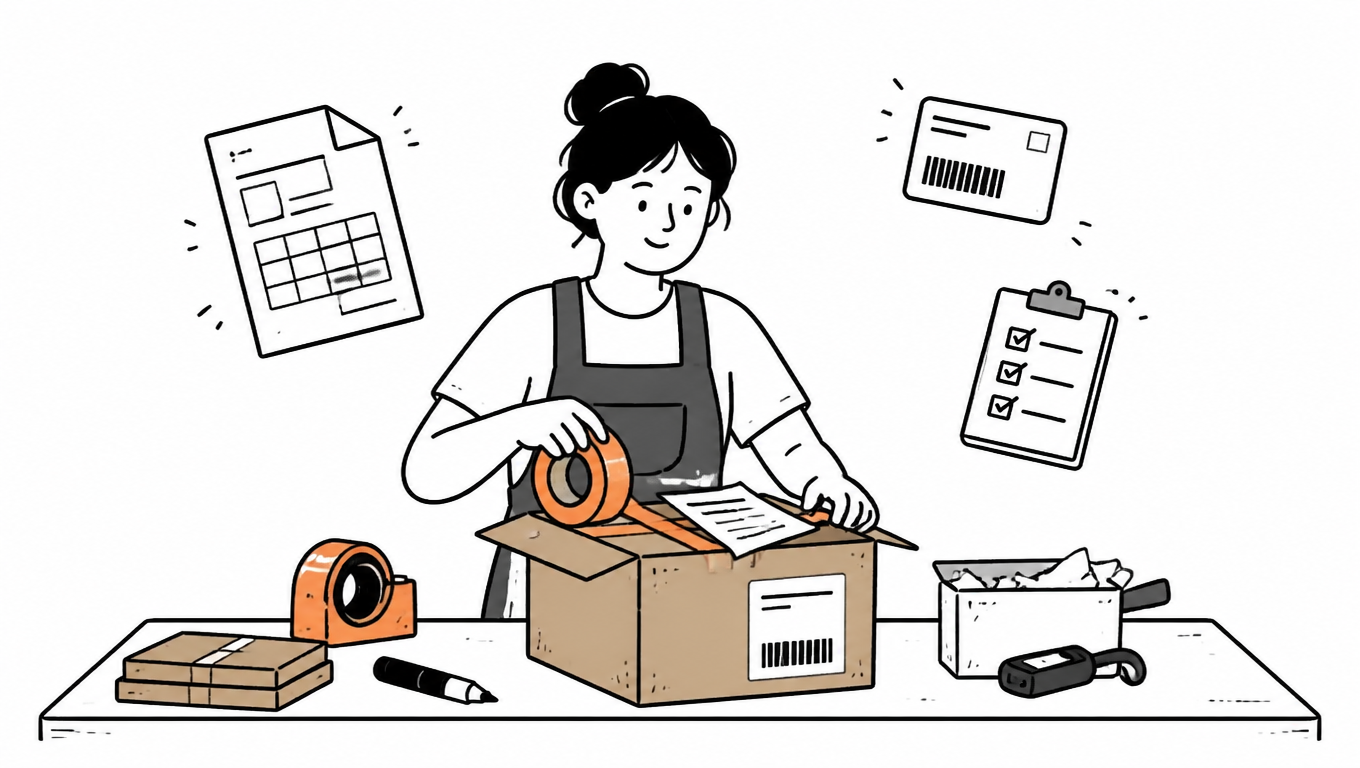
Editorial illustration of a packer at a bench sealing a box with tape, a folded packing slip resting on top of the contents inside, a barcode label already on the side of the box, small floating icons of an order sheet, a barcode label and a checklist around the figure.
One paper decides where it goes, the other decides what should be inside

Three documents, three jobs

A packing slip, a shipping label, and an invoice are often printed as one batch of "shipping paperwork," but they serve three different parties: the person who opens the box, the network that sorts and moves it, and whoever keeps the books. Each party asks a different question, so each document has to carry different information.

Document What it decides What must be on it Where it goes
Packing slipProves the parcel matches the order. It is also the only document inside the box that names both the recipient and the contents, so it is the fallback when the outer information is damaged or unreadable.Order number, order and ship date, SKU, item name and variant, quantity ordered, quantity in this parcel, and a support email or phone number.Folded inside, resting on top of the goods. Some sellers use a clear adhesive pouch on the outside instead.
Shipping labelTells the network where the box goes and gives every scan point a barcode to read. Sortation, linehaul, and the final leg to the door all run off this one page.Sender and recipient addresses, service level, routing code, tracking number, and a machine-readable barcode.On a flat face of the box, clear of seams, corners, and tape lines.
InvoiceRecords what was bought, what it cost, and whether it has been paid. It is the document a finance team or a customs broker wants.Billing name, invoice number, unit prices, tax, discounts, total, payment method, and payment status.Emailed to the payer as a PDF. A paper copy goes in the box only when the buyer asks for one or a customs process calls for it.

The three are not interchangeable. A label is a routing document: you read it to find out where the box is. A slip is a fulfilment document: you read it to find out what should be inside. An invoice is a billing document: you read it to find out how the money for this transaction works. Using one to answer another's question is usually where a dispute starts.
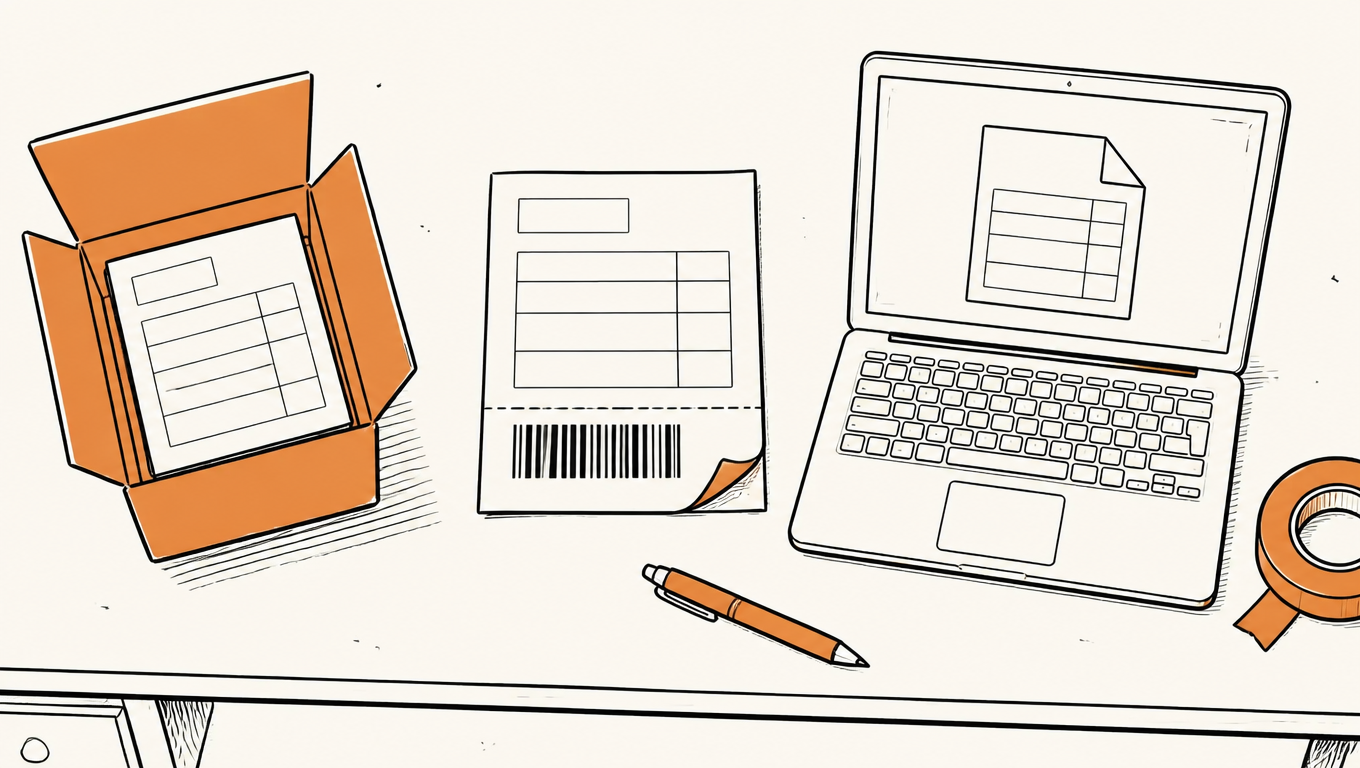
Hand-drawn editorial illustration, top-down view of a packing bench with three documents side by side: a folded slip inside a small open carton on the left, a rectangular barcode label with a dashed cut line in the middle, and a laptop showing a document icon on the right, with a pen and a tape roll at the edge.
Only one of the three goes inside the box

What belongs on a packing slip

A packing slip has one narrow job: let the recipient confirm, at the moment the box is open, that the contents match the order, without logging into anything or calling anyone. The test for every field is the same: can another person check it?

  • Order number: the single key that links the recipient, support, and the order record.
  • Order date and ship date: so the recipient can see how long the parcel has been moving.
  • One line per SKU: item name plus the variant, such as colour, size, or capacity.
  • Quantity ordered and quantity in this parcel as two separate columns: these two columns are the most valuable part of the sheet, and the only place a split order can be described honestly.
  • Seller name and support contact: so a question has somewhere to go.
  • An optional gift message or thank-you line: keep it in the footer so it does not crowd the checking area.

Here is a complete example for a B2C retail order. It reads like a form, not a letter, which is exactly what it should be.

=======================================================
                     PACKING SLIP
=======================================================
EchoStyle Living
support@echostyle.com  |  (800) 555-0199

Order:   ORD-2026-88214
Placed:  2026-03-28
Shipped: 2026-03-29

Ship to:
Jane Miller
1428 Elm Street, Apt 4B
Austin, TX 78701

-------------------------------------------------------
Line | SKU         | Item                          | Ordered | In this parcel
-------------------------------------------------------
 01  | CND-VAN-01  | Scented candle, vanilla, 8 oz |    2    |       2
 02  | MAT-YOG-BL  | Yoga mat, navy, 6 mm          |    1    |       1
 03  | BOT-SST-500 | Insulated bottle, 500 ml      |    1    |       1
-------------------------------------------------------
Items in this parcel: 4 of 4. This order ships in full.

Questions or damage: email the order number and a photo to
support@echostyle.com within 48 hours of signing.
=======================================================

Four things should stay off this sheet: unit prices, discount lines, the amount paid, and any copy of the full invoice. Pricing belongs to the billing document, and the moment it appears in the box, gift orders and reshipped orders both go wrong. The invoice should be sent to the payer by email, not tucked in the parcel.

The hard case: one order, two parcels

Splitting an order across parcels is routine in ecommerce: items with very different dimensions, a box that would go over a weight limit, or SKUs that already live in different warehouses. There is exactly one dangerous way to do it, and that is putting a master list of everything into the first box. The recipient opens box one, sees four lines on the sheet and one item in the box, concludes something is missing, and opens a dispute.

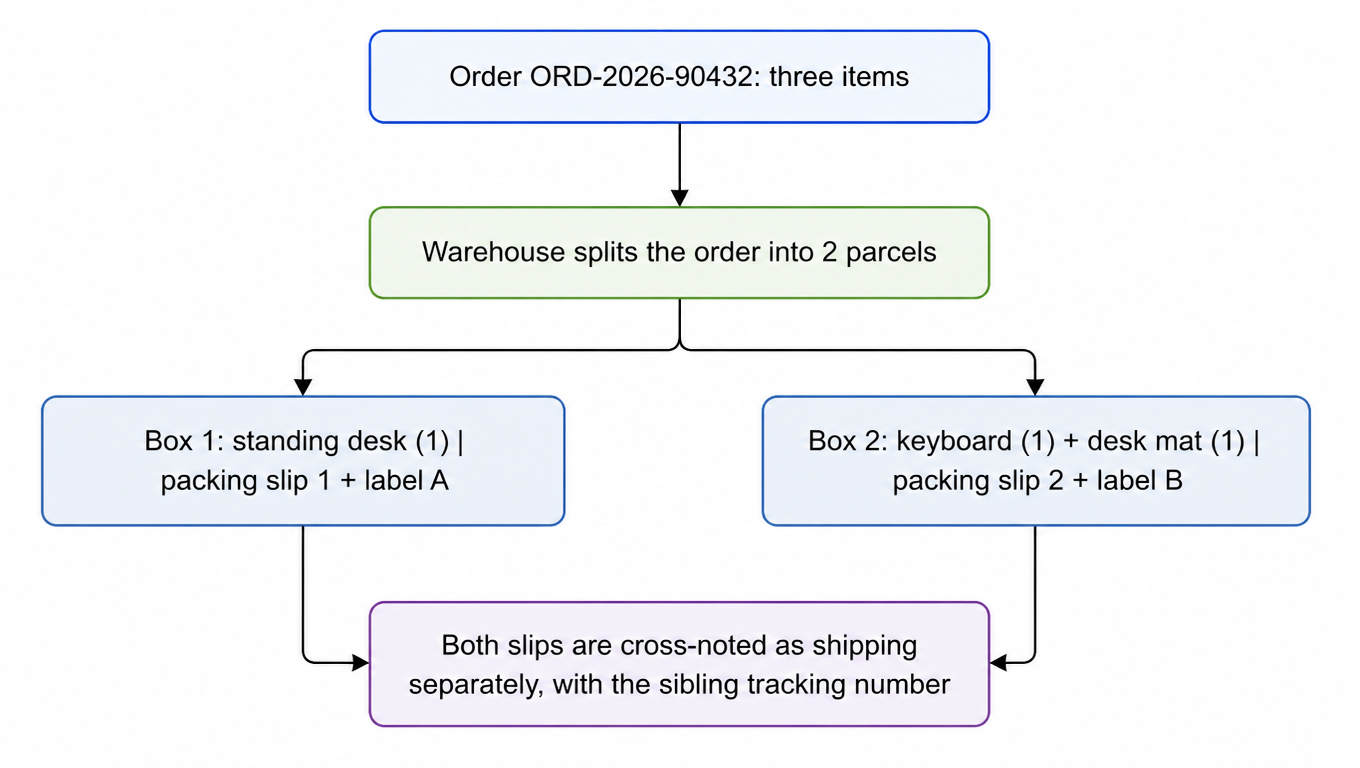
Flowchart: an order with three items is split into two parcels. Box 1 holds the desk with packing slip 1 and label A, box 2 holds the keyboard and desk mat with packing slip 2 and label B, and both slips are cross-noted as shipping separately with the sibling tracking number
Once an order is split, the slip, the label, and the notice are generated per parcel

The principle is one sentence long: the slip inside a box must describe that box honestly, and say where the rest went. Once an order system splits an order into separate shipments, each shipment generates its own documents and its own notice, which is the standard handling for this problem (ShipStation help, splitting orders into multiple shipments). Printing one master sheet per order and dividing it by hand at the bench is what pushes the error rate up as the parcel count grows.

Take an order, ORD-2026-90432, with three items: a standing desk that is large and heavy, a mechanical keyboard, and a desk mat. The warehouse decides that the desk ships alone in box one, and the keyboard and mat ship together in box two. The two slips read like this.

=======================================================
      PACKING SLIP - BOX 1 OF 2
=======================================================
Order:      ORD-2026-90432
Tracking (this box): USPS 9400 1000 0000 0000 0001 11

Ship to:
Robert Wilson
450 Fremont St, San Francisco, CA 94105

NOTE: Your order ships in TWO parcels. This box contains:
-------------------------------------------------------
SKU         | Item                       | Ordered | In this box | Status
-------------------------------------------------------
CHR-ERG-01  | Standing desk, black       |    1    |      1      | In this box
KBD-MEC-02  | Mechanical keyboard, white |    1    |      0      | Ships in box 2
PAD-DSK-03  | Desk mat, leather          |    1    |      0      | Ships in box 2
-------------------------------------------------------
Items in this box: 1 of 3
Sibling parcel (box 2): USPS 9400 1000 0000 0000 0002 22

The two parcels may not arrive together. That is normal.
=======================================================
=======================================================
      PACKING SLIP - BOX 2 OF 2
=======================================================
Order:      ORD-2026-90432
Tracking (this box): USPS 9400 1000 0000 0000 0002 22

Ship to:
Robert Wilson
450 Fremont St, San Francisco, CA 94105

NOTE: Your order ships in TWO parcels. This box contains:
-------------------------------------------------------
SKU         | Item                       | Ordered | In this box | Status
-------------------------------------------------------
CHR-ERG-01  | Standing desk, black       |    1    |      0      | Ships in box 1
KBD-MEC-02  | Mechanical keyboard, white |    1    |      1      | In this box
PAD-DSK-03  | Desk mat, leather          |    1    |      1      | In this box
-------------------------------------------------------
Items in this box: 2 of 3
Sibling parcel (box 1): USPS 9400 1000 0000 0000 0001 11

Nothing further is owed on this order.
=======================================================

Four things appear on both sheets: the box number, the tracking number for that box, the item count in that box, and the sibling parcel's number. It does not matter which box the recipient opens first, because each sheet answers both questions at once: what is in here, and where the rest is.

Splitting also has a cost, and it is usually much larger than one extra sheet of paper: another minimum charge, another parcel's worth of handling, and possibly another stop at the door. Splitting should therefore be a business decision, not a decision improvised at the bench. The cost structure belongs in one place, see the true cost of a split shipment, and the mirror case, two small orders going out in one box, is covered in combine orders into one shipment.

Gift orders: the recipient is not the payer

During gifting seasons a specific document mismatch shows up: one person pays, another person receives. In that situation the packing slip is the only document the recipient ever sees, so its contents have to be written from the recipient's point of view instead of copied from the checkout page.

Rule one: remove every price signal

A gift packing slip should carry no unit price, no discount line, no amount paid, and no payment method. Where the system supports it, switch to a gift slip template that keeps only SKU, item name, variant, and quantity, and leaves room for a message in the footer. A payer seeing the amount is normal; a recipient seeing it is a different kind of problem.

Rule two: the invoice travels by email, never in the box

An invoice with amounts on it must not ship inside the parcel. The correct path is for the order system to email the PDF to the payer, so the accounting information reaches the person who needs it while the recipient opens a box containing goods and an amount-free slip. If the packaging itself needs to stay neutral, audit the shop name and item description on the outer label at the same time; that check is covered in the discreet shipping audit for DTC brands.

The pack-station loop: four steps and the step that breaks

A mismatched document is not a typo, it is a process gap. The usual scene is a stack of pre-printed slips and labels sitting at the bench while the operator seals boxes and pulls the next sheet from the pile, with nothing beeping when the wrong one is taken. The fix is to keep one document pair moving with one parcel from start to finish, which is the most basic rhythm in warehouse shipping operations.

Step one: pick and verify

Bring the physical items to the bench from the pick list, scan each barcode or check each SKU, and confirm that the count and the variant match the order record. The output of this step is not "picking finished," it is "the contents of this box are now decided."

Step two: insert the matching slip

Place the slip on top of the goods before the box is closed. Print one at a time: print one, verify one, pack one. A multi-box order needs one sheet per box, with that box's contents on it, and the sheet should carry the box number, the item count in that box, and the sibling parcel's reference.

Step three: match the label

The label must be generated from the order record rather than retyped from another system. The mapping between order, parcel, and label is where every mismatch is born, and the field-level version of that model is in the order, shipment, package, and label data model. Once the box is sealed and labelled, the tracking number is bound to the contents list, and changing either side afterwards leaves the pair inconsistent.

Step four: scan before handoff

Scan the outer label once more before handoff so the system status, the contents list, and the barcode all agree at the same moment, then sort the parcels for collection. The checks here are the same ones the handoff itself depends on, listed in the carrier handoff checklist.

EasyShippingX is a channel-neutral shipping layer: it compares US carrier options in one place and executes them through the Portal, Excel, or the API. For a pack station the point is not which additional provider is available, it is that the label and the tracking number are created inside the system that already holds the order record, so the contents list and the barcode on the box share one source of truth.

Summary

  • A slip, a label, and an invoice serve three different parties and cannot swap roles: one says what is inside, one says where the box goes, one says how the money works.
  • The core of a slip is two quantity columns: ordered, and in this parcel. Without them the sheet is just paper.
  • When an order splits, one sheet per box, each carrying the box number, the count in that box, and the sibling parcel's reference, so that whichever box arrives first cannot be read as a shortage.
  • Gift orders hide prices and send the invoice by email; the box carries only what the recipient needs.
  • The correct rhythm at volume is one document pair per parcel: print one, verify one, pack one, then rescan at handoff.

FAQ

The label goes on the outside and is read by the network, so it decides how the box moves. The slip goes inside and is read by the recipient, so it decides what should be in the box. The label carries addresses and a tracking number, and neither needs nor should carry an item list.
Usually not. Pricing belongs to the invoice, and any amount inside the box creates problems for gift orders and reshipped orders. If a business genuinely needs payment information to travel with the goods, use a separate invoice document rather than merging it into the slip.
The order does not matter, verifiability does. Give each box its own slip with the box number, the count in that box, and the other box's tracking number, and tell the customer in the shipping notice how many parcels to expect.
By default, no. The standard path is for the system to email the PDF to the payer. Prepare a paper copy only when the buyer asks for one, or when a cross-border clearance process requires paperwork to travel with the goods.

Keep the label and the contents list on one source of truth

EasyShippingX compares US carrier options in one place and executes them through the Portal, Excel, or the API. The label is created in the same system that holds the order record, so the contents list and the barcode on the box cannot drift apart.