
Integration Decision Guide

EDI vs. Shipping API: What Your 3PL Needs, and When You Need Both

EDI and shipping APIs get compared in the same column, but they do not sit on the same rail. EDI carries the business rules your customer requires you to follow. A shipping API carries what a carrier will actually let you execute. The useful question is not which one is newer, it is which failure you can absorb, and who pays when it happens.

The whole decision is easier to follow through one concrete case: a 3PL that is already shipping well, a new customer whose integration pack asks for a 940 and a 945, and a team that has to work out which link is missing, who supplies it, and how to prove the loop closed rather than merely that the software did not error.

By the end you should be able to turn a customer's requirement into a table you can accept against, choose by failure cost rather than by technology generation, and find the single point that has to be the source of truth when both systems run at once.

Editorial illustration of a warehouse office split in two halves: on the left a desk with documents and printed forms, on the right a packing bench with a parcel, a label printer and a hand scanner, a small figure walking between the two halves carrying one sheet of paper, off-white background with a single orange accent, deliberately asymmetric composition with visible paper grain.
Two systems, two kinds of work, one sheet of paper travelling between them

A 3PL that can already ship, and a customer asking for 940 and 945

Take a hypothetical 3PL running a mid-size fulfillment operation, not a published case study. It already does the hard part of shipping well: it shops across carriers, buys labels, prints them at the pack station, and returns a tracking number to the customer's storefront within minutes of a shipment leaving the dock. By any reasonable definition, this warehouse is shipping.

Then a new customer onboards, and their integration pack asks for two documents: a 940 and a 945. X12 defines the 940 as a Warehouse Shipping Order, the instruction a customer sends to a warehouse to ship goods (X12 940 overview). The 945 is a Warehouse Shipping Advice, the message the warehouse sends back to confirm that goods have shipped, carrying both the quantity ordered and the quantity actually shipped (X12 945 overview). Neither is about labels, rates, or tracking numbers. They are about the customer's process: what they told you to do, and what you confirm you did.

That is where the question usually gets asked in the wrong form: do we need EDI or an API. The team's real questions are narrower and more useful. Which link in the chain is missing, who is responsible for supplying it, and how will we prove the loop closed rather than that our software returned a success code.

One boundary before going further, because it prevents wasted work: which documents a partner exchanges, at which version, with which fields, and by which cutoff, is confirmed partner by partner. There is no universal document set every 3PL must adopt, and no outside vendor can tell you what your customer's receiving process will accept. This guide is about how to decide, not about how to test API calls, and the testing side lives in a separate guide on WMS and shipping API integration testing.
Why "EDI is old, API is new" answers the wrong question

The framing sounds practical and quietly replaces four concrete questions with one technology preference. What documents and interactions does the trading partner accept, which system holds the true record of what left the building, which interface owns quoting and shipment execution, and is the information returned sufficient to complete the business process the partner actually requires.

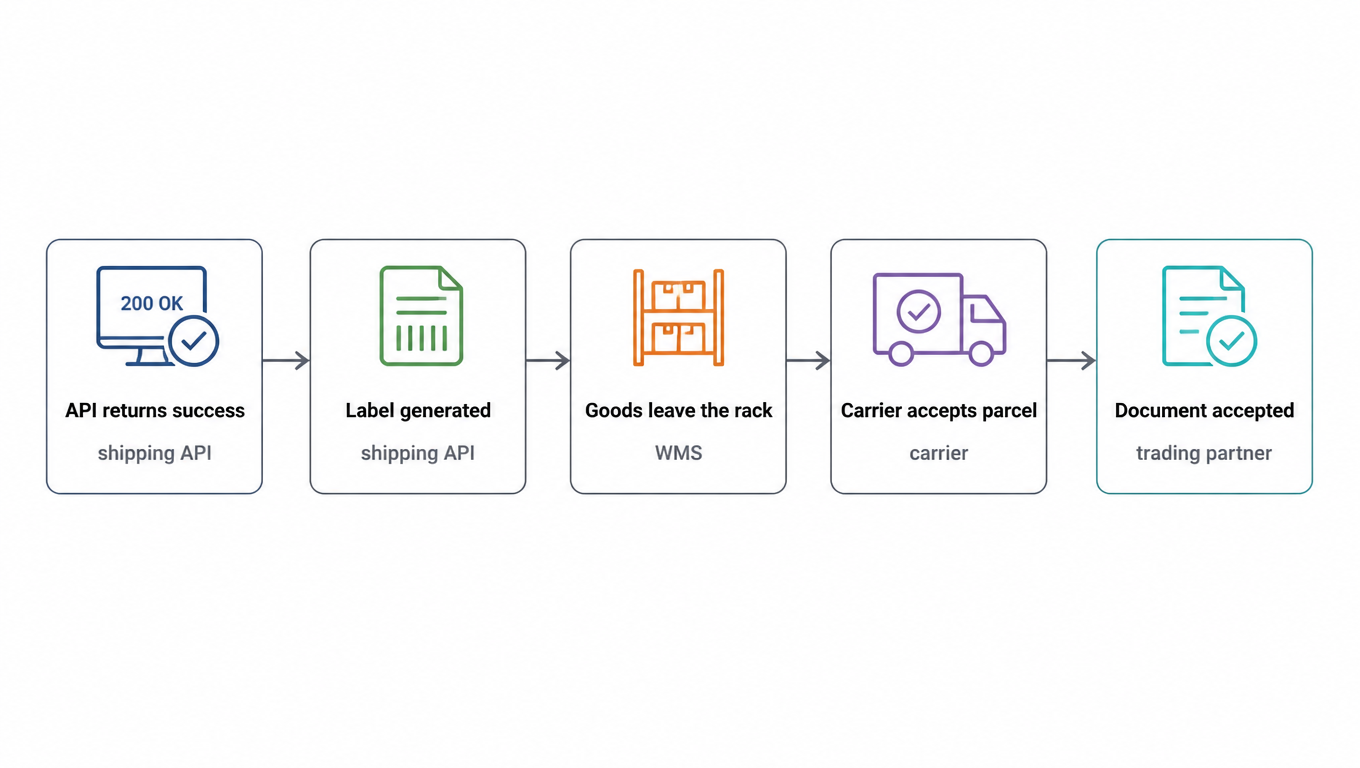
Those questions exist because five different events get treated as one. They happen in sequence, they are asserted by different systems, and only the last one is what the customer's process is waiting for.

Flowchart: five events in sequence, API returns success asserted by the shipping API, label generated asserted by the shipping API, goods leave the rack asserted by the WMS, carrier accepts parcel asserted by the carrier, and the document accepted asserted by the customer's system
Five events, five different assertions, and only the last one discharges the obligation the 940 created

A success response means the request was understood. It does not mean the label is valid, it does not mean anything was picked, and it certainly does not mean the customer's system accepted a shipping advice. A label existing means an identifier was reserved. A first carrier scan means the parcel is physically in the network. Only the last event in the chain settles the obligation the 940 created.

The 997 illustrates the same trap in the EDI direction. A 997 Functional Acknowledgment reports the result of the syntactic check on a document, whether the interchange and the transaction set were received and could be parsed (the semantics of a 997 acknowledgment). It is not a business acceptance and not confirmation of a shipment, and treating it as either produces the classic, expensive misreading: we got a 997, so the order is handled.

This distinction is what makes responsibility assignable. When a customer asks why they never received an ASN and your team answers that the API returned a success code, the two sides are describing different events and no amount of arguing reconciles them. It also explains a pattern from real operations: when shipped quantities, documents, and tracking numbers stop agreeing, teams start shopping for a new vendor. The vendor is usually fine. What broke is an event trigger, normally the one that decides when a document is generated and what state the shipment has to be in for it to be true.

The four columns to fill before you decide anything

Before choosing a path, write the requirement down as a table: one row per requirement, four columns wide. This table is the working instrument of the whole decision, and the referee for every argument that follows.

Requirement Event it depends on System that answers for it Evidence that closes the loop
940 shipping order accepted and validatedOrder received, parsed, accepted into the WMS3PL WMS, through the EDI translation layerDocument control number matched to a WMS order ID
945 shipping advice returnedGoods picked, packed, manifested and handed off3PL WMS via the translation layer945 carrying ship quantity per line, tied back to the 940
856 ASN to the customer or retailerShipment manifested and handed to a carrierEDI translation layer, fed by the shipping APISSCC-18 on the physical label matching the ASN
Label and tracking dataCarrier accepts the label purchaseShipping APIValid tracking number, label not voided
Inventory feedStock movements after each shipmentWMS to translation layerAdjustment quantity and timestamp per SKU

The ASN row is the one that breaks most often in practice. The serial shipping container code printed on the carton has to match the code carried in the electronic document exactly, and a mismatch is a receiving failure rather than a data quality issue (GS1-128 and SSCC labeling requirements).

Granularity matters in every column. Under requirement, break down to document, version, fields, submission timing, and the feedback the partner expects. Under event, break down to order receipt, change, cancellation, partial shipment, label generation, physical handoff, and final delivery. Under responsibility, assign each cell to a named system: the brand's ERP, the 3PL's WMS, the EDI translation layer, the shipping API, the carrier. Under evidence, list the records that would let a stranger reconstruct what happened: document control numbers, order and package IDs, valid tracking numbers, actual shipped quantities, and the processing and retry logs.

The rule that gives the table its teeth: a row whose evidence cell you cannot fill is a requirement you cannot accept today. It will fail in production, and it will fail in a way that is hard to argue about, because nothing was recorded.

One more reminder: the table is filled per trading partner. Two retail customers of the same 3PL can legitimately require different document sets, versions, and cutoff windows. A template copied from one relationship into another is a guess, not a configuration.

Where the failure cost actually lands

The useful difference between the two interfaces is not speed or modernity. It is the shape of a mistake.

EDI is batch and reconcile. Documents arrive in files, get parsed in groups, and the error surfaces downstream of the physical event. A bad 945, a missing ASN, or a label without the right identifier is usually found when the truck is already at the receiving dock, or worse, when a deduction shows up on a remittance later. By then the goods have moved, the labor has been spent, and the fix is retrospective.

Retail compliance programs make that cost explicit rather than theoretical. Published deduction schedules treat OTIF misses, ASN errors, and labeling violations as separate chargeback categories, with OTIF penalties commonly cited in the range of 1 to 3 percent of order value (see this summary of retailer chargeback categories), and the ASN rules tend to tighten rather than relax: published vendor compliance guidance now scores ASN availability, ASN accuracy, and physical barcode accuracy as separate measured metrics (see this vendor compliance guide).

Shipping APIs are real-time and per-unit. A failed call is discovered at the moment it fails, before the parcel exists. You can retry it, route it to another carrier, or stop and let a human look. A single failed call is therefore cheap. Cheap is not the same as safe: a silent retry loop that buys the same label twice, or a quote that quietly falls back to a default service level across a whole batch, turns a per-unit problem into a batch problem with nobody watching.

Failure mode Blast radius Detected Who bears the cost Remedy
Duplicate shipping instruction processedOne order shipped twiceAt the dock, when two cartons appearThe 3PL, until it can prove the duplicateIdempotency key on the incoming order document
ASN late or never sentWhole shipment rejected or deducted at receivingAt the customer's dockThe brand, who passes it back up the chainGenerate the ASN at handoff, not at packing
Label identifier does not match the ASNWhole shipment refused at the doorAt the dock doorDepends on the contract, usually the 3PLValidate SSCC-18 at label print, not at packing
Voided label replaced, new tracking number never reportedCustomer sees stale tracking on a shipped orderA customer service ticket, days laterThe 3PL, plus the brand's reputationTracking change becomes an event that feeds the document layer
Partial shipment with no document reflecting itOrder shows shipped in fullMonth-end reconciliationThe 3PLShip quantity per line on the 945, and a new ASN
Silent retry buys the same label twiceCost, not delivery, until the invoice arrivesBilling reviewThe 3PLIdempotency on label purchase, duplicate alarms

The point of the table is the fourth column. Before deciding which interface is better, establish which failures your operation can absorb and which ones land on a party that will invoice you for them. Blast radius is the real differentiator: an API error costs one parcel, a document error costs a shipment or an entire receiving appointment.

Four outcomes: what your current situation actually calls for

Most 3PLs do not need a technology verdict. They need a direction that matches their current state, and four situations cover the majority of cases.

Current situation Path to take first
The customer has no EDI requirement and the current interface already supports the business exchangeAssess carrier execution needs against the shipping API in use. Do not start an EDI project just because order volume grew
The customer requires EDI and the warehouse can already complete carrier shippingFill in document translation, trading partner mapping, and acceptance testing. The shipping side is not the gap
EDI exchange runs correctly, but carriers or rate comparison are missingAdd a transportation execution layer. Do not rebuild a document layer that already works
Both capabilities exist, but shipped quantity, documents and tracking do not agreeFix event triggers and identifier mapping before considering a vendor change
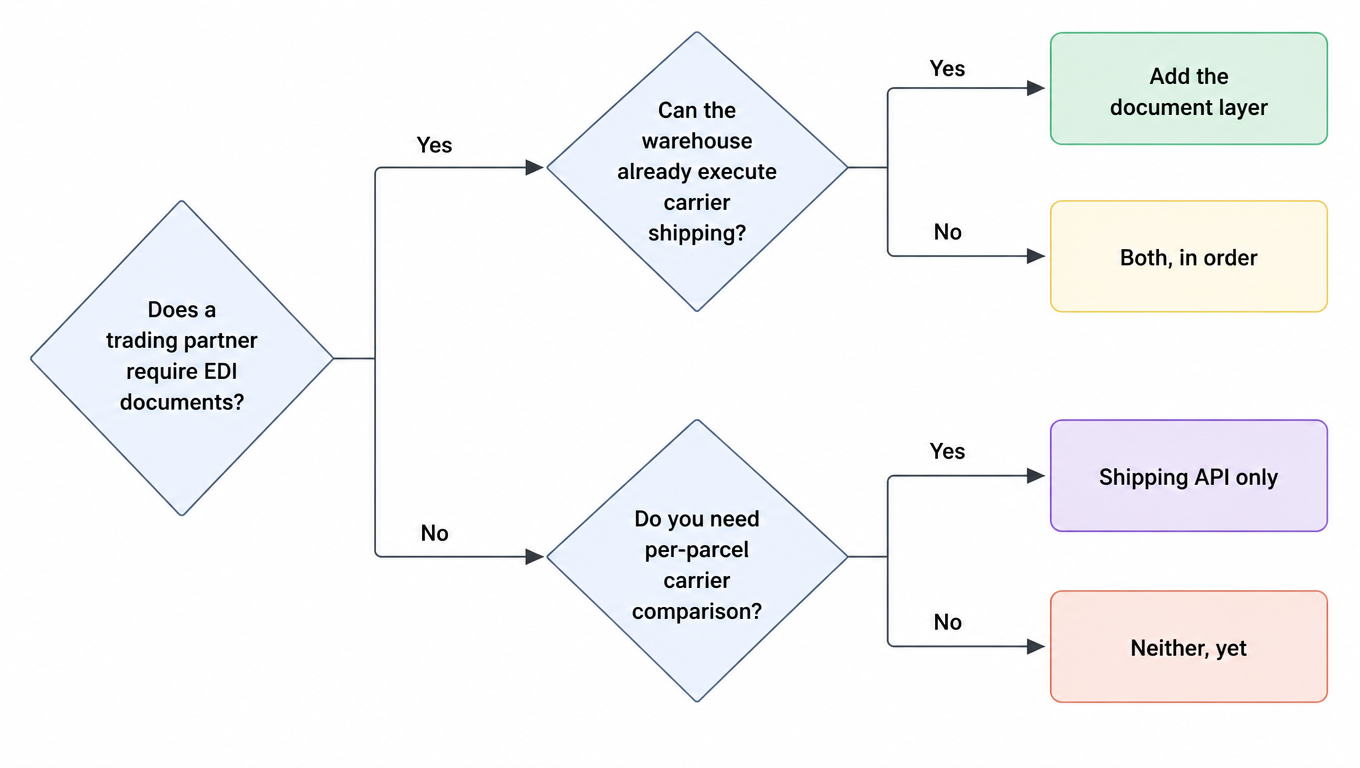
Flowchart: the first question asks whether a trading partner requires EDI documents. If yes, the second asks whether the warehouse can already execute carrier shipping, leading either to adding the document layer or to adopting both in order. If no, the second asks whether per-parcel carrier comparison is needed, leading either to a shipping API only or to neither, for now
Three questions in, four outcomes out: ask about the external mandate first, the execution gap second

Neither deserves to be said plainly, because it is a legitimate answer. A warehouse shipping for a handful of direct-to-consumer brands, on one or two carriers, with no retail compliance requirements and volumes too low to justify partner onboarding and mapping work, does not need an EDI program. It needs reliable carrier execution and clean records. EDI becomes necessary when an external party imposes it, not when a warehouse grows.

The order of judgement is the same at every scale. First, is there an external mandate, meaning a trading partner whose process requires documents. Second, is there a transportation execution need the current stack does not cover, such as per-parcel comparison, additional carriers, or service level selection. Third, and only third, do the two sides need to be reconciled, which is a design problem rather than a purchasing one.

Cost, and the reconciliation point when you run both

Cost comparisons go wrong in a predictable way: they compare a per-call price against an EDI subscription fee and stop. That leaves out the items that dominate real spend, which are partner onboarding, field mapping, end-to-end testing with the counterparty's team, ongoing maintenance when a partner changes a version or adds a field, and exception handling every time a document fails in production. The equivalent hidden items on the API side are integration work, monitoring, and the labor to resolve failures that automated retries could not fix. Compare total cost of ownership per order over a defined period, not list prices per transaction.

When both are running, the division of labor is clean and worth writing down. EDI owns the commitments made to the customer: the shipping order, the shipping advice, the ASN, and the inventory feed. The execution layer owns what happens at the carriers: buying labels, obtaining tracking, handing off parcels, and choosing which service level is bought. Neither should be asked to do the other's job.

The expensive trap is divergence. Two systems report different shipped quantities for the same order, and nobody notices until someone reconciles a month of data. It happens for boring reasons: the 945 is generated when the label prints rather than when the parcel is handed off, a partial shipment updates the WMS but never the document, or a voided label and its replacement both count as a shipment. The invoice then reflects one number and the compliance report reflects another, and the argument that follows costs more than the original discrepancy.

Editorial illustration of a retail receiving dock: a worker at a roll-up door holding a clipboard and a scanner beside stacked cartons, a label visible on the nearest box, a conveyor disappearing into the dark warehouse behind, off-white background with a single orange accent, gently asymmetric composition with visible paper grain.
This is where the bill for a document error is usually written

The fix is one event, one record. Define the single moment that means this shipment exists, write the record there, and have both sides read from it. That record carries the document control number, the order ID, the package ID, and the tracking number together, so any party can walk from a customer's question to a physical parcel. It is the same identifier discipline described in the order, shipment, package and label data model, and the same ownership question covered in the RACI for shipping cost and shipping operations.

Reconciliation has to happen at the event trigger, not in a report. A report tells you the numbers diverged, usually too late to fix the cause. A trigger that fires at the right moment prevents the divergence from being created. If a warehouse reconciles documents against shipments by hand every month, the right next move is to find the missing trigger, not to add staff to the reporting process.

One last practical question: where the boundary between the two systems should sit. A channel-neutral transportation layer can carry the carrier side of execution, leaving the EDI translation layer responsible only for the document commitments made to customers (see what that execution layer covers). Once the boundary is drawn, deciding whether to add EDI and deciding whether to widen carrier coverage become two independent decisions, which is the same question behind choosing between a portal-first and API-first onboarding order.

Acceptance: four failure scenarios

A process is not proven by a successful shipment. It is proven by how it recovers. Four scenarios cover most of the ways a document and carrier chain breaks, and each one should have a written answer to three questions: who acts, what linkage is preserved, and how recovery is confirmed.

Failure scenario Who handles it What linkage is kept How recovery is confirmed
The same shipping instruction arrives twiceThe WMS detects the duplicate order reference and blocks the second; the document layer suppresses the duplicate acknowledgmentThe partner's document control number plus the internal order ID mapping to one shipment recordThe second document is logged as a duplicate, and only one shipment exists in the WMS
An order ships partiallyThe WMS creates one shipment per parcel group; the document layer sends the shipping advice with per-line shipped quantityThe original order ID, line identifiers, and each package ID bound to its tracking numberOrdered and shipped quantity agree per line across the advice, the ASN, and the WMS record
A label is voided and replaced with a new tracking numberThe shipping API voids and reissues; the exception or tracking-change event is routed to the document layerThe package ID stays the same while the tracking number is versioned, with both values retainedThe customer's system shows the current tracking number, and the replacement is visible in the event history
Goods shipped but the return document failedThe exception queue owns it, with a human checkpoint in the portal; the carrier handoff is not repeatedThe shipment record created at handoff, the document control number, and the processing log entryThe document is successfully retried or resent, and the shipment record shows completed on both the physical and the document side

Two notes on how to use the table. First, these are business acceptance tests, not integration tests, and the mechanics of API-level testing belong to the WMS and shipping API testing guide. Second, run them with the customer's own documents and identifiers rather than test data your team invented, because the failures that matter in production come from real partner formats.

Two of these scenarios deserve their own operational detail: what happens when a label is voided and reissued is covered in the guide to unused and voided labels, and the true cost of splitting an order is worked through in the split shipment cost framework. Tracking status semantics, which decide whether a shipment may be reported as shipped at all, are covered in the order and shipment tracking status guide.

Four steps you can finish in one quarter

This is a sequence, not a menu. Each step assumes the previous one is stable.

Step one: instrument the carrier execution path. Quote, label, and tracking calls for one carrier, with logs that record what was requested, what was returned, and what was retried. Without that log, every later disagreement is an opinion.

Step two: stand up the customer-facing document path. Translation, partner mapping, and a test cycle with the counterparty that ends in written acceptance from their side rather than yours. If two customers require different document sets, do them one at a time.

Step three: build the reconciliation event before you scale volume. Define the moment that creates a shipment record, and make both the document layer and the reporting layer read from it. A warehouse that skips this step discovers it during the first peak season, when there is no time to design anything.

Step four: test the failure path on purpose. Send a duplicate instruction, cancel an order mid-pick, void a label after printing, break the outbound document deliberately, and watch what the queue does. The happy path proves the integration exists. The failure path proves the operation works.

Three common misjudgments belong here. A customer who says EDI is stating a document requirement, which says nothing about whether the warehouse can compare carriers, print compliant labels, or produce the tracking data an ASN has to carry; a document layer sitting on top of an execution layer that cannot deliver those values produces documents that are formally correct and factually wrong. An API integration covers execution, and it does not create an order record, an ASN, or a shipping advice, nor does it warn anyone when a receiving appointment is at risk. And coverage is a property of records rather than connections, so two live systems that disagree about how many units shipped are worse than one system plus a manual check, because the disagreement stays invisible until someone is billed for it.

Bring it back to the warehouse from the opening scenario, holding a customer's request for 940 and 945 documents next to a working label printer. The question that decides the next move is not which technology is newer. It is: if this chain breaks tonight, who finds out, when, and who pays. Answer that, and the choice between EDI, a shipping API, or both stops being a debate and becomes a specification. If the gap turns out to be on the carrier execution side, the build versus buy comparison for carrier integrations is the next read.

Frequently asked questions

No. A customer requirement covers documents, and it does not cover where the data those documents must carry comes from. An ASN has to carry tracking numbers and package identifiers, and a 945 has to carry shipped quantity per line, all of which are produced in the execution layer. If that layer cannot produce them, the documents are formally correct and factually wrong. The gap is usually not an EDI project, it is the execution layer.
The 940 is the shipping order a customer sends to the warehouse, running from the buyer's system to the warehouse. The 945 is the shipping advice the warehouse returns, confirming that goods shipped and carrying both the quantity ordered and the quantity actually shipped. Both carry business meaning, but only the 945 tells the other side that goods physically left, which is why it must be generated after the handoff rather than when a label prints.
No. A 997 reports the syntactic check on a document, whether the interchange and transaction set were received and could be parsed. It does not mean the document was accepted in business terms, and it does not mean anything shipped. Using a 997 to answer why an ASN never arrived answers a different question, and the customer will not accept it.
Fix event triggers and identifier mapping rather than changing vendors. Most divergence traces to one of three causes: a document generated too early, at label print instead of after handoff; a partial shipment that updated the WMS but never the document; or a voided label and its replacement counted as two shipments. Define the single moment that means a shipment exists, let both sides read from that one record, and the divergence stops being created.
When no trading partner imposes a document requirement and the execution capability already covers real shipping needs. A warehouse serving a handful of direct-to-consumer brands, on one or two carriers, with no retail compliance program, needs reliable execution and clean records rather than an EDI program. EDI becomes necessary when an external party imposes it. Growing order volume alone does not create the need, changed customer requirements do.

Make the execution side something you can check

EasyShippingX is a channel-neutral shipping layer: it compares US carrier options in one place and executes them through the Portal, Excel, or the API, with services and rates governed by the enabled account list. Validate coverage and total charges by origin hub, destination, and parcel profile, then pilot tracking, billing, and a fallback path. Automatic routing or fallback requires separate configuration and validation.