Why Nobody Owns Your Total Shipping Cost
Start with a typical monthly review. The shipping bill went up again, but nobody can say where. Packaging says we switched to lighter boxes. Support says the free-shipping threshold was set six months ago. Operations says the routing rules have not moved in months. Finance says there is a fee on the bill nobody has seen before [^3]. Everyone runs their own slice well, but the phrase “total shipping cost” finds no owner in the team.
Use the shipping-cost optimization overview to decide which cost driver each role should address. The shipping reconciliation workflow provides the shared shipment and billing records needed to verify that responsibility.
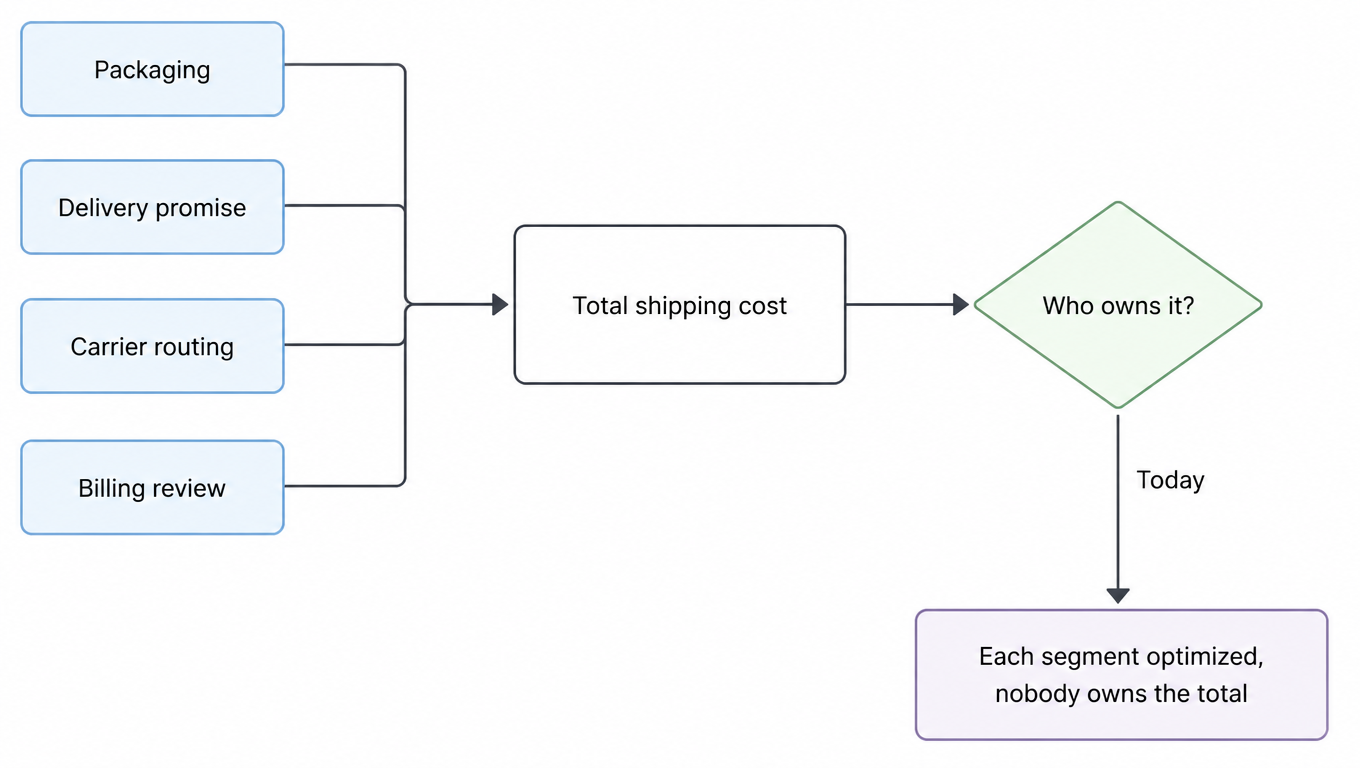
Last-mile cost naturally splits across four centers: packaging (boxes, fill, dimensional weight [^2]), delivery promises (free-shipping threshold, transit display), carrier routing (which carrier, at what rate), and billing (reconciliation, disputes). Someone optimizes each one, but nobody is accountable for the sum, and that is the root of the mess. The centers also fight each other: promise too much and routing cannot keep up, so support pays out of pocket to explain it; packaging saves weight on the box, and an unregistered surcharge appears on the bill. The structure:
You do not need software for this. One RACI matrix is enough. RACI is four letters: R is Responsible, the person who does the work; A is Accountable, the person who owns the outcome and makes the final call; C is Consulted, the person whose input you need before deciding; I is Informed, the person who only needs to know the result [^1]. The core rule is a single one: every task has exactly one A. A is not the same as R. You can have several Rs, but only one A.
This guide gives you two tables. The first is the internal matrix: founder, operations, support, and finance, across the four cost centers, one row per task, with R, A, C, or I marked. The second is a small external interface matrix: where the 3PL and carriers do the work, who on your side interfaces with them, and who approves. Then we close with the rollout steps and the four most common failure modes.