
Marketplace Rate Guide

Etsy Calculated Shipping: Setup, Common Mistakes, and How to Avoid Undercharging

Editorial illustration of an independent seller at a home packing bench holding a ceramic mug and a kitchen scale, an open carton and a roll of tape on the bench, a laptop showing a shipping label at the edge of the frame.
The number the buyer sees depends on the weight, size, and box you entered. Illustration.

You turned on calculated shipping, Etsy showed the buyer a number at checkout, and then you bought the label and paid more than the buyer paid you. Nothing crashed, nothing errored, and the gap was small enough to overlook, until you added up ten orders and found forty dollars missing from the month.

That gap is almost never the algorithm. Calculated shipping is a lookup: Etsy takes your origin ZIP code, the buyer's location, and the order's weight and size, then picks the least expensive service eligible for that weight and size[^1]. When the number is wrong, one of those inputs is wrong, or the packaging it chose is not the packaging you actually used.

What follows covers the setup, the three numbers sellers confuse, the reasons a quote comes out high or low, how multi-item orders are priced, and where packaging and labor costs have to live now that Etsy no longer lets you charge them as fees.

What calculated shipping is, and when it fits your shop

Calculated shipping is Etsy's live rate lookup for a listing. Buyers can preview the cost by entering a ZIP code or country, and Etsy defaults to the least expensive method eligible for the order's total weight and dimensions[^1]. You are not choosing a carrier for each order; you are telling Etsy which services you are willing to offer and letting it price them.

It is available to sellers shipping from the US or Canada with USPS or Canada Post, and US sellers can also check USPS, UPS, and FedEx rates through the Etsy Shipping Calculator before an order arrives[^3]. If an item is too large or too small to move as a standard postal package, Etsy still expects you to set your own fixed rates instead[^1].
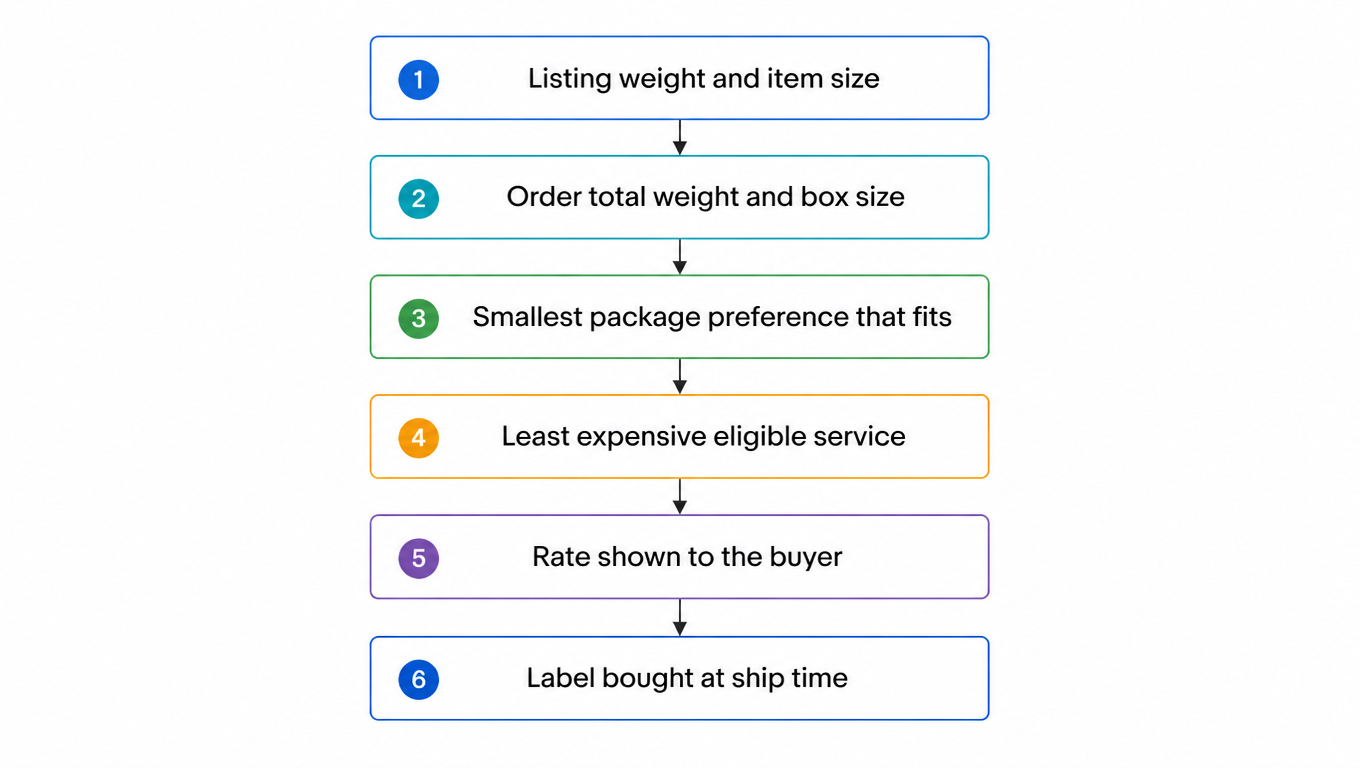
Flow chart: listing weight and item size become the order total weight and box size, which match the smallest package preference that fits, which selects the least expensive eligible service, producing the rate the buyer sees, which is finally compared with the label bought at ship time
One wrong link on this chain, and the rate the buyer sees drifts away from what you actually pay.

The difference from fixed shipping is where the error goes. With a fixed rate you name one price per listing, plus an additional-item charge, and every buyer pays it whether they are two zones away or eight. That is predictable and easy to explain, but it is systematically wrong somewhere: too much for the neighbor, too little for the coast. Calculated shipping moves with the zone and the weight, which is what you want if your items vary or you ship nationwide.

What to compareFixed shippingCalculated shipping
What the buyer seesThe number you typedA rate for their address
Behavior across zonesSame price everywhereRises with distance
Multi-item ordersBase price plus your additional-item feeRepriced on combined weight and size
Where it goes wrongToo high locally, too low far awayWrong whenever the inputs are wrong
Setup effortMinutes per listingOnce per profile, then maintenance

Calculated shipping is a poor fit in a few honest cases: a listing whose sizes differ enormously in packed weight, an item that must ship in an oversized carton, or a product line where you would rather absorb distance than explain a $14 rate to a buyer three states away. In those cases, fixed rates plus a deliberate margin are a cleaner answer than a broken calculator. For the wider playbook, see how to lower shipping costs.

Item weight, item size, and package preferences are three different numbers

This is where most undercharging starts. Etsy asks for three related but distinct things, and sellers routinely paste the same value into two of them.

Item weight is how heavy the order is. It should be the packed weight: the product plus its inner wrap, box, and card. A 10-ounce candle in a jar with a lid, cushioned in a small carton, is not 10 ounces when it goes on a scale.

Item size is the dimensions of the packed item. Etsy uses it to work out which package the order fits into, and if the item is larger than everything in your preferences, Etsy falls back to using the item's own size as the package size[^2]. That fallback is the quiet trap: enter the product's footprint with no packing allowance, and you have told Etsy the parcel is smaller than it is.

Package preferences are the boxes and mailers you actually own. Set them once under Shop Manager, Settings, Shipping settings, Package preferences. Etsy picks the smallest and cheapest package that fits the order from that list plus its own default sizes, unless you switch the defaults off[^2][^1]. If your real carton is not on the list, Etsy prices a box you do not have.

Here is the same small item described all three ways, in an example you can copy:

FieldWhat goes in itExample (8 oz mug)
Item weightPacked, on a scale1 lb 4 oz (mug 8 oz, inner box 4 oz, cushioning 6 oz, carton 2 oz)
Item sizePacked item dimensions5 x 5 x 5 in (mug in its inner box, before the outer carton)
Package preferenceA carton you own8 x 6 x 4 in corrugated box

Etsy will pick the 8 x 6 x 4 carton because the 5 x 5 x 5 item fits inside it and nothing smaller in your list does. Change the item size to 4 x 4 x 4 because that is the bare mug, and the same order may price against a smaller package than you will ever put in the mail.

Line illustration of two cartons side by side on a packing bench: the left one oversized for a small wrapped mug with loose filler and empty space, the right one snug with a thin layer of paper, a kitchen scale in the foreground.
One mug, two cartons. Which one Etsy picks decides both the rate and what you pay.

Dimensional weight: when the box, not the mug, sets the price

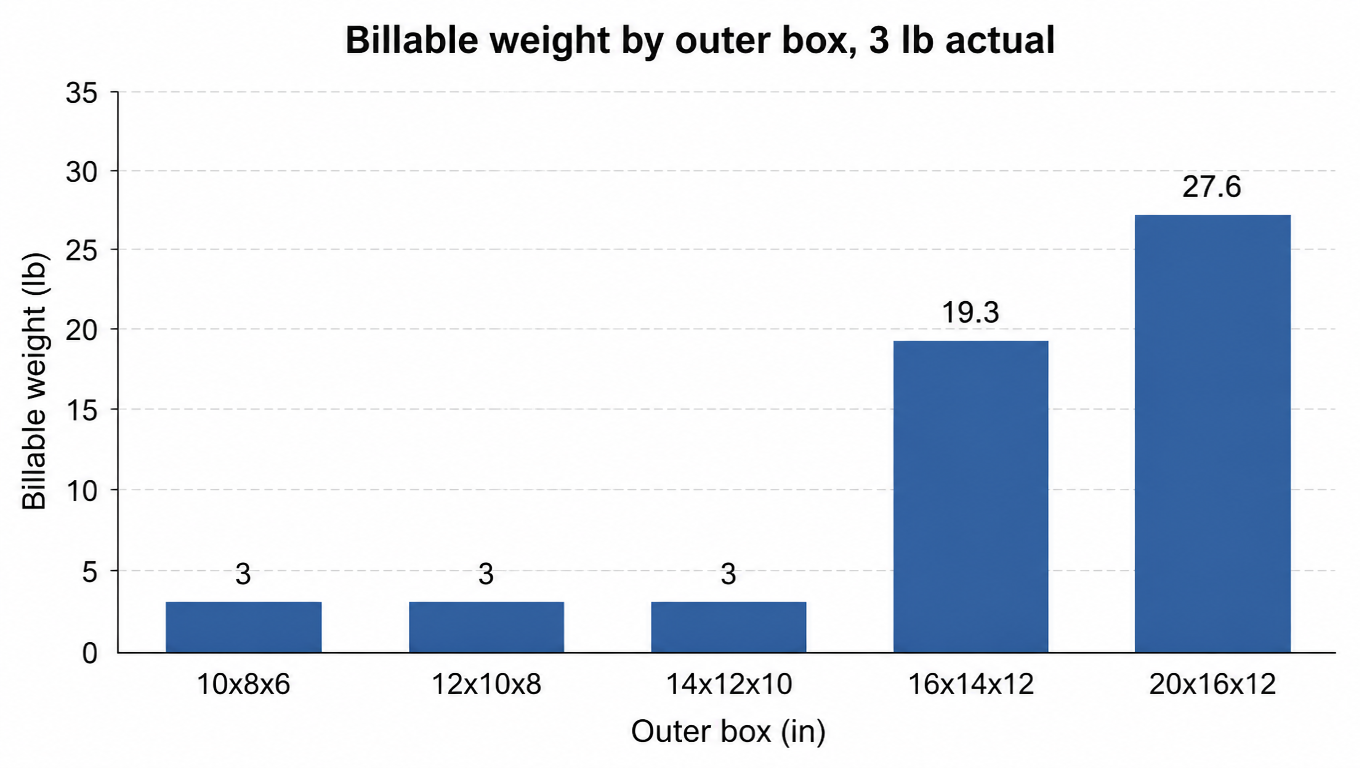
For services such as USPS Ground Advantage, a package larger than 1 cubic foot (1,728 cubic inches) is priced on dimensional weight: length times width times height, divided by 139, billed at whichever is greater, actual or dimensional[^5]. FedEx uses the same 139 divisor for US shipments[^7]. UPS has priced parcel services on dimensional weight for years.

That threshold is generous for small goods and brutal for lightly packed ones. Take an example order with 3 pounds of actual contents:

Outer box (inches)Volume (cubic inches)Over 1 cubic footDimensional weightBillable weight
10 x 8 x 6480NoNot applied3 lb
12 x 10 x 8960NoNot applied3 lb
14 x 12 x 101,680NoNot applied3 lb
16 x 14 x 122,688Yes19.3 lb19.3 lb
20 x 16 x 123,840Yes27.6 lb27.6 lb
Bar chart of billable weight for 3 pounds of actual contents across five outer box sizes: 3 lb for 10x8x6, 12x10x8, and 14x12x10, then 19.3 lb at 16x14x12 and 27.6 lb at 20x16x12, the jump occurring as the box crosses 1,728 cubic inches
The jump between 14 x 12 x 10 and 16 x 14 x 12 is not a pricing quirk, it is 1,728 cubic inches being crossed.

If your package preferences only include large cartons, every order prices as if it were in one, and no amount of reweighing saves you. Add the small and mid-size boxes you actually use, then decide whether to keep Etsy's defaults in the list. Tools for the arithmetic: the package size checker and the dimensional weight guide.

The one-weight-per-listing problem

Etsy stores a single item weight per listing, so a listing with a small and a large size shares one weight. If the small size is 9 ounces and the large is 2 pounds, calculated shipping either overcharges the small buyer or undercharges you on the large one, and there is no field to fix it. Sellers work around this in three ways: split the sizes into separate listings, price the smaller sizes up so the average works, or switch that listing to fixed rates with an additional-item charge. Pick one deliberately rather than discovering the gap in your payout summary.

Why the buyer's rate is too high or too low

Most complaints collapse into a short list. Work down the table, fix one line at a time, and re-quote the same test order after each change so you know what moved.

SymptomWhat to checkFix
Rate looks high for a light itemPackage preferences contain only large cartons, or Etsy's defaults are on and larger than your stockAdd your real mailer and box sizes, then disable Etsy's default sizes if they do not match
Rate spikes on a two-item orderItem size entered as the outer carton, so two items cannot share a boxEnter the packed item size, not the carton, so the pair fits in one package
You top up the label every timeWeight entered as the bare product, or never updated after a redesignWeigh the packed order on a kitchen scale and update the listing weight
Nearby buyers see odd ratesOrigin ZIP in the shipping profile is a former studio, a relative's address, or a warehouse you no longer useEdit the profile and enter the ZIP you actually ship from[^1]
Only expensive services appearProfile offers Priority Mail or Express but not the ground service you would really useAdd the cheaper eligible service to the profile
Rate looks fine, label costs moreThe shown rate is a reference; the final price appears when you buy the label[^6]Compare quoted rate to label cost per order, not in the abstract
International quotes look randomDestination country, duty handling, or a service that does not reach that addressTest a real destination and keep one international service you trust
One listing is always wrongMultiple sizes sharing one weightSplit the listing or move it to fixed rates

Two tests separate a data error from a rate you simply dislike. First, quote the same item to a local ZIP and to a distant one; if the difference is implausibly large, suspect package size or weight rather than distance. Second, quote one unit and then two units; if the second unit does not reduce the per-unit cost much, Etsy is splitting the order into two packages because your item size does not let them share a box[^3].

The gap between a quote and the final label is its own subject: see rate quote versus final charge, and on reweighs, shipping weight adjustment disputes.

Multiple items in one order

For calculated shipping, Etsy adds up the total weight and the combined dimensions of the items, then chooses the smallest and cheapest package from your preferences and its defaults that will hold them[^2]. If the combined order does not fit, calculated shipping splits it into more than one package, and that raises the cost rather than lowering it[^3].

Orders that mix calculated and fixed-rate listings follow their own rule: Etsy calculates the shipping for all the calculated items, then adds the additional-item costs for the fixed-cost items, whatever those costs happen to be[^3]. So a fixed second item is not repriced into the combined package. If the fixed item's additional-item fee is high, the buyer pays for a box that does not exist.

A test protocol that takes about fifteen minutes:

ScenarioWhat to recordWhat a correct result looks like
One unit, local ZIPQuoted rate and the label cost you would paySmall gap, within a dollar or two
One unit, distant ZIPSame two numbersHigher quote, same small gap
Two identical units, localQuote and per-unit shareThe second unit adds weight, not a second full rate
Two different items, localQuote and whether Etsy picked one packageOne package if the items fit together
One calculated plus one fixed itemHow the fixed item's additional-item fee appearsA clear, defensible number, not a surprise

If the two-identical-units row charges almost twice the single rate, go back to item size. That is the signature of items that cannot share a box in Etsy's model, even though they obviously would on your bench. The full cost model for consolidation is in combining orders into one shipment.

Packaging and labor costs now have to live in the item price

In March 2025, Etsy removed the option to charge handling and package fees. If you use calculated shipping, you can no longer add those fees to your shipping prices, and Etsy's guidance is to account for the costs by adjusting your item prices[^4].

That is a pricing change disguised as a settings change. The costs did not disappear; they moved from a line the buyer could see to a line the buyer cannot. Sellers who never repriced are now paying for mailers out of margin.

Start with a per-order packaging cost, not a per-item guess, because packaging is consumed per shipment. An example for a small ceramics shop:

Cost linePer order
Corrugated carton$0.68
Bubble wrap or paper cushioning$0.22
Tissue, sticker, thank-you card$0.19
Label and tape$0.07
Packing time, 90 seconds at $18 per hour$0.45
Total$1.61

At 300 orders a month that is about $483, or $1.61 per order. If your average item sells for $32, folding that cost into the price means roughly a 5% increase, which is a far smaller change than the 5% of revenue that quietly leaves every month. Do it per listing category, since a mug and a framed print do not share packaging.

Hand-drawn editorial cartoon of a seller at a desk with a simple ledger open in a notebook, a pen in one hand, the other resting on a stack of flat-packed mailers, a kitchen scale, tape, and a half-drunk cup of tea nearby.
Once packaging and labor leave the shipping line, they have two homes left: the item price, or your margin.

Two details worth checking while you are in there. Old shipping profiles built before the change may still carry a handling or package fee line that no longer does anything, which makes your settings harder to reason about. And if you offer free shipping, the packaging cost has to be inside the item price regardless, because there is no shipping line to hide it in.

Auditing packaging by parcel rather than by item is covered in parcel-first packaging cost audit, and platform labels versus your own rates in marketplace prepaid labels: build or buy.

The twenty-minute audit

You do not need to rebuild your shop. You need ten real orders and a spreadsheet column for the gap.

  1. Pull your last ten orders and record the shipping the buyer paid next to the label cost you were charged.
  2. Sort by the size of the gap. Fix the worst three first, not the average.
  3. For each bad order, note the packed weight, the box you actually used, and the box Etsy chose. One of those three is the culprit.
  4. Correct the input: listing weight, item size, package preference, or origin ZIP.
  5. Re-quote the same order with a test address in the same ZIP and confirm the number moved in the direction you expected.
  6. Only then adjust prices for packaging and labor, so you are not raising a price to cover a data error.

The reconciliation view is the whole exercise:

OrderBuyer paidLabel costDifferenceCause
#1041$6.85$7.10-$0.25Weight 2 oz light
#1044$9.40$15.20-$5.80Large box only in preferences
#1047$12.10$8.05+$4.05Fixed rate on a local order

Positive differences are not automatically wins. An overcharge on local orders is the most common reason a promising item gets abandoned in a cart, and it usually traces back to the same oversized package preference.

The number to check before you change anything

Before you edit a weight or raise a price, price the exact parcel you are about to mail: the packed weight, the outer carton dimensions, and the destination ZIP. Compare that with what your shop charged the buyer. The difference is your answer, and it is usually one field, not a whole pricing strategy.

EasyShippingX exists for that comparison step. You can price a parcel across US carriers for the weight, dimensions, and destination you actually ship, then buy the label once the number holds up against what the order collected. It is a shorter loop than guessing at a profile setting, re-quoting a test address, and hoping the next order closes the gap.

FAQ

Most often the package. Either your preferences only contain large cartons, Etsy's default sizes are still enabled and larger than what you use, or your item size is inflated so Etsy cannot fit two items together. Check package preferences before touching the weight.
They are not the same number. Rates shown through Etsy's shipping calculator are for reference and can change; the final cost appears when you purchase the label[^6]. A small difference is normal, a large one means the order shipped in a box or at a weight your profile did not describe.
It sums the weight and combined dimensions, picks the smallest eligible package it can, and splits the order into multiple packages if the items do not fit in one, which costs more[^3]. In a mixed order, calculated items are priced together and fixed-rate items are added at their additional-item cost[^3].
No. The handling and package fee option was removed in March 2025 for calculated shipping, and Etsy points sellers to item pricing instead[^4].
Enter the packed item size, the product with its inner wrap, and put the outer cartons in package preferences. If the item is bigger than every preference, Etsy falls back to the item size as the package size[^2], so that field has to describe something you can actually mail.
Split the sizes that ship very differently into their own listings, or move that listing to fixed rates with an additional-item charge. One weight cannot serve a 9-ounce version and a 2-pound version at the same time.

Compare the parcel you actually ship

Before you touch a profile, put in the packed weight, the outer carton size, and the destination ZIP, see what the parcel actually costs across US carrier options, then hold that against what your shop collected. The gap tells you which field to fix.

EasyShippingX compares carrier options inside the US in one place as a channel-neutral shipping layer and executes them through the Portal, Excel, or the API.