Fragile Packaging Guide

How to Ship Glassware: Packaging, Shipping Costs, and Damage Prevention

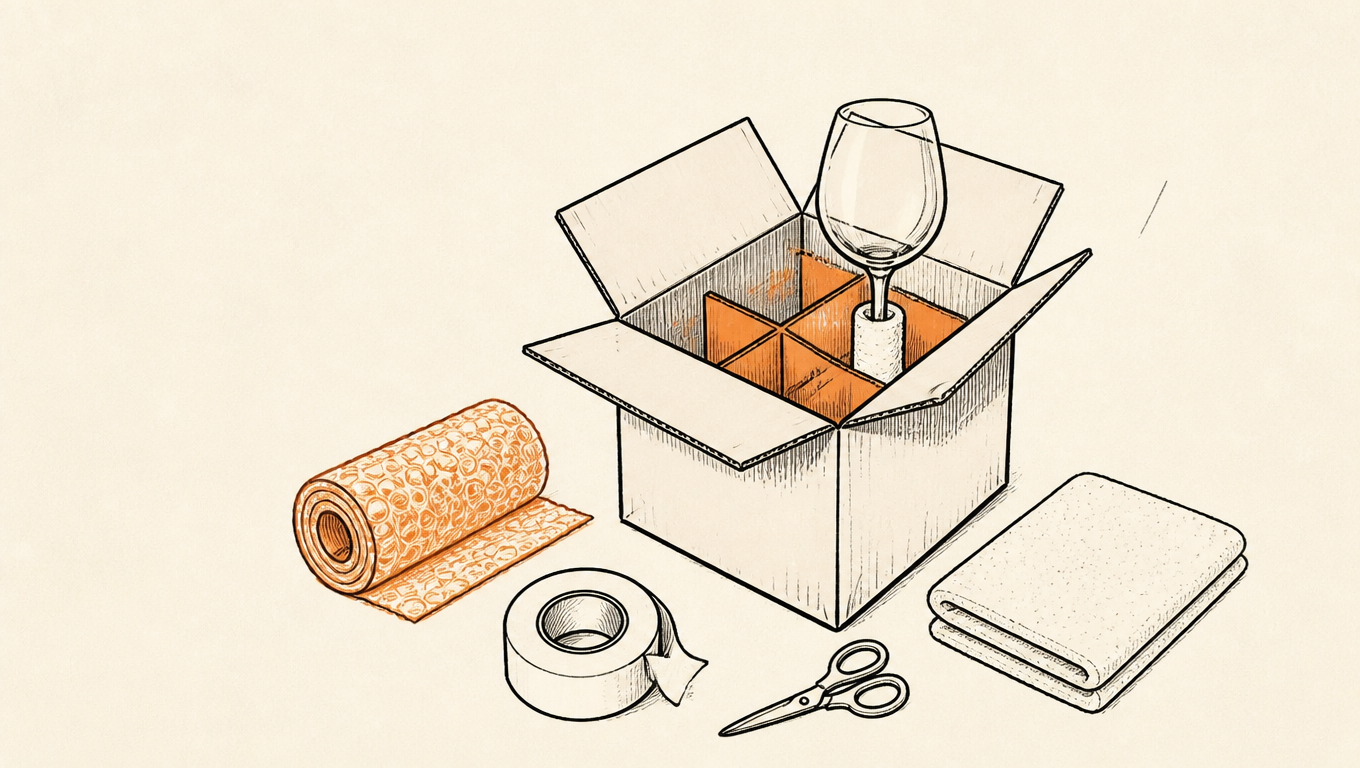
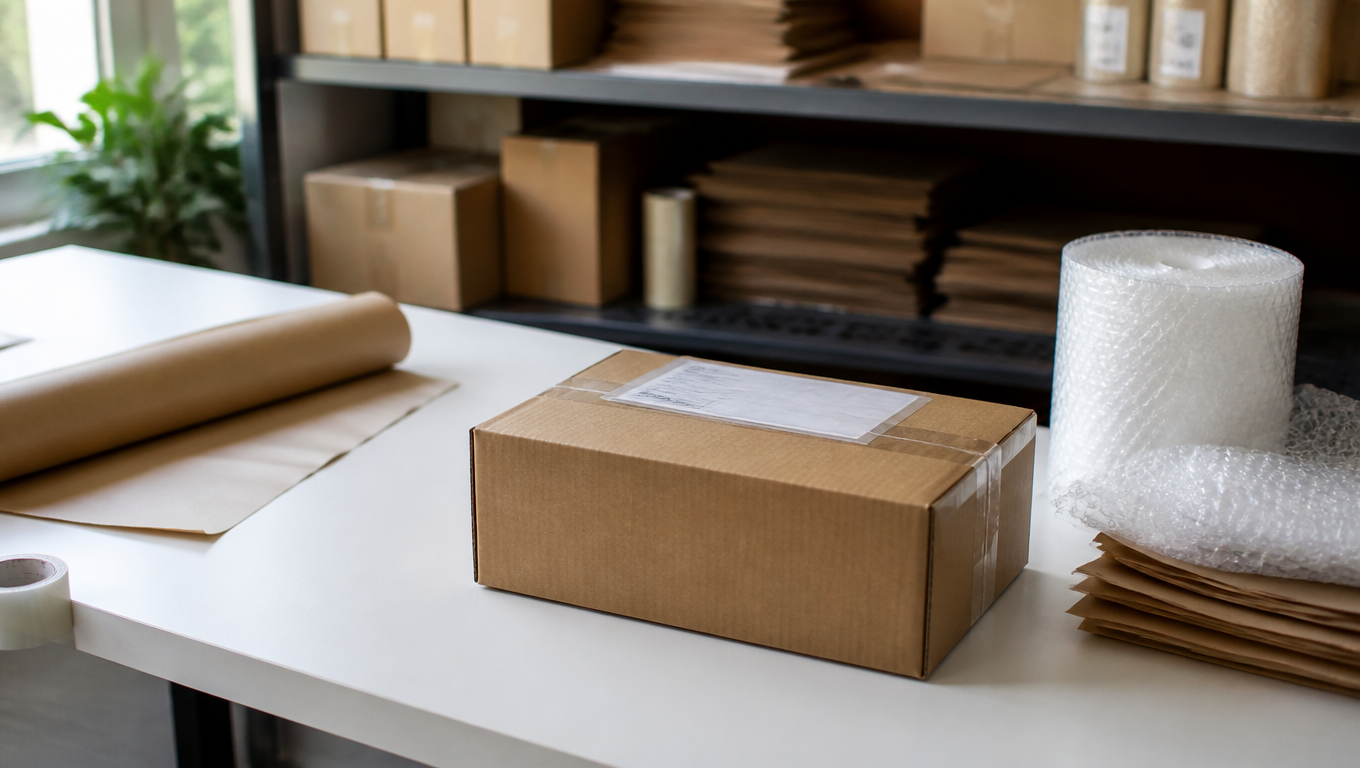
Editorial illustration of a half-packed kraft carton on a packing bench, divided into cells by corrugated inserts with one wine glass standing upright inside, a roll of bubble wrap, a roll of tape, crumpled paper pushed into a corner of the box and a partly extended tape measure on the desk.
Glassware usually breaks inside the box, not because of the box. Illustration.

An intact box with broken glass inside is the most common sight at a returns desk, and the most misread one. It rarely says the parcel was dropped too hard. It says something inside moved: two glass items hitting each other, or a loose item gaining speed in a void and then stopping abruptly.

So packaging solves two problems, restraining movement and separating contact, not simply adding more paper. Get those two right, then price the parcel from the finished carton, and you have a method that holds up at volume.

Three short answers

  • Breakage inside the box is usually movement, not impact. Seal the carton and shake it; if you hear contents shifting, add cushioning. That test comes straight from the Postal Service packaging guidance[1].
  • The weak point is set by shape. Tumblers need the rim and handle protected, wine glasses need the stem, tall vases need the neck. One generic three-layer method performs very differently across those three.
  • Price the finished box. Quoting from the product's own weight ignores the cushioning and carton you just added, which are exactly what the price responds to.

1. Why the glass breaks while the box survives

Three force paths explain nearly every intact carton with a broken base that comes back to a returns desk.

Path one: item against item. UPS packing guidance asks for at least two inches of sheeting around each item and two inches of clearance from the box walls, for a stated reason: it prevents product-against-product damage and blocks shock and vibration travelling in from outside the box[4]. Two glasses side by side with one sheet of tissue between them pass the impact straight through, and the carton looks untouched. For glass and dishes the same guidance suggests foam sheets and bubble wrap together rather than one or the other.

Path two: movement inside the box. The Postal Service test is refreshingly plain: close the box and shake it, and if you hear items shifting, add cushioning[1]. Movement alone does not break glass; movement being stopped suddenly does. The parcel is thrown, dropped, or stopped by a diverter on a belt, and the contents pick up speed inside the void before hitting a wall or another item.

Path three: load on a thin section. A wine glass stem, a vase neck and a mug handle share one property: a small cross-section, hanging free, with no supporting surface around it. When the carton is stacked under weight or lands flat, force follows the stiffest path and the rim or the stem takes it while the bowl stays intact.

One more mechanism gets overlooked: settling. Shredded paper and air pillows sink under vibration. The box passes the shake test on day one and has a void on day three, and the item spends the rest of the journey flying across it. The fix is not more shredded paper but two layers of work: wrap the item into one solid unit with bubble wrap or foam sheet, then fill the remaining space with something that springs back.

One expectation worth correcting: writing Fragile does not oblige a carrier to handle the parcel gently. The Postal Service discontinued its Special Handling service, and a handwritten instruction is not a contractual promise, so marking plus insurance is the complete approach while marking alone is not a substitute for packing[4].

2. Choose packaging by shape: find the weak point first

The load path differs for every glass shape. Decide the shape first, then the wrapping method; that beats memorising a three-layer mantra.

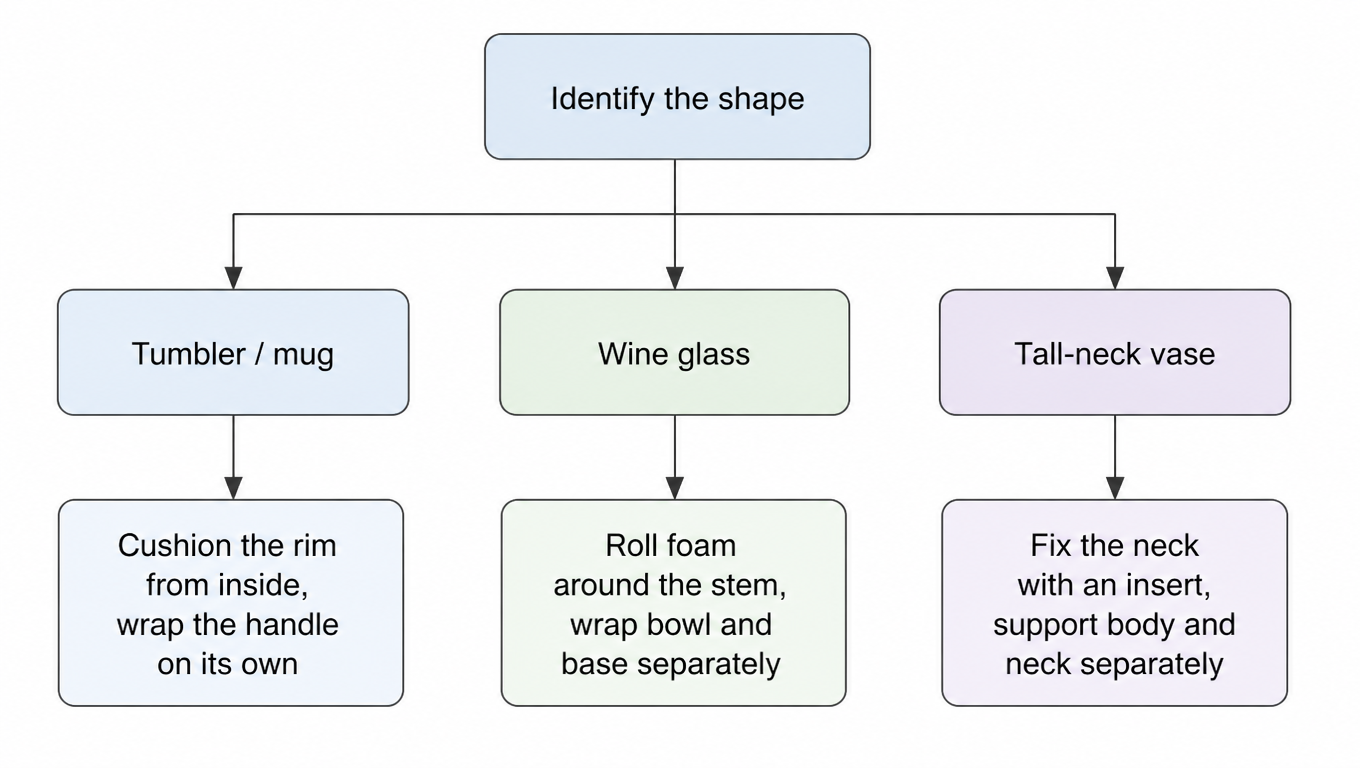
Flow chart: decide the shape first. A tumbler or mug needs the rim cushioned from inside and the handle wrapped separately. A wine glass needs the stem wrapped on its own with the bowl and base packed apart. A tall vase needs the neck fixed by an insert with body and neck supported separately
Three shapes, three weak points. Thickness is not the same as targeting.
ShapeMost fragile pointWhat to doCommon mistake
Tumbler, mugRim edge, handle rootCushion the inside of the hollow too, wrap the handle on its own, then wrap the whole item in two inchesWrapping only the body, leaving the rim against a wall
Wine glassThe stem, then the base jointRoll foam strip around the stem, wrap bowl and base separately, then wrap the whole item in two inches and stand it uprightLaying it flat and relying on loose fill, so the stem takes the shear load
Tall-neck vaseThe neck, then the bodySupport neck and body separately, using a corrugated insert to fix the neck to the carton so it is neither hanging free nor rigidly clampedWrapping only the body and leaving the neck in open air

Cushioning the inside of hollow items is written into the official guidance rather than being folklore: fragile items should be protected with foam or padding, with cushioning placed inside hollow items as well[1]. Leave the cavity empty and the wall can be pressed inward from within, however thick the outer wrap.

3. Boxing a single item and a multi-piece order

Fix the sequence for a single item and the error rate drops fast:

  1. Wrap the item: two inches of bubble wrap or foam sheet, taped into one solid unit.
  2. Cushion the base: one to two inches first, and cover all six faces, not just top and bottom.
  3. Centre it: keep at least two inches from every wall, touching none of them.
  4. Fill the rest: fill outside the wrap layer so no void remains.
  5. Shake test: once before sealing and once after; any shifting noise sends it back.
  6. Seal it: tape the seams fully, and leave no loose corner that can catch on machinery.

For a multi-piece order there is one rule: wrap each piece on its own, and put cushioning between pieces; never rely on them merely resting against each other.

  • Stand pieces upright rather than stacking them flat, keep heavy items off light ones, and keep rims up so load does not land on a wall.
  • From four pieces up, add dividers: corrugated or foam inserts cut the carton into cells and make contact physically impossible.
  • Do not force a twelve-piece set into one carton. Splitting adds a base rate per box, but a single shattered box costs more, and heavier cartons change the dimensional weight and oversize arithmetic.

Where double boxing belongs. FedEx guidance is specific: place the fragile item in an inner box, put that box inside a larger one, and include about three inches of cushioning in and around the inner box[2]; the wrap around an individual fragile product is also specified at a minimum three inches of air-cellular cushioning[3]. The value is not the extra cardboard but the outer box crushing first while the inner one stays intact. It fits a narrow set of cases: a single high-value piece, a product with protruding edges, or an inner box already tight against the item. It costs volume and weight, so it is a tool for specific orders rather than the default.

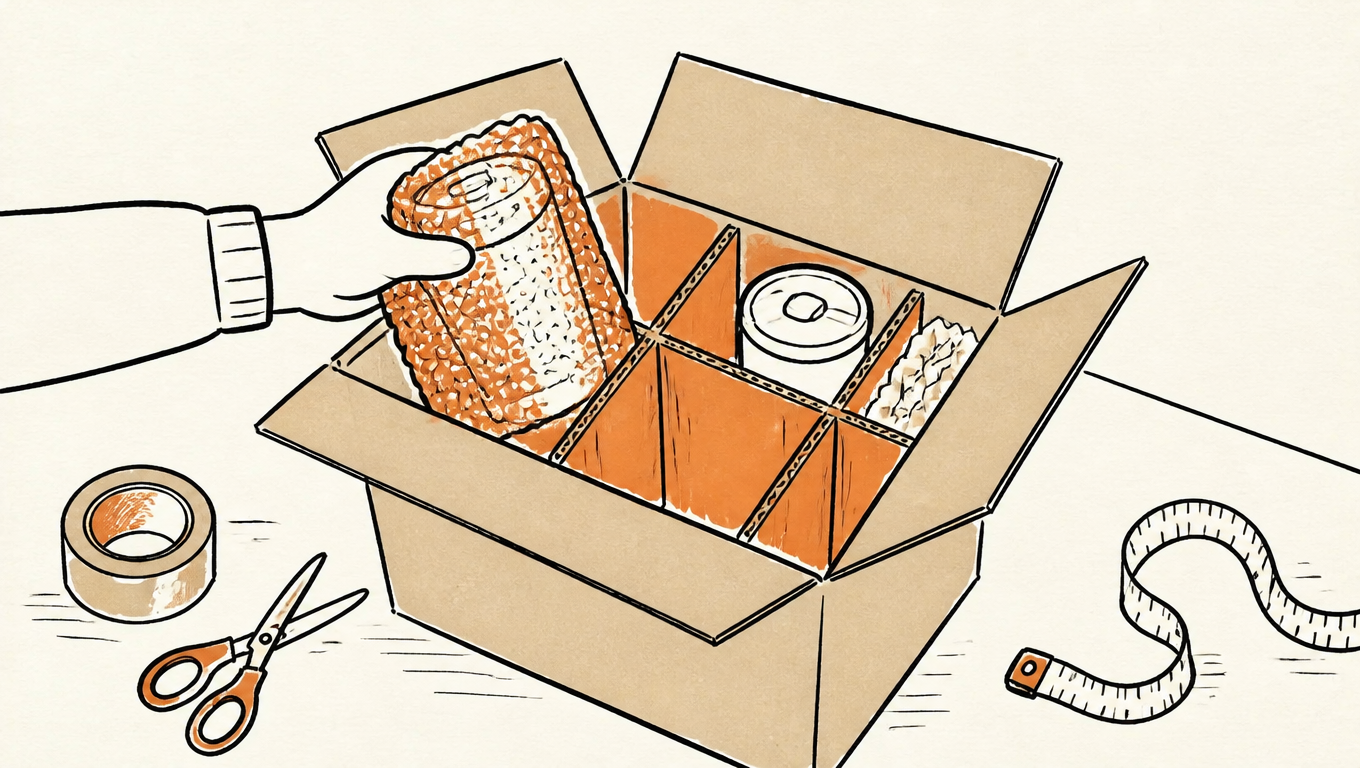
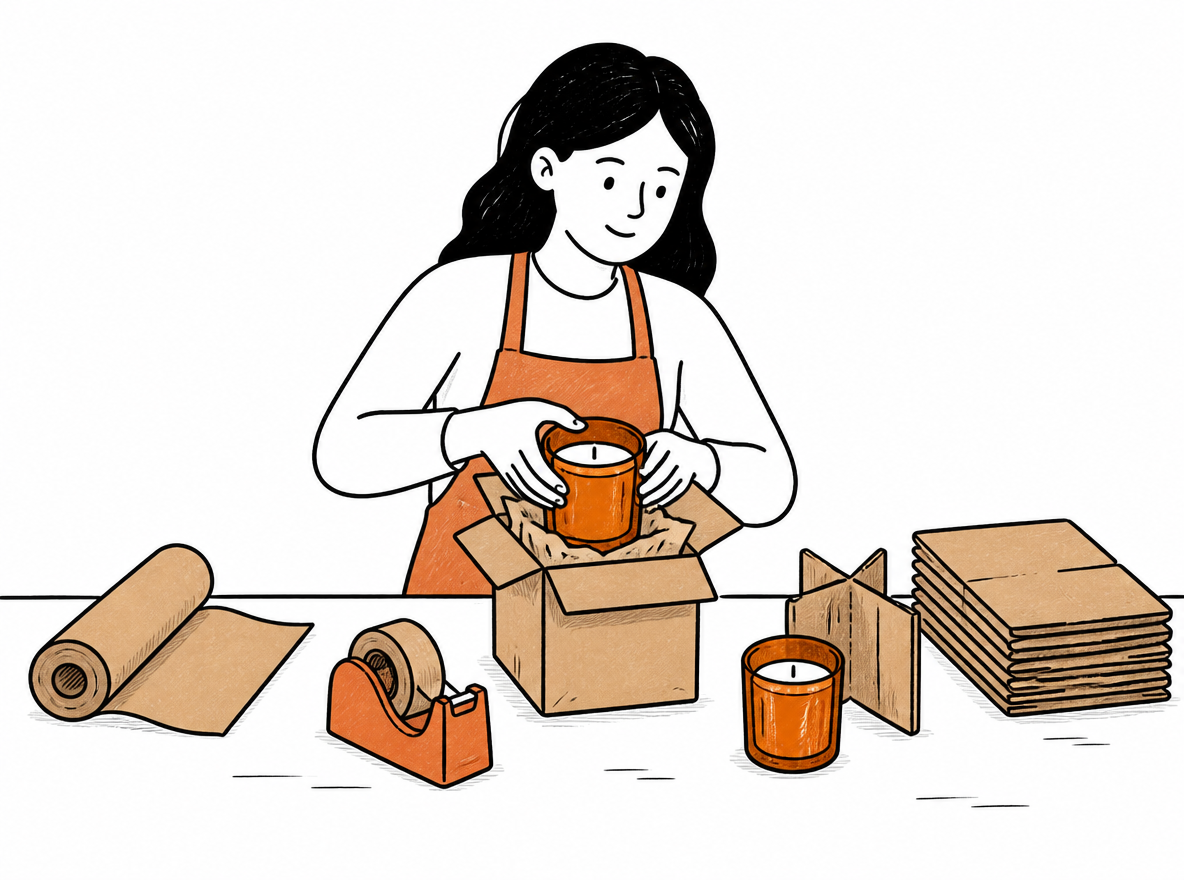
Hand-drawn editorial illustration from above a packing bench: a kraft carton with a divider grid and one glass already in place, a hand lowering a bubble-wrapped glass into a second cell, crumpled paper pushed into a corner gap, tape and scissors beside the box.
A divider turns do not touch into structure. Illustration.

A packing checklist for repeat shipping, ready to print and stick on the bench:

  • The shape is classified as tumbler, stemmed glass or tall-neck vase, and wrapped accordingly
  • Hollow interiors are cushioned
  • Every piece has its own wrap, with handles and stems reinforced separately
  • Dividers or cushioning sit between pieces, with no two points touching
  • Two inches of clearance from every wall, with cushioning on all six faces
  • The sealed carton shakes without contents moving
  • The carton is undamaged, dry, and carries no old label
  • The finished carton is weighed and measured, and priced from those numbers

4. Price the parcel after the box is closed

Order matters: close the box, weigh it, measure it, then quote. Estimating from the product's own weight or pre-pack dimensions produces a number with no meaning, because cushioning and carton size are precisely the two variables that move the billing basis. Packaging is also a cost line in its own right; for costing it separately see the parcel-first packaging cost audit.

Three rules decide what an extra inch of cushioning actually costs, all from the USPS price list effective 4 October 2026[7]:

  • Dimensional weight threshold. Above one cubic foot (1,728 cubic inches) the greater of actual and dimensional weight is billed, with dimensional weight being length times width times height divided by 139.
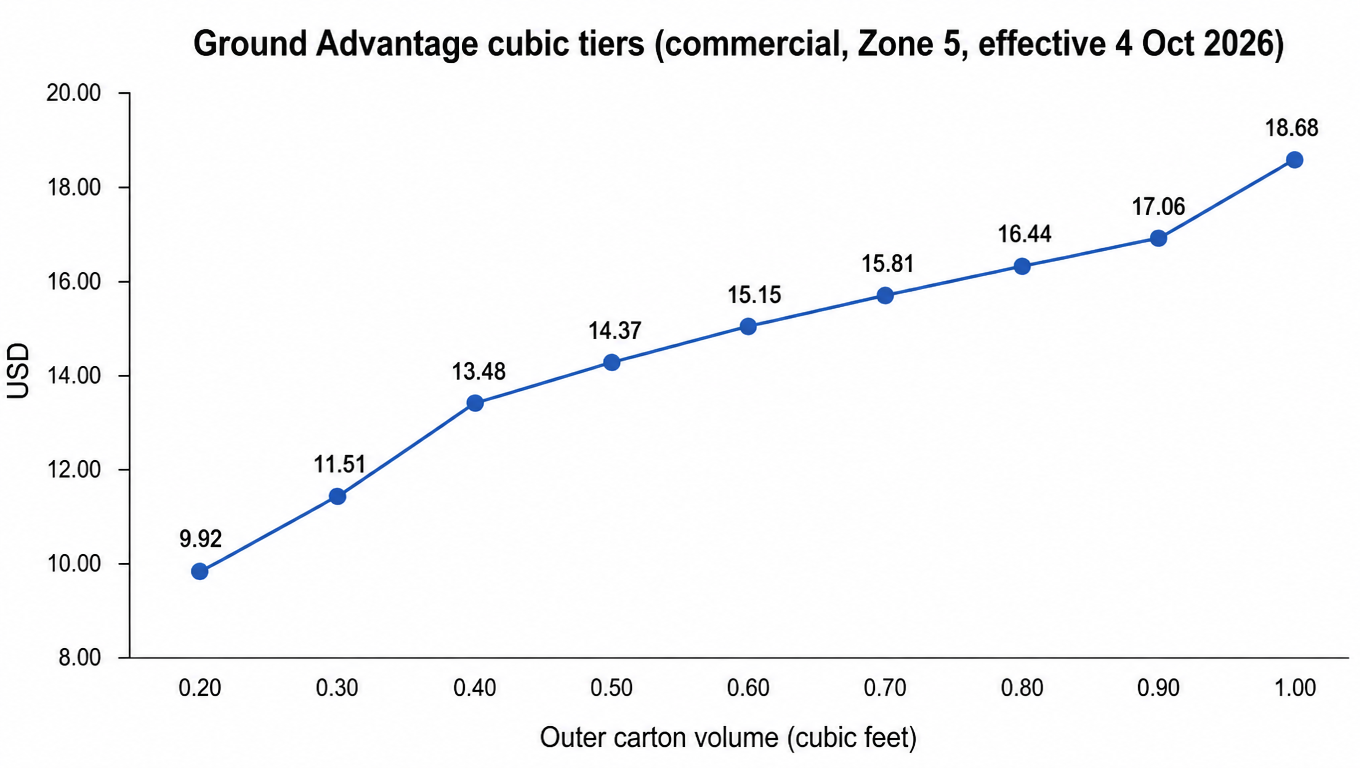
  • Cubic pricing. Ground Advantage commercial prices let a parcel of one cubic foot or less, 20 lb or less, no side over 22 inches and not a roll, price by cubic tier from 0.10 to 1.00 cubic foot. In Zone 5 the 0.20 tier is $9.92, the 0.50 tier $14.37, and the 1.00 tier $18.68[7].
  • Size surcharges. A side over 22 inches but not over 30 inches adds $4.50; over 30 inches adds $10.00; over two cubic feet adds another $21.00. Cubic pricing and the size charge do not co-exist: once the longest side passes 22 inches the parcel loses cubic eligibility and falls back to weight[7].
Line chart of USPS Ground Advantage commercial cubic tiers in Zone 5: 0.20 cubic foot at 9.92 dollars, 0.30 at 11.51, 0.40 at 13.48, 0.50 at 14.37, 0.60 at 15.15, 0.70 at 15.81, 0.80 at 16.44, 0.90 at 17.06 and 1.00 at 18.68
Cubic price rises with carton size, not with weight. Zone 5 commercial, effective 4 October 2026.

The reading is direct: under cubic pricing the price is set by how big you build the carton, not by what it weighs. For the same batch of glasses, moving from a 0.30 to a 0.60 cubic foot carton takes Zone 5 from $11.51 to $15.15, and crossing one cubic foot switches billing to dimensional weight and jumps another tier[7]. So the optimisation target is not thicker cushioning, it is the smallest carton that still passes the shake test. For the arithmetic and a calculator, see the dimensional weight guide and the package size checker.

5. Three worked orders: one mug, four tumblers, one vase

Every number below shares one set of conditions: USPS Ground Advantage commercial prices, Zone 5, the price list effective 4 October 2026, without insurance, signature or peak surcharge, read from the same public table[7]. These are example parcels illustrating the billing basis, not what your account will be charged; counter retail is higher and negotiated rates can be lower.

OrderPackagingCartonBilling basisZone 5 price
A, one mugCushion inside, two turns around the handle, two inches of wrap, about 1.4 lb packed7x7x7 inCubic 0.20 tier, under the 2 lb weight price of $10.50$9.92
B, four tumblersEach wrapped separately, corrugated insert cut into four cells, about 4.6 lb packed9x9x9 inCubic 0.50 tier, against $14.53 for 5 lb by weight$14.37
C, one tall vaseNeck fixed by a corrugated insert, body and neck supported separately, about 3 lb packed6x6x18 inCubic 0.40 tier, longest side 18 inches so no size charge$13.48

One mug. The weight lands on the 2 lb tier at $10.50, but a 7x7x7 carton prices at $9.92 cubic, cheaper than by weight. Small single pieces are exactly where a bigger box is most tempting: move to 10x10x10, which is 1,000 cubic inches or 0.58 cubic foot, and the tier jumps from 0.20 to 0.60 at $15.15, $5.23 more with no real gain in protection[7].

Four tumblers. This is the order most likely to fail: four pieces crowded together with no dividers means four hard objects cushioning each other. With dividers a 9x9x9 carton fits them at 0.42 cubic foot, landing on the 0.50 tier at $14.37 against $14.53 by weight for 4.6 lb, so the divider is nearly free. Switch to 12x12x12 for safety and you are at exactly one cubic foot, the 1.00 tier at $18.68; go one size further and dimensional weight takes over, with 13x13x13 working out to about 15.8 lb and billing at 16 lb for $23.64[7]. That is what over-cushioning actually costs.

One vase. A tall piece carries two risks, a neck in open air and length. A 6x6x18 carton keeps the longest side at 18 inches, inside the 22 inch line, at the 0.40 cubic tier for $13.48. Switch to 6x6x24 for more cushioning and two penalties land at once: the longest side passes 22 inches, which ends cubic eligibility and adds $4.50, and the parcel falls back to weight at 3 lb, so $12.12 plus $4.50 comes to $16.62, $3.14 more than before[7]. The right move for a tall piece is vertical support and inserts, not a larger carton all round. For the other ways size charges trigger, see avoiding USPS dimension fees.

One carton size upVolumeBilling basisZone 5 price
7x7x7343 cu in / 0.20 cu ftCubic 0.20$9.92
10x10x101,000 cu in / 0.58 cu ftCubic 0.60$15.15
12x12x121,728 cu in / 1.00 cu ftCubic 1.00$18.68
13x13x132,197 cu in, dimensional weight about 15.8 lbBilled at 16 lb$23.64
6x6x24Longest side 24 in, cubic no longer available3 lb by weight $12.12 + $4.50 size charge$16.62

6. What to do after the glass arrives broken

Handling breakage has two goals: recover what the claim entitles you to, and turn the event into a cost you can actually book.

Photograph before you unpack. Reverse the order and the evidence is gone. Keep at least these eight:

  1. All six faces of the outer carton, especially the damaged face and its neighbours
  2. Tape and seams, checking whether they were resealed
  3. The cushioning as found, not tidied
  4. The inner wrap around the broken item
  5. Close-ups of the break: stem, neck, crack origin
  6. One wide shot of product and packaging together
  7. The label and tracking number
  8. A photo from the packing station, if you shoot at the bench; this one carries the most weight in a dispute

Keep the item and the packaging. The USPS claims process asks that the damaged item and its packaging be retained for inspection until the claim is resolved[5]. Plenty of sellers bin the broken glass right after photographing it and then cannot produce it when inspection is requested.

Know the deadlines. USPS damage claims must be filed no later than 60 days after the mailing date[5]; FedEx asks for filing within 60 calendar days of the ship date for US parcels and 21 calendar days for international ones[6]. Neither window is generous, and it works better on the first line of an after-sales SOP than buried in a training doc.

Reduce breakage to one number. The real cost of a broken order includes at least:

  • Product cost including the write-off, since the piece cannot be resold
  • Replacement product and replacement shipping
  • Whether the original shipping charge is refundable
  • Support time, converted to minutes
  • The gap between the insurance payout and declared value
  • The packaging materials consumed

Multiply breakage rate by cost per breakage to get breakage cost per order, then hold it against the extra packaging and carton cost per order; whether to upgrade stops being a matter of feel. And if the data clusters on one shape, all stemware for instance, the problem is the method rather than the amount of cushioning. For when insurance genuinely pays, see shipping insurance for ecommerce.

What your finished carton costs today

A published rate table answers what a pound costs. It does not answer what your 9x9x9 carton holding two wine glasses at 4 lb 6 oz costs on the day you print the label, because zone, cubic tier, billed weight and any active surcharge all move.

That is the case for a lookup rather than a table: enter the packed weight, the outer carton dimensions and the destination ZIP, compare carrier options in one place, then buy the label from where you compared. EasyShippingX works as a channel-neutral shipping layer, comparing US carrier options together and executing through the Portal, Excel or the API, so when the packaging numbers change the quote changes with them. For the safety principles behind the method, see how to ship packages safely.

FAQ

Judge it with the shake test rather than by eye. Seal the carton and shake it; any shifting noise means more cushioning. On numbers: about two inches of wrap per item and two inches of clearance from the walls is the common standard, and three inches of wrap is safer for a single fragile piece. The decisive point is that no two items touch.
Upright, with the stem supported on its own. Laid flat, the stem becomes the only load path and takes all the shear when the carton lands or is compressed. Upright, with bowl and base wrapped separately and foam strip rolled around the stem, gives the load somewhere else to go.
Three cases justify it: a single high-value piece, a product with protruding edges, or an inner box already tight against the item with no cushioning room. The method is an inner box inside a larger outer box with about three inches of cushioning in and around the inner box. It adds both volume and weight, so it does not belong in the default workflow.
Yes, and there are two thresholds. Past one cubic foot (1,728 cubic inches) the parcel bills on dimensional weight with a divisor of 139; past 22 inches on the longest side it also loses cubic eligibility and picks up a size charge. The right target is therefore the smallest carton that still passes the shake test, not the thickest cushioning.
It is worth marking, but it is not a safeguard. It creates no obligation to handle the parcel gently, and the Postal Service has discontinued its Special Handling service. What works is the packaging itself plus insurance: pack to the guidance, declare a defensible value, and the claim has something to stand on.
USPS damage claims must be filed within 60 days of the mailing date, and the damaged item and packaging must be retained for inspection until the claim is resolved. FedEx allows 60 calendar days from the ship date domestically and 21 days internationally. Photograph before unpacking; reversing that order destroys the evidence.