To ship a painting, identify the surface and support first, design the package around the parts that can carry load, then measure and weigh the sealed carton. Compare parcel services only after the package and the work pass those checks. An unstable or irreplaceable piece may need assessment and handling by an art shipping specialist.
Consider a hypothetical set of works, each described as 18 × 24 inches. A paper print may fit a flat mailer or an approved roll. A stretched canvas needs a rigid space in front of its surface and support at its perimeter. A glass-fronted frame adds a pane that can flex, break, or move against the art. The same artwork dimensions tell you little about how thick the finished package will be or who can safely handle it.
This guide covers US domestic shipments for studios, galleries, framers, ecommerce sellers and their 3PLs. Use it to decide whether to pack, pause, or request a specialist quote. Paper-specific flat and tube techniques are in the poster and art print guide. Sculptures, museum loans and international shipments require separate plans.
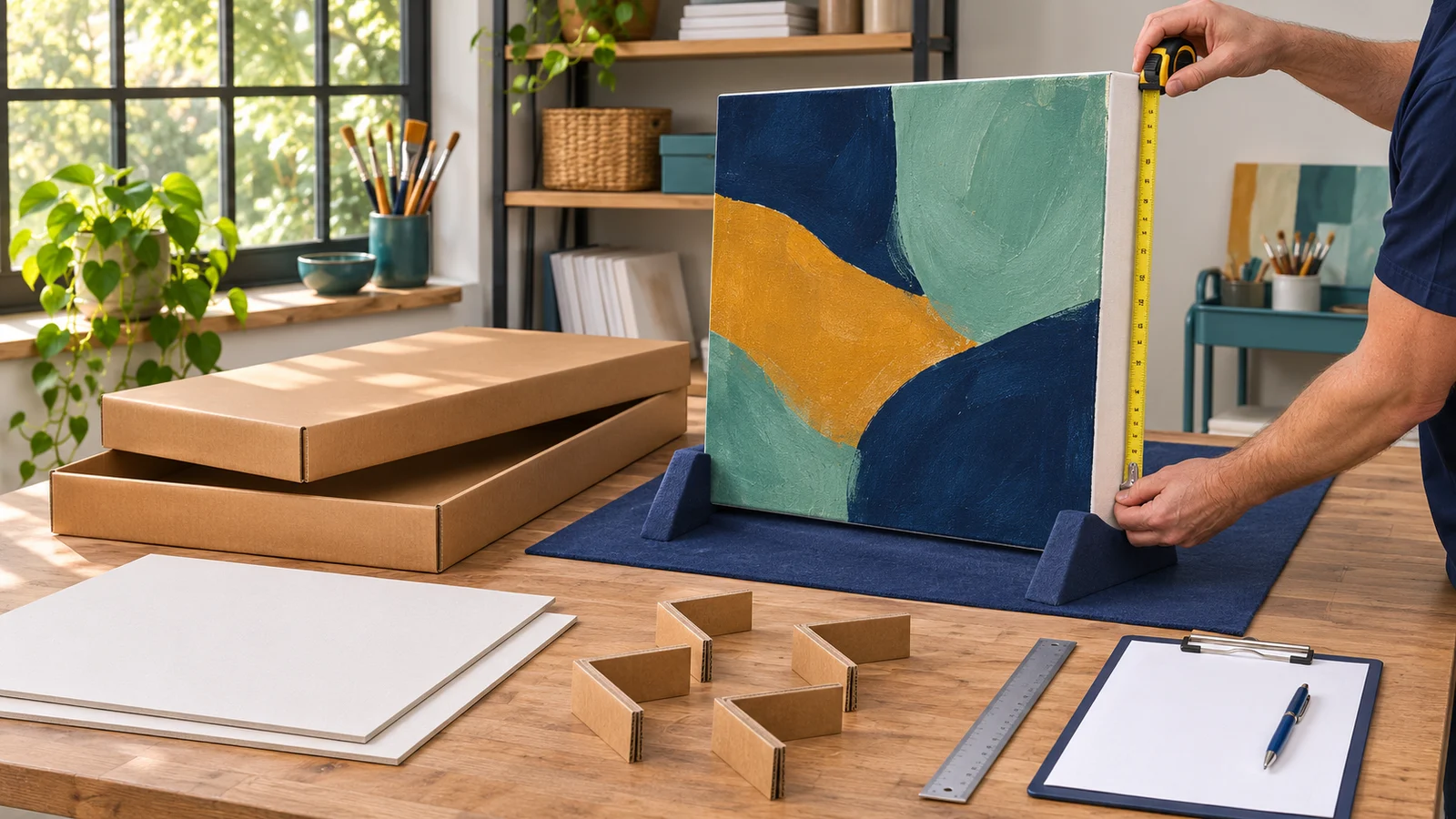
Studio packing illustration. Measure the stretched canvas before selecting its packaging.
1. Identify the construction and decide whether to ship by parcel
A stretched canvas is tensioned on a stretcher, the structural bars behind the fabric. It may have no decorative frame and still need to travel flat. An unstretched canvas is loose fabric and may be painted, printed, lined or otherwise treated. A frame is the surrounding assembly and can be decorative, structural, or both. Glazing is the transparent panel in front of a work, typically glass or acrylic. A backing board protects the reverse when the assembly and attachment suit the work.
Start with the record from the artist, supplier or framer. Identify the substrate, coating and any raised, loose or tacky material, then check corners, joints, hardware and the back. Look under good light without touching the image. If a pane is present, identify the material from the work record or ask the framer. A loose pane, unidentified coating, cracking, flaking, dampness or an unstable frame is reason to stop and get an assessment. Photograph the condition before handling further. Canadian Conservation Institute travel guidance
Construction
Main risk
Pack to consider
Verify first
Escalate if
Loose canvas approved to roll
Crease or abrasion
Approved core and rigid shell
Medium, bend, receiver
Coating or bend uncertain
Stretched canvas, no outer frame
Puncture or stretcher twist
Edge supports and rigid shields
Stable face and sound bars
Bars or paint unstable
Unglazed framed work
Corner loss or frame distortion
Fitted supported art carton
Strong contact points and hardware
Ornament cannot bear load
Glass or acrylic glazing
Pane flex, breakage or scratches
Rigid shields and pane clearance
Mounting, spacers and frame
Crack, looseness or poor support
Large, valuable or unstable original
Irreplaceable loss or handling failure
Professional support or crate
Condition, access and terms
Unacceptable residual risk
Identify the item at the workbench as well as in the order. The same image may be sold as loose canvas, stretched canvas or a glazed piece. Give each construction its own packing record and include any framing or hardware chosen by the buyer.
The first decision is whether the owner and the appropriate artist, framer or conservator have approved rolling this specific work. For a stretched piece, evaluate it as a flat shipment unless removal and later mounting are part of an authorized plan. For a loose canvas, confirm the paint system, condition, safe bend and receipt plan. If suitability is unresolved, pause. A listing that says unframed may describe the absence of decoration around a stretcher.
The second decision is what must stay clear of the package. Glass or acrylic changes where the frame can be supported, and a sensitive painting can need clearance with or without glazing. Decide whether the frame or stretcher can accept the loads from the fitted supports. If the only way to close a box is to squeeze the face, change the design. If there is no safe contact point, have a specialist specify a travel support.
The last decision is whether the ordinary parcel network can handle the complete package and the consequences of failure. Check package eligibility, likely handling, route conditions, access at delivery, applicable liability, and what happens if the work cannot be replaced. A workable carton and a rate quote can coexist with an unacceptable residual risk. Get specialist advice for unstable, awkward or irreplaceable work, even if a website returns a price. Canadian Conservation Institute wrapping guidance
Suggested screening order. Pause when the work, its supports or the transport conditions need further assessment.
2. Build the package around the structure of the work
Plan separate defenses for contact, puncture, shock and movement. The face needs space or a surface treatment approved for the specific finish. Rigid panels help protect broad faces, but they can bow if poorly supported. Fitted edge supports spread forces into sound parts of the stretcher or frame. Cushioning isolates that supported assembly from the shell. A loose insert can slide into the image area, so review it as part of the package, including what happens when the box is set on a different edge.
Surface protection starts with permission to touch
Keep bubble wrap, adhesive and compressive padding away from the painted surface. For a sound framed painting, CCI describes a rigid cover supported by frame depth or edge strips, with wrapping outside the cover. It recommends a handling, travel and storage frame when the existing support cannot maintain clearance. Saatchi Art specifies archival contact materials in some of its own packing instructions. That material label alone does not establish compatibility with a particular texture, varnish or uncured coating. Ask the artist or conservator which surfaces may be touched and what can contact them. CCI wrapping note and Saatchi Art instructions
A surface that feels dry can still be unsuitable for packing. Confirm the medium, coating, working conditions and transport readiness with the maker or a conservation professional. An employee should not test readiness by pressing a fingertip, tissue or wrap into a finished face. Build an intake hold for work with missing handling instructions, recent treatment, lifting paint or a surface that may transfer. Ask for a documented decision before closing the box. Saatchi Art drying and packaging guidance
An approved roll needs support at both ends
If rolling has been approved, use the core, roll orientation and interleaf specified for the work. Support the roll across its width, and keep the painted edges clear of the caps. The inner support and the outer container have separate jobs. The core supports the approved curve, while a rigid shell and end restraint limit crushing and sliding. Choose restraints that transfer load through the approved support and leave the artwork edges clear. Confirm the receiver can unroll and mount the work as agreed.
Taking a painting off its stretcher adds handling at the tacking edges and can affect tension, alignment and the finished appearance. Include the artist’s or framer’s work at both ends, documentation, and the risk of exposing or stressing the surface. A new core or a smaller tube is a design change that needs approval. Saatchi Art’s tube procedure belongs to its platform instructions. Use it only within the applicable instructions and the work’s own handling limits. Saatchi Art rolled artwork guidance
Support a sound stretched canvas or unglazed frame at the perimeter
For a sound, unglazed piece with approved support points, fit corner guards and edge supports to the rigid assembly. Account for protruding hardware and decorative molding. Keep accessories secured in a separate compartment if they could swing into the art. A fragile frame corner may need support from a travel frame or stronger edge, even if a standard protector fits over it. Photograph the support contact points so a second person can confirm them.
Set a stiff front shield on the perimeter standoffs and inspect the gap over the highest part of the image. Protect the back as well, especially open fabric behind the stretcher. Use a framer-approved backing where suitable and an external rear shield held by the package structure. The shield cannot press a stretcher key or protruding fastener into the canvas. Check front and rear clearance after closing the carton. Allow for flex under normal handling and for inserts to stay seated. CCI wrapping guidance
Illustrative cross-section for a sound, unglazed stretched canvas with approved contact points. Size and support must be checked for the work.
Check clearance on a representative dummy before adopting a new fit. Inspect the packed and reopened mockup for shifted inserts, a bent shield or a marked witness surface. Reserve any handling trials for samples. Record the finished assembly rather than relying on a carton catalog dimension.
A fitted art carton is a candidate for stable repeatable pieces when it can hold those parts in place. A second carton can add an isolated cushioning zone around a secured inner assembly, provided the inner box stays supported without pressure on the face. A larger or heavier piece, unstable joints, uncertain loads, or a frame that needs handling fixtures may warrant a professionally designed crate. Saatchi Art has format and size requirements for its own orders. Check that platform’s current requirements when applicable, and ask the carrier and packer about the finished crate before quoting. Saatchi Art packaging requirements
Treat glazing as part of the framed assembly
Before packing glass or acrylic, ask the framer to check the pane, spacer, mounting and backing. Confirm the glazing has room away from the artwork and is secured against movement. Support load-bearing parts of the frame, keep the front shield clear of the pane, and protect the rear from puncture. A cup can often be protected as a separate object. A frame has a broad pane close to a vulnerable surface, so its clearance and restraint need their own checks. See the glassware guide for the separate problem of immobilizing glass vessels.
Acrylic can change weight, appearance, scratch sensitivity and how the glazing interacts with the work. Ask the framer to approve the fit and material for the medium, involve a conservator for sensitive work, and get owner and buyer approval before changing the agreed product. Separate glazing is another possible arrangement when both ends can handle it safely. Account for extra packing and reinstallation. CCI describes low-tack protection as a conditional measure for certain nonlaminated glass, subject to coating guidance and safe removal. Saatchi Art describes a different procedure for removed panels on its orders. Tape may help retain shards in some circumstances. It cannot prevent breakage. CCI wrapping note and Saatchi Art instructions
Confirm how the recipient will lift the work out. A box that opens at the right edge lets the buyer remove the restraint before lifting. Mark the opening and arrange the inserts so a blade can stay away from the face and pane.
Keep packing materials clean and dry. For a sensitive work, ask how temperature changes, humidity and arrival acclimation affect the trip. CCI discusses wrapping as a way to moderate short-term humidity changes for suitable work and additional insulation where thermal changes are expected. A moisture barrier by itself does not establish temperature control. A damp work or a route requiring controlled handling needs an agreed plan before sealing. Generic fragile packing guidance can help with the outer box and movement control after those artwork-specific decisions. CCI wrapping note and Pirate Ship fragile packing guidance
3. Price the sealed parcel and the complete fulfillment cost
Measure the work when selecting packaging, then measure the sealed box again for postage. Record its maximum outside length, width and height, including bulges, and weigh everything that will travel. The frame and glazing can change the product dimensions. Corner blocks, standoffs, panels, an inner carton and cushion space can change both the outside dimensions and gross weight. Keep the scale and tape readings in the order record. Requote when a substituted carton changes either.
Compare two hypothetical rectangular outer boxes. Box A measures 24 × 20 × 4 inches and occupies 1,920 cubic inches. Box B measures 28 × 24 × 6 inches and occupies 4,032 cubic inches. The difference is 2,112 cubic inches, or 2,112 ÷ 1,920 = 110% more volume. These dimensions illustrate the arithmetic. A protection design for a specific work requires separate approval. A volume change affects the inputs to a rate calculation, and the resulting price depends on service, destination, weight, and fees.
For a specific example, USPS Ground Advantage Commercial applies dimensional weight to parcels to zones 1–9 above 1,728 cubic inches under DMM 283.1.4. For rectangular parcels, round each measured side up to a whole inch, multiply, divide by 139 and round the result up to a whole pound. The rounding and divisor provisions are marked effective July 12, 2026. The sample sides are already whole inches. A yields 14 lb of DIM weight, and B yields 30 lb because 139 × 29 = 4,031. Compare each with its actual weight under the applicable weight increment rules. Neither result is a price. USPS DMM 283.1.4
Nonstandard fees are separate from DIM weight. In that same commercial example, both longest sides fall in the over-22-through-30-inch length tier. B also exceeds 3,456 cubic inches under the cube fee calculation, which uses nearest-inch rounding on rectangular parcels. The sample whole-inch measurements avoid a rounding difference here. Check service and contract terms for the live shipment, including any applicable length, shape, cube or oversize charge. For other services, use their own rules. USPS DMM 283.1.7 and the USPS dimension fee guide
Keep a copy of the quote with its ship date, dimensions, zone or ZIP Codes and package type. Check how an outer tube or wooden crate is classified before comparing it with corrugated packaging. A different exterior can change acceptance and fees. USPS Ground Advantage size and shape rules
List postage, materials, labor, optional protection and other applicable charges. If the quote already includes a fee, leave it out of the separate fee line. Use packing time at the loaded labor rate and include any destination mounting that the shipper pays. Compare the same destination and service constraints. The following teaching amounts are independent of the USPS illustration and assume that both packages have already passed the work’s protection and service checks.
Assumed cost
A
B
Postage
$16
$22
Materials
$8
$13
Labor
$6
$7
Optional protection
$2
$2
Other fees
$4
$8
Upfront total
$36
$52
Teaching assumptions. The volume change and the cost model are separate. The costs are illustrative.
Suppose an incident on a replaceable product leaves $220 of net unrecovered item loss after salvage and any recoveries. Add $35 to prepare and ship a replacement and $25 for customer service, for $280 per incident. In this example the three costs are distinct and apply once per incident. If A has an assumed 8% incident probability and B has 2%, expected totals are $36 + 0.08 × $280 = $58.40 and $52 + 0.02 × $280 = $57.60. The extra $16 upfront breaks even at a probability reduction of $16 ÷ $280, about 5.71 percentage points. Six points clears that threshold in this scenario.
Track arrival condition separately from the claim result. A refund or denied claim can change your net loss without changing the physical failure rate. Revisit the assumptions when the product, insert or delivery mix changes.
Change the assumptions to test the decision. Use comparable packing and arrival records rather than borrowing a damage rate from another product. Record whether repair, replacement, a refund or denial actually occurred and assign the costs to the correct event. A marginal modeled advantage does not establish that the pricier box will perform better. For an original that cannot be replaced, decide what handling and risk are acceptable before using a cost comparison at all.
4. Separate proof of value, declared value and insurance
Write down the agreed sale price and how you could prove the value at shipment. For a repeat SKU, save the paid order, item identity and supporting cost records. For an original, match the artist, title, medium, dimensions, condition and any edition or provenance evidence to a dated invoice, dealer valuation or other proof accepted by the applicable terms. A certificate can identify the work, while a paid sale or suitable valuation supports the amount. Document the difference if the sale includes framing, installation or other services.
Declared value is a figure supplied under a carrier’s terms. FedEx describes its declared value as a liability limit and directs shippers to commodity and service limits, including for artwork. Its artwork page describes packing and service options for its own network. A separate insurance policy has its own covered property, transit scope, exclusions, deductible and evidence rules. Before purchasing either, ask about the exact piece and glazing, packing responsibility, who is covered, who files the claim, and the applicable reporting deadlines. FedEx artwork guide and FedEx declared value guidance
The eventual payment depends on the covered event, actual damage and accepted evidence, subject to the applicable limit. For eligible USPS insured mail, DMM 609 addresses proof of value and insurance, compensation, and packaging-related grounds for denial. It also requires the recipient to retain the container, packaging and received contents for a damage or missing-contents claim, with inspection on written request. Capture the original condition, each protective layer, sealed box, label, dimensions, weight, value evidence and mailing receipt. Use the USPS claim guide when an incident occurs. USPS DMM 609
Keep the terms and purchase record together. If a buyer, seller and warehouse are all involved, record who paid for the protection and who controls the evidence. Ask how any other policy or carrier recovery is coordinated before assuming the same loss can be recovered twice.
Have the shipper and 3PL agree on who verifies protection and retains the evidence. Ask for written confirmation of unusual commodity or glazing conditions before relying on them. Compare any premium, deductible and unrecoverable exposure using the ecommerce shipping insurance guide. If the contract cannot address a loss that the owner considers unacceptable, pause the parcel plan even when an additional fee is offered.
5. Four shipments with different release decisions
A. Standardize a repeatable canvas SKU
In this hypothetical DTC order, the product is a small, unglazed, stretched decorative reproduction. The supplier confirms a stable finish and approved handling points. The brand stocks replacements, ships it ready to hang, and wants a repeatable process that a 3PL can perform. Test a fitted art carton and an isolated double carton with representative non-sale samples of the actual construction. Record panel clearance, corner fit, restraint, closure, packed dimensions, and labor minutes. Inspect the piece after the trial and track real arrival outcomes.
Reject a smaller carton if its cover can flex into the canvas. When the fitted design passes, document the materials by part number, the order of assembly and the checks that release each parcel. Photograph the reference assembly and train the packer on the same SKU. Recheck after a change in stretcher depth, insert supplier or frame hardware. Release matching orders to ordinary parcel service when the actual package meets the service terms.
B. Hold a stretched original for approval
In this hypothetical studio sale, the canvas is already stretched and has a raised painted texture. The listing omits an outer frame, and the maker has yet to confirm the finish is ready to travel. A compact roll may look attractive in the rate tool, but removing the stretcher requires handling and creates a re-stretching job at delivery. Even in an approved roll scenario, a hypothetical $14 label and $70 destination mounting cost already total $84, compared with a hypothetical $51 flat shipment made up of a $31 label and $20 for packing and other costs. The rolled total is already higher before any disassembly or roll packaging, and the customer expects the work ready to hang.
Keep the work on hold. Ask the artist to confirm condition, allowed contact and safe support, and have a framer or conservator specify clearance if needed. Compare a supported flat package and a specialist option only after that review. Record the written decision and plan before quoting a final service. Leave the stretcher in place unless a separate, authorized treatment and receiving plan calls for removal.
C. Resolve the glazing choice with the buyer
In this hypothetical framer order, a medium-sized work is already assembled with glass. The customer expects the same glazing and an assembled delivery. Inspect pane security, spacing, finish, corners and backing with the framer. Compare preserving the glass in a properly supported assembly, substituting suitable acrylic with written approval, and professional packing or delivery. Separate glazing adds handling and installation that the buyer may be unable to arrange. A low parcel price loses its advantage if the recipient cannot accept the delivery format.
If the pane and frame are suitable and a professional can design the required front and rear protection and restraint, quote that approved assembly and verify the service accepts it. Change the glazing only with approval and a revised product record. If a crack, loose pane or unsupported frame prevents safe packing, pause. Give the buyer safe unpacking instructions and a clear contact if damage is visible.
D. Request a specialist quote for an irreplaceable work
In this hypothetical gallery shipment, a large original is irreplaceable and has a delicate surface. The cheapest ordinary quote assumes a box that fits the network, but tells the gallery little about how the item will be supported, moved through transfers, or delivered through a narrow entrance. A high declared amount does not resolve those conditions. Exclude ordinary parcel service for this shipment and request specialist assessment and a written quote.
If the gallery needs a crew to carry the work inside, include the delivery access and mounting plan in the scope. Confirm where responsibility transfers when a separate installer receives the package.
Provide artwork and framed dimensions, estimated weight and packed size if known, condition images, medium and glazing, contact restrictions, the stated value and proof, addresses and access constraints, pickup and delivery windows, and unpacking or installation expectations. Ask who designs the crate, handles transfers, documents condition at handoffs, and can accept the stated requirements. Confirm the applicable protection terms and who is responsible for them. Use those answers to approve the route before setting a delivery promise.
6. Give the packer and reviewer a release record
At intake, record the owner, order or SKU, artwork identity and condition. Photograph the face without touching it, the back, frame corners, pane and any preexisting damage. Hold the shipment for cracking or flaking, tackiness or moisture, unidentified or loose glazing, loose hardware, damaged supports, missing approval or a mismatch with the buyer’s order. Send the owner the condition evidence and a question that identifies the decision needed. Keep the piece supported in an approved location while waiting.
The packer matches the design and confirms what can be touched, then photographs supports, clearances, rigid shields, restraint and closure. The reviewer checks the permitted contact, frame and glazing, actual box version, final scale and tape readings, service eligibility and protection paperwork. Record a hold if a panel can bow into the art, if an insert is missing, or if a substituted box changes the result. Link the label and handoff record only when the reviewer clears the order.
Record area
Fields to fill
Identify the work
Order, owner, artwork type, original or reproduction, surface condition, stretcher, outer frame, glazing
Approve the design
Value evidence, bare dimensions, pack ID, handling approval and photo record
Review the sealed parcel
Outside dimensions, actual weight, destination, service, protection terms, reviewer and release status
Trace handoff
Label or tracking ID, receipt and ship date
Record the specific hold reason and the decision needed to clear it. A replacement panel, new hardware or changed destination can invalidate earlier checks. Send the revision back through the same review before issuing a label.
Send the buyer the opening side and handling notes in advance. If the artwork is returned and the approved packaging is missing, get photos and agree on a replacement pack and service before issuing return instructions. The previous label describes a particular package and service. A different box, weight or pickup arrangement requires a new eligibility and rating check.
Copyable buyer message
Open at the marked side and follow the handling instructions. Support the frame while removing the inserts. If you see cracked glass, exposed shards or an unsafe package, stop. Keep others away and contact us for safe next steps. Take photos only if safe, and retain the box and packaging for review.
7. Prepare the details before requesting a rate
Once the package passes review, have origin and destination ZIP Codes, sealed outside dimensions, weight, package type, item details and handling needs at hand. Check the service’s eligibility and protection terms before buying a label. EasyShippingX supports rate comparison, label creation and tracking on available channels for US shipments. Use those packed measurements to request a rate comparison after you have chosen a transport plan that suits the work.
Painting shipping FAQ
Yes, if its construction and condition allow it. For a sound stretched canvas, protect the face and rear and carry loads through approved rigid points.
Only with approval for that work. Confirm the medium, safe bend, interleaf and receiving plan with the appropriate specialist.
Have the framer check the pane, spacer and frame. Keep the front shield clear, protect the rear, and support the frame at approved points. Escalate loose or cracked glass.
Quote the sealed package using its outside dimensions, actual weight and destination. Add packing, labor, applicable fees and optional protection.
No. A declared amount can set a liability limit under the service terms. Insurance is separate, and a payment depends on the terms and evidence.
Ask a specialist when the surface or structure is unstable, the package needs custom handling, or parcel damage would be unacceptable for an irreplaceable work.
Sources and methodology
Sources reviewed November 6, 2026. Packing decisions depend on the work. Platform and carrier examples apply to the cited terms. Dimensions, costs and cases used for comparison are hypothetical.
Conservation guidance for suitable works, separation, wrapping, glazing and support. CCI Wrapping a Painting