Shipping and Packaging Guide

How to Ship Posters and Art Prints in the US: Flat Mailers, Tubes, and Shipping Costs

A 24 by 36 inch decorative poster can weigh under five ounces and still cost more to mail than a two pound pair of shoes. What sets the price is never the poster: it is the container you choose, how long that container is, and whether a sorting line can handle its shape. The question of how to ship posters therefore splits in two, and the order is not optional.

Decide the packaging first, then price the parcel at its packed weight, its outside dimensions and its destination. Do it the other way round and the label you print is not the price you pay. The packaging trade-off is the same one covered in box vs poly mailer vs padded mailer, pushed one step harder: a poster needs rigidity in one axis and nothing at all in the other. The whole chain sits inside ecommerce shipping solutions.

Short answer. If the paper rolls without memory, the buyer does not need it flat, and the order is one sheet, ship rolled in a reinforced tube with plastic end caps. If the paper cannot roll, is mounted or signed, or the buyer is a collector, ship flat in a rigid mailer with a crossed corrugated sandwich. Either way, quote the packed weight and outside dimensions you measured, not the number on the product page.

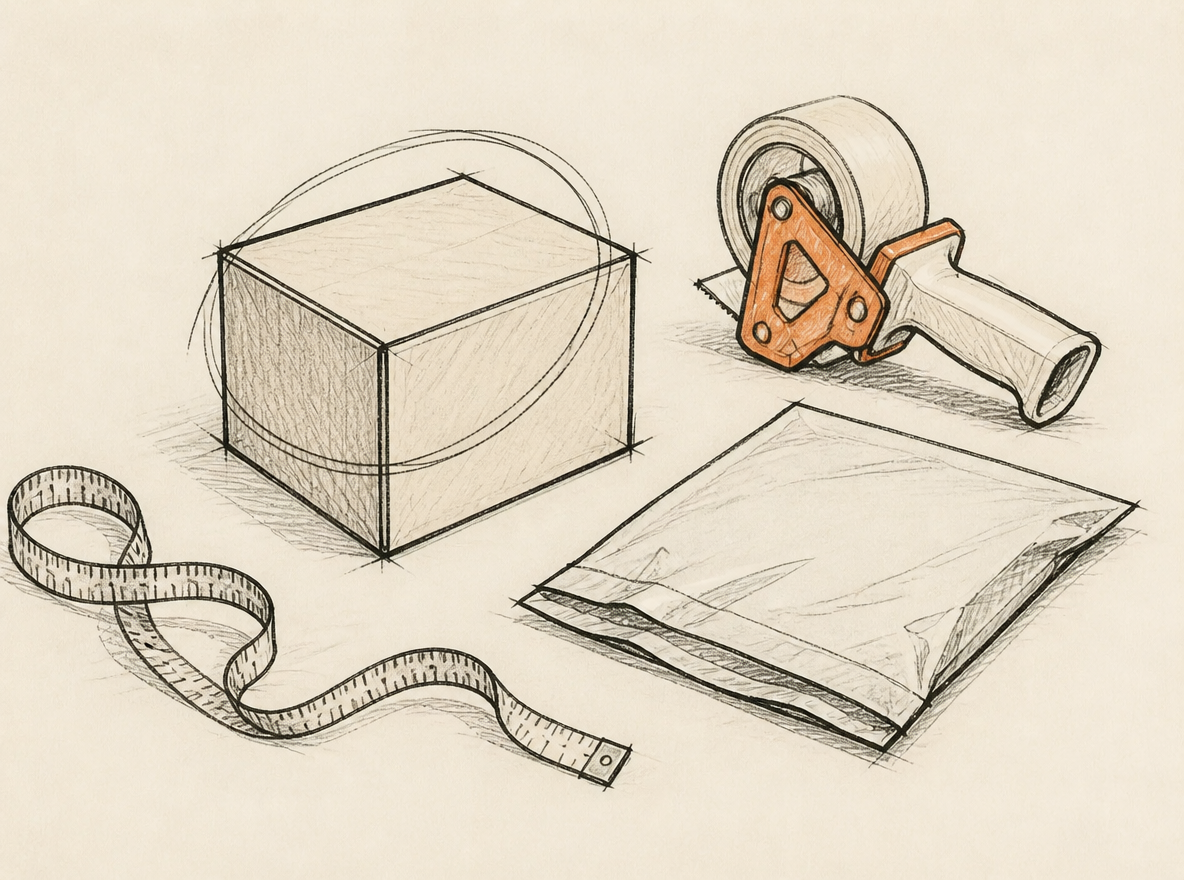
Poster packing bench illustration: a printed sheet, a rolled kraft tube, corrugated sheets and a label printer on one workbench, with a scale and a tape measure alongside.
Decide the container first, then weigh, measure and label

Four checks that decide flat versus tube

Choose the container from the print, not from what you have on the shelf. Run these four checks in order, and any one that fails sends the order flat.

  1. Paper stock and weight. Coated offset and standard poster stock take a bend and spring back with no memory, so they roll fine. Heavy art paper, cotton rag, screenprints and anything embossed or foil stamped hold the curve; once unrolled they lift at the edges, and a collector rejects that.
  2. Whether it can be rolled at all. Beyond the paper, look for mounting, a rigid backing, a signature, hand finishing or a numbered edition. A mounted print goes flat, no exceptions.
  3. Whether the surface survives contact. Flat is not the same as tight. Ink laydown, UV coating and foil lift or scuff where board rubs the print, so glassine or acid-free tissue goes on first and a poly sleeve goes over that for moisture (the packing sequence is described by Paper Mart).
  4. Who receives it. The most overlooked check and the most useful one. Galleries and collectors insist on flat and will pay the difference; large decorative posters, event runs and wholesale orders ship rolled and nobody minds. One question before you pack is cheaper than one reship after.
Decision flowchart: whether the paper rolls without memory, whether the buyer asked for flat, and whether the order is a single sheet over 11 by 17, leading either to a flat rigid mailer or a reinforced tube, then measuring outside dimensions against 22 inches, 30 inches and 1728 cubic inches
Three questions decide the route; the last step measures it for the rate

Packaging choice by print type

For stretched canvas, framed paintings and works with glazing, use the painting shipping guide to check face clearance, frame support and glazing.

Print situation Route Container What to do Common failure
Heavy art paper, cotton rag, embossed or foil, signed and numberedFlatRigid flat mailer or flat shipping boxGlassine plus a poly sleeve, two corrugated sheets with flutes crossed, board 1 to 2 inches past each edgeCorners dinged, pressure marks, ink lift
Standard poster or coated stock, rollable, larger than 11 by 17Rolled3 inch reinforced kraft tube with plastic end capsKraft liner, roll to about 1.5 inches across, press a cap on each endCurl that will not relax, edges rubbed
Rollable but must arrive flat, or one order with mixed sizesRolled inside a sleeveTriangular tube, or a long carton around the tubeSleeve the tube so it cannot roll on a conveyorMid-section crushed under a stack
Mounted, framed or oversized rigidFlat in a heavy cartonCustom carton with corner protectorsNever rolled, brace each corner separatelyCorner cracks, broken glazing

A. Nothing that can be rolled. Glassine or acid-free tissue first, then a poly sleeve. Two corrugated sheets sandwich the print with the flutes crossed, board 1 to 2 inches larger on each side. Finish in a rigid flat mailer or a flat shipping box, protect the four corners, and run strapping tape around the whole perimeter.

B. A rollable poster over 11 by 17. Roll a kraft liner with the print so the roll cannot slide into an end cap. About 1.5 inches across is enough; tighter than that leaves a permanent crease. Use a 3 inch reinforced kraft tube with plastic caps on both ends, tape each cap down, and put the label on the body of the tube, never across a cap.

C. Rollable but must arrive flat, or one order with mixed sizes. A triangular carton resists bending better than a flat box of the same board, and it will not collapse under a stack the way a sleeve will. Sleeving a round tube into a triangular one also helps, because sorting equipment handles circles badly (Scavenger Life).

D. Mounted, framed or oversized rigid. That is a custom or double-wall carton and outside this guide. Its billable weight is set by the carton and the corner bracing, barely by the size of the print.

How to keep a flat parcel from bending, and a tube from rubbing an edge

Flat parcels: stiffness comes from structure, not thickness

Two corrugated sheets stacked with their flutes at right angles give stiffness in both directions; two sheets with the flutes running the same way bend along the grain. Tape the sandwich on all four edges so the sheets cannot shift, then run strapping tape around the perimeter.

Second: the margin cannot be empty. Board that overhangs the print by an inch with nothing behind it collapses first, and when it collapses it presses on the image. Fold the overhang back over the edges, or put a corner protector at each of the four corners. Third: never let the printed side touch the board, keep tissue between them.

Tubes: edge damage is almost always movement

A print that slides inside a tube is the main cause of rubbed edges. Roll a kraft liner with it so the roll diameter matches the inside of the tube and it cannot travel end to end. Do not pull the roll tight: about 1.5 inches is enough, and any tighter leaves a curve in the image. Plastic end caps are not optional, because the impact at the ends is axial and tape does not absorb it.

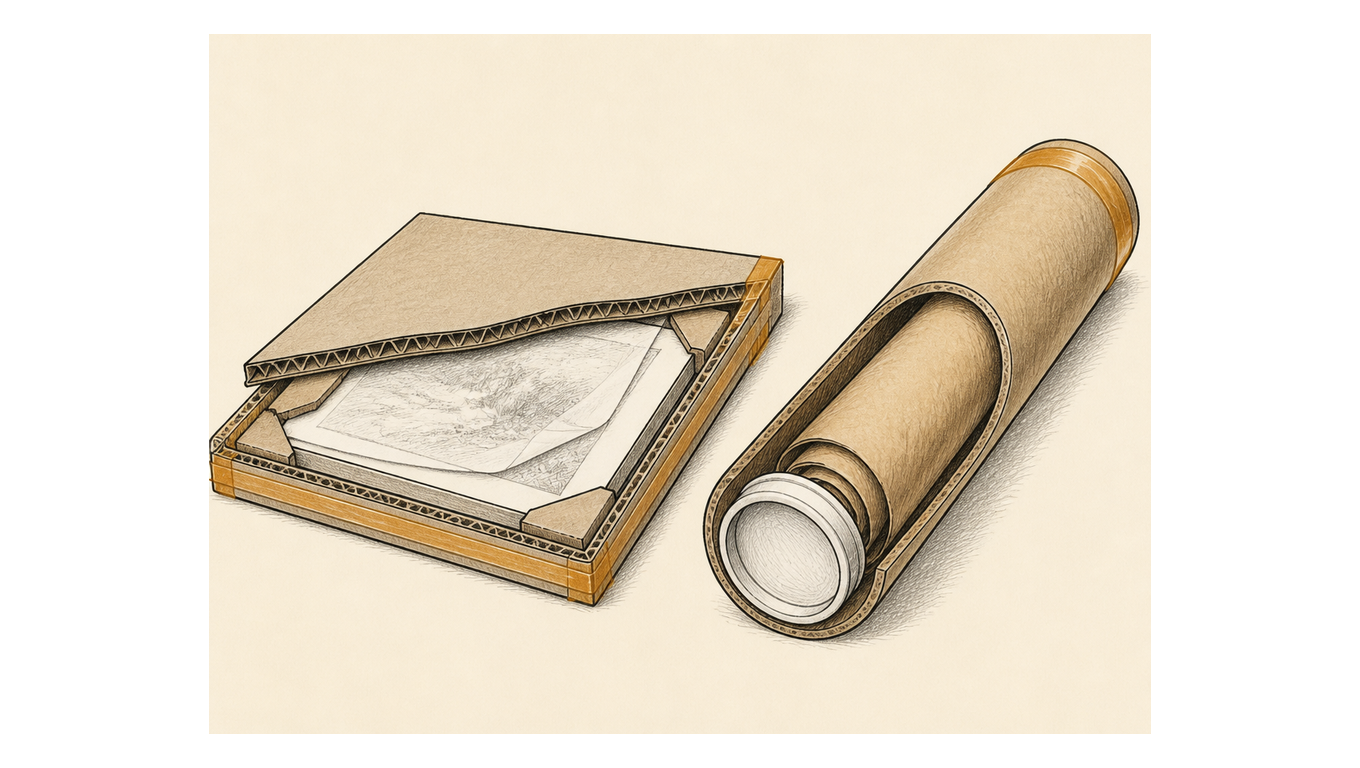
Cutaway illustration comparing two poster parcels: on the left, a printed sheet between crossed corrugated sheets; on the right, a print rolled in kraft inside a tube with a plastic end cap at each end.
The same print in two containers, in cross section

Three orders, packed and priced

The weights, outer dimensions and material costs below are an illustrative example that shows the method; replace them with your own purchase prices. The fee and postage anchors are not invented: they come from the USPS commercial price list in effect October 4, 2026, USPS Ground Advantage at zone 5, so all three orders are priced on the same lane (Notice 123). A different destination ZIP moves the base postage, but not the 22 and 30 inch length tiers, the 1,728 cubic inch dimensional threshold, or the tube shape fee.

Order Contents Packaging Packed weight Outer dimensions Billable weight Postage plus fees
A11 by 14 giclée, single sheet, collector13 by 16 rigid flat mailer12 oz13 x 16 x 1 in12 oz$8.24
B24 by 36 poster, rolled3 by 26 reinforced tube22 oz26 x 4 x 4 in2 lb$15.00
B2Same poster, flatFlat shipping box3 lb26 x 38 x 2 in15 lb$32.90
C10 sheets, 18 by 24 event posters, one tube4 by 24 reinforced tube25 oz24 x 4 x 4 in2 lb$15.00
C2Same 10 sheets, one flat cartonFlat shipping box25 oz20 x 26 x 4 in15 lb$27.40

Order A. 13 by 16 by 1 is 208 cubic inches, far under the 1,728 threshold, so USPS never applies dimensional weight and the parcel bills on its actual 12 ounces. The longest side is 16 inches, under the 22 inch line, and it is not a tube, so the parcel is clean. At 12 ounces, zone 5 commercial postage is $8.24. Put the same print in a 3 by 18 tube at about 10 ounces and it still bills at the 12 ounce tier, $8.24, but the tube adds the $4.50 shape fee for $12.74: the same print for more money (Notice 123).

Order B, rolled. 26 by 4 by 4 is 416 cubic inches, and the 0.785 non-rectangular factor brings it to 327, still far under 1,728, so the parcel bills at 2 pounds from its actual 22 ounces. The 26 inch side sits in the over 22, up to 30 inch tier, a $4.50 length fee, and the tube also triggers the $4.50 shape fee; the rule charges the higher of the two, so it stays $4.50. Postage of $10.50 at 2 pounds plus $4.50 comes to $15.00 (Notice 123; thresholds and factors in DMM 283).

Order B2, the same poster flat. 26 by 38 by 2 is 1,976 cubic inches, past the 1,728 threshold, so dimensional weight applies: 1,976 divided by 139 is 14.2, rounded up to 15 pounds, and the actual 3 pounds is irrelevant. At 38 inches the parcel is over 30 inches and takes the higher length tier at $10.00; 1,976 is still under the 3,456 cubic inches that trigger the cube fee. $22.90 at 15 pounds plus $10.00 is $32.90 (Notice 123).

Order C. Ten 18 by 24 sheets rolled together measure 24 by 4 by 4, which is 384 cubic inches, about 301 after the 0.785 factor, so 25 actual ounces bill at 2 pounds. The 24 inch side crosses the 22 inch line for $4.50, the shape fee takes the same amount rather than adding to it, and the total is $15.00. Split the ten sheets into two tubes and the $4.50 is paid twice, with a possible weight tier jump on each. The same ten sheets flat in a 20 by 26 by 4 carton are 2,080 cubic inches, 15 pounds of dimensional weight, $22.90 plus a $4.50 length fee for the 26 inch side, or $27.40 (Notice 123).

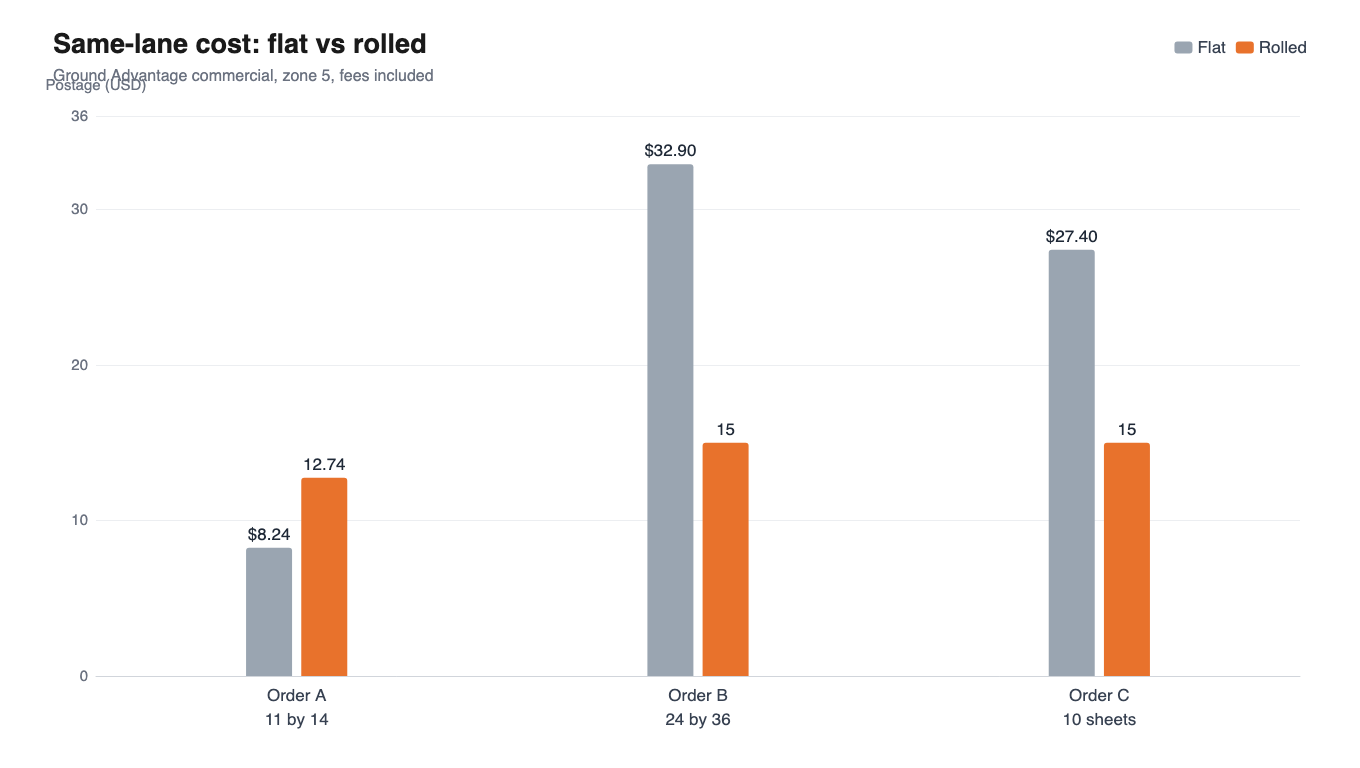
Bar chart of the same-lane cost comparison: order A flat at 8.24 dollars against rolled at 12.74, order B flat at 32.90 against rolled at 15.00, order C flat at 27.40 against rolled at 15.00
Ground Advantage commercial prices, zone 5, fees included

Read together, the pattern is clearer than any single order: flat only wins at A's small size, and once the print grows, the whole cost lands on that bounding box and its long side. Rolled cost barely tracks poster area at all, holding at $15.00 from a single 24 by 36 to a bundle of ten, because what grows is tube length, not the number of sheets. Materials point the same way: about $1.00 to $1.30 for A, $1.20 to $1.80 for B's tube, $1.50 to $2.20 for C's tube, against $2.50 to $3.50 for B2's flat carton. Money saved on board can buy a doubled postage bill.

Why a five ounce poster can carry a surcharge

Dimensional weight starts at one cubic foot

USPS gates dimensional weight behind one threshold: it applies only when the outside dimensions multiply past 1,728 cubic inches, one cubic foot. Below that the parcel bills on actual weight. Three steps decide the result: round each dimension up to the next whole inch, multiply the three, then divide by 139 and round up. The divisor moved from 166 to 139 on July 12, 2026, so the same carton now calculates heavier than before (DMM 283). Non-rectangular parcels take one more step: multiply the extreme dimensions, then apply the 0.785 factor, which is why a tube lands a tier below a box of the same bounding size.

UPS and FedEx have no such threshold: every parcel bills on the larger of actual and dimensional weight. A 26 by 4 by 4 tube bills at 2 pounds with USPS and starts at 3 pounds with UPS or FedEx. Widen the tube from 4 to 6 inches and USPS barely moves, because 24 by 6 by 6 is 864 cubic inches and still under 1,728, while dimensional weight at the other two climbs from about 3 pounds to about 7. One packaging spec producing different bills in different systems is normal (DMM 283).

Length fees start above 22 inches

The Ground Advantage commercial length fee has two tiers: a longest side over 22 inches but not over 30 inches adds $4.50, and over 30 inches adds $10.00. A separate volume tier adds $21.00 once the outside dimensions multiply past 2 cubic feet, 3,456 cubic inches. The first two read length and the third reads volume, and one parcel can pay both (Notice 123).

Priority Mail prices the same 30 inch line twice as high: over 30 inches adds $21.00, and Priority Mail Express matches it. Upgrading a long tube therefore buys speed at the cost of a fee that can swallow the whole difference, and unless the buyer named a date, a long tube is not worth upgrading (Notice 123).

This is unkind to poster sellers: a 24 by 36 print rolled along its long edge lands above 26 inches of tube, over the line by default. Reach for a standard 36 inch tube for a large print and the fee jumps from $4.50 to $10.00. Cut the tube to the shortest length the print needs, and leave the safety margin out (Notice 123).

Nonstandard shape is a separate charge

USPS lists cylindrical tubes or rolls among the nonstandard characteristics in DMM 201, alongside cans, wooden boxes and metal boxes. Parcels that carry those characteristics are not treated as machinable, and the price list carries a matching fee: a parcel that contains a cylindrical tube adds $4.50 (Notice 123).

It is the only charge in the set that reads shape alone and ignores both weight and size. A 26 inch tube pays it, a 24 inch tube pays it, and a 20 inch tube pays it. It is also the easiest to miss, because it sits below the dimensions and the cubic foot line on the price page, and most people stop checking once the weight is confirmed.

One exception is worth memorising: the length fee and the shape fee do not stack, they charge the higher of the two. A 26 inch tube is $4.50, a 32 inch tube is $10.00 rather than $14.50, because the length tier already exceeds the shape fee. The cube fee does stack with either, so an oversized flat carton pays length plus cube (Notice 123). One more detail: the test reads the outer piece. Sleeve the tube in a triangular carton and the parcel is no longer cylindrical, so the shape fee usually drops away, but the outside dimensions grow and may cross 22 inches or trip dimensional weight. Price both versions before you decide.

Fee Trigger Amount Stacks with
Length fee, lower tierLongest side over 22 inches, not over 30$4.50Not with the shape fee
Length fee, upper tierLongest side over 30 inches$10.00Not with the shape fee
Nonstandard shapeParcel contains a cylindrical tube or roll$4.50Not with the length fee
Cube feeOutside dimensions over 3,456 cubic inches$21.00Yes, with either of the above
Priority Mail length feeLongest side over 30 inches$21.00Freestanding, double the Ground Advantage tier

Cubic pricing is an option, not the answer

The Ground Advantage commercial price list carries a second table priced by cubic tier, with hard conditions: within 1 cubic foot, within 20 pounds, longest side not over 22 inches, and explicitly not a roll or a tube. A flat mailer fits that shape exactly, and order A's 13 by 16 by 1 lands in the 0.20 tier (Notice 123).

Whether it is cheaper depends on the lane and the weight. At zone 5 the 0.20 tier is $9.92, while the same zone at 12 ounces is $8.24 on weight, so cubic is the more expensive of the two. The rough rule: light, small, short parcels price better by weight, and cubic has room to win on a flat box near 22 inches that also carries real weight. Price both on the same order rather than assuming cubic wins (Notice 123; the mechanics are in when USPS cubic pricing beats weight-based rates). One trap: the two methods round in opposite directions. Cubic rounds each dimension down to the nearest quarter inch, dimensional weight rounds up to the whole inch, so a boundary-sized carton reads smaller under cubic and larger under dimensional weight.


Can posters go Media Mail?

Short answer: a decorative poster cannot go Media Mail. Only a printed piece that genuinely qualifies as a printed educational reference chart can. There is no category called poster on the eligibility list; the closest entry is printed educational reference charts, and DMM 173 puts four hard conditions on it.

  • It has to be a single printed sheet; a bound multi-page publication belongs to another category.
  • It has to be designed for educational or training purposes, not for decoration, promotion or retail display.
  • The information has to be primarily non-narrative: charts, diagrams, tables.
  • A sheet that is mostly narrative text does not qualify, even when it includes diagrams.

The line is therefore clear. An anatomy chart, a periodic table, a sheet of mathematical formulas, a grammar conjugation table or a map made for teaching may qualify. A 24 by 36 decorative poster with branding, prices, promotional copy or illustration does not, and mailing it as Media Mail misstates the class, leaving the postage difference and any penalty with the sender. There is a cost beyond money too: Media Mail may not be sealed, and handing it over is treated as consent for USPS to open and inspect the contents.

Do not count on the price either. Media Mail is $4.39 retail at 1 pound, which is genuinely cheap, but it prices by weight and carries none of the 22 inch or tube fee structure, and if the contents do not qualify, the few dollars saved are not worth the exposure. For everyday decorative poster orders, a standard parcel product such as Ground Advantage is the safer route. The full eligibility test and cost comparison sit in USPS Media Mail costs and eligibility (rates in Notice 123).

Daily orders and event runs need different rules

Daily orders: compare packaging plus postage

The goal on daily volume is not the lowest postage, it is the lowest total. Sixty cents more for a stiffer mailer with smaller outside dimensions can drop a whole weight tier, while fifty cents saved on thinner board can push the parcel past 22 inches or over 1,728 cubic inches and take both fees at once. Hold the comparison still: same origin ZIP, same destination ZIP, same packed weight, same outside dimensions, and change only the packaging form and the channel.

One more thing easy to miss: USPS ignores dimensional weight below 1,728 cubic inches, so a small mailer bills on actual weight and shaving an inch often changes nothing. What decides the cost is whether the parcel crosses 22 inches and whether it is a tube. UPS and FedEx are a different algorithm entirely, where every size is dimensional, and there shaving an inch pays immediately. Run the threshold and rounding through the dimensional weight calculator, then check shape and limits with the package size checker.

Standardise two or three specs: a 13 by 16 mailer for 11 by 14 and below, a 3 by 26 tube for 18 by 24 through 24 by 36, and a 4 by 24 tube for multiple sheets. Once the specs are fixed, billable weight becomes a constant, quotes become comparable, and the shipping rate calculator can put both routes side by side.

Event runs: the date window comes before the price

Event orders carry one more variable: when the parcel can be received. Venues, schools and event spaces keep fixed receiving windows, refuse weekend and holiday deliveries, and turn away freight that arrives early. Work backwards with three buffers: production to packing, the worst case transit time, and the wait before the venue's window opens. In practice, subtract 3 to 5 business days from the required arrival date, ship the whole run in one tube where the sizes allow, and track one parcel instead of five.

A shipping checklist you can copy

CheckWhy it matters
Confirm paper and buyer requirement before choosing flat or rolledMounted prints and collector orders go flat; a wrong roll is a return
Flat: two corrugated sheets with flutes crossed, 1 to 2 inches of marginStiffness comes from crossing, not thickening
Flat: tissue on the printed side, then a poly sleeveStops ink lift and keeps moisture out
Rolled: kraft liner, about 1.5 inches across, not tighterKeeps the roll from sliding and the image from curving
Rolled: plastic end caps pressed and tapedCaps take the axial impact
Protect four corners, or fold the board over the edgesAn empty margin collapses onto the image
Strapping tape around the full perimeterKeeps the sandwich from shifting
Measure outside dimensions, rounding up to the inchRounding direction decides the cube
Check the cube against 1,728 cubic inches firstUSPS dimensional weight starts there
Check the longest side against 22 and 30 inchesThe two length tiers are $4.50 and $10.00
Confirm whether the outer piece is a tube or can rollShape fee $4.50, charged as the higher of the two
Over 3,456 cubic inches, add the $21.00 cube feeThe one fee that stacks
Label on a flat surface, not across a cap or a seamKeeps the barcode scannable
Event orders: check the receiving window and leave 3 to 5 business daysEarly arrivals get turned away
Price both routes on the same lane before you commitThe cheaper route flips with size

Why the quote and the final charge part ways is covered in rate quote versus final charge. The cost of a mistake on a light poster is small, but it repeats reliably: one wrong tube length shows up on every order that uses it.

Frequently asked questions

Ship it flat between two corrugated sheets, or roll it and put the roll inside a long triangular carton. In practice: cut two sheets 1 to 2 inches larger than the print on every side, cross the flutes, wrap the print in tissue and a poly sleeve, protect the corners, and run strapping tape around the whole perimeter. If you have no tube, several wraps of heavy kraft paper around the roll plus a triangular carton will get you through an emergency, but it resists crushing less well than a reinforced tube.
Structure, not thickness: two corrugated sheets with their flutes perpendicular give stiffness in both directions, and the same two sheets with flutes parallel bend along the grain. Give the print 1 to 2 inches of margin on every side, turn that margin into cushioning with corner protectors or folded edges so it never hangs empty, and tape the full perimeter so the sheets cannot shift. Keep tissue between the print and the board.
A decorative poster cannot. The only entry on the eligibility list that resembles one is a printed educational reference chart, which must be a single sheet, designed for educational or training purposes, and primarily non-narrative in content. An anatomy chart, a periodic table or a formula sheet may qualify; a 24 by 36 poster with branding, prices, promotional copy or illustration does not, and mailing it as Media Mail misstates the class. Media Mail also may not be sealed, and handing it over is consent to inspection.
Size decides it, not weight. Small pieces ship cheaper flat: 12 ounces at zone 5 commercial is $8.24, while the same print in a tube is $12.74. At 24 by 36 the flat version measures 26 by 38 by 2, bills 15 pounds of dimensional weight and costs $32.90, while a 26 by 4 by 4 tube costs $15.00. Small flat, large rolled, and rolled cost barely moves with sheet count: a second tube is what adds another length and shape fee.

Run your own parcel through a real comparison

Every number above is a method, not a price you can bank. Once the packaging is fixed, the job is to hold the variables still: confirm the packed weight, the outside dimensions and the destination, check which services are available and what packaging limits each one applies, then pick the route. That is how it runs in EasyShippingX: enter the measured weight, outside dimensions and destination, check available channels and packaging limits, then execute through the Portal, a spreadsheet import, or the API if you want it inside your own system. Multiple channels sit in one place, so comparing and switching does not mean switching tabs.