Ecommerce Brand Shipping Guide

How Many Delivery Speeds Should an Ecommerce Brand Offer? A Margin-and-Reliability Framework

The checkout page asks a deceptively simple question: how many delivery speed options should a customer see? Two, three, five? Too few, the reasoning goes, and you lose customers who want speed. Too many, and you drown them in choices while your operations team drowns in complexity[2]. Both instincts are right, which is why the question usually gets answered with intuition instead of math.

The fix is to stop asking about buttons. A delivery option is not a UI element, it is a promise. Standard means we will get this to you in 2 to 3 business days. Economy means in 3 to 5. When a customer clicks one of those options, they anchor their expectation to it, and your warehouse, carriers, and support team are on the hook for honoring it, every order, at volume, at a price that does not erase margin. Platform data points the same way: showing a clear delivery-date commitment at checkout measurably lifts conversion[1]. That reframing is the whole article. How many delivery speeds should you offer? As many as you can fulfill reliably and profitably, and not one more. The framework in one line: every candidate tier must pass four gates, Distinct, Serviceable, Economically Sustainable, and Operationally Executable, before it earns a spot in your checkout.

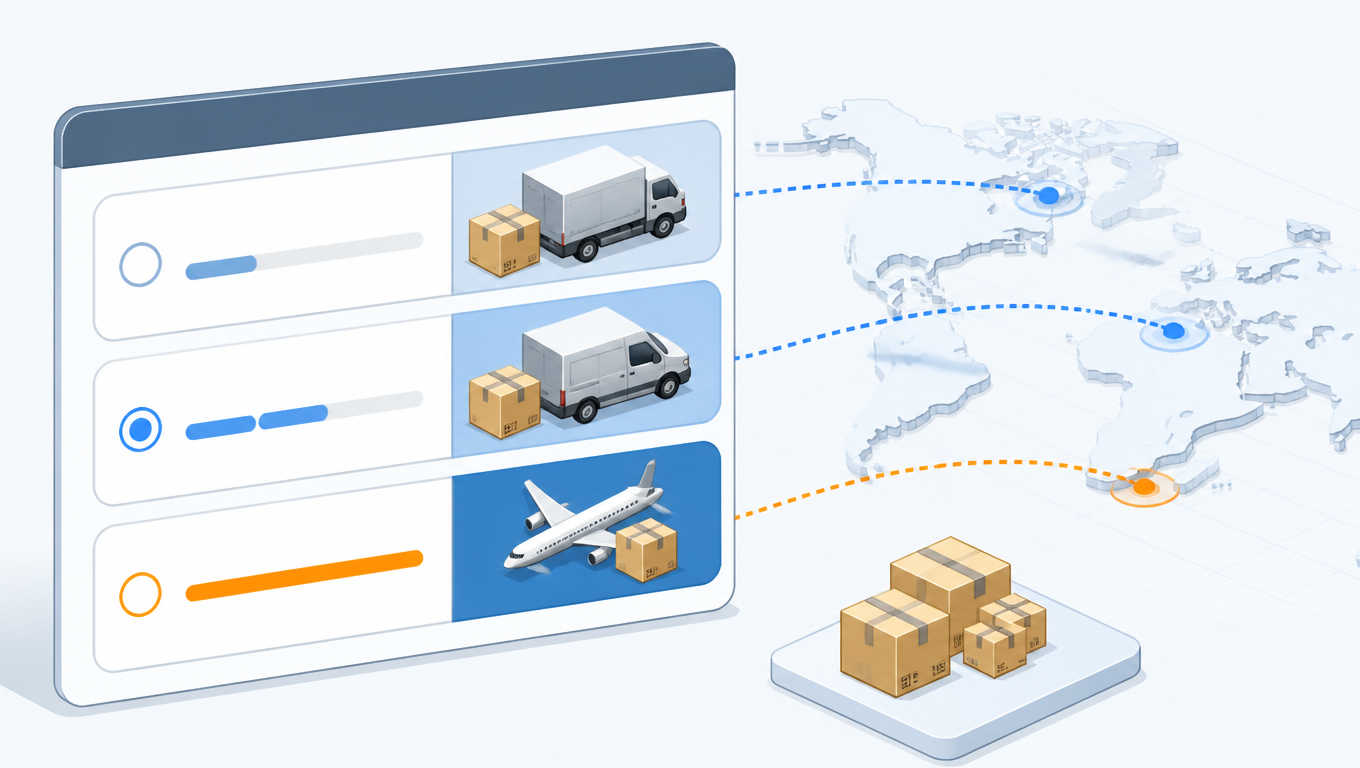
Shopkeeper weighs a stack of parcels against a list of delivery options on a balance scale.
A delivery option is not a button, it is a promise

Why the Label-First Approach Breaks Down

The traditional playbook goes like this: decide you will offer Economy, Standard, and Expedited, then go find a carrier service for each label. It feels logical. Three buttons, three carrier services, done. The problem is that labels and carrier services are different kinds of things. A label is customer language. It describes an experience: fast enough, fast, faster. A carrier service is a network capability. It describes what a specific physical network can actually do between a specific origin and a specific ZIP, for a specific parcel, on a specific day. The two do not map one to one, and pretending they do is where margin and trust leak out.

Tie each checkout promise to the roles defined in the multi-carrier strategy overview. Use the carrier serviceability checks to confirm that the destination and parcel qualify for the service behind that promise.

The same Standard promise can need a completely different carrier service and cost depending on where the parcel ships from, where it is going, how big it is, and when the order drops. A 2 to 3 day promise from a West Coast warehouse to a nearby zone might be a short-haul regional service at a low rate, while the same promise to a cross-country ZIP needs a national ground product at a higher rate with different surcharges. Now add split inventory: the promise is only serviceable from the warehouse that actually has the stock. The label says one thing, the network does another, and you only find out at peak season or on the exception queue, in the form of missed delivery dates, refunds, and support tickets.

This is why the framework works backwards. Start from the promise you want to make, then ask whether any carrier network, from the warehouses you actually ship from, can keep it for the orders you actually get.
The Four Gates Every Delivery Tier Must Pass

Gate 1, Distinct: is this a genuinely different customer promise? If your Standard and Expedited options both arrive in the same 2 to 3 days for most orders, one of them is decoration. A tier earns its place by changing something the customer can feel: transit time, delivery-date certainty, signature capture, or a scheduled time window. Duplicate promises just split clicks and complicate forecasting.

Gate 2, Serviceable: is it actually reachable? A promise is only real if it can be kept for your actual order mix: your parcel weights and dimensions, your destination ZIP distribution, your ship-from warehouses. If a 2-day option only covers 60 percent of your order ZIPs, it is not a checkout option, it is a premium product for a minority of orders, and it should be priced or gated accordingly.

Gate 3, Economically Sustainable: can the numbers hold? Add up the all-in cost of the tier: label price, surcharges, packaging, exception handling, refunds when the promise is missed. Then weigh it against what the order brings: margin, shipping revenue collected from the customer, and the business value of the conversion itself. Remember that free shipping is not free; it is a discount you subsidize out of order margin, and every tier has a version of that math[4].

Gate 4, Operationally Executable: can you actually run it? This is the gate that kills the most good ideas. Do you have the warehouse cutoff and staffing to make the pickup? Can your Portal, WMS, OMS, or API route the order to the right carrier service, generate the right label, and fall back when a service is unavailable? Can support see the exception before the customer does? A tier that passes the first three gates but fails this one will fail in production, at the worst possible time. The decision rule is blunt: fail any gate, and the option does not get shown to customers. Not shown and hoped for, hidden until it passes. The cost of showing an unkeepable promise is paid twice, in refunds and in trust.

The Variables That Decide Serviceability and Cost

Ten variables decide whether a tier is real, and they interact. Ship-from warehouse and inventory location set the origin. Destination ZIP and zone set the distance. Parcel weight, dimensions, and restricted items decide which services even accept the shipment. Warehouse processing time and pickup cutoff decide whether an order placed at 4 p.m. can possibly ride tonight's truck.

Carrier coverage and serviceability determine what the network will actually promise for that origin, destination, and parcel combination, and your actual on-time-to-promise performance, measured over real history rather than marketing brochures, tells you whether the promise holds in practice[5]. Tracking and exception visibility decide how fast you learn about a miss.

Then come the economics: label price, surcharges, failure and recovery cost on one side; order margin, AOV, and shipping revenue on the other. And underneath everything sits a systems question: can your Portal, WMS, OMS, or API actually execute the routing and fallback logic, or does offering expedited mean a human re-keying labels every afternoon?

None of these variables is exotic, which is exactly the trap. Each one is individually obvious, so the collection gets skipped, and the tier gets launched on a single rate quote from a single carrier for a single ZIP.

The Decision Workflow: From Candidate Tiers to Pilot to Monitor

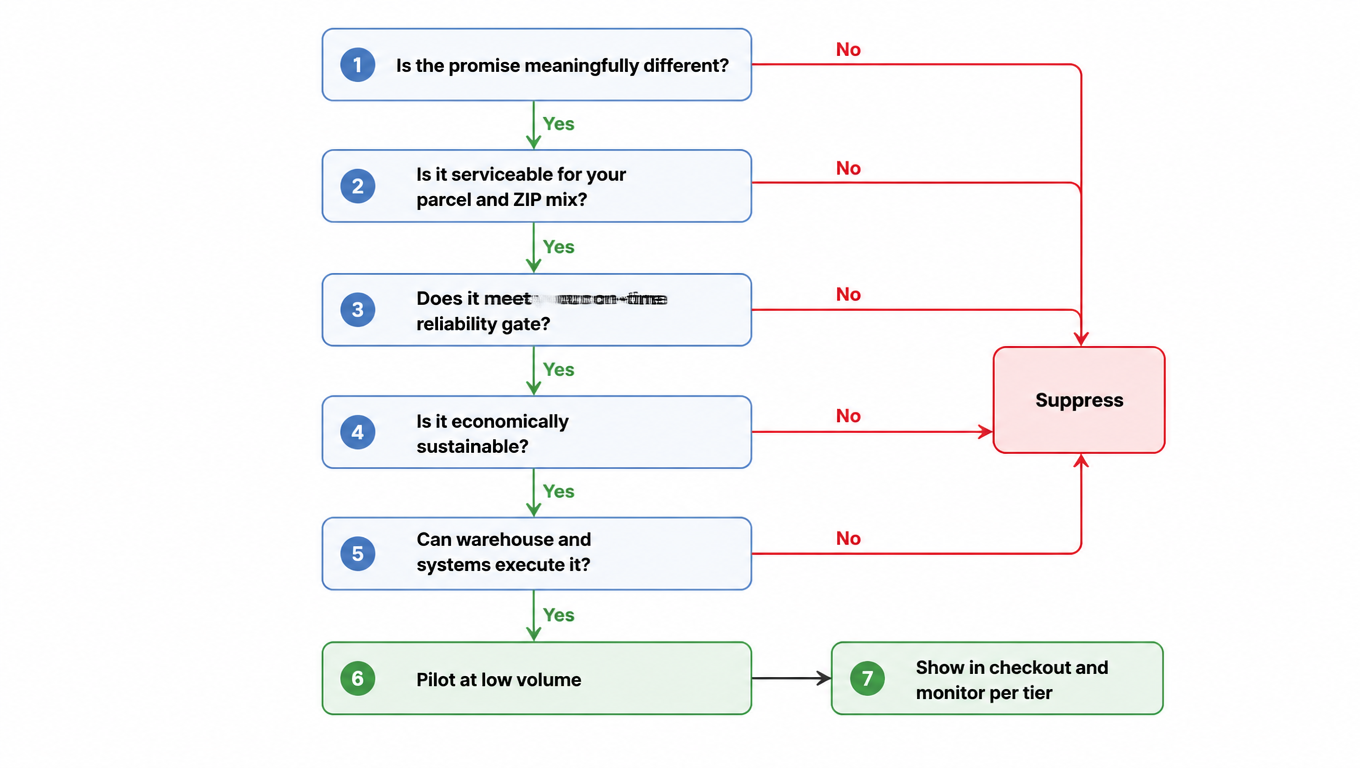
The framework compresses into a workflow. Start by building a candidate tier list from customer value, not from carrier availability: economy, standard, expedited, and anything genuinely differentiated like a guaranteed delivery date. Then run each candidate through the gates in order: judge whether the promise is truly differentiated, test serviceability against your real parcel and ZIP data, set reliability gates from your historical on-time performance, and calculate the all-in cost per tier. Check warehouse and system execution capability, then pilot the survivors at low volume before they touch the full checkout.

Decision tree: is the promise meaningfully different, else suppress; is it serviceable for your parcel and ZIP mix, else suppress; does it meet your on-time reliability gate, else suppress; is it economically sustainable, else suppress; can warehouse and systems execute it, else suppress; then pilot at low volume, then show in checkout and monitor per tier
Four gates, and only a full pass reaches the pilot

During the pilot and after launch, monitor each promise tier separately: on-time percentage against the promise, cost per order including failures, support contacts per thousand orders, and take rate. A tier that misses its reliability gate two weeks running is not a marketing problem, it is a promise problem. Keep it if the numbers hold, adjust the promise or the carrier if they are close, and hide it if they are not.

The Promise-to-Execution Matrix

Once a candidate tier has its gates and evidence, record it in a Promise-to-Execution matrix, one row per tier. The columns force every decision to be visible: the customer-facing label, the exact promise, the parcel and zone profile it is serviceable for, the carrier candidates that can execute it, the reliability threshold, the cost threshold, and the fallback if the primary service fails. Here is an illustrative example for a $50 to $100 AOV brand shipping from two US warehouses (example figures, replace with your own data).

Customer-facing tierPromiseEligible parcel / zone profileCarrier candidatesReliability gateCost gateFallback
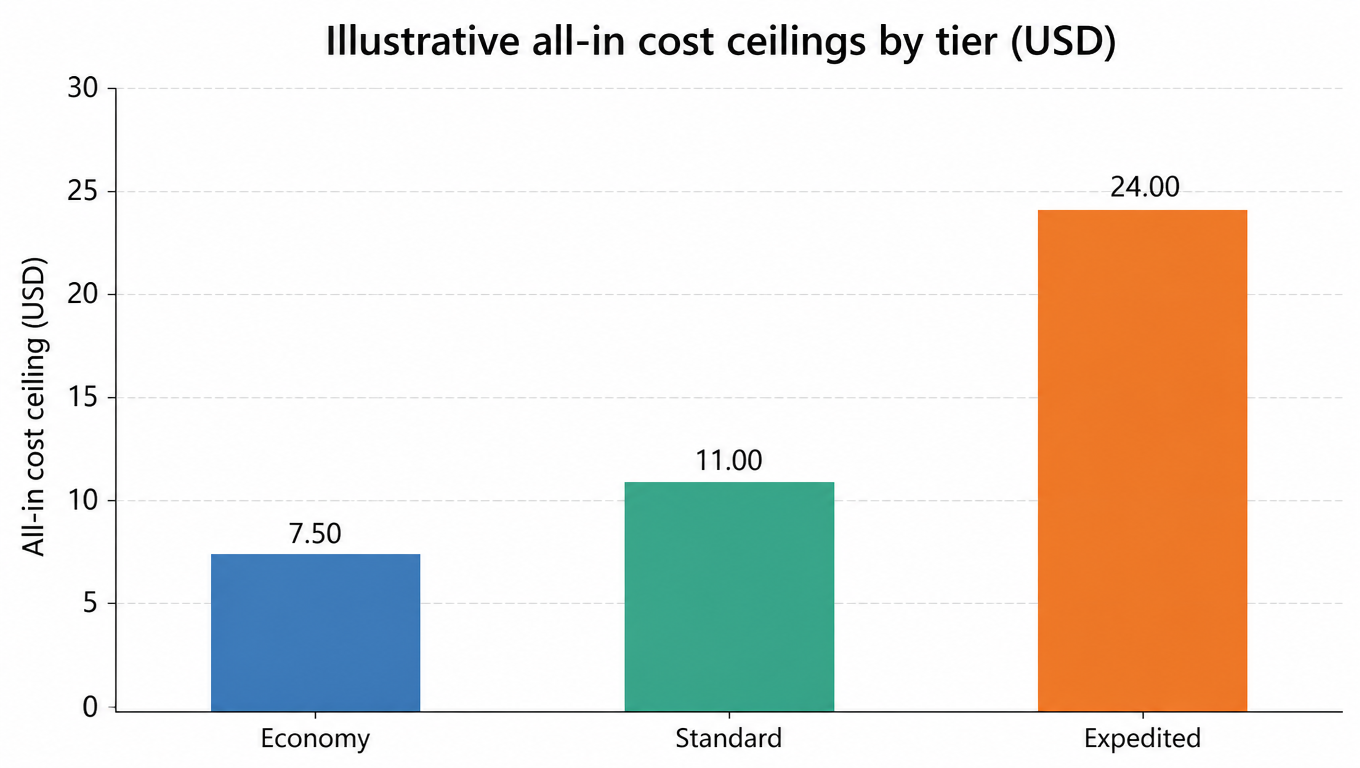
Economy3-5 business days, no date guarantee≤ 5 lb, all zones, non-fragileUSPS ground (discounted), regional ground≥ 95% within 5 daysAll-in ≤ $7.50Auto-upgrade to Standard when the gap is large
Standard2-3 business days≤ 15 lb, all zonesUSPS ground (discounted), national ground≥ 95% within 3 daysAll-in ≤ $11.00Regional ground for short-haul zones
ExpeditedNext business day, only where serviceable≤ 5 lb, selected metro ZIPsRegional express, national air≥ 92% within 1 dayAll-in ≤ $24.00Suppress per ZIP outside the serviceable set
Bar chart: illustrative all-in cost ceilings by tier (USD), Economy 7.5, Standard 11, Expedited 24
Illustrative all-in cost ceilings by tier (USD)

The numbers in the table are placeholders for your own analysis, but the shape is the point. Every tier has a defined promise, a defined reach, a defined cost ceiling, and a defined way to fail gracefully. When the merchandising team asks why there is no 2-day button for every zone, the matrix answers with evidence instead of an argument.

Tuning by Order Economics

The four gates never change, but the pass thresholds do, and order economics sets them. This article anchors on the typical DTC range of $50 to $100 AOV, where shipping is a meaningful share of the basket. At this level, a free Standard tier eats real margin on every order, an Economy tier protects margin on low-value and bulky orders, and Expedited should usually be a paid upsell that funds its own failures.

At higher AOVs, say $200 and up, the calculus loosens. Shipping is a smaller share of the basket, so free premium tiers and even next-day options become affordable marketing, and they earn their place faster because the conversion and repeat-purchase value is larger. At the low end, $30 and below, the opposite holds: fewer tiers, a free-shipping threshold that pushes baskets up, and expedited only as a paid add-on for the rare customer who wants it.

The pattern is the same in every case. The gates stay identical, and only the numbers move: what on-time percentage is acceptable, what all-in cost the margin can carry, how many zones the tier must cover to be worth showing. That is the entire tuning exercise, and it is why a framework beats a default answer. A brand selling $300 furniture and a brand selling $35 candles can both run the same four gates and reach different, correct answers.

The Bottom Line, and What Needs Verification Before Launch

Most brands land in the same place after running the gates: a small tier set, typically Economy, Standard, and Expedited, with anything faster gated by zone or parcel profile. That is a feature, not a failure. Fewer, keepable promises convert better over the long run than a menu of options that miss[3]. But the landing zone is an output of the framework, not an input; if your numbers say two tiers or four, trust the gates.

Before launch, verify the carrier facts from official sources, because this is where most delivery-option disasters start: official service areas and transit commitments, ZIP-level coverage and serviceability, weekend, holiday, and pickup schedules, size and weight limits and restricted-item rules, surcharges and refund policies, and the service and ETA fields your carrier API actually returns. And treat vendor-reported case studies, like Veho's published delivery results, as case studies rather than industry averages or benchmarks; they are directional evidence for a specific operation, not a market baseline[6].

When your team has defined the candidate tiers, the next step is comparing USPS discounted rates, regional carrier options, and executable multi-carrier paths against your own weights, dimensions, destination zones, and order volumes. For the related decision tools, see Cost per Successful Delivery, When Does a Regional Carrier Save Money, and Rate Quote vs Final Charge. EasyShippingX can support exactly this comparison: side-by-side USPS discounted rates and regional carrier options for your shipment profile, carrier-mix evaluation, and a Portal or API path to execute routing and fallback. That comparison, not the number of buttons, is what decides whether a tier survives.

Ready to test your tier list against real rates?

EasyShippingX is a channel-neutral shipping layer: one consistent way to compare US domestic carrier options and execute through a portal, a spreadsheet, or an API. Comparing USPS discounted rates against regional carrier options for your own parcel profile is exactly the step that tells you what Standard really costs. See pricing or book a multi-carrier workflow demo.

FAQ

There is no universal number. Run each candidate tier through the four gates: Distinct, Serviceable, Economically Sustainable, and Operationally Executable, and show only the tiers that pass. Most $50 to $100 AOV brands land on three: economy, standard, and expedited, with anything faster gated by zone or parcel profile. If your numbers say two tiers or four, trust the gates, not a default answer.
Only if the all-in cost per order fits inside the margin the basket can carry. At $50 to $100 AOV, free expedited usually loses money on every order; it is typically a paid upsell that funds its own failures. At higher AOVs ($200 and up), free premium tiers can become affordable marketing. Run the economics gate before you decide.
Because a label is customer language and a carrier service is a network capability. The same 2 to 3 day promise may need a short-haul regional service for a nearby zone and a national ground product with different surcharges for a cross-country ZIP, and it is only serviceable from the warehouse that actually has the stock. Serviceability and cost vary by origin, ZIP, parcel size, and cutoff, which is exactly why each tier's profile belongs in the matrix.
A tier is serviceable when at least one carrier network can keep its promise for your actual order mix: your parcel weights and dimensions, your destination ZIP distribution, and your ship-from warehouses. If a 2-day option covers only 60% of your order ZIPs, it is not a checkout option; it is a premium product for a minority of orders, and it should be suppressed per ZIP or priced separately.
Set it from your own historical on-time-to-promise performance, measured per promise tier, not from carrier marketing. Use percentiles, not averages: an average transit of 2.1 days against a 2-day promise can look fine while the tail hides 30% of orders taking 3 days or more. A common starting gate is 95% within the promised window for standard tiers, tightened after a pilot; expedited can sit a little lower, because it is already a premium product for a minority of orders.