Every seller can quote the commission rate of a new marketplace from memory. Very few can quote what it costs to ship for that marketplace, and that asymmetry is where the money leaks. The common mistake is modeling a new channel's P&L on the fee schedule: commission, payment processing, advertising. Fulfillment is treated as an afterthought, a line item inherited from the existing channel. But a marketplace is not just another storefront that happens to sell your product. It is a separate operating environment with its own order profiles, delivery SLAs, carrier rules, returns behavior, and dispute processes[1]. The same product shipped the same way can be comfortably profitable on one platform and marginal on another. The hidden costs live inside the shipping operation itself, not in the fee schedule: how orders are ingested, how data is normalized, how rates are shopped and labels printed, how tracking is returned to the channel, how funds are reconciled. None of these appears on a marketplace invoice, which is exactly why they get missed[2]. They are recurring, they are per-order, and they compound as the catalog grows.
The costs that eat your margin never show up on the marketplace invoice
Why a New Marketplace Quietly Rewrites Your Shipping Economics
The most expensive assumption is that a new channel is just "the existing channel plus one more line". Adding a marketplace is not adding a storefront, it is adding a separate operating environment: a different order profile (units, average weight, product mix, destination geography), different delivery SLAs (each platform enforces its own timing and on-time expectations, TikTok Shop, for example, requires delivery within a stated number of business days and tracks on-time rates for some services[1]), different carrier rules (the cheapest carrier may simply not be permitted), different returns behavior (categories like home goods carry return-rate benchmarks far above others[3]), and different dispute processes.
The same product shipped the same way can be comfortably profitable on one platform and marginal on another. The difference lives in the shipping operation itself, not in the fee schedule: how orders are ingested, how data is normalized, how rates are shopped and labels printed, how tracking is returned to the channel, how funds are reconciled. These costs are recurring, they are per-order, and they compound as the catalog grows. They also never show up on a single invoice, so teams treat them as if they did not exist, until the quarterly reconciliation proves otherwise[2].
This framework is written for the whole chain that carries a new channel: DTC brands, marketplace sellers, operations managers, 3PLs, and the WMS, ERP, and SaaS product teams that glue the operation together. Each has a different job to do, and each will find one artifact in this framework that is theirs to own: the checklist, the cost model, or the lifecycle gates. For the full multichannel picture, start with our guide to the complete ecommerce shipping setup.
Part 1: The Pre-Launch Assessment Checklist
Before a single dollar goes into a cost model, you have to describe the channel you are actually adding. A marketplace is not an abstract new revenue stream; it is a specific set of order characteristics, obligations, and failure modes. Work through these seven items before launch and write the answers down as assumptions, not mental notes.
Forecast the order profile: expected units, average order weight and dimensions, product mix, and destination geography. This is the single biggest driver of everything that follows.
Choose the fulfillment model: existing 3PL, self-fulfillment, or the marketplace's own fulfillment program. Each option changes which cost items apply and who owns them.
Map carrier and service-level requirements: allowed carriers, delivery deadlines, late-shipment metrics, weekend coverage. Platforms differ sharply here, and the cheapest carrier may not be permitted. Every platform has its own rule set, our Walmart Marketplace shipping guide breaks down one platform's carrier and timing rules in detail.
Verify integration readiness: order ingestion, address and data normalization, rate shopping, label and manifest workflows. An integration gap here becomes an engineering line item later.
Scope returns obligations: policy, RMA flow, restock versus dispose, customer service SLAs, cross-border return routes. Returns are the most underestimated item in the model.
Stress-test inventory allocation and cash flow: the cash-flow impact of splitting stock across channels. The second channel does not create new inventory; it competes for the same pool.
Quantify chargeback and dispute exposure: how each marketplace adjudicates lost, late, and damaged orders. The dispute process is a cost that only materializes after a failure.
Every "we assume X" from this checklist becomes a variable in the cost model in Part 2. If an answer is unknown, the model treats it as a risk, which is the honest way to run a go/no-go decision.
Part 2: The Incremental Channel Cost Model
The fee schedule tells you what the marketplace charges you. The Incremental Channel Cost Model tells you what the channel costs to operate. It is built from nine line items that span the life of an order, from the moment it enters your systems to the month-end reconciliation of settled funds.
The Nine Line Items
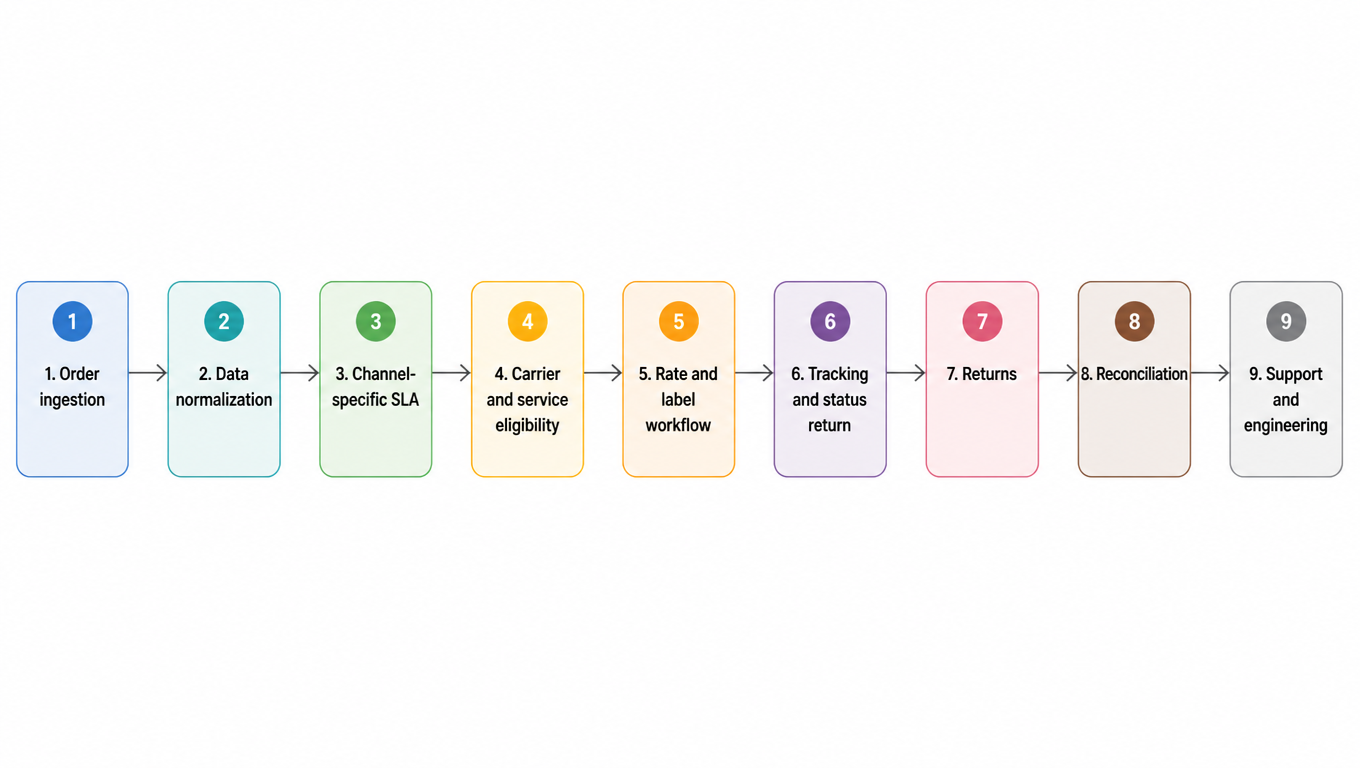
Treat the nine items as a pipeline: each order passes through all of them, and each one carries a cost.
The nine incremental costs run as a pipeline every order passes through
Order ingestion: the API, EDI, polling, webhook, or file-drop machinery that gets an order from the channel into your systems.
Data normalization: mapping channel fields (addresses, phone, taxes, customs data) into one clean order record.
Channel-specific SLA: the service-level obligations each platform imposes on shipment speed and timing.
Carrier and service eligibility: which carriers and service levels each channel allows or requires.
Rate and label workflow: rating the order, buying the label, printing, and manifesting.
Tracking and status return: pushing tracking numbers back to the channel and syncing status updates.
Reconciliation: matching settled funds, fees, and adjustments back to orders and shipments.
Additional support and engineering cost: per-channel fixes, exceptions, and the team time that never shows up on an invoice.
Every item converts into dollars three ways: per-order labor, per-label fees, and monthly software or engineering cost. Items 1, 2, and 9 are mostly fixed and monthly. Items 3, 5, and 6 are strictly per-order. Items 4 and 7 scale with order mix and returns rate. Item 8 is monthly but spikes with every exception.
A channel-neutral shipping layer cuts across items 4, 5, and 6. Instead of building separate carrier plumbing for each marketplace, a neutral layer such as EasyShippingX gives one consistent way to compare US domestic carrier options and execute through a portal, a spreadsheet, or an API. It does not replace the channel integration that handles ingestion; it sits under it, so rate shopping, label buying, and tracking return behave the same way regardless of which channel produced the order. For how to meet each platform's label and manifest requirements, see our build vs buy guide for marketplace prepaid shipping labels.
Worked Example: A DTC Home-Goods Brand Adds One Marketplace
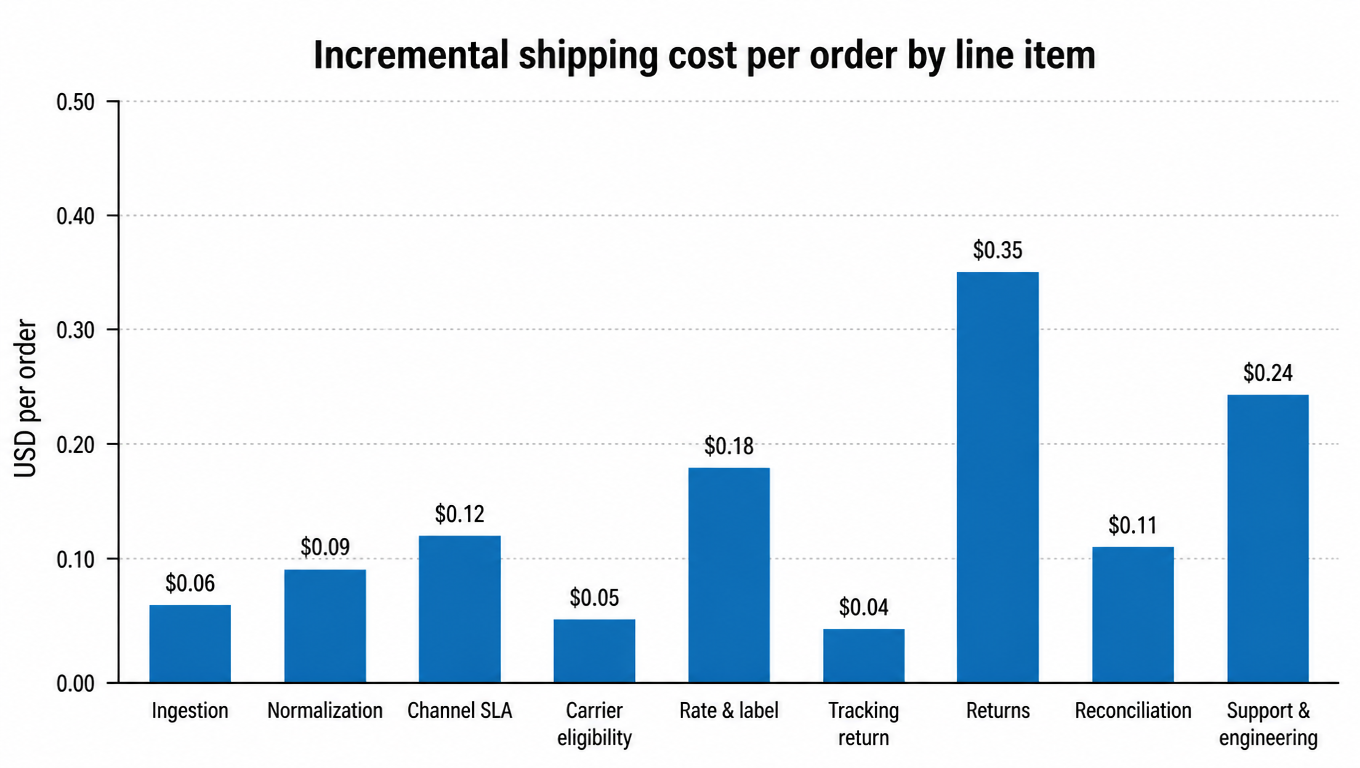
The following is an illustrative scenario. A home-goods brand currently sells through its own site, shipping an average 3 lb package to US addresses, and decides to add one marketplace. Pulling real operations data through the model produces these per-order incremental costs:
#
Line item
Cost per order
1
Order ingestion
$0.06
2
Data normalization
$0.09
3
Channel-specific SLA
$0.12
4
Carrier and service eligibility
$0.05
5
Rate and label workflow
$0.18
6
Tracking and status return
$0.04
7
Returns
$0.35
8
Reconciliation
$0.11
9
Support and engineering
$0.24
Total: $1.24 per order.
$1.24 per order, with returns as the single biggest item
Three observations stand out. First, returns is the biggest item: a 6% return-rate assumption, against home-goods benchmarks of 15% to 20%[3], multiplied by the labor to receive, inspect, and restock. Second, the channel SLA forces a slightly more expensive service than the brand would otherwise choose. Third, the "small" items, ingestion, normalization, and tracking return, add up to nearly a third of the total. None of this appears on a marketplace invoice. For how to do the matching rigorously, see our shipping reconciliation guide.
The Sensitivity Levers
The $1.24 number is not a constant; it moves with four levers: average order weight, dimensional weight, zone mix, and carrier contract terms. Add a product line that averages 5 lb with bulky dimensions, and the label cost and SLA surcharges climb faster than revenue does, because pound-based services like USPS Ground Advantage price by weight and distance in steps[4]. The same model that produced $1.24 per order for this brand would produce a very different number for a brand shipping 1 lb apparel or 8 lb furniture. A new channel often forces a rethink of your carrier mix, for the FBM-style playbook see our multi-carrier strategy for Amazon FBM.
The Break-Even Contribution Margin
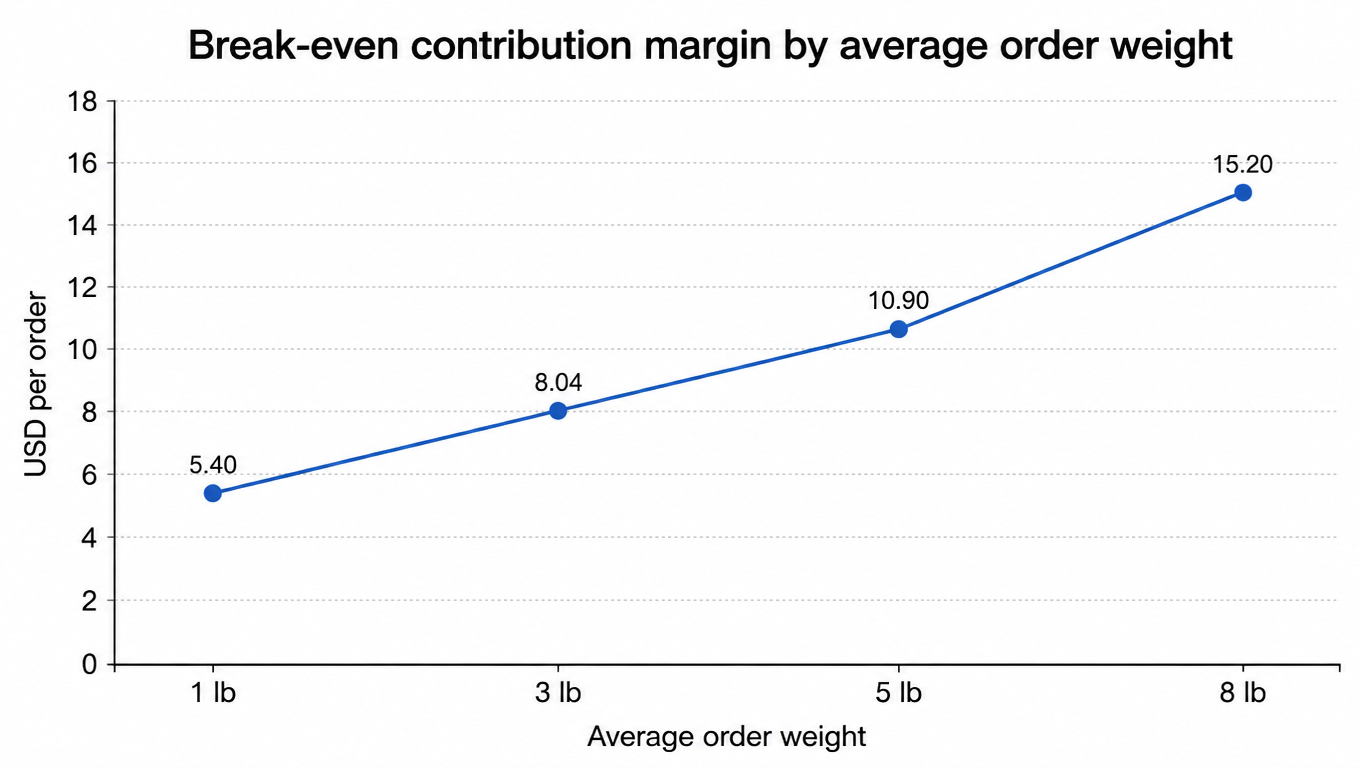
The number that matters is not the cost per order but the contribution margin per order after every shipping-related cost. In this scenario the outbound carrier charge runs about $4.16 per order at 1 lb average weight, $6.80 at 3 lb, $9.66 at 5 lb, and $13.96 at 8 lb. Add the $1.24 incremental channel cost, and the all-in shipping cost per order, which is also the break-even contribution margin, rises from about $5.40 to about $15.20:
Double the weight, and the break-even bar nearly doubles
A channel that ships 1 lb products needs to earn only $5.40 of contribution per order to cover its shipping. The same channel shipping 8 lb products needs more than twice that. If the product margin cannot clear the bar at the weight you actually sell, the channel is structurally unprofitable before a single order ships. For how to measure and track it, see our guide to cost per successful delivery.
Part 3: The Lifecycle, from Pilot to Scale
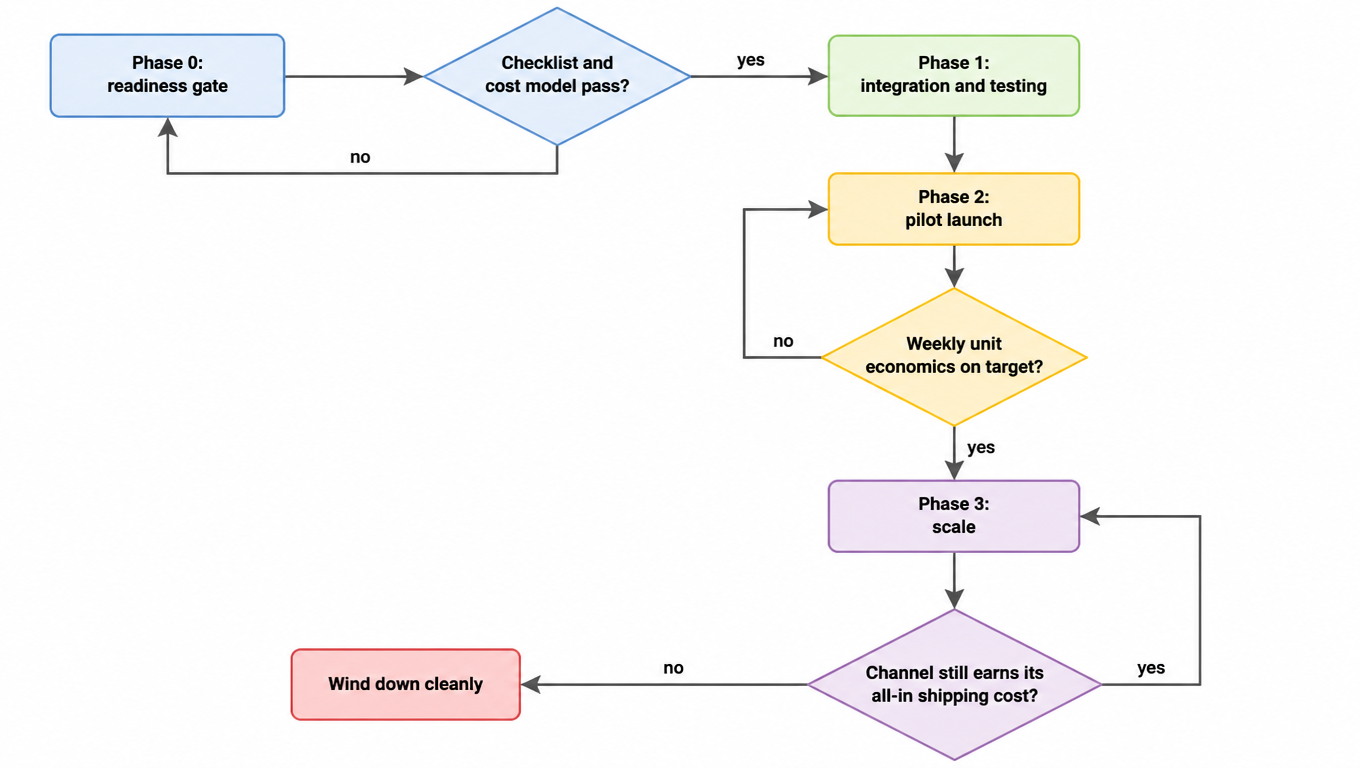
The checklist and the cost model are snapshots. A marketplace is a process, and it should be run like one: through four phases with explicit gates between them.
Four phases, and every gate is a number
Phase 0 is the readiness gate. Both artifacts must pass before any catalog goes live: the checklist must be complete, and the cost model must clear the target contribution margin at the product weight you actually sell. If either fails, the answer is not "launch anyway"; it is a list of specific things to fix and re-run.
Phase 1 is integration and testing. Run sandbox orders end to end, test label and manifest workflows, and verify that tracking numbers round-trip back to the channel. This is the cheapest place to find a normalization bug, because the cost is engineering time, not customer experience.
Phase 2 is the pilot launch: a limited catalog, a defined shipping service, and a weekly unit-economics review against the cost model. If the first four weeks drift from the model, fix the model or fix the operation, and only then widen the catalog.
Phase 3 is scale: carrier rate renegotiation, inventory rebalancing, SLA tuning, and a standing triage process for exceptions. Scale is also when the exit criteria start to matter. When a marketplace stops earning its all-in shipping cost, wind it down cleanly: stop selling, drain inventory, reconcile open funds, and keep the integration dormant rather than deleted, so the channel can be re-entered without rebuilding.
Who Owns What: Merchant, 3PL, and Software Teams
The framework only works if every cost item has an owner. The merchant owns the catalog, the policies, the demand forecast, and the P&L of the channel. If the channel loses money, it is the merchant's number to know and the merchant's call to make.
The 3PL owns storage, picking, label compliance, carrier relationships, and SLA reporting. The 3PL is where items 3, 4, and 5 physically happen, and its rate cards and performance data are the raw material for the cost model. For how to run channel returns operationally, see our returns shipping strategy for DTC and 3PL.
The WMS, ERP, and SaaS teams own the integrations, the data contracts, the rate engines, and the reporting. They own items 1, 2, 6, 8, and 9 end to end, and they are the ones who know whether the checklist's integration assumptions were right.
The handshake points between these three are where the model lives or dies: the SKU master, the order flow, the returns flow, and the shared metrics both sides report against. If the merchant's forecast, the 3PL's rate card, and the software team's data contract describe three different orders, the cost model will be wrong in the most expensive way possible: quietly.
The Readiness Framework at a Glance
Three artifacts carry the whole framework. The checklist describes the channel before launch. The Incremental Channel Cost Model turns that description into dollars across nine line items. The lifecycle gates turn those dollars into a decision, a pilot, and a scale plan.
The one number to know is the contribution margin per order after every shipping-related cost. It is the number the model produces and the gates measure. Everything else in this framework exists to make that number trustworthy.
What each audience does this quarter: merchants run the checklist and build the cost model before committing inventory. 3PLs publish the rate cards and SLA performance data the model needs, and flag channel-specific carrier rules early. Software teams audit items 1, 2, 6, 8, and 9 for the new channel, and confirm whether a channel-neutral shipping layer can cover items 4, 5, and 6 without per-channel carrier plumbing. For the board-level view, return to our complete ecommerce shipping solutions guide.
Want to price a new channel on its real shipping cost?
EasyShippingX is a channel-neutral shipping layer: one consistent way to compare US domestic carrier options and execute through a portal, a spreadsheet, or an API. Rate shopping, label buying, and tracking return behave the same way for every channel, without per-marketplace carrier plumbing. See pricing or book a demo.
Order ingestion, data normalization, tracking return, reconciliation, and support and engineering never appear on a marketplace invoice, so they get missed first. Returns is the biggest per-order item: the labor to receive, inspect, and restock plus channel-side fees, with home-goods benchmarks of 15% to 20% far above the assumptions most models start with. The channel-specific SLA can also force a pricier service tier than you would otherwise pick.
Build one model per channel, fed by the assumptions in your pre-launch checklist. Every item converts into dollars three ways: per-order labor, per-label fees, and monthly software or engineering cost. The output is the contribution margin per order after every shipping cost, which is your break-even bar: if product margin cannot clear it, the channel is structurally unprofitable before the first order ships.
It is a channel-neutral shipping layer covering items 4, 5, and 6 of the cost model: one consistent way to compare US domestic carrier options and execute through a portal, a spreadsheet, or an API. It does not replace the per-channel integrations that handle order ingestion, and it does not claim native marketplace connections; ingestion stays channel-specific, while rate shopping, label buying, and tracking return behave the same way on the neutral layer.
Because returns cost is a multiplier, not an add-on: the return rate times the labor to receive, inspect, and restock, plus channel-side return fees and the RMA flow. With home-goods benchmarks of 15% to 20%, even a 6% model assumption can be two or three times off. Returns is the single item most worth sensitivity-testing in the model.
When the channel stops earning its all-in shipping cost and does not recover after a reasonable ramp. Wind down cleanly: stop selling, drain inventory, reconcile open funds, and keep the integration dormant rather than deleted, so the channel can be re-entered without rebuilding. Exiting is not failure; it is executing the framework's conclusion.