Crowdfunding Fulfillment Guide

Crowdfunding Fulfillment in the US: How to Budget and Ship Kickstarter Rewards

Crowdfunding fulfillment is the work of turning pledged rewards into physical packages: fixing a SKU list, packing cartons, quoting postage, and getting each one to a backer after the campaign closes. It starts in a different place from store fulfillment. A shop hands you an order with a product and a price attached. A campaign hands you a backer with a tier, a set of survey answers, and possibly two add-ons, and somebody has to decide what that becomes inside a box.

The collecting is a solved problem. A pledge manager such as BackerKit gathers reward selections, shipping addresses, payment details, and add-on purchases through a single backer survey (BackerKit Pledge Manager), and its fulfillment integration turns survey responses into orders that carry an itemized content list a warehouse or a label platform can act on (BackerKit fulfillment integrations). What no tool decides for you is the translation in the middle: which items belong in one parcel, how heavy that parcel is once it is packed, and what it costs to move to the ZIP codes your backers actually live in.

That translation is the subject here. Everything below runs on one worked example: a campaign that closed with 1,000 backers, all in the United States, and a product family of three physical items (a main unit, accessory A, accessory B) offered in three reward shapes. Every charge, carton, and cost below is an illustrative example built to show the method. None of it is a benchmark, a quote, or a rate you should copy. The whole chain sits inside ecommerce shipping solutions; this guide cuts out just the stretch between a closed campaign and the first wave leaving the dock.

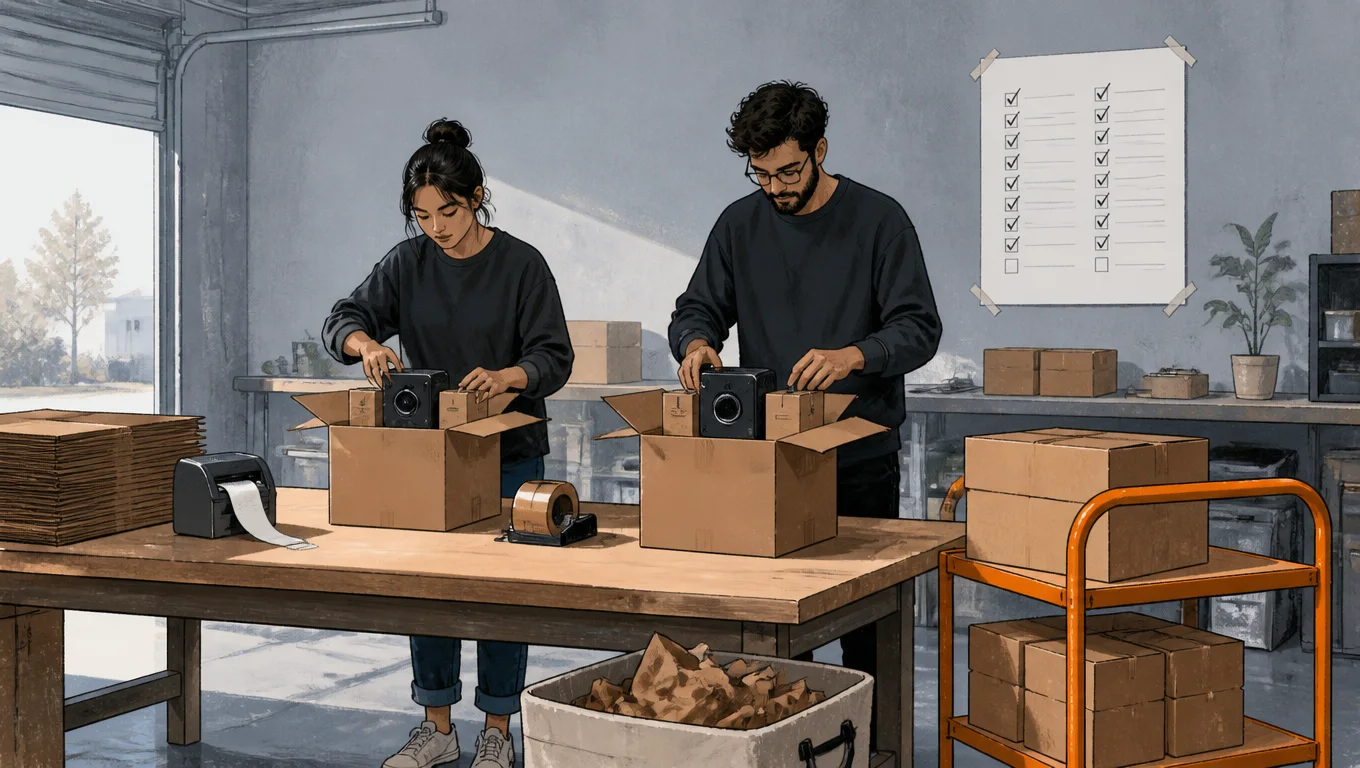
Packing-day illustration for a small campaign team: two people filling kraft cartons with a main unit and two accessory boxes at a long bench, a checked-off backer list taped to the wall, flat-packed cartons and a thermal label printer beside them.
The real work after a campaign closes: translating tiers and add-ons into one carton at a time

Step 1: Turn reward tiers into package specs

A tier is a marketing unit. A parcel is a physical unit. The two are never one to one, and the gap is where budgets break. Four things have to happen before anyone can quote a cost.

Export an itemized list, and pick the right export. Tier, options, and add-ons arrive through a pledge manager such as BackerKit and can be exported as a per-backer item list for your fulfillment partner. Choose the file with care: a raw backer export can include backers whose surveys are incomplete or whose add-on charges never cleared, which is fine for forecasting and wrong for picking (BackerKit, overview of exports). Backer reports are time limited as well, so pull the data you need while the report is still open rather than the week you start shipping (Kickstarter Creator Handbook, fulfillment).

Give every physical item its own SKU and net weight. Main unit, accessory A, accessory B, manual, thank-you card, replacement part. Six SKUs, six net weights. "Reward value" is not a shippable quantity, and the pledge amount will never reconcile against a carton.

Move from net weight to packed weight and carton size. Net weight plus void fill, carton, insert, and card is the number the carrier bills. Keep the carton range small, two or three sizes, but do not force a fit that crushes corners. A reship costs more than one extra carton size ever will.

Define the package unit. One backer equals one parcel, or two when the set does not fit reasonably? Does the two-unit set ship in one carton or split? Decide before quoting, because the warehouse will not decide for you, and a late decision means every quote has to be rebuilt. The trade-off behind that call has its own guide in split shipments and their true cost.

Reward shape Backers (example) SKUs per parcel Net weight Packed weight Carton
Single unit tier600Main unit1.9 lb2.2 lb9 x 7 x 4 in
Two-unit set250Main unit x23.6 lb4.0 lb10 x 8 x 6 in
Tier plus add-ons150Main unit + accessory A + accessory B2.7 lb3.1 lb10 x 8 x 5 in

Add-ons are the line item most often missed. Add-on revenue improves the gross margin on paper, but every add-on changes weight and volume, and a parcel that crosses a weight step or a cubic threshold changes price at the counter. None of the three specs above exceeds 22 inches on its longest side or one cubic foot, so all three bill on actual weight; once a combination crosses that line, the billing method changes with it (dimensional weight rules in USPS DMM 283). So each time the add-on mix shifts, the per-parcel cost has to be recomputed from the spec table, not multiplied from an old average. The measurement discipline is the same one behind dimensional weight: weigh the parcel, cube the parcel, then re-tier it.

Turning those three shapes into an executable packing spec belongs to kitting and assembly work: which items go in first, where the insert and manual sit, and what gets checked before sealing. Until the spec is written down, the same tier packed by three people produces three different weights.

Flowchart: reward tier, options and add-ons become an itemized SKU list per backer, then packed weight and carton size, then a rate quote by package spec and destination ZIP, then a label, tracking number and backer order record
The three middle steps are the job; the tools already cover the ends

Step 2: Budget US delivery from the order distribution

The unit of a shipping quote is not a national average. It is a package spec crossed with a destination ZIP. The same 4.0 lb carton priced to a neighboring state and priced across the country are two different numbers, and a campaign with 1,000 backers will contain both. USPS publishes that difference as zone prices (Notice 123), which is exactly why one national average per parcel cannot survive contact with a real backer list.

So build the budget from the distribution outward. Take the two or three parcel specs you defined, pick a set of representative ZIPs for each, collect a real quote for every spec and ZIP pair, then weight those quotes by where your backers actually are. You do not need ZIP-level precision for 1,000 backers, but you do need a rough shape: how much volume sits in the near zones, the middle, and the far zones.

Four cost lines belong in the per-parcel number, not just the last one:

  • Packaging. Carton, void fill, tape, insert card.
  • Pick, pack, and kitting labor. Minutes per parcel at a loaded rate, plus a premium where a tier needs an extra kit step.
  • Postage. The quoted rate for the billable weight and zone the parcel actually produces.
  • Surcharge allowance. Residential delivery, oversize or additional handling, peak or seasonal fees, signature, and insurance. These rarely appear on a first quote.

Carriers publish surcharges on a separate schedule from base rates, and revise that schedule on its own calendar (see, for example, FedEx 2026 surcharge changes). A quote copied from last season's spreadsheet can be right on postage and wrong on the total, which is why the allowance belongs in the model as its own line rather than a rounding cushion.

Cost line Single unit (600) Two-unit set (250) Tier plus add-ons (150)
Packaging$0.85$1.10$1.20
Pick, pack, kitting$1.40$1.75$1.90
Postage (distribution-weighted)$7.60$10.40$8.90
Surcharge allowance$0.35$0.55$0.45
Per parcel$10.20$13.80$12.45
Extended$6,120$3,450$1,868

Destination assumption for the example: 45 percent of backers in the near zones, 40 percent in the middle, 15 percent far. The three subtotals come to roughly $11,438 for 1,000 parcels.

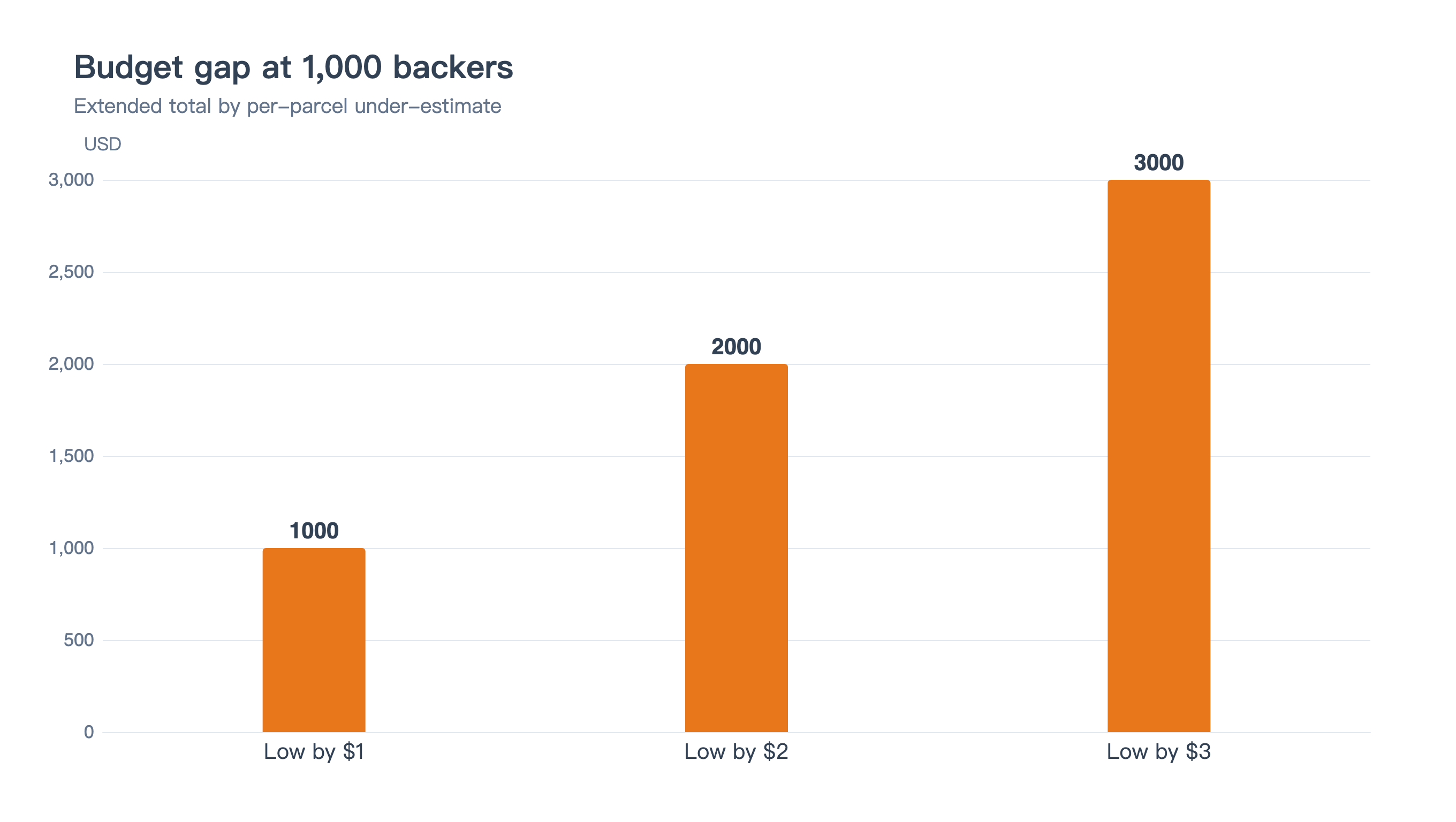
Now read the sensitivity. If the per-parcel number is low by $2, 1,000 parcels is $2,000 of unbudgeted spend, which in this example is about 17 percent of the delivery budget. That $2 does not arrive as one visible error. It arrives as three quiet ones: net weight used instead of packed weight, a carton that grew after add-ons were merged into the parcel, and a surcharge allowance that covered only the obvious fee.

Bar chart: a per-parcel under-estimate of one dollar becomes a 1,000 dollar budget gap at 1,000 backers, two dollars becomes 2,000, and three dollars becomes 3,000
A small per-parcel error only shows its size at 1,000 parcels

Beyond the base budget, hold a separate line for reships, damaged parcels, returns, and returns to sender. Set it as an explicit percentage of parcel count based on how fragile the product is and how clean the address data is, and write the number down. "We will deal with it if it happens" is how the reship cost ends up outside the plan entirely, and a crowdfunding project has no second raise to absorb it. Why a quote and the final charge part ways is covered in quote versus final charge, and the fulfillment cost calculator is the right way to turn these lines into unit economics.

Step 3: Confirm backer data before the release

Months pass between a campaign closing and the first wave leaving the dock. Addresses go stale, people move, add-ons change. Address confirmation is not one reminder email, it is five specific checks.

  1. The address itself. Apartment and unit numbers present or missing, state as a two-letter code, ZIP matching city and state, a PO box where the chosen service will not deliver, and international addresses mixed into a US-only campaign. Backers outside the shipping scope need a refund path or a separate plan, and that decision has a cost either way.
  2. Item options. Color, size, edition, plug standard, language version. In the survey these are options. In the warehouse they are different SKUs, and an option that was never mapped to a SKU is a pick error waiting for a packing bench.
  3. Add-on content. Whether the charge actually cleared, whether the add-on ships in the same parcel, and whether merging it forces a larger carton.
  4. Cancellations and duplicates. Refund records, one backer with multiple pledges, and several accounts pointing at one address. Duplicates are the expensive mistake, because you pay postage twice for one reward and often ship a parcel nobody wants.
  5. A freeze date. Name a cutoff, for example seven days before the first wave. Pledge managers handle this in stages: BackerKit locks orders first, then locks addresses, and either lock can go out with a final notice giving every backer one last chance to change (BackerKit help center). Anything that arrives after the cutoff goes to a separate exception list, not into the main file.

Then version the file. Put the export date in the filename, and let the warehouse ship from that file only. A warehouse working from two exports is the single most common cause of a duplicate shipment that nobody can explain afterward.

The last pass is address hygiene. Pull out records with a missing unit number, a ZIP that disagrees with the state, or an address line too long for the label. The USPS ZIP Code Lookup is enough to confirm that a city, state, and ZIP triple agrees before the file leaves the building. Catching these before the label is cheap. Catching them after the parcel travels is roughly twice the original postage plus a support conversation. The system-side version of that pass is in address validation.

Step 4: Separate what the brand, the warehouse, and the shipping platform own

Most crowdfunding shipping failures are not effort problems. They are boundary problems: two parties each assuming the other one checked something.

Party Owns Does not own
Brand (creator)Reward content and BOM, SKU list, quantities, packaging design, insert and manual, reship and refund policy, backer communicationPicking accuracy on the floor, carrier rate tables
Warehouse / 3PLReceiving and counting inventory, kitting, picking to the SKU list, packing, weighing, labeling, tender to the carrier, holding exception parcelsDeciding what a reward contains, answering backer emails
Shipping platformRate comparison across carriers, label generation, address validation, tracking numbers returned to the backer order recordPacking, storage, campaign messaging
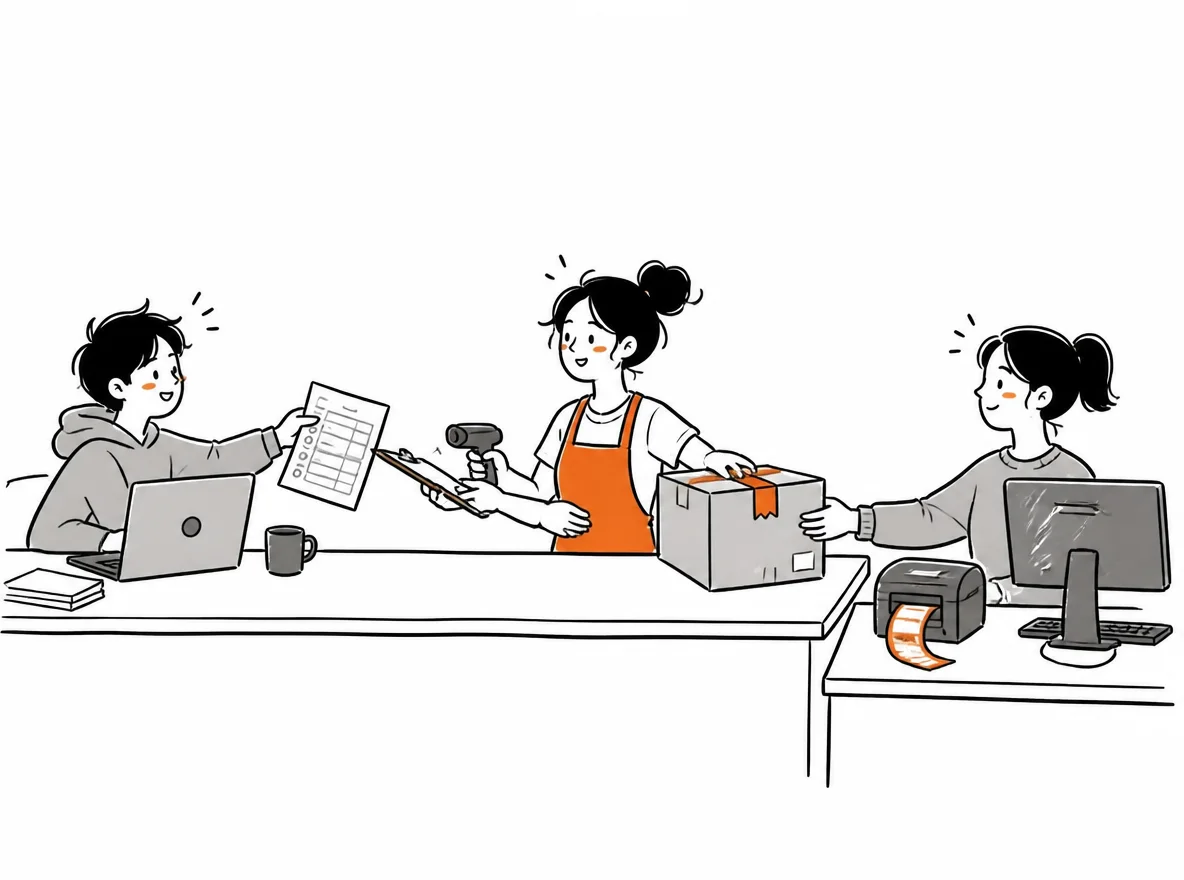
Three-way handoff illustration: a creator holding a printed BOM at a laptop on the left, a warehouse worker with a scanner and a taped carton in the middle, and a shipping desk with a rate comparison screen and label printer on the right, hands meeting over a long table.
Write the boundaries down and the handoff stops depending on memory

A handoff checklist makes the boundaries checkable. Whatever you cannot tick, you still owe someone:

  • Itemized backer file with tier, options, and add-ons, carrying an export date and version
  • SKU crosswalk: campaign option name to warehouse SKU to quantity
  • Packed weight and carton size for every parcel shape
  • Carton list plus a packing diagram showing where the insert, manual, and card go
  • Inventory arrival date, batch or lot number, and count per SKU
  • Freeze date for address changes, and the rule for what happens after it
  • Definition of a damaged, short, or returned parcel, and the reship path
  • Tracking number format and the primary key it comes back on (backer order ID, not email)
  • Wave order and target completion date for each wave

If you are comparing fulfillment partners, on-time ship rate matters more than the quoted per-parcel price, because late rewards turn into refund requests and public comment threads. Rate the candidates on the same parcel specs and the same destination mix, or the comparison is not a comparison. The questions that produce comparable answers are the same ones in SKU-level shipping rules and kitting fulfillment.

Step 5: Run a pilot batch, then ship in waves

Do not hand 1,000 parcels to a warehouse on day one. Start with a pilot of 20 to 30 backers chosen on purpose: a few of each parcel shape, at least three destination zones, one multi-item add-on order, and one deliberately awkward address.

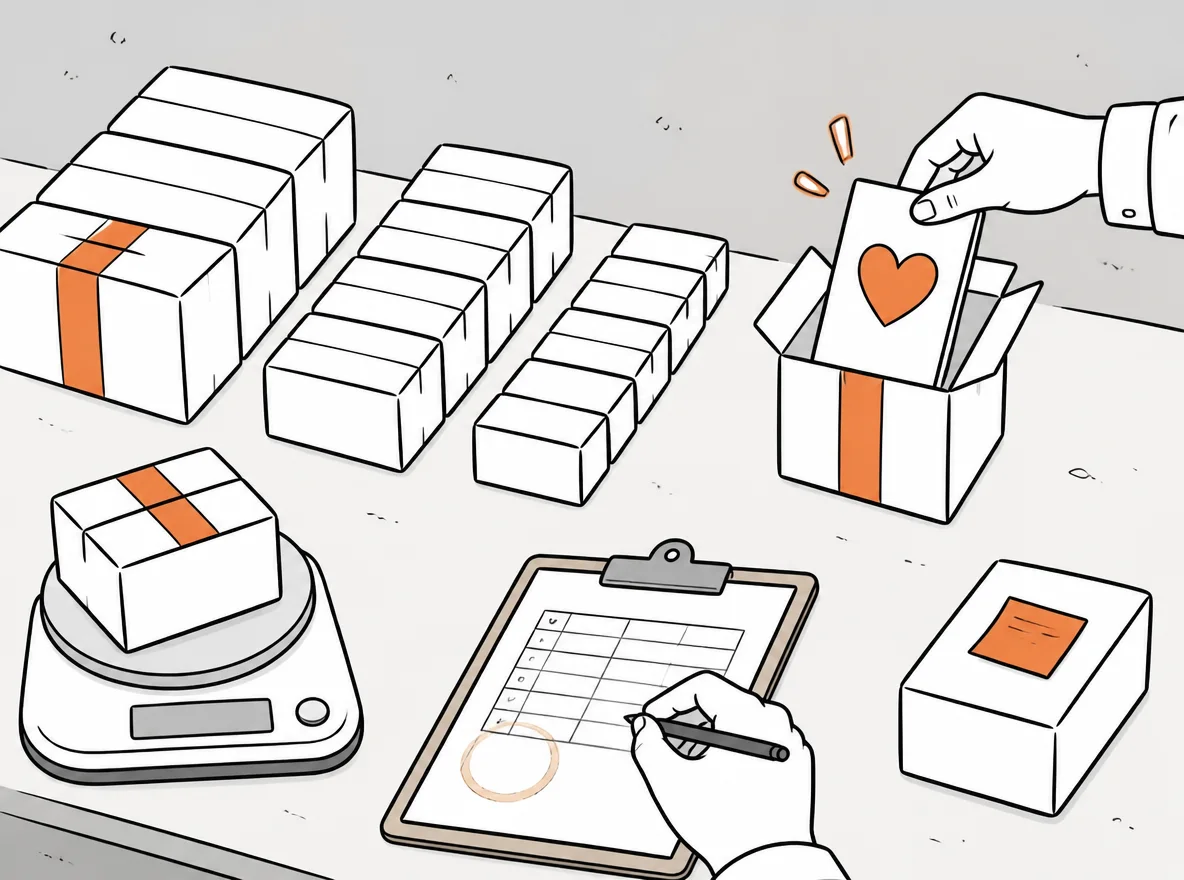
Pilot batch illustration on a packing bench: cartons sorted into three rows by size, a sealed parcel on a kitchen scale, a clipboard recording measured weight beside a printed spec row, and one exception carton set aside with a sticky note.
The pilot checks the spec, not whether the day went smoothly

The pilot verifies four things, and each one fails loudly if it is wrong:

  1. Actual weighed parcel matches the spec table. A 0.2 lb drift can cross a weight step.
  2. Contents fit. The carton closes without crushing, and cushioning is adequate.
  3. The label scans at acceptance, and the declared weight and dimensions match what the carrier measures.
  4. The tracking number lands on the right backer order record, not on a spreadsheet somebody edits by hand.

After that, release in waves grouped by parcel shape rather than in backer order. A packing bench that handles one carton and one packing diagram at a time is faster and makes fewer mistakes than a bench alternating between three shapes. At the end of each wave, compare actual cost against the Step 2 budget and adjust before the next wave, while there is still volume left to influence. Batch handling at that scale is the subject of bulk upload for shipping orders.

Three exception types will run continuously: short shipments (on the list, not in the box), mis-picks (not on the list, packed anyway), and address failures (undeliverable, refused, returned). Attach each one to a specific backer order ID with the resolution and its cost. A reship almost always costs more per parcel than the original, because it carries no batch advantage.

Frequently asked questions

Build the estimate from parcel shapes, not from the pledge amount. Define packed weight and carton size for each reward shape, get real quotes for those shapes against representative destination ZIPs, then weight the results by your backer distribution. Include packaging, labor, and a surcharge allowance. Finish with a sensitivity check: what happens if every parcel costs two dollars more than planned. Prototype weights measured on a kitchen scale and a carton borrowed from a local supplier are enough to start.
Not always. A few hundred backers, a handful of SKUs, small parcels, and a generous timeline can be handled in-house with a label platform and a rented storage unit. The signals that you need a warehouse are: more than five or six SKUs, four figures of parcels, a kitting or assembly step, inbound freight you cannot receive yourself, returned parcels that need somewhere to live, or a team outside the US. What does not change with the choice is the quality check on inbound inventory, which has to happen at receiving, not at the packing bench.
In three layers. Weight, because the add-on adds billable pounds. Volume, because merging it can push the parcel into a larger carton and a different dimensional or cubic band. Surcharges, because an oversized or irregular parcel can pick up additional handling. That is why every change to the add-on mix has to be re-quoted rather than multiplied by an old average rate.

Sources

  1. BackerKit: Pledge Manager
  2. BackerKit: Fulfillment Integrations
  3. BackerKit Help: Overview of Exports
  4. BackerKit Help: I've sent out my surveys, now what?
  5. Kickstarter Creator Handbook: Fulfillment
  6. USPS Domestic Mail Manual 283: USPS Ground Advantage and dimensional weight
  7. USPS Notice 123: Price List
  8. USPS: ZIP Code Lookup
  9. FedEx: 2026 Surcharge and Fee Changes

Links verified October 29, 2026. Every weight, carton and amount in this guide is an illustrative example used to show the method. Platform features, billing rules and surcharges change with provider policy, so re-run the arithmetic with your own parcel data before you quote.

If you already have US inventory and a backer file, the next step is small

Produce three columns for every parcel: packed weight, packed dimensions, and destination ZIP. With those three, you can check which US services are available for each parcel shape and what they actually cost, instead of pricing the whole campaign off one national average.

EasyShippingX handles that last stretch: comparing US carrier options for the same parcel and destination, then creating labels through a portal, an Excel upload, or an API. A backer file with confirmed addresses, weights, and dimensions can be prepared as a spreadsheet, quoted, and turned into labels and tracking numbers in batches. It is not a warehouse and it is not a pledge manager, and it is not a native integration with any crowdfunding platform. It sits between a confirmed order list and a label, which for most creators is exactly the gap left after the campaign closes.

The order that works: spec table first, budget second, data freeze third, pilot fourth, waves last. Funding a campaign only proves people wanted the product. Delivering 1,000 parcels on time, to the right addresses, at a cost you planned for is what turns a funded project into a shipped one.